Главный овощ Хэллоуина. Все достоинства и рецепты приготовления тыквы
В ночь с 31 октября на 1 ноября отмечается Хэллоуин. Одним из основных символов этого праздника является тыква. О полезных свойствах тыквы и рецептах блюд из нее читайте в подборке РИА Новости.
https://cdnn21.img.ria.ru/images/97393/65/973936590_0:105:2000:1230_1920x0_80_0_0_a1c771907f81935921139696100fe446.jpg
2013-10-31T14:24
РИА Новости
internet-group@rian.ru
7 495 645-6601
ФГУП МИА «Россия сегодня»
https://xn--c1acbl2abdlkab1og.xn--p1ai/awards/
14:24 31.10.2013 (обновлено: 12:33 16.12.2019)
Главный овощ Хэллоуина. Все достоинства и рецепты приготовления тыквы
В ночь с 31 октября на 1 ноября отмечается Хэллоуин. Одним из основных символов этого праздника является тыква. О полезных свойствах тыквы и рецептах блюд из нее читайте в подборке РИА Новости.
Одним из основных символов Хэллоуина, кануна Дня всех святых, является тыква. К сожалению, полезные свойства тыквы многие недооценивают, ее безжалостно кромсают, вырезая фонари на Хэллоуин, а остатки выкидывают, в то время как «внутренности», которые оказались в мусорном ведре — самое ценное, что может дать нам этот плод.
Оранжевая аптека
Мякоть и семена тыквы до отказа наполнены витаминами группы В, витаминами А, С, Е, К, Т, жирами, белками, углеводами, целлюлозой, пектиновыми веществами, минералами, в том числе калием, кальцием, железом. При этом тыква на 90% состоит из воды.
Аскорбиновая кислота, содержащаяся в мякоти тыквы, помогает справиться с простудными заболеваниями. Содержащиеся в ней витамины группы B помогают справиться с переутомлением, усталостью, раздражительностью и бессонницей. Для того чтобы избавиться от всех перечисленных недугов, необязательно есть тыкву, достаточно просто выпить на ночь стакан тыквенного сока или ее отвар с медом.
Сырая мякоть тыквы поможет при заболеваниях печени, также для этих целей подойдут тыквенные каши с различными крупами. Если вы страдаете заболеваниями мочевого пузыря или почек, вам также поможет тыква, а точнее ее семечки. Из них готовят напиток: стакан семян тыквы и стакан конопляного семени перетирают, добавляя кипяток (примерно три стакана), затем сцеживают. Этот напиток пьют с медом и сахаром.
Если вы много времени в течение дня проводите на ногах, вечером снять боль в ступнях поможет кашица из мякоти свежей тыквы. Она же снимет воспаление и боль при ожогах, сыпях, прыщах.
Диетологи неспроста так трепетно относятся к тыкве и не зря рекомендуют чаще употреблять в пищу именно тыкву тем, кто мечтает похудеть. Все дело в витамине Т, который содержится в этом чудесном овоще и который способствует усвоению тяжелой пищи, предотвращает ожирение. Так что если вы мечтаете об идеальной фигуре или просто хотите сбросить пару лишних килограммов, ешьте тыкву как гарнир к говядине, свинине и прочим жирным блюдам.
В тыкве содержится железо. В ней его больше, чем во всех остальных овощах. Благодаря этому любители тыквы всегда в хорошем настроении и имеют здоровый цвет лица. Из-за железа тыкву рекомендуют употреблять людям, страдающим анемией. Кроме того, в «оранжевом чуде» содержится витамин К, который влияет на свертываемость крови. Этого витамина нет ни в одном другом овоще.
Специалисты давно отметили чудесный эффект, оказываемый тыквенным соком на мужское здоровье. Сильному полу также рекомендуется для таких целей употреблять и тыквенные семечки. Тыква считается также отличным средством от тошноты, поэтому ее советуют есть беременным женщинам при токсикозе.
В тыкве в пять раз больше каротина, чем в моркови. Поэтому тыкву и тыквенный сок рекомендуют употреблять людям с нарушениями зрения. Кроме того, каротин обладает антиоксидантным, иммуностимулирующим действием. Также в тыкве содержатся пектиновые вещества, которые помогают выводить из организма холестерин и токсичные вещества.
В древности из тыквенных семечек готовили приворотное зелье. Но тыква может вылечить не только разбитое сердце, но и более серьезные заболевания, связанные с сердечно-сосудистой системой. Все это из-за того, что в чудодейственном плоде содержится калий, который укрепляет сосуды и улучшает работу сердца.
Тыква поможет тем, кто страдает бессонницей. Для того чтобы ночью крепко спать рекомендуется пить тыквенный сок, либо отвар тыквы с медом. Также от этого недуга помогут семечки тыквы. Рекомендуют взять 20 миндальных орехов, 1 чайную ложку очищенных семян тыквы, измельчить и залить кипяченой водой.
Такой коктейль должен настояться 8 часов, пить его следует перед сном.
Полезные семечки
Тыквенные семечки и их полезные свойства достойны отдельного внимания. Всем давно известно, что семечки тыквы — эффективное глистогонное средство. Для того чтобы избавиться от глистов, а также для профилактики достаточно просто есть сушеные тыквенные семечки.
В Европе масло семечек тыквы употребляют в пищу, используют его для заправки салатов. Тыквенные семечки очень питательны, они содержат до 28% белка. На их основе даже делают некоторые лекарственные препараты, например, для лечения заболеваний печени. Цинк, также содержащийся в семенах тыквы в больших количествах, способствует устранению заболеваний, вызванных недостатком этого минерального вещества — угревой сыпи, перхоти, себорее.
Для того чтобы высушить тыквенные семечки, их для начала надо отмыть от мякоти. Важно это сделать тщательно, иначе лакомство сгниет. Выкладываем семена на гладкую поверхность ровным слоем и выставляем на свежий воздух примерно на 3 часа. После этого семечки можно очистить, выложить на противень, сбрызнуть маслом, солью и поставить в духовку, разогретую до 189С, примерно на 25 минут. Во время приготовления семечки рекомендуется переворачивать каждые пять минут.
Тыква-косметолог
Кроме лечебного эффекта тыква оказывает и косметическое воздействие на кожу. Например, благодаря высокому содержанию витамина А и Е, тыква является настоящим «борцом» с возрастом, преждевременным старением кожи и морщинами. Также тыква поможет сузить поры, избавит от угревой сыпи, окажет матирующее действие. Для этого достаточно протирать лицо кусочком сырой тыквы.
Для того чтобы приготовить питательную маску для лица, вам понадобится: 3 столовые ложки вареной тыквы, яичный желток, 1 чайная ложка меда. Тыкву разотрите в кашицу, смешайте с желтком и медом. Маску нанесите на лицо на 10-15 минут, затем смойте холодной водой.
Для приготовления другой маски вам понадобится: 2 ложки вареной тыквы, 1 столовая ложка оливкового масла. Тыкву взбиваем, затем смешиваем с маслом. Маску следует наносить на лицо примерно на 20 минут, потом ее нужно смыть прохладной водой.
Мякоть и сок тыквы являются превосходным тонизирующим средством для кожи. Косметологи рекомендуют делать компрессы из кашицы из натертой тыквы или из ее сока. Вату, смоченную в соке, накладывают на лицо на 15-20 минут, после смывают холодной водой. По такой же схеме делаются и компрессы из кашицы, ее лучше выкладывать на марлю. Такую косметическую процедуру лучше делать 2-3 раза в неделю, компрессы желательно чередовать.
Полезные блюда из тыквы
Помимо косметических средств из тыквы можно приготовить множество изысканных блюд. Но прежде всего тыкву нужно правильно выбрать. Покупать следует небольшой плод, весом он должен быть 3-5 кг. Такая тыква будет мягкой, а кожица — тонкой. Не забудьте перед приготовлением кулинарных шедевров очистить тыкву от кожуры и вытащить косточки. В салаты иногда добавляют молодые цветки тыквы, они тоже съедобны.
Если вы готовите блюда из тыквы в первый раз, они могут не получиться совсем или показаться вам безвкусными. Рекомендуется добавлять к тыкве специи или овощи с сильным вкусом. Также стоит отметить, что тыкву лучше запекать, так ее вкус и запах усиливаются.
Тыквенный суп
Ингредиенты: 1 кг тыквы, 1 луковица, 3 столовые ложки оливкового масла, 1 л овощного бульона, 100 г тыквенных семечек, соль, перец. Лук и тыкву чистим и нарезаем кубиками. На разогретой сковороде с маслом обжариваем тыкву и лук, затем заливаем бульоном и варим 20 мин. на маленьком огне. Затем растираем суп в пюре, добавляем соль и перец по вкусу. Очищенные тыквенные семечки при желании можно посыпать в готовый суп.
Оладьи из тыквы
Ингредиенты: 1,5 кг тыквы, 0,5 стакана муки и 0,5 стакана манной крупы, 2 столовые ложки сахара, соль. Очищаем тыкву и натираем ее на крупной терке. Муку, крупу, сахар и соль по вкусу добавляем в тыквенную массу. Тесто перемешиваем и жарим на хорошо разогретой сковороде. Подавать тыквенные оладьи лучше со сметаной.
Салат из тыквы
Ингредиенты: 500 г тыквы, яблоки, 2 столовые ложки меда, полстакана грецких орехов, полстакана изюма, сметана, лимонный сок. Натираем тыкву на крупной терке, добавляем соль по вкусу, немного меда и сахара. Яблоки нарезаем кубиками, смешиваем с тыквой. Затем добавляем орехи, изюм, лимонный сок, заправляем сметаной.
Цукаты из тыквы
Ингредиенты: тыква; для сиропа: 200 г воды или сока без мякоти, 1200 г сахара, 1 лимон или 3 г лимонной кислоты, ванилин (на 1 кг тыквы). Варим сироп. Очищенную тыкву нарезаем кубиками, заливаем сиропом и варим 5 мин. Оставляем на 6-8 часов. Затем вновь кипятим 3-5 мин. Оставляем на 10-12 часов. После — откидываем тыкву на сито, после того как сироп стек, посыпаем сахарной пудрой.
Масло из тыквенных семян
Масло из тыквенных семян можно приготовить в домашних условиях методом холодного прессования. Это непросто. Вам понадобится 3 кг тыквенных семян (на 1 л масла). Их нужно как следует высушить, перемолоть в муку, обжарить, добавляя при этом небольшое количество воды, и отжать прессом. Однако тыквенное масло можно купить и в аптеке.
Маринованная тыква
Ингредиенты: 1 тыква, 4 огурца, 2 луковицы, морковь, 1 головка чеснока, 5 помидоров, стакан воды, соль, перец. Рассол: на 1 л воды 2 чайные ложки соли, перец. Тыкву разрезаем на две равные части, вырезаем мякоть, а полученные чаши заполняем мелко порубленными овощами, в том числе и мякотью тыквы, заливаем рассолом, добавляем чеснок. Затем тыкву оставляем бродить на 3-4 дня при комнатной температуре, после этого блюдо готово.
Тыква в желе
Ингредиенты: 300 г тыквы, 60 г сахара, 6 г желатина, ром или фруктовая эссенция, 200 г воды. Очищенную, нарезанную кубиками, тыкву варим в подслащенной воде. Затем сливаем жидкость и замачиваем в ней желатин, после — нагреваем его. Вливаем немного рома или фруктовой эссенции. Кубики выкладываем в формы, заливаем раствором и остужаем.
Тыква в сливках
Ингредиенты: 1 тыква, 1 стакан сливок, 2 яйца, 200 г масла, 2 столовые ложки сухарей, соль и сахар. Очищенную тыкву нарезаем ломтиками, выкладываем в посуду смазанную маслом, пересыпаем сухарями, добавляем остатки масла. Сливки, яйца перемешиваем, добавляем соль и сахар по вкусу. Заливаем соусом тыкву и запекаем в духовке до готовности.
Тыква с рисом и изюмом
Ингредиенты: 500 г тыквы, 1 стакан риса (отварного), 1/2 стакана сливок, мед — по вкусу, 1/2 стакана изюма, 50 г сливочного масла. Очищенную тыкву, режем кубиками и отвариваем. Добавляем рис, сливки и мед и тушим около 20 мин. Затем добавляем изюм и масло.
Жареная тыква
Ингредиенты: 200 г тыквы, 1 столовая ложка муки, 1 чайная ложка сахара, 1 столовая ложка сливочного масла. Тыву чистим и нарезаем тонкими ломтиками. Обваливаем кусочки в муке и обжариваем на сковороде с маслом до готовности. После этого ломтики можно посыпать сахаром. Также к готовому блюду можно подать сметану.
Тыква в кляре
Ингредиенты: тыква; кляр: 2 яйца, 1/2 стакана молока, 1,5 столовых ложек муки. Очищенную тыкву нарезаем ломтиками и обжариваем на масле. Слегка обжаренную тыкву окунаем в кляр и жарим во фритюре до румяной корочки. Даем маслу стечь, подаем на стол с зеленью. При желании кляр можно сделать сладким, а тыкву перед подачей на стол посыпать сахарной пудрой.
Кисель из тыквы
Ингредиенты: 570 г тыквы, 50 г крахмала, 500 г молока, 80 г сахара, ягодный сок. Очищенную тыкву натираем на мелкой терке. Крахмал разводим холодным молоком, выливаем в горячее и, помешивая, доводим до кипения. В молоко добавляем ванилин, соль, сахар, тертую тыкву. Помешивая, прогреваем кисель, после чего разливаем в вазочки и охлаждаем. К столу кисель рекомендуется подавать с ягодным соком.
Вафли из тыквы
Ингредиенты: 450-500 г тыквы, 1 чайная ложка соли, 1 чайная ложка молотой куркумы, 1/4 чайной ложки молотого кайенского перца, 3 столовые ложки рисовой (или гороховой) муки. Очищенную тыкву нарезаем ломтиками толщиной 5 мм и длиной 4-5 см. Выкладываем ломтики на поднос, посыпаем солью, куркумой, перцем и оставляем на полчаса. Затем высушиваем тыкву салфетками, обсыпаем мукой и обжариваем во фритюре в течение 5 минут при температуре 180 градусов.
Каша тыквенная
Ингредиенты: 1 кг тыквы, 4,5 стакана молока, 1 стакан риса, 4-5 столовых ложек сливочного масла, соль сахар. Очищенную тыкву нарезаем кубиками, заливаем 1,5 стаканами молока и варим, потом протираем тыкву через сито. Рис заливаем оставшимся молоком и варим кашу. Смешиваем кашу с тыквой, добавляем масло и ставим в духовку, пока каша не зарумянится.
Пудинг из тыквы
Ингредиенты: 1 кг тыквы, толченые сухари, 1/4 стакана сахара, 1/4 чайной ложки корицы, 5 желтков, 1 столовая ложка сливочного масла, 5 белков. Тыкву очищаем, варим и протираем через сито. Добавляем в массу сухари, сахар, корицу, даем смеси остыть. Взбиваем 5 желтков, добавляем масло, отдельно взбиваем белки. Все ингредиенты перемешиваем, выкладываем в форму и запекаем 30 мин.
Запеканка из тыквы
Ингредиенты: 400 г тыквы, 3 столовые ложки сливочного масла, 3 яйца, 100 г риса, 100 г сахара, корица, цедра лимона, орехи. Готовим рисовую кашу. Очищенную тыкву натираем на мелкой терке, масло смешиваем с желтками, сахаром, лимонной цедрой, корицей, дроблеными орехами, тыквой и рисовой кашей.
В конце добавляем взбитые белки. Массу выкладываем в смазанную жиром (или маслом) форму и запекаем.
Тыквенная икра
Ингредиенты: тыква, лук репчатый, морковь, помидоры, соль, чеснок, зелень. Мякоть тыквы нарезаем кубиками либо натираем на терке, тушим, добавляем слегка обжаренные лук, морковь, помидоры. За 10 минут до готовности добавляем соль, перец, толченый чеснок и зелень.
Материал подготовлен на основе информации открытых источников
Это интересно
История Хэллоуина: как праздник урожая превратился в праздник нечисти
Приближается Хэллоуин, один из самых веселых и неоднозначных праздников. В России он не особо популярен, но американцы и европейцы его очень любят: уже летом начинают продавать карнавальные костюмы, с середины октября в домах появляется тематическая атрибутика, а в парках развлечений — новые жуткие аттракционы. Давайте разберемся, откуда появилась традиция отмечать торжество жизни над смертью.
История Хэллоуина
Хэллоуин зародился на территории Британских островов, у ирландских и шотландских кельтов. У этих народов традиционно выделялось два времени года: зима и лето, и, конечно, сезонность была связана с урожаем. 1 ноября начиналась зима, а значит, к этому времени должен был быть собран весь урожай.

Этот праздник урожая назывался Самайн. Праздновался он целую неделю (три дня до 31 октября и три дня после) и символизировал переход из лета в зиму. Все это было задолго до рождения Христа, и тогда Самайн вообще никак не ассоциировался с темной стороной и мертвыми, это был всего лишь праздник урожая. Традиционно во время праздника резали животных, но это не было даже жертвоприношением: просто заготовка мяса на холодное время года. Выбирали ту скотину, которая могла бы не пережить зиму.
Пожалуй, единственная связь с потусторонним — гадания друидов. Однако какой языческий праздник (и не только кельтский) мог проходить без жрецов? Жгли костры, на них готовили мясо, а по костям животных друиды предсказывали будущее.
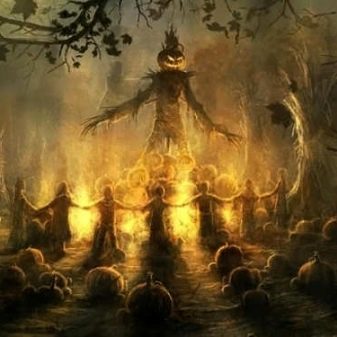
Одной из забав на Самайн были прыжки через костры (не напоминает ли вам это Масленицу?), считалось, что это поможет очиститься. Иногда прыжки заменяли просто проходом между двух костров, и такой ритуал очищения проводили также для домашних животных.
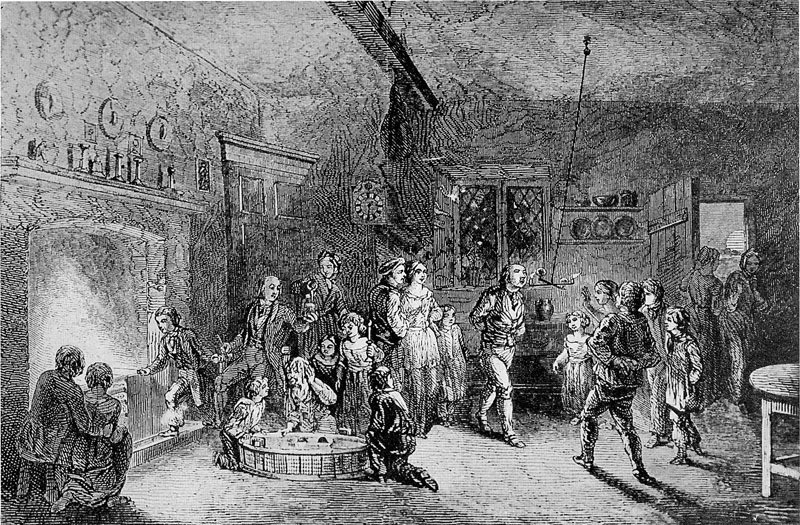
А ассоциации с мертвыми и потусторонними силами прочно закрепились позже, благодаря наложению христианских и языческих традиций: когда кельтские народы приняли христианство (II-III век), то Новый год 1 ноября совпал с религиозным праздником — Днем всех святых (он и сегодня у католиков празднуется 1 ноября). Монахи на протяжении нескольких веков писали о языческом празднике как о порождении Дьявола, а церковь несколько раз пыталась объединить Самайн и День всех святых. В итоге им это удалось, в X-XI появился Хэллоуин, или канун Дня всех святых (от английского All-Hallows-Even).
Откуда взялась тыква
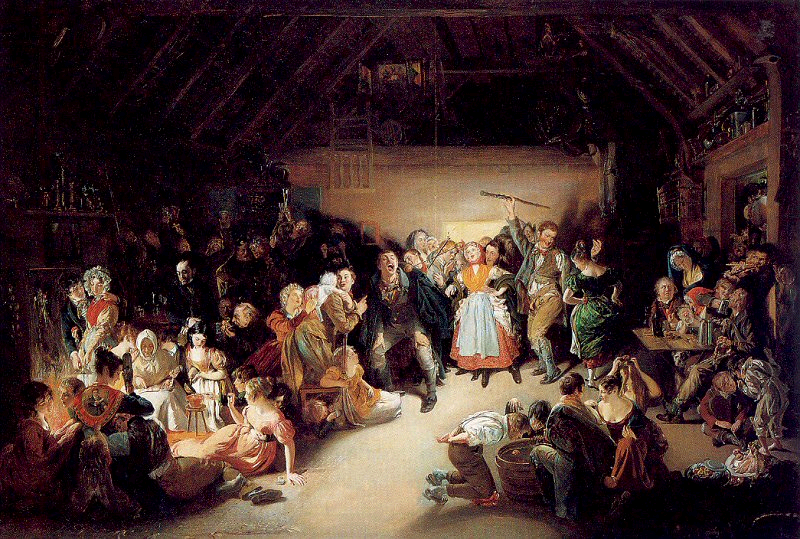
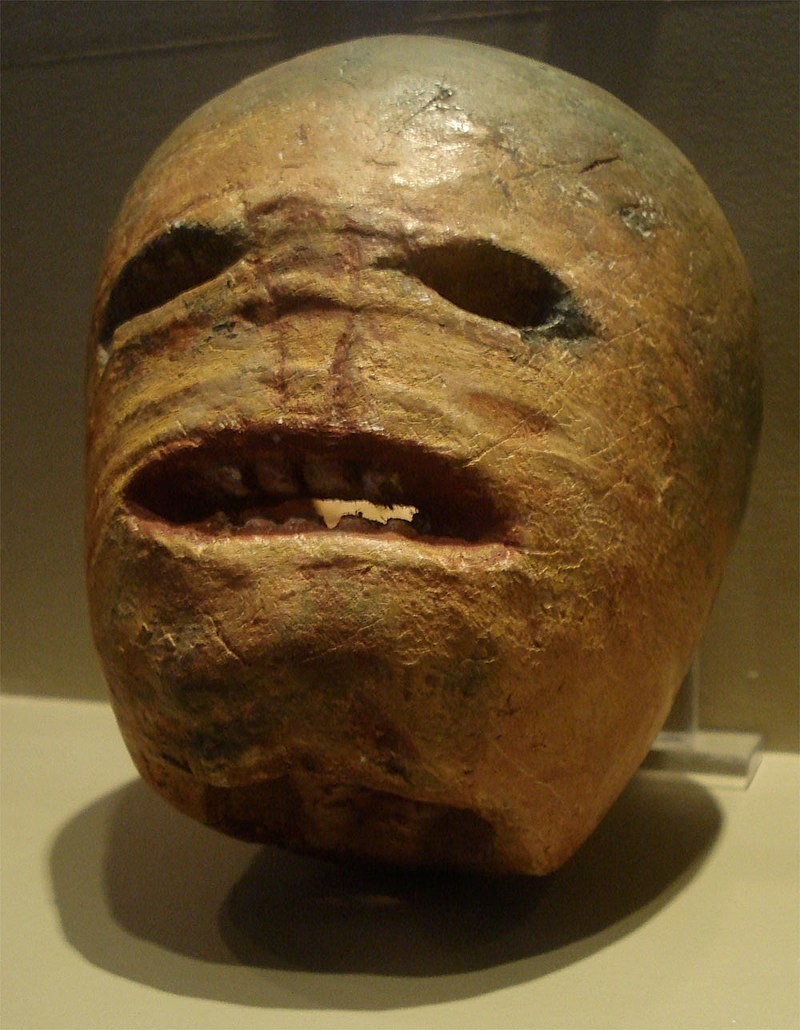
Что же до тыквы, то изначально вместо нее была брюква или репа. Кельты вырезали рожицу и внутрь помещали свечу. Считалось, что такие светильники помогут душам найти путь в чистилище. Позже светильники стали ставить возле домов, чтобы отпугнуть злых духов. В США репу заменили на более дешевую тыкву, но светильники из нее появились только в XIX веке. Кстати, тыква в США задолго до Хэллоуина была символом урожая, а к празднику не имела никакого отношения. В XIX веке появилась и еще одна традиция: наряжаться в костюмы. Правда в прошлом они были очень жуткие.

Полтора века Хэллоуин празднуется примерно так, каким мы видим его сегодня: атрибутика, костюмы, выпрашивание сладостей. При этом на Британских островах до сих пор живы и древние традиции: так, на западе и сегодня в некоторых семьях пекут хлеб в форме рогов, приветствуя зиму. А на севере Ирландии и Шотландии поздним вечером 31 октября рассказывают легенды о предках, чтобы успокоить мертвых.
В России праздник стал популярным в последние десятилетия, хотя отмечают его совсем немногие. Но почему бы не воспользоваться таким прекрасным поводом и лишний раз в году не собраться со своими близкими?
Присоединяйся к нашему сообществу в телеграмме, нас уже более 1 млн человек 😍
Ссылка на тематические чаты тут https://t.me/+69dR1AvDfdM0MTYy
Светильник Джека. Почему тыква является символом Хэллоуина и какие блюда можно из нее приготовить
Шеф-повар Стрельцов поделился рецептами блюд из тыквы
Приближается самый мистический и загадочный праздник — Хэллоуин. Главным его символом является тыква. «Ямал-Медиа» решил рассказать, чем полезен этот овощ и какие вкусные блюда можно из него приготовить на Хэллоуин и не только.
Краткая история праздника
Хэллоуин отмечается ежегодно в ночь с 31 октября на 1 ноября, также его называют кануном Дня всех святых. История появления праздника уходит в дохристианскую эпоху, во времена древних кельтов, которые проживали на территории современной Ирландии и Шотландии. Они называли этот праздник Самайне, сообщил сайт kp.ru.
Кельты делили год на две равные половины, первый период — с мая по октябрь — считали добрым и светлым, а период с ноября по апрель — временем зла и тьмы. Именно ночь с 31 октября на 1 ноября была рубежом между этими двумя отрезками года — так и образовался праздник Самайне, который дошел до наших дней как Хэллоуин.

Фото: Romolo Tavani/Shutterstock/Fotodom
В Саймане было принято проводить ритуалы по изгнанию бесов от своих жилищ. Считалось, что в ночь с 31 октября на 1 ноября между миром живых и миром мертвых открывалась невидимый портал, через него духи могли затянуть людей к себе. Кельты придумали множество ритуалов, чтобы защитить себя. Например, приносили жертвы языческим богам, надевали звериные шкуры и несли домой огонь от священного костра.
Почему тыква — символ Хэллоуина?
Неотъемлемым символом Хэллоуина является фонарь из тыквы. Не все знают, что у нее есть официальное название — Jack-o-lanterns (Светильник Джека).
В Ирландии есть легенда: как-то скупой кузнец Джек выпивал в баре с самим дьяволом. Кузнец платить за счет не захотел и предложил дьяволу превратиться в монетку, когда тот выполнил просьбу, Джек положил ее в карман, где лежал серебряный крестик, сдерживающий силу дьявола. Вернуться обратно в прежнее состояние нечистый не смог и попросил Джека выпустить его, взамен дьявол пообещал год не устраивать ему неприятностей, а после смерти — не претендовать на душу кузнеца.
Ровно через год Джек провел дьявола еще раз. Он попросил нечисть залезть на дерево, чтобы сорвать фруктов. Когда тот взобрался, Джек нацарапал на стволе крест, чтобы помешать ему спуститься. Дьявол пообещал не трогать кузнеца еще 10 лет, и Джек освободил его.

Фото: graystudiopro1/Freepik
Когда после смерти Джека не пустили ни в рай, ни в ад, дьявол отправил кузнеца в вечную темную ночь на постоянные скитания. На прощанье он дал ему горящий уголек, чтобы тот освящал ему путь. Этот уголек Джек положил в фонарь из тыквы. Говорят, что он до сих пор скитается по земле.
Польза тыквы
Тыква богата витаминами группы В, витаминами А, С, Е, К, Т, жирами, белками, углеводами, целлюлозой, пектиновыми веществами, минералами, в том числе калием, кальцием и железом, сообщило РИА «Новости».
За счет аскорбиновой кислоты в составе тыквы, овощ помогает бороться с простудой, а витамины группы В способны прогонять усталость и бессонницу. Чтобы справиться с перечисленными недугами достаточно раз в день — лучше вечером, выпивать стакан тыквенного сока с медом.
Мякоть тыквы полезна при заболеваниях печени, а семечки — при проблемах с мочевым пузырем или почками.

Фото: KamranAydinov/Freepik
Диетологи рекомендуют включить в рацион тыкву тем, кто желает похудеть. Витамин Т, который содержится этом овоще, способствует быстрому усвоению тяжелой пищи и предотвращает ожирение.
Много в тыкве и железа. Это особенно актуально для людей с анемией. Если есть этот овощ каждый день, то у человека будет всегда хорошее настроение и здоровый цвет лица. Также в тыкве содержится витамин К, который влияет на свертываемость крови. Этого витамина нет в других овощах.
Рецепты из тыквы
Суп
Шеф-повар Владимир Стрельцов рассказал «Ямал-Медиа», что из тыквы получаются вкусные крем-суп и каша. Чтобы приготовить первое блюдо необходимо подготовить овощ: промыть под проточной водой, почистить и нарезать его на порционные куски. Кожу не выбрасываем, а отправляем вариться в подсоленной воде на 40 минут. Саму тыкву запекаем с солью и перцем, рассказал шеф-повар.

Фото: Anna_Pustynnikova/Shutterstock/Fotodom
«После разламываем тыкву вилкой и добавляем немного отвара, в котором варилась кожура, и сливки. Варим до густоты, добавляем куркуму и мускатный орех. Все, суп готов, подаем его с пшеничными гренками», — продолжил Стрельцов.
Каша
Перед приготовлением овощ также нужно намыть и почистить. После режем тыкву на кусочки и отправляем запекаться до корочки в духовку. В процессе можно проверять их на готовность с помощью вилки, отметил шеф-повар.
«После этого разминаем кусочки тыквы и вливаем [в кашицу] немного молока, а после протушиваем. Дальше все идет по аналогии, как все готовят овсянку с утра. Доводим до нужной густоты, добавляем сахар, сливочное масло и мускатный орех. Подавать лучше вместе с зеленью», — поделился рецептом Стрельцов.
Шарлотка
Шарлотка — это привычный всем пирог с яблоками, но его можно приготовить таким же вкусным и из тыквы. Сначала подготовим тесто: берем три яйца, стакан муки и стакан сахара, замешиваем ингредиенты кухонным комбайном. После смазываем форму маслом и посыпаем манкой, чтобы на дне формы получилась панировка. Выливаем половину теста, нарезаем тыкву тонкими слайсами и выкладываем, потом заливаем оставшуюся часть теста и также выкладываем тонкие слайсы тыквы. Сверху обильно смазывается сливочным маслом и ставим в духовку на 18-20 минут на 200 градусов, рассказал шеф-повар.

Фото: Brent Hofacker/Shutterstock/Fotodom
Салат
Также из тыквы получаются вкусные салаты. Берем сам овощ, яблоки, полстакана грецких орехов, столько же изюма, сметану, ложку меда и лимонный сок. Тыкву натираем на крупной терке, добавляем соль по вкусу, немного меда и сахара. Яблоки нарезаем кубиками и смешиваем с тыквой. Затем добавляем орехи, изюм, лимонный сок, заправляем сметаной.
Ранее ямальский шеф-повар поделился рецептами варенья из местных ягод. Подробнее>>
Самые актуальные новости — в нашем телеграм-канале «Ямал-Медиа».
Опубликовано:
24 октября 2022, 14:35
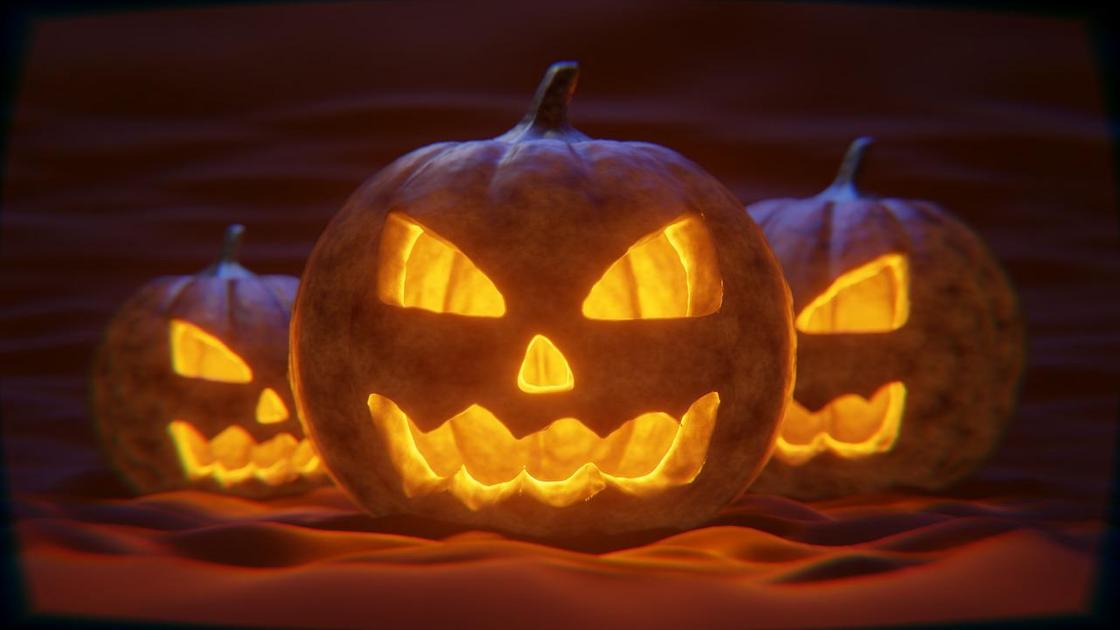
Хэллоуин возник из-за слияния языческих и христианских обычаев. Самый узнаваемый символ праздника — тыква в форме улыбающейся зловещей рожицы, которую называют фонарь Джека. Как светильник из овоща получил имя, как возник такой образ и почему тыква стала символом праздника нечисти?
История фонаря из тыквы на Хэллоуин
Традиции будущего праздника Хэллоуин зародились более 2 тысяч лет назад в культуре и верованиях кельтских племен. Их календарный год заканчивался 31 октября и делился на 2 сезона — лето и зиму. Свой Новый год кельты встречали 1 ноября, а ночью накануне ждали появления потусторонних духов. Чтобы отпугнуть темных сущностей, жрецы-друиды в эту ночь зажигали костры и приносили жертвы. Так они обеспечивали благополучие наступающего года. От этой языческой практики была заимствована традиция защищаться от всяких мифических существ огнем.
Особое значение огонь имел в жизни многих народов. Вот традиции праздника, которые дошли до современников:
- Кельты старались унести домой искру жертвенного костра — лучинку, уголек или свечу. Чтобы ее не затушил ветер, огонь прятали от ветра внутри какого-нибудь корнеплода.
- Люди верили, что в ночь накануне Нового года бог смерти собирает души людей, которые покинули этот мир в уходящем году. Считалось, что огоньки помогут им найти путь в чистилище.
- В мифах европейских народов мерцающим в ночи огням придавалось особое мистическое значение. Необъяснимые блуждающие огни на болотах считали душами умерших людей.
В Англии, Ирландии, Шотландии первоначально фонари на Хэллоуин делали из картофеля, свеклы или репы. Их вычищали и размещали внутри свечи. Импровизированный фонарь выставляли около жилищ, в окнах, чтобы отпугивать нечистую силу. Часто для надежности с такими светильниками в руках трижды обходили дом.
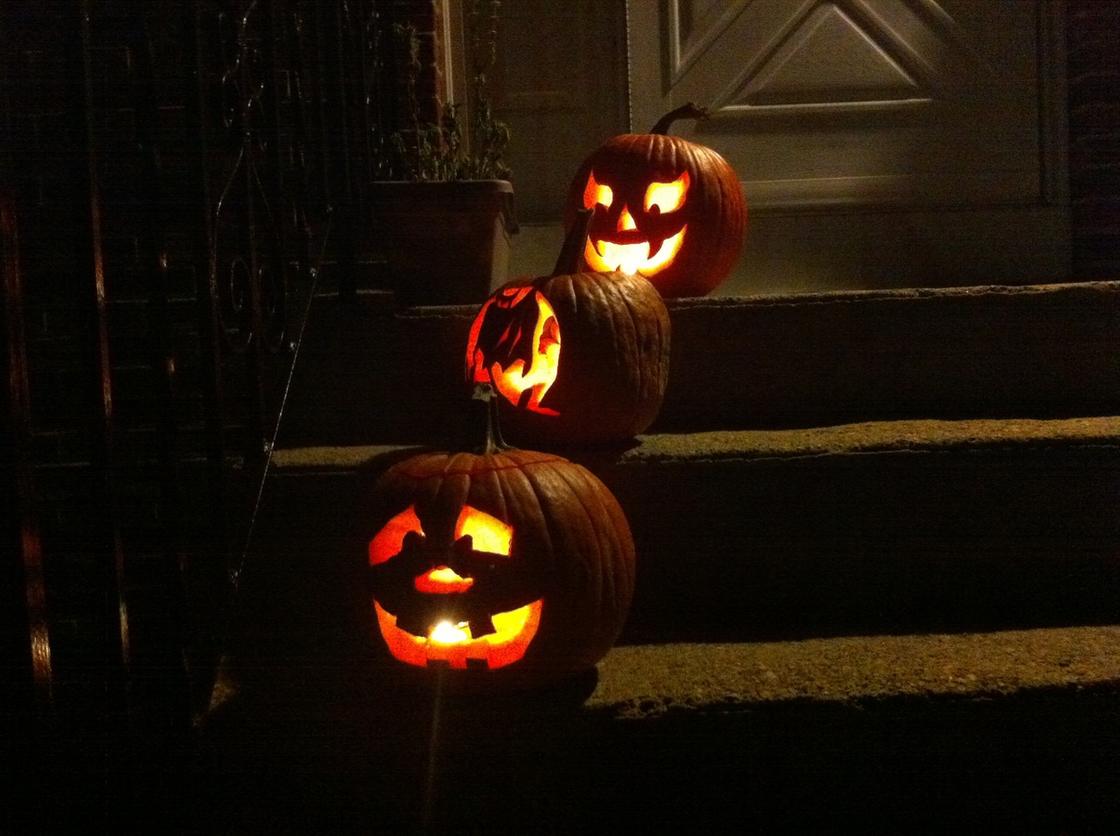
В XVII веке в Англии впервые появился термин «Джек с фонарем». В те времена имя Джек было нарицательным и обозначало любого парня. «Джеком с фонарем» называли ночных сторожей. Они обходили улицы и освещали себе дорогу ручными светильниками, внутри которых горела свеча.
Появление ирландской народной сказки о Скупом Джеке сегодня относят к середине XVIII века. По преданию, его неприкаянная душа в поисках пристанища блуждает по земле с фонариком из репы. Так возникло название символа «Jack-o’-lantern» — Джек-фонарь.
Формирование главного символа Хэллоуина продолжилось в Северной Америке. Туда эмигрировали тысячи ирландцев, которые в 1840 году спасались от голода. У американцев тыква была одним из самых распространенных овощей. В США существовал ритуал во время сбора овощей — вырезать из тыкв забавные рожицы.
К тому времени многим американцам был известен образ всадника с тыквой вместо головы. В 1820 году в новелле «Легенда о сонной лощине» его создал отец американской литературы Вашингтон Ирвинг.
Старинное американское издательство Merrian-Webster считает, что история появления фонаря Джека гораздо прозаичнее. По их версии, в XIX веке в Америке молодые шутники пугали прохожих тыквами с вырезанными глазами, носом, ртом, подсвеченными изнутри. Они напоминали людям мистические болотные огни и вызывали ужас.
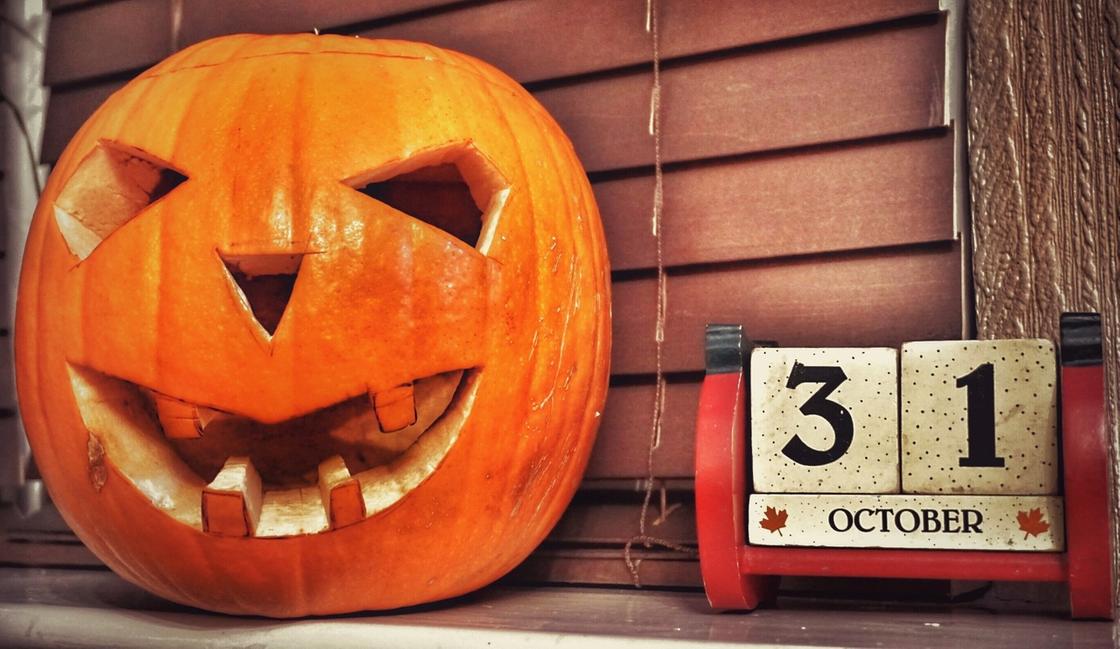
Ирландская легенда, давшая название символу Хэллоуина
Как появилась легенда о Джеке-фонаре? Международный телеканал History Channel на своем сайте излагает самую известную и популярную версию появления символа Хэллоуина. Она связана с ирландским народным преданием о Скупом Джеке.
Джек был кузнецом в одной из деревень. Он прославился своей жадностью, враньем, воровством и пьянством. Когда за его душой пришел дьявол, изворотливому Джеку удалось заманить его в ловушку: он предложил дьяволу прежде расплатиться за выпивку. Денег у нечистого не было, и он сам стал монетами. Тогда Джек схватил их и спрятал в свой кошелек. Дьявол не мог выбраться из западни, так как в кошельке лежал крест. Джек освободил правителя преисподней в обмен на обещание не забирать его душу еще год.
Через год дьявол опять был обманут. Теперь изворотливый Джек попросил выполнить свое последнее желание — сорвать яблоко с дерева. Когда дьявол залез на дерево, Джек вырезал на стволе крест, перекрыв тому путь. Теперь он отпустил нечистого при условии, что тот никогда не заберет его душу.
Когда Джек умер, его душу за недостойную жизнь не пустили в рай. Не взял ее в ад и дьявол, потому что выполнял обещание. Царь преисподней отправил Джека туда, откуда пришел, а на прощание бросил уголек из адского костра. Джек поместил его в репу, чтобы освещать себе путь. Так и бродит его неприкаянная душа по свету в ожидании Судного дня.
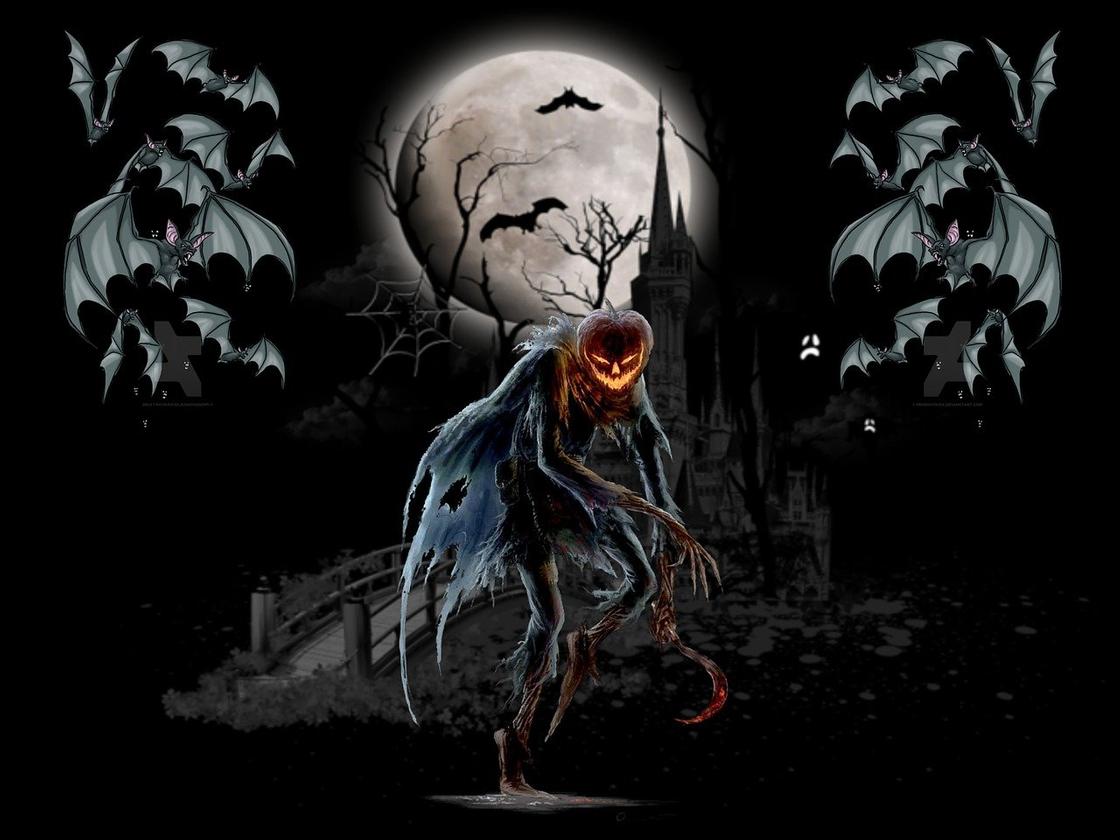
Легенда о Джеке-фонаре уже не один век прочно связана с главным символом праздника.
Что означает тыква на Хэллоуин? Как показывает история, этот символ формировался веками. В нем воплотилось множество значений и образов:
- Тыква символизирует первоначальный смысл праздника — сбор урожая, завершение сельскохозяйственного года.
- Вырезанная из тыквы голова — это символ злых духов и всяких потусторонних сущностей, пришедших из старинных преданий и мифов. По верованиям кельтов, они появлялись в ночь перед Новым годом.
- Размещенный внутри огонь призван оберегать людей и жилища от злых духов.
Изготовление праздничной символики, как и весь праздник Хэллоуин, превратилось в прибыльный коммерческий проект, ставшим вторым после рождественского. Но многим приятнее изготовить такой символ из тыквы самостоятельно, проявить фантазию, придать ему зловещий или смешной вид.
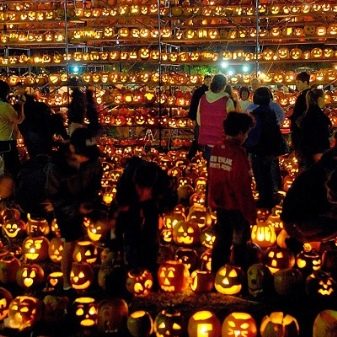
В США популярны конкурсы на скорость изготовления или на поражающее воображение количество фонарей. В разных американских городах в 2006–2011 годах пытались установить рекорды по изготовлению множества фонарей из тыкв. Наконец, в городе Кин (штат Нью-Гэмпшир) 19 октября 2013 года был установлен рекорд, который внесли в Книгу рекордов Гиннесса, — 30581 фонарь из тыкв.
В эпоху информационных технологий Хэллоуин стал глобальным праздником. Там, где о нем раньше не знали, его воспринимают как веселое шоу с оттенком мистицизма. Многих людей привлекает атрибутика этого ночного праздника, а больше всего — пылающие в ночи фонари Джека из тыквы, которые вселяют страх.
Оригинал статьи: https://www.nur.kz/leisure/holidays/1759989-tykva-na-hellouin-istoria/
Автор:
19 октября 2021 11:03
Даже те, кто не интересуется западной культурой, знают, что тыква – это символ праздника Хэллоуин. А вот почему такая роль отведена именно этому овощу?
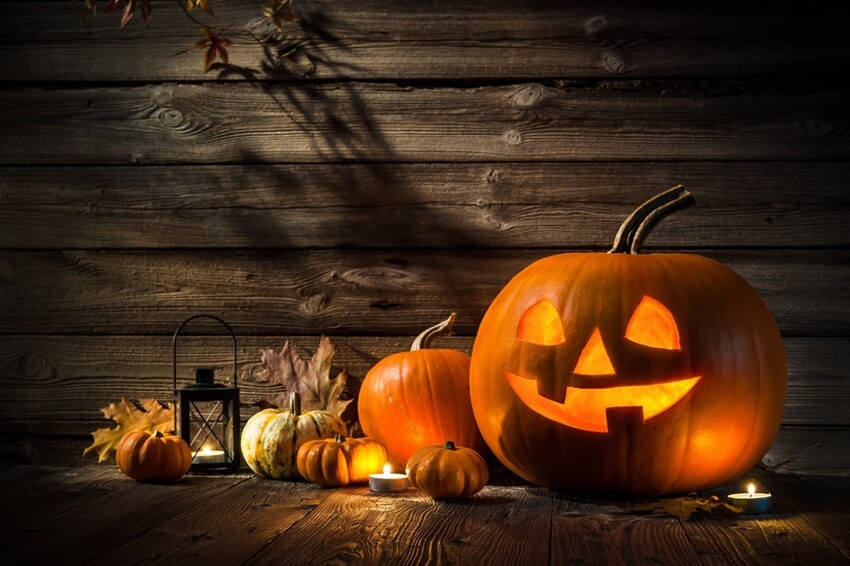
Источник:
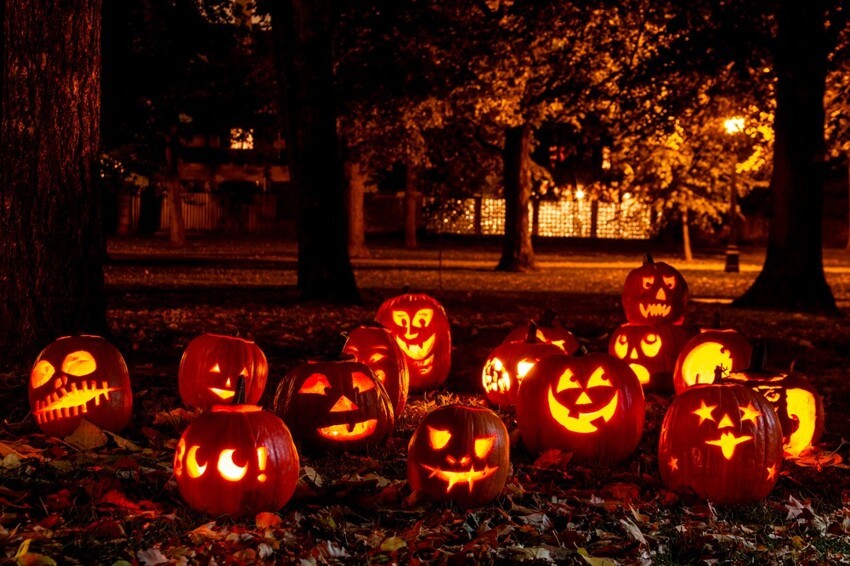
Интерес к этому празднику обусловлен, прежде всего, необычной атрибутикой, символикой, традициями, маскарадными костюмами. Главный символ – светильник Джека, который представляет собой очищенную от мякоти и семян тыкву с вырезанной на ней зловещей рожицей с обязательной ухмылкой. Для пущего ужаса внутрь помещается зажженная свеча.
Отправной точкой создания этого символа стала история о человеке по прозвищу Скупой Джек. Как-то ему довелось выпить в баре с самим дьяволом. Следуя своим жизненным принципам жадности, он не хотел платить за выпивку и убедил дьявола обернуться монеткой, чтобы отдать ее в качестве платы. Тот так и поступил. Но жадность взяла свое, и скупец решил не отдавать плату, положив монетку в карман, где уже лежал серебряный крест, помешавший повелителю ада принять истинное обличье.
Источник:
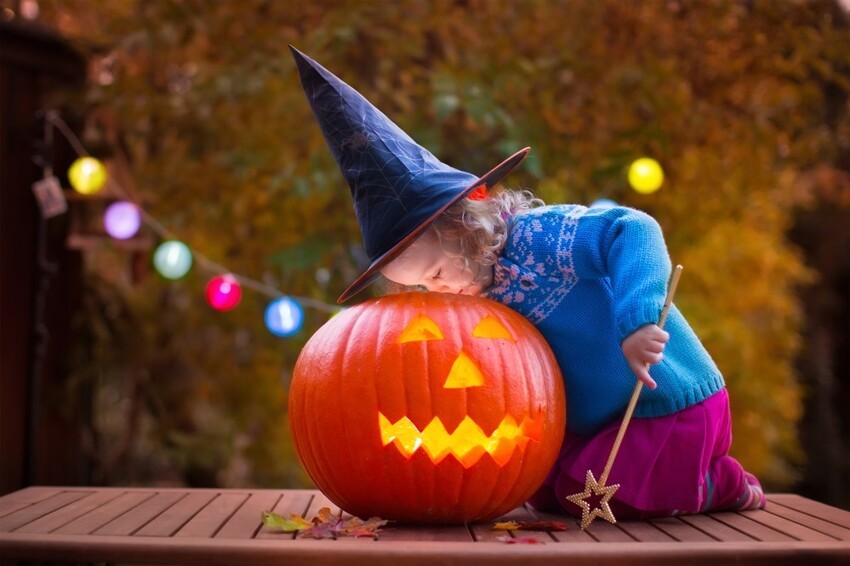
Через некоторое время Джек решил позволить дьяволу вернуть свой истинный облик, но при условии, что тот не появится в течение года и не заберет душу Джека в ад после смерти. Через год история повторилась: предприимчивый парень уговорил старого знакомого залезть на дерево за плодом и вырезал на коре крест, чтобы дьявол не мог спуститься. За разрешение слезть Джек взял обещание не беспокоить его уже целых 10 лет.
Источник:
Но никто не живет вечно. Однажды пришел и черед Джека. Но поскольку он вел далеко не праведную жизнь, то путь в рай был ему заказан. А так как дьявол соблюдал условия договора, то в ад грешник тоже не смог попасть. Но старый знакомый дал Джеку угольки из адского пламени, чтобы освещать себе путь. Дабы подольше сохранить их свет, мужчина поместил угли в импровизированную емкость-подсвечник, вырезанную из репы. С той поры и повелось, что фонарь Джека стал символизировать собой неприкаянную душу, которая вечно мечется во мраке, освещая дорогу тлеющими углями. После того, как Хэллоуин стал элементом американской культуры, репу заменили тыквой.
Родиной Хэллоуина считается Ирландия, а его главные цвета – черный, символизирующий тьму, и оранжевый – цвет собранного урожая. Во многих европейских странах считается, что в США празднику уделяется слишком много внимания. И европейцы не далеки от истины, поскольку относительно недавно он вошел в перечень самых популярных детских фобий.
А как вы относитесь к этому празднику?
Источник:
Ссылки по теме:
В конце второго месяца осени в странах мира, в том числе и в РФ, празднуется одновременно языческий и церковный праздник, уходящий корнями в древность, под названием Хеллоуин. Попробуем установить основные факты и проследить момент его появления, дальнейшее развитие и распространение.
Происхождение праздника
Россия переняла обычай вырезания страшных рожиц из тыкв с зажиганием в них свечей, переодевания в маскарадные костюмы и угощения маленьких детей сладостями из книг, комиксов и кинофильмов, произведенных в США и Англии. Однако сам праздник возник задолго до открытия Америки — в IV-I тысячелетии до н. э. у древних кельтов.
В ночь с 31 октября на 1 ноября этот народ отмечал конец старого и начало следующего года. В этот вечер зажигались костры в честь окончания сбора урожая, проводились масштабные шествия с переодеванием в шкуры животных, чтобы отпугнуть призраков. Считалось, что в ночь на 1 ноября истончаются границы между мирами живых и мертвых, и души усопших блуждают по земле. Назывался праздник Самайн, Самхайн, Самхэйн, что означает «Конец лета» или «Последний урожай».

В I веке до н. э. кельтов завоевали римляне, которые искоренили кельтские праздники, но традиции этого народа сумели дожить до наших дней в форме легенд.
Современное название появилось с подачи Папы Римского Григория III (731-741 гг), который назначил праздник восхваления подвигов мучеников и святых на 1 ноября. Отсюда и название All Hallo Even, что означает «Вечер (День) всех святых», которое сократилось и упростилось до Halloween (Хеллоуин). Однако искоренить праздник подменой не удалось, поскольку традиции кельтского Самайна постепенно начали возрождаться. В XVI веке в Шотландии, Ирландии и Англии происходили празднования кельтского Нового года. Затем традиции распространились на земли Нового Света (старое название Америки) и Канады.
Тыква

Тыква или «фонарь Джека» (Jack-O-Lantern) — незыблемый атрибут празднования Дня всех святых. У кельтов был обычай вырезать фонари, чтобы помочь душам найти чистилище. Известна также легенда (миф, сказка) о «Скупом Джеке», который был то ли фермером, то ли кузнецом, повстречавшим однажды в таверне самого Дьявола.
Или у него закончились деньги, или он не хотел платить за себя и за собутыльника, но Джек договорился с Нечистым, что тот превратится в монету взамен на душу смертного. Затем монета была брошена в карман, где лежал серебряный крест не позволявший главнокомандующему нечистью принять первоначальный вид. Со временем Джек отпустил Дьявола взамен на обещание, что тот не будет беспокоить его год, а если за это время герой мифа скончается, — то не заберет его душу.
Через год скупец хитростью заманил Дьявола на дерево, а сам начертил на древесине крест, вновь поместив последнего в ловушку. В этот раз Джек выторговал себе 10 лет жизни и обещание не забирать душу в ад. Когда герой легенды умер, Бог не взял душу грешника в рай, да и Дьявол, памятуя об уговоре, отказал ей в приюте, и только дал скупцу яркие угольки из адского пекла, чтобы те освещали неприкаянной душе путь. Чтобы угольки дольше тлели и не обжигали, Джек вырезал из репы фонарик. С тех пор и пошел обычай вырезать страшные рожицы из крупных картофелин или репы.
В XVIII веке, иммигрировав в Америку, ирландцы, шотландцы и англичане привезли традицию вырезать Фонарики Джека, и вскоре обнаружили другой доступный и пригодный для этого овощ. Так тыква стала символом празднования Хеллоуина.
Маскарадные костюмы
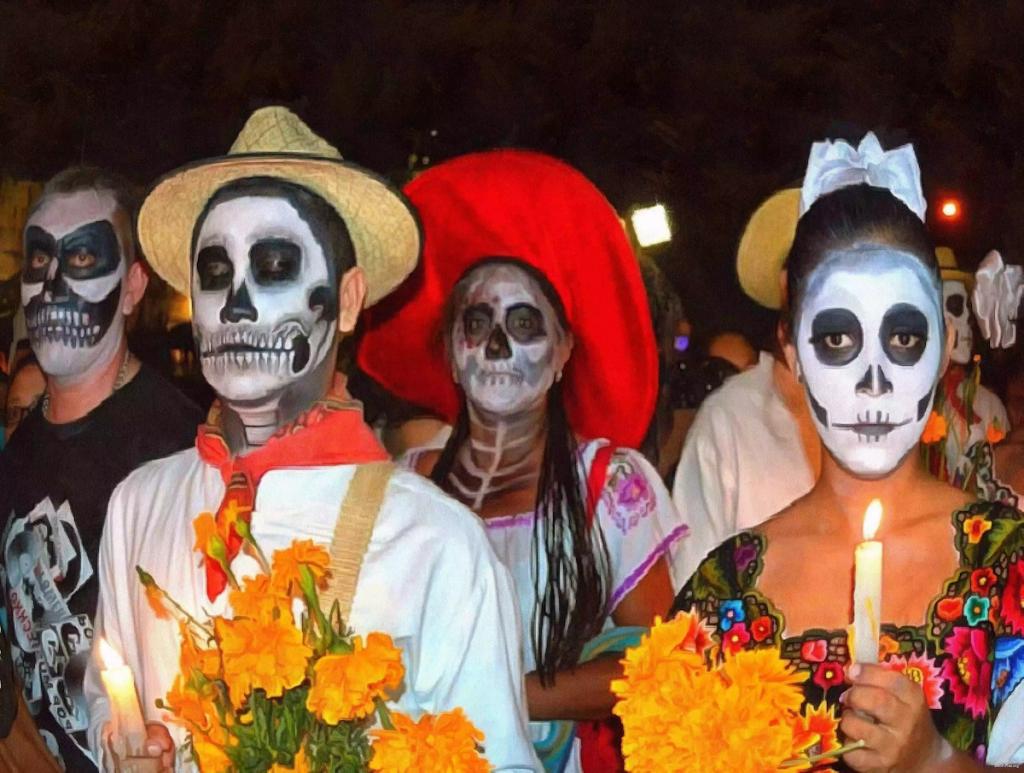
Кельты опасались призраков, которые блуждали по земле на Самайн, поэтому, выходя на улицу после заката солнца, закрывали лица масками в надежде на то, что души умерших примут их за своих и оставят в покое.
На заре заселения Америки коренные американцы и первые европейцы праздновали, скорее, сбор урожая, а не Хеллоуин. С появлением ирландцев ситуация переменилась, и праздник стал популярным по всей стране.
В конце XIX века люди стали делать вечеринки для соседей и членов семьи, оттесняя на задний план веру в явление духов или религиозное почитание мучеников и святых. Поэтому теперь американцы переодеваются на праздник в известных личностей и людей разных профессий. А не только в костюмы нечисти, ведьм, скелетов или призраков, как в других странах.
Жизнь или кошелек?

Эта традиция зародилась в Европе, а точнее в Англии, где бедным людям в канун праздника Дня всех душ (2 ноября) состоятельные англичане давали небольшие пироги со специями и изюмом, прозванные в народе «пироги за упокой души» или «пироги душ» (Going a-souling). А бедняки за это пели молитвы за упокой душ, умерших родственников их благодетелей. Обычай просуществовал до 1930-х годов и сохранился у американцев. Только теперь по домам ходят дети (до 12 лет включительно, остальным выписывается штраф), и просят сладости под лозунгом: Trick or treat?, что дословно переводится как «Шутка или угощение?» или «Сладость или гадость?». Однако чаще переводчики в фильмах оставляют фразу: «Жизнь или кошелек?».
Праздники-аналоги

Праздник стал 2-м после Рождества коммерчески успешным в США. Количество сладостей, скупаемых в канун Дня всех святых, по объему превышает количество конфет, продаваемых перед Днем св. Валентина.
В удаленных уголках планеты существуют аналогичные праздники (в Мексике, Непале, в Японии, в скандинавских странах, в Германии, Индонезии, Китае, Сингапуре). Как правило, все они приходятся на середину или конец лета, а также на начало осени и заключаются в поминании умерших близких родственников, сопровождаемом фестивалями, вечеринками, массовыми гуляньями, посещениями мест захоронений и угощением сладостями, ритуальными блюдами или раздачей сюрпризов.
Нашли нарушение? Пожаловаться на содержание
| Halloween | |
|---|---|

Carving a jack-o’-lantern is a common Halloween tradition |
|
| Also called |
|
| Observed by | Western Christians and many non-Christians around the world[1] |
| Type | Christian |
| Significance | First day of Allhallowtide |
| Celebrations | Trick-or-treating, costume parties, making jack-o’-lanterns, lighting bonfires, divination, apple bobbing, visiting haunted attractions. |
| Observances | Church services,[2] prayer,[3] fasting,[1] and vigil[4] |
| Date | 31 October |
| Related to | Samhain, Hop-tu-Naa, Calan Gaeaf, Allantide, Day of the Dead, Reformation Day, All Saints’ Day, Mischief Night (cf. vigil) |
Halloween or Hallowe’en (less commonly known as Allhalloween,[5] All Hallows’ Eve,[6] or All Saints’ Eve)[7] is a celebration observed in many countries on 31 October, the eve of the Western Christian feast of All Saints’ Day. It begins the observance of Allhallowtide,[8] the time in the liturgical year dedicated to remembering the dead, including saints (hallows), martyrs, and all the faithful departed.[9][10][11][12]
One theory holds that many Halloween traditions were influenced by Celtic harvest festivals, particularly the Gaelic festival Samhain, which are believed to have pagan roots.[13][14][15][16] Some go further and suggest that Samhain may have been Christianized as All Hallow’s Day, along with its eve, by the early Church.[17] Other academics believe Halloween began solely as a Christian holiday, being the vigil of All Hallow’s Day.[18][19][20][21] Celebrated in Ireland and Scotland for centuries, Irish and Scottish immigrants took many Halloween customs to North America in the 19th century,[22][23] and then through American influence Halloween had spread to other countries by the late 20th and early 21st century.[24][25]
Popular Halloween activities include trick-or-treating (or the related guising and souling), attending Halloween costume parties, carving pumpkins or turnips into jack-o’-lanterns, lighting bonfires, apple bobbing, divination games, playing pranks, visiting haunted attractions, telling scary stories, and watching horror or Halloween-themed films.[26] Some people practice the Christian religious observances of All Hallows’ Eve, including attending church services and lighting candles on the graves of the dead,[27][28][29] although it is a secular celebration for others.[30][31][32] Some Christians historically abstained from meat on All Hallows’ Eve, a tradition reflected in the eating of certain vegetarian foods on this vigil day, including apples, potato pancakes, and soul cakes.[33][34][35][36]
Etymology

The word Halloween or Hallowe’en («Saints’ evening»[37]) is of Christian origin;[38][39] a term equivalent to «All Hallows Eve» is attested in Old English.[40] The word hallowe[‘]en comes from the Scottish form of All Hallows’ Eve (the evening before All Hallows’ Day):[41] even is the Scots term for «eve» or «evening»,[42] and is contracted to e’en or een;[43] (All) Hallow(s) E(v)en became Hallowe’en.
History
Christian origins and historic customs
Halloween is thought to have influences from Christian beliefs and practices.[44][45] The English word ‘Halloween’ comes from «All Hallows’ Eve», being the evening before the Christian holy days of All Hallows’ Day (All Saints’ Day) on 1 November and All Souls’ Day on 2 November.[46] Since the time of the early Church,[47] major feasts in Christianity (such as Christmas, Easter and Pentecost) had vigils that began the night before, as did the feast of All Hallows’.[48][44] These three days are collectively called Allhallowtide and are a time when Western Christians honour all saints and pray for recently departed souls who have yet to reach Heaven. Commemorations of all saints and martyrs were held by several churches on various dates, mostly in springtime.[49] In 4th-century Roman Edessa it was held on 13 May, and on 13 May 609, Pope Boniface IV re-dedicated the Pantheon in Rome to «St Mary and all martyrs».[50] This was the date of Lemuria, an ancient Roman festival of the dead.[51]
In the 8th century, Pope Gregory III (731–741) founded an oratory in St Peter’s for the relics «of the holy apostles and of all saints, martyrs and confessors».[44][52] Some sources say it was dedicated on 1 November,[53] while others say it was on Palm Sunday in April 732.[54][55] By 800, there is evidence that churches in Ireland[56] and Northumbria were holding a feast commemorating all saints on 1 November.[57] Alcuin of Northumbria, a member of Charlemagne’s court, may then have introduced this 1 November date in the Frankish Empire.[58] In 835, it became the official date in the Frankish Empire.[57] Some suggest this was due to Celtic influence, while others suggest it was a Germanic idea,[57] although it is claimed that both Germanic and Celtic-speaking peoples commemorated the dead at the beginning of winter.[59] They may have seen it as the most fitting time to do so, as it is a time of ‘dying’ in nature.[57][59] It is also suggested the change was made on the «practical grounds that Rome in summer could not accommodate the great number of pilgrims who flocked to it», and perhaps because of public health concerns over Roman Fever, which claimed a number of lives during Rome’s sultry summers.[60][44]


On All Hallows’ Eve, Christians in some parts of the world visit cemeteries to pray and place flowers and candles on the graves of their loved ones.[61] Top: Christians in Bangladesh lighting candles on the headstone of a relative. Bottom: Lutheran Christians praying and lighting candles in front of the central crucifix of a graveyard.
By the end of the 12th century, the celebration had become known as the holy days of obligation in Western Christianity and involved such traditions as ringing church bells for souls in purgatory. It was also «customary for criers dressed in black to parade the streets, ringing a bell of mournful sound and calling on all good Christians to remember the poor souls».[62] The Allhallowtide custom of baking and sharing soul cakes for all christened souls,[63] has been suggested as the origin of trick-or-treating.[64] The custom dates back at least as far as the 15th century[65] and was found in parts of England, Wales, Flanders, Bavaria and Austria.[66] Groups of poor people, often children, would go door-to-door during Allhallowtide, collecting soul cakes, in exchange for praying for the dead, especially the souls of the givers’ friends and relatives. This was called «souling».[65][67][68] Soul cakes were also offered for the souls themselves to eat,[66] or the ‘soulers’ would act as their representatives.[69] As with the Lenten tradition of hot cross buns, soul cakes were often marked with a cross, indicating they were baked as alms.[70] Shakespeare mentions souling in his comedy The Two Gentlemen of Verona (1593).[71] While souling, Christians would carry «lanterns made of hollowed-out turnips», which could have originally represented souls of the dead;[72][73] jack-o’-lanterns were used to ward off evil spirits.[74][75] On All Saints’ and All Souls’ Day during the 19th century, candles were lit in homes in Ireland,[76] Flanders, Bavaria, and in Tyrol, where they were called «soul lights»,[77] that served «to guide the souls back to visit their earthly homes».[78] In many of these places, candles were also lit at graves on All Souls’ Day.[77] In Brittany, libations of milk were poured on the graves of kinfolk,[66] or food would be left overnight on the dinner table for the returning souls;[77] a custom also found in Tyrol and parts of Italy.[79][77]
Christian minister Prince Sorie Conteh linked the wearing of costumes to the belief in vengeful ghosts: «It was traditionally believed that the souls of the departed wandered the earth until All Saints’ Day, and All Hallows’ Eve provided one last chance for the dead to gain vengeance on their enemies before moving to the next world. In order to avoid being recognized by any soul that might be seeking such vengeance, people would don masks or costumes».[80] In the Middle Ages, churches in Europe that were too poor to display relics of martyred saints at Allhallowtide let parishioners dress up as saints instead.[81][82] Some Christians observe this custom at Halloween today.[83] Lesley Bannatyne believes this could have been a Christianization of an earlier pagan custom.[84] Many Christians in mainland Europe, especially in France, believed «that once a year, on Hallowe’en, the dead of the churchyards rose for one wild, hideous carnival» known as the danse macabre, which was often depicted in church decoration.[85] Christopher Allmand and Rosamond McKitterick write in The New Cambridge Medieval History that the danse macabre urged Christians «not to forget the end of all earthly things».[86] The danse macabre was sometimes enacted in European village pageants and court masques, with people «dressing up as corpses from various strata of society», and this may be the origin of Halloween costume parties.[87][88][89][72]
In Britain, these customs came under attack during the Reformation, as Protestants berated purgatory as a «popish» doctrine incompatible with the Calvinist doctrine of predestination. State-sanctioned ceremonies associated with the intercession of saints and prayer for souls in purgatory were abolished during the Elizabethan reform, though All Hallow’s Day remained in the English liturgical calendar to «commemorate saints as godly human beings».[90] For some Nonconformist Protestants, the theology of All Hallows’ Eve was redefined; «souls cannot be journeying from Purgatory on their way to Heaven, as Catholics frequently believe and assert. Instead, the so-called ghosts are thought to be in actuality evil spirits».[91] Other Protestants believed in an intermediate state known as Hades (Bosom of Abraham).[92] In some localities, Catholics and Protestants continued souling, candlelit processions, or ringing church bells for the dead;[46][93] the Anglican church eventually suppressed this bell-ringing.[94] Mark Donnelly, a professor of medieval archaeology, and historian Daniel Diehl write that «barns and homes were blessed to protect people and livestock from the effect of witches, who were believed to accompany the malignant spirits as they traveled the earth».[95] After 1605, Hallowtide was eclipsed in England by Guy Fawkes Night (5 November), which appropriated some of its customs.[96] In England, the ending of official ceremonies related to the intercession of saints led to the development of new, unofficial Hallowtide customs. In 18th–19th century rural Lancashire, Catholic families gathered on hills on the night of All Hallows’ Eve. One held a bunch of burning straw on a pitchfork while the rest knelt around him, praying for the souls of relatives and friends until the flames went out. This was known as teen’lay.[97] There was a similar custom in Hertfordshire, and the lighting of ‘tindle’ fires in Derbyshire.[98] Some suggested these ‘tindles’ were originally lit to «guide the poor souls back to earth».[99] In Scotland and Ireland, old Allhallowtide customs that were at odds with Reformed teaching were not suppressed as they «were important to the life cycle and rites of passage of local communities» and curbing them would have been difficult.[22]
In parts of Italy until the 15th century, families left a meal out for the ghosts of relatives, before leaving for church services.[79] In 19th-century Italy, churches staged «theatrical re-enactments of scenes from the lives of the saints» on All Hallow’s Day, with «participants represented by realistic wax figures».[79] In 1823, the graveyard of Holy Spirit Hospital in Rome presented a scene in which bodies of those who recently died were arrayed around a wax statue of an angel who pointed upward towards heaven.[79] In the same country, «parish priests went house-to-house, asking for small gifts of food which they shared among themselves throughout that night».[79] In Spain, they continue to bake special pastries called «bones of the holy» (Spanish: Huesos de Santo) and set them on graves.[100] At cemeteries in Spain and France, as well as in Latin America, priests lead Christian processions and services during Allhallowtide, after which people keep an all night vigil.[101] In 19th-century San Sebastián, there was a procession to the city cemetery at Allhallowtide, an event that drew beggars who «appeal[ed] to the tender recollectons of one’s deceased relations and friends» for sympathy.[102]
Gaelic folk influence

Today’s Halloween customs are thought to have been influenced by folk customs and beliefs from the Celtic-speaking countries, some of which are believed to have pagan roots.[103] Jack Santino, a folklorist, writes that «there was throughout Ireland an uneasy truce existing between customs and beliefs associated with Christianity and those associated with religions that were Irish before Christianity arrived».[104] The origins of Halloween customs are typically linked to the Gaelic festival Samhain.[105]
Samhain is one of the quarter days in the medieval Gaelic calendar and has been celebrated on 31 October – 1 November[106] in Ireland, Scotland and the Isle of Man.[107][108] A kindred festival has been held by the Brittonic Celts, called Calan Gaeaf in Wales, Kalan Gwav in Cornwall and Kalan Goañv in Brittany; a name meaning «first day of winter». For the Celts, the day ended and began at sunset; thus the festival begins the evening before 1 November by modern reckoning.[109] Samhain is mentioned in some of the earliest Irish literature. The names have been used by historians to refer to Celtic Halloween customs up until the 19th century,[110] and are still the Gaelic and Welsh names for Halloween.

Snap-Apple Night, painted by Daniel Maclise in 1833, shows people feasting and playing divination games on Halloween in Ireland.[111]
Samhain marked the end of the harvest season and beginning of winter or the ‘darker half’ of the year.[112][113] It was seen as a liminal time, when the boundary between this world and the Otherworld thinned. This meant the Aos Sí, the ‘spirits’ or ‘fairies’, could more easily come into this world and were particularly active.[114][115] Most scholars see them as «degraded versions of ancient gods […] whose power remained active in the people’s minds even after they had been officially replaced by later religious beliefs».[116] They were both respected and feared, with individuals often invoking the protection of God when approaching their dwellings.[117][118] At Samhain, the Aos Sí were appeased to ensure the people and livestock survived the winter. Offerings of food and drink, or portions of the crops, were left outside for them.[119][120][121] The souls of the dead were also said to revisit their homes seeking hospitality.[122] Places were set at the dinner table and by the fire to welcome them.[123] The belief that the souls of the dead return home on one night of the year and must be appeased seems to have ancient origins and is found in many cultures.[66] In 19th century Ireland, «candles would be lit and prayers formally offered for the souls of the dead. After this the eating, drinking, and games would begin».[124]
Throughout Ireland and Britain, especially in the Celtic-speaking regions, the household festivities included divination rituals and games intended to foretell one’s future, especially regarding death and marriage.[125] Apples and nuts were often used, and customs included apple bobbing, nut roasting, scrying or mirror-gazing, pouring molten lead or egg whites into water, dream interpretation, and others.[126] Special bonfires were lit and there were rituals involving them. Their flames, smoke, and ashes were deemed to have protective and cleansing powers.[112] In some places, torches lit from the bonfire were carried sunwise around homes and fields to protect them.[110] It is suggested the fires were a kind of imitative or sympathetic magic – they mimicked the Sun and held back the decay and darkness of winter.[123][127][128] They were also used for divination and to ward off evil spirits.[74] In Scotland, these bonfires and divination games were banned by the church elders in some parishes.[129] In Wales, bonfires were also lit to «prevent the souls of the dead from falling to earth».[130] Later, these bonfires «kept away the devil».[131]
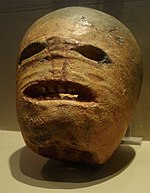
A plaster cast of a traditional Irish Halloween turnip (rutabaga) lantern on display in the Museum of Country Life, Ireland[132]
From at least the 16th century,[133] the festival included mumming and guising in Ireland, Scotland, the Isle of Man and Wales.[134] This involved people going house-to-house in costume (or in disguise), usually reciting verses or songs in exchange for food. It may have originally been a tradition whereby people impersonated the Aos Sí, or the souls of the dead, and received offerings on their behalf, similar to ‘souling’. Impersonating these beings, or wearing a disguise, was also believed to protect oneself from them.[135] In parts of southern Ireland, the guisers included a hobby horse. A man dressed as a Láir Bhán (white mare) led youths house-to-house reciting verses – some of which had pagan overtones – in exchange for food. If the household donated food it could expect good fortune from the ‘Muck Olla’; not doing so would bring misfortune.[136] In Scotland, youths went house-to-house with masked, painted or blackened faces, often threatening to do mischief if they were not welcomed.[134] F. Marian McNeill suggests the ancient festival included people in costume representing the spirits, and that faces were marked or blackened with ashes from the sacred bonfire.[133] In parts of Wales, men went about dressed as fearsome beings called gwrachod.[134] In the late 19th and early 20th century, young people in Glamorgan and Orkney cross-dressed.[134]
Elsewhere in Europe, mumming was part of other festivals, but in the Celtic-speaking regions, it was «particularly appropriate to a night upon which supernatural beings were said to be abroad and could be imitated or warded off by human wanderers».[134] From at least the 18th century, «imitating malignant spirits» led to playing pranks in Ireland and the Scottish Highlands. Wearing costumes and playing pranks at Halloween did not spread to England until the 20th century.[134] Pranksters used hollowed-out turnips or mangel wurzels as lanterns, often carved with grotesque faces.[134] By those who made them, the lanterns were variously said to represent the spirits,[134] or used to ward off evil spirits.[137][138] They were common in parts of Ireland and the Scottish Highlands in the 19th century,[134] as well as in Somerset (see Punkie Night). In the 20th century they spread to other parts of Britain and became generally known as jack-o’-lanterns.[134]
Spread to North America

Lesley Bannatyne and Cindy Ott write that Anglican colonists in the southern United States and Catholic colonists in Maryland «recognized All Hallow’s Eve in their church calendars»,[140][141] although the Puritans of New England strongly opposed the holiday, along with other traditional celebrations of the established Church, including Christmas.[142] Almanacs of the late 18th and early 19th century give no indication that Halloween was widely celebrated in North America.[22]
It was not until after mass Irish and Scottish immigration in the 19th century that Halloween became a major holiday in America.[22] Most American Halloween traditions were inherited from the Irish and Scots,[23][143] though «In Cajun areas, a nocturnal Mass was said in cemeteries on Halloween night. Candles that had been blessed were placed on graves, and families sometimes spent the entire night at the graveside».[144] Originally confined to these immigrant communities, it was gradually assimilated into mainstream society and was celebrated coast to coast by people of all social, racial, and religious backgrounds by the early 20th century.[145] Then, through American influence, these Halloween traditions spread to many other countries by the late 20th and early 21st century, including to mainland Europe and some parts of the Far East.[24][25][146]
Symbols

Development of artifacts and symbols associated with Halloween formed over time. Jack-o’-lanterns are traditionally carried by guisers on All Hallows’ Eve in order to frighten evil spirits.[73][147] There is a popular Irish Christian folktale associated with the jack-o’-lantern,[148] which in folklore is said to represent a «soul who has been denied entry into both heaven and hell»:[149]
On route home after a night’s drinking, Jack encounters the Devil and tricks him into climbing a tree. A quick-thinking Jack etches the sign of the cross into the bark, thus trapping the Devil. Jack strikes a bargain that Satan can never claim his soul. After a life of sin, drink, and mendacity, Jack is refused entry to heaven when he dies. Keeping his promise, the Devil refuses to let Jack into hell and throws a live coal straight from the fires of hell at him. It was a cold night, so Jack places the coal in a hollowed out turnip to stop it from going out, since which time Jack and his lantern have been roaming looking for a place to rest.[150]
In Ireland and Scotland, the turnip has traditionally been carved during Halloween,[151][152] but immigrants to North America used the native pumpkin, which is both much softer and much larger, making it easier to carve than a turnip.[151] The American tradition of carving pumpkins is recorded in 1837[153] and was originally associated with harvest time in general, not becoming specifically associated with Halloween until the mid-to-late 19th century.[154]
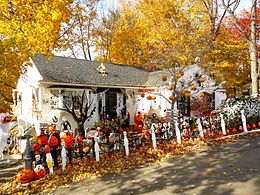
The modern imagery of Halloween comes from many sources, including Christian eschatology, national customs, works of Gothic and horror literature (such as the novels Frankenstein; or, The Modern Prometheus and Dracula) and classic horror films such as Frankenstein (1931) and The Mummy (1932).[155][156] Imagery of the skull, a reference to Golgotha in the Christian tradition, serves as «a reminder of death and the transitory quality of human life» and is consequently found in memento mori and vanitas compositions;[157] skulls have therefore been commonplace in Halloween, which touches on this theme.[158] Traditionally, the back walls of churches are «decorated with a depiction of the Last Judgment, complete with graves opening and the dead rising, with a heaven filled with angels and a hell filled with devils», a motif that has permeated the observance of this triduum.[159] One of the earliest works on the subject of Halloween is from Scottish poet John Mayne, who, in 1780, made note of pranks at Halloween; «What fearfu’ pranks ensue!», as well as the supernatural associated with the night, «bogles» (ghosts),[160] influencing Robert Burns’ «Halloween» (1785).[161] Elements of the autumn season, such as pumpkins, corn husks, and scarecrows, are also prevalent. Homes are often decorated with these types of symbols around Halloween. Halloween imagery includes themes of death, evil, and mythical monsters.[162] Black cats, which have been long associated with witches, are also a common symbol of Halloween. Black, orange, and sometimes purple are Halloween’s traditional colors.[163]
Trick-or-treating and guising
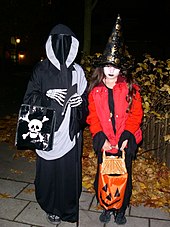
Trick-or-treaters in Sweden
Trick-or-treating is a customary celebration for children on Halloween. Children go in costume from house to house, asking for treats such as candy or sometimes money, with the question, «Trick or treat?» The word «trick» implies a «threat» to perform mischief on the homeowners or their property if no treat is given.[64] The practice is said to have roots in the medieval practice of mumming, which is closely related to souling.[164] John Pymm wrote that «many of the feast days associated with the presentation of mumming plays were celebrated by the Christian Church.»[165] These feast days included All Hallows’ Eve, Christmas, Twelfth Night and Shrove Tuesday.[166][167] Mumming practiced in Germany, Scandinavia and other parts of Europe,[168] involved masked persons in fancy dress who «paraded the streets and entered houses to dance or play dice in silence».[169]

Girl in a Halloween costume in 1928, Ontario, Canada, the same province where the Scottish Halloween custom of guising was first recorded in North America
In England, from the medieval period,[170] up until the 1930s,[171] people practiced the Christian custom of souling on Halloween, which involved groups of soulers, both Protestant and Catholic,[93] going from parish to parish, begging the rich for soul cakes, in exchange for praying for the souls of the givers and their friends.[67] In the Philippines, the practice of souling is called Pangangaluluwa and is practiced on All Hallow’s Eve among children in rural areas.[26] People drape themselves in white cloths to represent souls and then visit houses, where they sing in return for prayers and sweets.[26]
In Scotland and Ireland, guising – children disguised in costume going from door to door for food or coins – is a traditional Halloween custom.[172] It is recorded in Scotland at Halloween in 1895 where masqueraders in disguise carrying lanterns made out of scooped out turnips, visit homes to be rewarded with cakes, fruit, and money.[152][173] In Ireland, the most popular phrase for kids to shout (until the 2000s) was «Help the Halloween Party».[172] The practice of guising at Halloween in North America was first recorded in 1911, where a newspaper in Kingston, Ontario, Canada, reported children going «guising» around the neighborhood.[174]
American historian and author Ruth Edna Kelley of Massachusetts wrote the first book-length history of Halloween in the US; The Book of Hallowe’en (1919), and references souling in the chapter «Hallowe’en in America».[175] In her book, Kelley touches on customs that arrived from across the Atlantic; «Americans have fostered them, and are making this an occasion something like what it must have been in its best days overseas. All Halloween customs in the United States are borrowed directly or adapted from those of other countries».[176]
While the first reference to «guising» in North America occurs in 1911, another reference to ritual begging on Halloween appears, place unknown, in 1915, with a third reference in Chicago in 1920.[177] The earliest known use in print of the term «trick or treat» appears in 1927, in the Blackie Herald, of Alberta, Canada.[178]
The thousands of Halloween postcards produced between the turn of the 20th century and the 1920s commonly show children but not trick-or-treating.[179] Trick-or-treating does not seem to have become a widespread practice in North America until the 1930s, with the first US appearances of the term in 1934,[180] and the first use in a national publication occurring in 1939.[181]
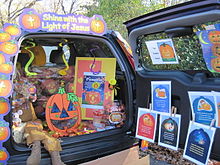
A popular variant of trick-or-treating, known as trunk-or-treating (or Halloween tailgating), occurs when «children are offered treats from the trunks of cars parked in a church parking lot», or sometimes, a school parking lot.[100][182] In a trunk-or-treat event, the trunk (boot) of each automobile is decorated with a certain theme,[183] such as those of children’s literature, movies, scripture, and job roles.[184] Trunk-or-treating has grown in popularity due to its perception as being more safe than going door to door, a point that resonates well with parents, as well as the fact that it «solves the rural conundrum in which homes [are] built a half-mile apart».[185][186]
Costumes
Halloween costumes were traditionally modeled after figures such as vampires, ghosts, skeletons, scary looking witches, and devils.[64] Over time, the costume selection extended to include popular characters from fiction, celebrities, and generic archetypes such as ninjas and princesses.

Halloween shop in Derry, Northern Ireland, selling masks
Dressing up in costumes and going «guising» was prevalent in Scotland and Ireland at Halloween by the late 19th century.[152] A Scottish term, the tradition is called «guising» because of the disguises or costumes worn by the children.[173] In Ireland and Scotland, the masks are known as ‘false faces’,[38][187] a term recorded in Ayr, Scotland in 1890 by a Scot describing guisers: «I had mind it was Halloween . . . the wee callans were at it already, rinning aboot wi’ their fause-faces (false faces) on and their bits o’ turnip lanthrons (lanterns) in their haun (hand)».[38] Costuming became popular for Halloween parties in the US in the early 20th century, as often for adults as for children, and when trick-or-treating was becoming popular in Canada and the US in the 1920s and 1930s.[178][188]
Eddie J. Smith, in his book Halloween, Hallowed is Thy Name, offers a religious perspective to the wearing of costumes on All Hallows’ Eve, suggesting that by dressing up as creatures «who at one time caused us to fear and tremble», people are able to poke fun at Satan «whose kingdom has been plundered by our Saviour». Images of skeletons and the dead are traditional decorations used as memento mori.[189][190]
«Trick-or-Treat for UNICEF» is a fundraising program to support UNICEF,[64] a United Nations Programme that provides humanitarian aid to children in developing countries. Started as a local event in a Northeast Philadelphia neighborhood in 1950 and expanded nationally in 1952, the program involves the distribution of small boxes by schools (or in modern times, corporate sponsors like Hallmark, at their licensed stores) to trick-or-treaters, in which they can solicit small-change donations from the houses they visit. It is estimated that children have collected more than $118 million for UNICEF since its inception. In Canada, in 2006, UNICEF decided to discontinue their Halloween collection boxes, citing safety and administrative concerns; after consultation with schools, they instead redesigned the program.[191][192]
The yearly New York’s Village Halloween Parade was begun in 1974; it is the world’s largest Halloween parade and America’s only major nighttime parade, attracting more than 60,000 costumed participants, two million spectators, and a worldwide television audience.[193]
Since the late 2010s, ethnic stereotypes as costumes have increasingly come under scrutiny in the United States.[194] Such and other potentially offensive costumes have been met with increasing public disapproval.[195][196]
Pet costumes
According to a 2018 report from the National Retail Federation, 30 million Americans will spend an estimated $480 million on Halloween costumes for their pets in 2018. This is up from an estimated $200 million in 2010. The most popular costumes for pets are the pumpkin, followed by the hot dog, and the bumblebee in third place.[197]
Games and other activities

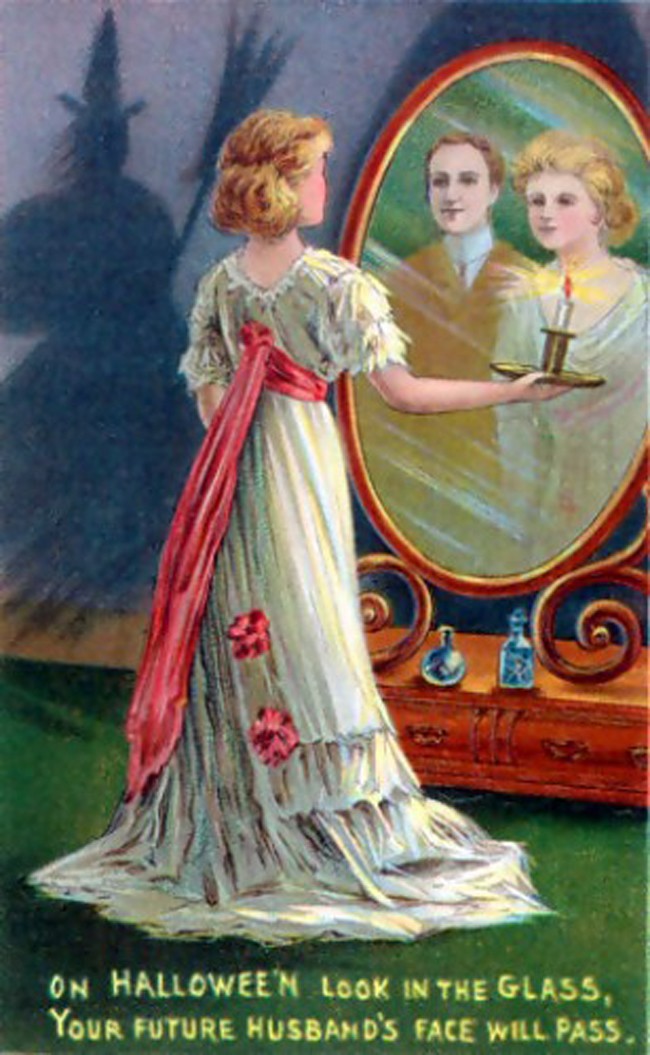
In this 1904 Halloween greeting card, divination is depicted: the young woman looking into a mirror in a darkened room hopes to catch a glimpse of her future husband.
There are several games traditionally associated with Halloween. Some of these games originated as divination rituals or ways of foretelling one’s future, especially regarding death, marriage and children. During the Middle Ages, these rituals were done by a «rare few» in rural communities as they were considered to be «deadly serious» practices.[198] In recent centuries, these divination games have been «a common feature of the household festivities» in Ireland and Britain.[125] They often involve apples and hazelnuts. In Celtic mythology, apples were strongly associated with the Otherworld and immortality, while hazelnuts were associated with divine wisdom.[199] Some also suggest that they derive from Roman practices in celebration of Pomona.[64]

Children bobbing for apples at Hallowe’en
The following activities were a common feature of Halloween in Ireland and Britain during the 17th–20th centuries. Some have become more widespread and continue to be popular today.
One common game is apple bobbing or dunking (which may be called «dooking» in Scotland)[200] in which apples float in a tub or a large basin of water and the participants must use only their teeth to remove an apple from the basin. A variant of dunking involves kneeling on a chair, holding a fork between the teeth and trying to drive the fork into an apple. Another common game involves hanging up treacle or syrup-coated scones by strings; these must be eaten without using hands while they remain attached to the string, an activity that inevitably leads to a sticky face. Another once-popular game involves hanging a small wooden rod from the ceiling at head height, with a lit candle on one end and an apple hanging from the other. The rod is spun round and everyone takes turns to try to catch the apple with their teeth.[201]

Image from the Book of Hallowe’en (1919) showing several Halloween activities, such as nut roasting
Several of the traditional activities from Ireland and Britain involve foretelling one’s future partner or spouse. An apple would be peeled in one long strip, then the peel tossed over the shoulder. The peel is believed to land in the shape of the first letter of the future spouse’s name.[202][203] Two hazelnuts would be roasted near a fire; one named for the person roasting them and the other for the person they desire. If the nuts jump away from the heat, it is a bad sign, but if the nuts roast quietly it foretells a good match.[204][205] A salty oatmeal bannock would be baked; the person would eat it in three bites and then go to bed in silence without anything to drink. This is said to result in a dream in which their future spouse offers them a drink to quench their thirst.[206] Unmarried women were told that if they sat in a darkened room and gazed into a mirror on Halloween night, the face of their future husband would appear in the mirror.[207] The custom was widespread enough to be commemorated on greeting cards[208] from the late 19th century and early 20th century.
Another popular Irish game was known as púicíní («blindfolds»); a person would be blindfolded and then would choose between several saucers. The item in the saucer would provide a hint as to their future: a ring would mean that they would marry soon; clay, that they would die soon, perhaps within the year; water, that they would emigrate; rosary beads, that they would take Holy Orders (become a nun, priest, monk, etc.); a coin, that they would become rich; a bean, that they would be poor.[209][210][211][212] The game features prominently in the James Joyce short story «Clay» (1914).[213][214][215]
In Ireland and Scotland, items would be hidden in food – usually a cake, barmbrack, cranachan, champ or colcannon – and portions of it served out at random. A person’s future would be foretold by the item they happened to find; for example, a ring meant marriage and a coin meant wealth.[216]
Up until the 19th century, the Halloween bonfires were also used for divination in parts of Scotland, Wales and Brittany. When the fire died down, a ring of stones would be laid in the ashes, one for each person. In the morning, if any stone was mislaid it was said that the person it represented would not live out the year.[110]
Telling ghost stories, listening to Halloween-themed songs and watching horror films are common fixtures of Halloween parties. Episodes of television series and Halloween-themed specials (with the specials usually aimed at children) are commonly aired on or before Halloween, while new horror films are often released before Halloween to take advantage of the holiday.
Haunted attractions
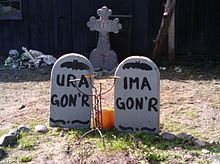
Humorous tombstones in front of a house in California
Haunted attractions are entertainment venues designed to thrill and scare patrons. Most attractions are seasonal Halloween businesses that may include haunted houses, corn mazes, and hayrides,[217] and the level of sophistication of the effects has risen as the industry has grown.
The first recorded purpose-built haunted attraction was the Orton and Spooner Ghost House, which opened in 1915 in Liphook, England. This attraction actually most closely resembles a carnival fun house, powered by steam.[218][219] The House still exists, in the Hollycombe Steam Collection.
It was during the 1930s, about the same time as trick-or-treating, that Halloween-themed haunted houses first began to appear in America. It was in the late 1950s that haunted houses as a major attraction began to appear, focusing first on California. Sponsored by the Children’s Health Home Junior Auxiliary, the San Mateo Haunted House opened in 1957. The San Bernardino Assistance League Haunted House opened in 1958. Home haunts began appearing across the country during 1962 and 1963. In 1964, the San Manteo Haunted House opened, as well as the Children’s Museum Haunted House in Indianapolis.[220]
The haunted house as an American cultural icon can be attributed to the opening of the Haunted Mansion in Disneyland on 12 August 1969.[221] Knott’s Berry Farm began hosting its own Halloween night attraction, Knott’s Scary Farm, which opened in 1973.[222] Evangelical Christians adopted a form of these attractions by opening one of the first «hell houses» in 1972.[223]
The first Halloween haunted house run by a nonprofit organization was produced in 1970 by the Sycamore-Deer Park Jaycees in Clifton, Ohio. It was cosponsored by WSAI, an AM radio station broadcasting out of Cincinnati, Ohio. It was last produced in 1982.[224] Other Jaycees followed suit with their own versions after the success of the Ohio house. The March of Dimes copyrighted a «Mini haunted house for the March of Dimes» in 1976 and began fundraising through their local chapters by conducting haunted houses soon after. Although they apparently quit supporting this type of event nationally sometime in the 1980s, some March of Dimes haunted houses have persisted until today.[225]
On the evening of 11 May 1984, in Jackson Township, New Jersey, the Haunted Castle (Six Flags Great Adventure) caught fire. As a result of the fire, eight teenagers perished.[226] The backlash to the tragedy was a tightening of regulations relating to safety, building codes and the frequency of inspections of attractions nationwide. The smaller venues, especially the nonprofit attractions, were unable to compete financially, and the better funded commercial enterprises filled the vacuum.[227][228] Facilities that were once able to avoid regulation because they were considered to be temporary installations now had to adhere to the stricter codes required of permanent attractions.[229][230][231]
In the late 1980s and early 1990s, theme parks entered the business seriously. Six Flags Fright Fest began in 1986 and Universal Studios Florida began Halloween Horror Nights in 1991. Knott’s Scary Farm experienced a surge in attendance in the 1990s as a result of America’s obsession with Halloween as a cultural event. Theme parks have played a major role in globalizing the holiday. Universal Studios Singapore and Universal Studios Japan both participate, while Disney now mounts Mickey’s Not-So-Scary Halloween Party events at its parks in Paris, Hong Kong and Tokyo, as well as in the United States.[232] The theme park haunts are by far the largest, both in scale and attendance.[233]
Food
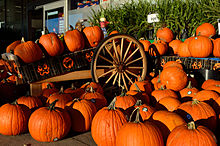
Pumpkins for sale during Halloween
On All Hallows’ Eve, many Western Christian denominations encourage abstinence from meat, giving rise to a variety of vegetarian foods associated with this day.[234]
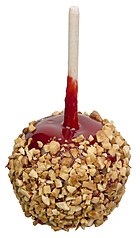
Because in the Northern Hemisphere Halloween comes in the wake of the yearly apple harvest, candy apples (known as toffee apples outside North America), caramel apples or taffy apples are common Halloween treats made by rolling whole apples in a sticky sugar syrup, sometimes followed by rolling them in nuts.
At one time, candy apples were commonly given to trick-or-treating children, but the practice rapidly waned in the wake of widespread rumors that some individuals were embedding items like pins and razor blades in the apples in the United States.[235] While there is evidence of such incidents,[236] relative to the degree of reporting of such cases, actual cases involving malicious acts are extremely rare and have never resulted in serious injury. Nonetheless, many parents assumed that such heinous practices were rampant because of the mass media. At the peak of the hysteria, some hospitals offered free X-rays of children’s Halloween hauls in order to find evidence of tampering. Virtually all of the few known candy poisoning incidents involved parents who poisoned their own children’s candy.[237]
One custom that persists in modern-day Ireland is the baking (or more often nowadays, the purchase) of a barmbrack (Irish: báirín breac), which is a light fruitcake, into which a plain ring, a coin, and other charms are placed before baking.[238] It is considered fortunate to be the lucky one who finds it.[238] It has also been said that those who get a ring will find their true love in the ensuing year. This is similar to the tradition of king cake at the festival of Epiphany.

List of foods associated with Halloween:
- Barmbrack (Ireland)
- Bonfire toffee (Great Britain)
- Candy apples/toffee apples (Great Britain and Ireland)
- Candy apples, candy corn, candy pumpkins (North America)
- Chocolate
- Monkey nuts (peanuts in their shells) (Ireland and Scotland)
- Caramel apples
- Caramel corn
- Colcannon (Ireland; see below)
- Halloween cake
- Sweets/candy
- Novelty candy shaped like skulls, pumpkins, bats, worms, etc.
- Roasted pumpkin seeds
- Roasted sweet corn
- Soul cakes
- Pumpkin Pie
Christian religious observances

The Vigil of All Hallows’ is being celebrated at an Episcopal Christian church on Hallowe’en
On Hallowe’en (All Hallows’ Eve), in Poland, believers were once taught to pray out loud as they walk through the forests in order that the souls of the dead might find comfort; in Spain, Christian priests in tiny villages toll their church bells in order to remind their congregants to remember the dead on All Hallows’ Eve.[239] In Ireland, and among immigrants in Canada, a custom includes the Christian practice of abstinence, keeping All Hallows’ Eve as a meat-free day and serving pancakes or colcannon instead.[240] In Mexico children make an altar to invite the return of the spirits of dead children (angelitos).[241]
The Christian Church traditionally observed Hallowe’en through a vigil. Worshippers prepared themselves for feasting on the following All Saints’ Day with prayers and fasting.[242] This church service is known as the Vigil of All Hallows or the Vigil of All Saints;[243][244] an initiative known as Night of Light seeks to further spread the Vigil of All Hallows throughout Christendom.[245][246] After the service, «suitable festivities and entertainments» often follow, as well as a visit to the graveyard or cemetery, where flowers and candles are often placed in preparation for All Hallows’ Day.[247][248] In Finland, because so many people visit the cemeteries on All Hallows’ Eve to light votive candles there, they «are known as valomeri, or seas of light».[249]

Today, Christian attitudes towards Halloween are diverse. In the Anglican Church, some dioceses have chosen to emphasize the Christian traditions associated with All Hallow’s Eve.[250][251] Some of these practices include praying, fasting and attending worship services.[1][2][3]
O LORD our God, increase, we pray thee, and multiply upon us the gifts of thy grace: that we, who do prevent the glorious festival of all thy Saints, may of thee be enabled joyfully to follow them in all virtuous and godly living. Through Jesus Christ, Our Lord, who liveth and reigneth with thee, in the unity of the Holy Ghost, ever one God, world without end. Amen. —Collect of the Vigil of All Saints, The Anglican Breviary[252]

Votive candles in the Halloween section of Walmart
Other Protestant Christians also celebrate All Hallows’ Eve as Reformation Day, a day to remember the Protestant Reformation, alongside All Hallow’s Eve or independently from it.[253] This is because Martin Luther is said to have nailed his Ninety-five Theses to All Saints’ Church in Wittenberg on All Hallows’ Eve.[254] Often, «Harvest Festivals» or «Reformation Festivals» are held on All Hallows’ Eve, in which children dress up as Bible characters or Reformers.[255] In addition to distributing candy to children who are trick-or-treating on Hallowe’en, many Christians also provide gospel tracts to them. One organization, the American Tract Society, stated that around 3 million gospel tracts are ordered from them alone for Hallowe’en celebrations.[256] Others order Halloween-themed Scripture Candy to pass out to children on this day.[257][258]

Belizean children dressed up as Biblical figures and Christian saints
Some Christians feel concerned about the modern celebration of Halloween because they feel it trivializes – or celebrates – paganism, the occult, or other practices and cultural phenomena deemed incompatible with their beliefs.[259] Father Gabriele Amorth, an exorcist in Rome, has said, «if English and American children like to dress up as witches and devils on one night of the year that is not a problem. If it is just a game, there is no harm in that.»[260] In more recent years, the Roman Catholic Archdiocese of Boston has organized a «Saint Fest» on Halloween.[261] Similarly, many contemporary Protestant churches view Halloween as a fun event for children, holding events in their churches where children and their parents can dress up, play games, and get candy for free. To these Christians, Halloween holds no threat to the spiritual lives of children: being taught about death and mortality, and the ways of the Celtic ancestors actually being a valuable life lesson and a part of many of their parishioners’ heritage.[262] Christian minister Sam Portaro wrote that Halloween is about using «humor and ridicule to confront the power of death».[263]
In the Roman Catholic Church, Halloween’s Christian connection is acknowledged, and Halloween celebrations are common in many Catholic parochial schools in the United States.[264][265] Many fundamentalist and evangelical churches use «Hell houses» and comic-style tracts in order to make use of Halloween’s popularity as an opportunity for evangelism.[266] Others consider Halloween to be completely incompatible with the Christian faith due to its putative origins in the Festival of the Dead celebration.[267] Indeed, even though Eastern Orthodox Christians observe All Hallows’ Day on the First Sunday after Pentecost, The Eastern Orthodox Church recommends the observance of Vespers or a Paraklesis on the Western observance of All Hallows’ Eve, out of the pastoral need to provide an alternative to popular celebrations.[268]
Analogous celebrations and perspectives
Judaism
According to Alfred J. Kolatch in the Second Jewish Book of Why, in Judaism, Halloween is not permitted by Jewish Halakha because it violates Leviticus 18:3, which forbids Jews from partaking in gentile customs. Many Jews observe Yizkor communally four times a year, which is vaguely similar to the observance of Allhallowtide in Christianity, in the sense that prayers are said for both «martyrs and for one’s own family».[269] Nevertheless, many American Jews celebrate Halloween, disconnected from its Christian origins.[270] Reform Rabbi Jeffrey Goldwasser has said that «There is no religious reason why contemporary Jews should not celebrate Halloween» while Orthodox Rabbi Michael Broyde has argued against Jews’ observing the holiday.[271] Purim has sometimes been compared to Halloween, in part due to some observants wearing costumes, especially of Biblical figures described in the Purim narrative.[272]
Islam
Sheikh Idris Palmer, author of A Brief Illustrated Guide to Understanding Islam, has ruled that Muslims should not participate in Halloween, stating that «participation in Halloween is worse than participation in Christmas, Easter, … it is more sinful than congratulating the Christians for their prostration to the crucifix».[273] It has also been ruled to be haram by the National Fatwa Council of Malaysia because of its alleged pagan roots stating «Halloween is celebrated using a humorous theme mixed with horror to entertain and resist the spirit of death that influence humans».[274][275] Dar Al-Ifta Al-Missriyyah disagrees provided the celebration is not referred to as an ‘eid’ and that behaviour remains in line with Islamic principles.[276]
Hinduism
Hindus remember the dead during the festival of Pitru Paksha, during which Hindus pay homage to and perform a ceremony «to keep the souls of their ancestors at rest». It is celebrated in the Hindu month of Bhadrapada, usually in mid-September.[277] The celebration of the Hindu festival Diwali sometimes conflicts with the date of Halloween; but some Hindus choose to participate in the popular customs of Halloween.[278] Other Hindus, such as Soumya Dasgupta, have opposed the celebration on the grounds that Western holidays like Halloween have «begun to adversely affect our indigenous festivals».[279]
Neopaganism
There is no consistent rule or view on Halloween amongst those who describe themselves as Neopagans or Wiccans. Some Neopagans do not observe Halloween, but instead observe Samhain on 1 November,[280] some neopagans do enjoy Halloween festivities, stating that one can observe both «the solemnity of Samhain in addition to the fun of Halloween». Some neopagans are opposed to the celebration of Hallowe’en, stating that it «trivializes Samhain»,[281] and «avoid Halloween, because of the interruptions from trick or treaters».[282] The Manitoban writes that «Wiccans don’t officially celebrate Halloween, despite the fact that 31 Oct. will still have a star beside it in any good Wiccan’s day planner. Starting at sundown, Wiccans celebrate a holiday known as Samhain. Samhain actually comes from old Celtic traditions and is not exclusive to Neopagan religions like Wicca. While the traditions of this holiday originate in Celtic countries, modern day Wiccans don’t try to historically replicate Samhain celebrations. Some traditional Samhain rituals are still practised, but at its core, the period is treated as a time to celebrate darkness and the dead – a possible reason why Samhain can be confused with Halloween celebrations.»[280]
Geography

Halloween display in Kobe, Japan
The traditions and importance of Halloween vary greatly among countries that observe it. In Scotland and Ireland, traditional Halloween customs include children dressing up in costume going «guising», holding parties, while other practices in Ireland include lighting bonfires, and having firework displays.[172][283][284] In Brittany children would play practical jokes by setting candles inside skulls in graveyards to frighten visitors.[285] Mass transatlantic immigration in the 19th century popularized Halloween in North America, and celebration in the United States and Canada has had a significant impact on how the event is observed in other nations.[172] This larger North American influence, particularly in iconic and commercial elements, has extended to places such as Brazil, Ecuador, Chile,[286] Australia,[287] New Zealand,[288] (most) continental Europe, Finland,[289] Japan, and other parts of East Asia.[25]
See also
- Campfire story
- Devil’s Night
- Dziady
- Ghost Festival
- Naraka Chaturdashi
- Kekri
- List of fiction works about Halloween
- List of films set around Halloween
- List of Halloween television specials
- Martinisingen
- Neewollah
- St. John’s Eve
- Walpurgis Night
- Will-o’-the-wisp
- English festivals
References
- ^ a b c «BBC – Religions – Christianity: All Hallows’ Eve». British Broadcasting Corporation (BBC). 2010. Archived from the original on 3 November 2011. Retrieved 1 November 2011.
It is widely believed that many Hallowe’en traditions have evolved from an ancient Celtic festival called Samhain which was Christianised by the early Church…. All Hallows’ Eve falls on 31st October each year, and is the day before All Hallows’ Day, also known as All Saints’ Day in the Christian calendar. The Church traditionally held a vigil on All Hallows’ Eve when worshippers would prepare themselves with prayers and fasting prior to the feast day itself. The name derives from the Old English ‘hallowed’ meaning holy or sanctified and is now usually contracted to the more familiar word Hallowe’en. …However, there are supporters of the view that Hallowe’en, as the eve of All Saints’ Day, originated entirely independently of Samhain …
- ^ a b «Service for All Hallows’ Eve». The Book of Occasional Services 2003. Church Publishing, Inc. 2004. p. 108. ISBN 978-0-89869-409-3.
This service may be used on the evening of October 31, known as All Hallows’ Eve. Suitable festivities and entertainments may take place before or after this service, and a visit may be made to a cemetery or burial place.
- ^ a b Anne E. Kitch (2004). The Anglican Family Prayer Book. Church Publishing, Inc. ISBN 978-0-8192-2565-8. Archived from the original on 25 January 2017. Retrieved 31 October 2011.
All Hallow’s Eve, which later became known as Halloween, is celebrated on the night before All Saints’ Day, November 1. Use this simple prayer service in conjunction with Halloween festivities to mark the Christian roots of this festival.
- ^ The Paulist Liturgy Planning Guide. Paulist Press. 2006. ISBN 978-0-8091-4414-3. Archived from the original on 31 October 2017. Retrieved 31 October 2011.
Rather than compete, liturgy planners would do well to consider ways of including children in the celebration of these vigil Masses. For example, children might be encouraged to wear Halloween costumes representing their patron saint or their favorite saint, clearly adding a new level of meaning to the Halloween celebrations and the celebration of All Saints’ Day.
- ^ Palmer, Abram Smythe (1882). Folk-etymology. Johnson Reprint. p. 6.
- ^ Elwell, Walter A. (2001). Evangelical Dictionary of Theology. Baker Academic. p. 533. ISBN 978-0-8010-2075-9.
Halloween (All Hallows Eve). The name given to October 31, the eve of the Christian festival of All Saints Day (November 1).
- ^ «NEDCO Producers’ Guide». 31–33. Northeast Dairy Cooperative Federation. 1973.
Originally celebrated as the night before All Saints’ Day, Christians chose November first to honor their many saints. The night before was called All Saints’ Eve or hallowed eve meaning holy evening.
- ^ «Tudor Hallowtide». National Trust for Places of Historic Interest or Natural Beauty. 2012. Archived from the original on 6 October 2014.
Hallowtide covers the three days – 31 October (All-Hallows Eve or Hallowe’en), 1 November (All Saints) and 2 November (All Souls).
- ^ Hughes, Rebekkah (29 October 2014). «Happy Hallowe’en Surrey!» (PDF). The Stag. University of Surrey. p. 1. Archived from the original (PDF) on 19 November 2015. Retrieved 31 October 2015.
Halloween or Hallowe’en, is the yearly celebration on October 31st that signifies the first day of Allhallowtide, being the time to remember the dead, including martyrs, saints and all faithful departed Christians.
- ^ Davis, Kenneth C. (29 December 2009). Don’t Know Much About Mythology: Everything You Need to Know About the Greatest Stories in Human History but Never Learned. HarperCollins. p. 231. ISBN 978-0-06-192575-7.
- ^ «All Faithful Departed, Commemoration of».
- ^ «The Commemoration of All the Faithful Departed (All Souls’ Day) — November 02, 2021 — Liturgical Calendar». www.catholicculture.org.
- ^ Smith, Bonnie G. (2004). Women’s History in Global Perspective. University of Illinois Press. p. 66. ISBN 978-0-252-02931-8. Retrieved 14 December 2015.
The pre-Christian observance obviously influenced the Christian celebration of All Hallows’ Eve, just as the Taoist festival affected the newer Buddhist Ullambana festival. Although the Christian version of All Saints’ and All Souls’ Days came to emphasize prayers for the dead, visits to graves, and the role of the living assuring the safe passage to heaven of their departed loved ones, older notions never disappeared.
- ^ Nicholas Rogers (2002). Halloween: From Pagan Ritual to Party Night. Oxford University Press. ISBN 978-0-19-516896-9. Retrieved 31 October 2011.
Halloween and the Day of the Dead share a common origin in the Christian commemoration of the dead on All Saints’ and All Souls’ Day. But both are thought to embody strong pre-Christian beliefs. In the case of Halloween, the Celtic celebration of Samhain is critical to its pagan legacy, a claim that has been foregrounded in recent years by both new-age enthusiasts and the evangelical Right.
- ^ Austrian information. 1965. Retrieved 31 October 2011.
The feasts of Hallowe’en, or All Hallows Eve and the devotions to the dead on All Saints’ and All Souls’ Day are both mixtures of old Celtic, Druid and other pagan customs intertwined with Christian practice.
- ^ Merriam-Webster’s Encyclopædia of World Religions. Merriam-Webster. 1999. p. 408. ISBN 978-0-87779-044-0. Retrieved 31 October 2011.
Halloween, also called All Hallows’ Eve, holy or hallowed evening observed on October 31, the eve of All Saints’ Day. The Irish pre-Christian observances influenced the Christian festival of All Hallows’ Eve, celebrated on the same date.
- ^ Roberts, Brian K. (1987). The Making of the English Village: A Study in Historical Geography. Longman Scientific & Technical. ISBN 978-0-582-30143-6. Retrieved 14 December 2015.
Time out of time’, when the barriers between this world and the next were down, the dead returned from the grave, and gods and strangers from the underworld walked abroad was a twice- yearly reality, on dates Christianised as All Hallows’ Eve and All Hallows’ Day.
- ^ O’Donnell, Hugh; Foley, Malcolm (18 December 2008). Treat or Trick? Halloween in a Globalising World. Cambridge Scholars Publishing. pp. 91–92. ISBN 978-1-4438-0265-9.
Hutton (1996, 363) identifies Rhys as a key figure who, along with another Oxbridge academic, James Frazer, romanticised the notion of Samhain and exaggerated its influence on Halloween. Hutton argues that Rhys had no substantiated documentary evidence for claiming that Halloween was the Celtic new year, but inferred it from contemporary folklore in Wales and Ireland. Moreover, he argues that Rhys: «thought that [he] was vindicated when he paid a subsequent visit to the Isle of Man and found its people sometimes called 31 October New Year’s Night (Hog-unnaa) and practised customs which were usually associated with 31 December. In fact the flimsy nature of all this evidence ought to have been apparent from the start. The divinatory and purificatory rituals on 31 October could be explained by a connection to the most eerie of Christian feasts (All Saints) or by the fact that they ushered in the most dreaded of seasons. The many «Hog-unnaa» customs were also widely practised on the conventional New Year’s Eve, and Rhys was uncomfortably aware that they might simply have been transferred, in recent years, from then Hallowe’en, to increase merriment and fundraising on the latter. He got round this problem by asserting that in his opinion (based upon no evidence at all) the transfer had been the other way round.» … Hutton points out that Rhy’s unsubstantiated notions were further popularised by Frazer who used them to support an idea of his own, that Samhain, as well as being the origin of Halloween, had also been a pagan Celtic feast of the dead—a notion used to account for the element of ghosts, witches and other unworldly spirits commonly featured within Halloween. … Halloween’s preoccupation with the netherworld and with the supernatural owes more to the Christian festival of All Saints or All Souls, rather than vice versa.
- ^ Barr, Beth Allison (28 October 2016). «Guess what? Halloween is more Christian than Pagan». The Washington Post. Retrieved 15 October 2020.
It is the medieval Christian festivals of All Saints’ and All Souls’ that provide our firmest foundation for Halloween. From emphasizing dead souls (both good and evil), to decorating skeletons, lighting candles for processions, building bonfires to ward off evil spirits, organizing community feasts, and even encouraging carnival practices like costumes, the medieval and early modern traditions of «Hallowtide» fit well with our modern holiday. So what does this all mean? It means that when we celebrate Halloween, we are definitely participating in a tradition with deep historical roots. But, while those roots are firmly situated in the medieval Christian past, their historical connection to «paganism» is rather more tenuous.
- ^
- Moser, Stefan (29 October 2010). «Kein ‘Trick or Treat’ bei Salzburgs Kelten» (in German). Salzburger Nachrichten. Archived from the original on 17 March 2014. Retrieved 11 August 2017.
Die Kelten haben gar nichts mit Halloween zu tun», entkräftet Stefan Moser, Direktor des Keltenmuseums Hallein, einen weit verbreiteten Mythos. Moser sieht die Ursprünge von Halloween insgesamt in einem christlichen Brauch, nicht in einem keltischen.
- Döring, Alois; Bolinius, Erich (31 October 2006), Samhain – Halloween – Allerheiligen (in German), FDP Emden,
Die lückenhaften religionsgeschichtlichen Überlieferungen, die auf die Neuzeit begrenzte historische Dimension der Halloween-Kultausprägung, vor allem auch die Halloween-Metaphorik legen nahe, daß wir umdenken müssen: Halloween geht nicht auf das heidnische Samhain zurück, sondern steht in Bezug zum christlichen Totengedenkfest Allerheiligen/ Allerseelen.
- Hörandner, Editha (2005). Halloween in der Steiermark und anderswo (in German). LIT Verlag Münster. pp. 8, 12, 30. ISBN 978-3-8258-8889-3.
Der Wunsch nach einer Tradition, deren Anfänge sich in grauer Vorzeit verlieren, ist bei Dachleuten wie laien gleichmäßig verbreitet. … Abgesehen von Irrtümern wie die Herleitung des Fests in ungebrochener Tradition («seit 2000 Jahren») ist eine mangelnde vertrautheit mit der heimischen Folklore festzustellen. Allerheiligen war lange vor der Halloween invasion ein wichtiger Brauchtermin und ist das ncoh heute. … So wie viele heimische Bräuche generell als fruchtbarkeitsbringend und dämonenaustreibend interpretiert werden, was trottz aller Aufklärungsarbeit nicht auszurotten ist, begegnet uns Halloween als …heidnisches Fest. Aber es wird nicht als solches inszeniert.
- Döring, Dr. Volkskundler Alois (2011). «Süßes, Saures – olle Kamellen? Ist Halloween schon wieder out?» (in German). Westdeutscher Rundfunk. Archived from the original on 14 June 2011. Retrieved 12 November 2015.
Dr. Alois Döring ist wissenschaftlicher Referent für Volkskunde beim LVR-Institut für Landeskunde und Regionalgeschichte Bonn. Er schrieb zahlreiche Bücher über Bräuche im Rheinland, darunter das Nachschlagewerk «Rheinische Bräuche durch das Jahr». Darin widerspricht Döring der These, Halloween sei ursprünglich ein keltisch-heidnisches Totenfest. Vielmehr stamme Halloween von den britischen Inseln, der Begriff leite sich ab von «All Hallows eve», Abend vor Allerheiligen. Irische Einwanderer hätten das Fest nach Amerika gebracht, so Döring, von wo aus es als «amerikanischer» Brauch nach Europa zurückkehrte.
- Moser, Stefan (29 October 2010). «Kein ‘Trick or Treat’ bei Salzburgs Kelten» (in German). Salzburger Nachrichten. Archived from the original on 17 March 2014. Retrieved 11 August 2017.
- ^ «All Hallows’ Eve». British Broadcasting Corporation. 20 October 2011. Retrieved 29 October 2020.
However, there are supporters of the view that Hallowe’en, as the eve of All Saints’ Day, originated entirely independently of Samhain and some question the existence of a specific pan-Celtic religious festival which took place on 31st October/1st November.
- ^ a b c d Rogers, Nicholas. Halloween: From Pagan Ritual to Party Night. Oxford University Press, 2002. pp. 49–50. ISBN 0-19-516896-8.
- ^ a b Brunvand, Jan (editor). American Folklore: An Encyclopedia. Routledge, 2006. p.749
- ^ a b Colavito, Jason. Knowing Fear: Science, Knowledge and the Development of the Horror Genre. McFarland, 2007. pp.151–152
- ^ a b c Rogers, Nicholas (2002). Halloween: From Pagan Ritual to Party Night, p. 164. New York: Oxford University Press. ISBN 0-19-516896-8
- ^ a b c Paul Fieldhouse (17 April 2017). Food, Feasts, and Faith: An Encyclopedia of Food Culture in World Religions. ABC-CLIO. p. 256. ISBN 978-1-61069-412-4.
- ^ Skog, Jason (2008). Teens in Finland. Capstone. p. 31. ISBN 978-0-7565-3405-9.
Most funerals are Lutheran, and nearly 98 percent of all funerals take place in a church. It is customary to take pictures of funerals or even videotape them. To Finns, death is a part of the cycle of life, and a funeral is another special occasion worth remembering. In fact, during All Hallow’s Eve and Christmas Eve, cemeteries are known as valomeri, or seas of light. Finns visit cemeteries and light candles in remembrance of the deceased.
- ^ «All Hallows Eve Service» (PDF). Duke University. 31 October 2012. Archived from the original (PDF) on 5 October 2013. Retrieved 31 May 2014.
About All Hallows Eve: Tonight is the eve of All Saints Day, the festival in the Church that recalls the faith and witness of the men and women who have come before us. The service celebrates our continuing communion with them, and memorializes the recently deceased. The early church followed the Jewish custom that a new day began at sundown; thus, feasts and festivals in the church were observed beginning the night before.
- ^ «The Christian Observances of Halloween». National Republic. 15: 33. 5 May 2009.
Among the European nations the beautiful custom of lighting candles for the dead was always a part of the «All Hallow’s Eve» festival.
- ^ Hynes, Mary Ellen (1993). Companion to the Calendar. Liturgy Training Publications. p. 160. ISBN 978-1-56854-011-5.
In most of Europe, Halloween is strictly a religious event. Sometimes in North America the church’s traditions are lost or confused.
- ^ Kernan, Joe (30 October 2013). «Not so spooky after all: The roots of Halloween are tamer than you think». Cranston Herald. Archived from the original on 26 November 2015. Retrieved 31 October 2015.
By the early 20th century, Halloween, like Christmas, was commercialized. Pre-made costumes, decorations and special candy all became available. The Christian origins of the holiday were downplayed.
- ^ Braden, Donna R.; Village, Henry Ford Museum and Greenfield (1988). Leisure and entertainment in America. Henry Ford Museum & Greenfield Village. ISBN 978-0-933728-32-5. Retrieved 2 June 2014.
Halloween, a holiday with religious origins but increasingly secularized as celebrated in America, came to assume major proportions as a children’s festivity.
- ^ Santino, p. 85
- ^ All Hallows’ Eve (Diana Swift), Anglican Journal
- ^ Mahon, Bríd (1991). Land of Milk and Honey: The Story of Traditional Irish Food & Drink. Poolbeg Press. p. 138. ISBN 978-1-85371-142-8.
The vigil of the feast is Halloween, the night when charms and incantations were powerful, when people looked into the future, and when feasting and merriment were ordained. Up to recent time this was a day of abstinence, when according to church ruling no flesh meat was allowed. Colcannon, apple cake and barm brack, as well as apples and nuts were part of the festive fare.
- ^ Fieldhouse, Paul (17 April 2017). Food, Feasts, and Faith: An Encyclopedia of Food Culture in World Religions. ABC-CLIO. p. 254. ISBN 978-1-61069-412-4. Archived from the original on 31 October 2017. Retrieved 13 August 2017.
In Ireland, dishes based on potatoes and other vegetables were associated with Halloween, as meat was forbidden during the Catholic vigil and fast leading up to All Saint’s Day.
- ^ Luck, Steve (1998). «All Saints’ Day». The American Desk Encyclopedia. Oxford University Press. p. 22. ISBN 978-0-19-521465-9.
- ^ a b c «DOST: Hallow Evin». Dsl.ac.uk. Archived from the original on 29 April 2014. Retrieved 13 October 2013.
- ^ The A to Z of Anglicanism (Colin Buchanan), Scarecrow Press, p. 8
- ^ «All Hallows’ Eve». Oxford English Dictionary (Online ed.). Oxford University Press.
ealra halgena mæsseæfen
(Subscription or participating institution membership required.) - ^ «Halloween». Oxford English Dictionary (Online ed.). Oxford University Press. (Subscription or participating institution membership required.)
- ^ Thomson, Thomas; Annandale, Charles (1896). A History of the Scottish People from the Earliest Times: From the Union of the kingdoms, 1706, to the present time. Blackie. Retrieved 31 October 2011.
Of the stated rustic festivals peculiar to Scotland the most important was Hallowe’en, a contraction for All-hallow Evening, or the evening of All-Saints Day, the annual return of which was a season for joy and festivity.
- ^ «E’EN, Een». Scottish National Dictionary (1700–). Vol. III =. 1952. snd8629.
- ^ a b c d Hopwood, James A. (2019). Keeping Christmas: Finding Joy in a Season of Excess and Strife. Wipf and Stock Publishers. p. 47. ISBN 978-1-5326-9537-7.
The name «Halloween,» of course, is a contraction of «All Hallow’s Eve.» That’s the eve of All Saints Day, or All Hallows Day, as it was popularly known in Britain. As with Christmas Eve and the Easter vigil, the celebration of All Saints Day began with a service the night before, on All Hallow’s Eve. With All Souls Day on November 2, it formed the feast of Allhallowtide. All Saints Day began in fourth-century Rome as a festival honoring Christian martyrs. By the eighth century, it was expanded to all those remembered as saints, and the date of its observance was moved from May 13 to November 1. That move, of course, put it smack dab on top of Samhain in Britain. But the decision to move the date was not made in Britain; it was made in Rome, where there was no Samhain or anything like it. There is no evidence that any Samhain customs rubbed off on Halloween anywhere because there is no evidence of any Samhain customs at all.
- ^ Beth Allison Barr (28 October 2016). «Guess what? Halloween is more Christian than Pagan – The Washington Post». The Washington Post. Retrieved 31 October 2018.
It is the medieval Christian festivals of All Saints’ and All Souls’ that provide our firmest foundation for Halloween. From emphasizing dead souls (both good and evil), to decorating skeletons, lighting candles for processions, building bonfires to ward off evil spirits, organizing community feasts, and even encouraging carnival practices like costumes, the medieval and early modern traditions of «Hallowtide» fit well with our modern holiday.
- ^ a b Rogers, Nicholas. Halloween: From Pagan Ritual to Party Night. Oxford University Press, 2002. pp. 22, 27. ISBN 0-19-516896-8.
- ^ New Proclamation Commentary on Feasts, Holy Days, and Other Celebrations (Bill Doggett, Gordon W. Lathrop), Fortress Press, p. 92
- ^ Benham, William (1887). The Dictionary of Religion: An Encyclopedia of Christian and Other Religious Doctrines, Denominations, Sects, Heresies, Ecclesiastical Terms, History, Biography, Etc. Cassell. p. 1085.
Vigils were kept at least till midnight before the feasts of martyrs, and those of Easter Eve and Christmas Eve were prolonged till cock-crow.
- ^ Holy Women, Holy Men: Celebrating the Saints. Church Publishing, Inc. 2010. p. 662. ISBN 978-0-89869-678-3.
- ^ Saunders, William. «All Saints and All Souls». Catholic Education Resource Center. Archived from the original on 18 September 2016. Retrieved 19 September 2016.
- ^ Melton, J Gordon (editor). Religious Celebrations: An Encyclopedia of Holidays, Festivals, Solemn Observances, and Spiritual Commemorations, Volume 1. ABC-CLIO, 2011. p.22
- ^ Chisholm, Hugh, ed. (1911). «All Saints, Festival of» . Encyclopædia Britannica (11th ed.). Cambridge University Press.
- ^ «All Saints’ Day», The Oxford Dictionary of the Christian Church, 3rd edition, ed. E. A. Livingstone. Oxford University Press, 1997. pp.41–42
- ^ McClendon, Charles. «Old Saint Peter’s and the Iconoclastic Controversy», in Old Saint Peter’s, Rome. Cambridge University Press, 2013. pp. 215–216. Quote: «Soon after his election in 731, Gregory III summoned a synod to gather on 1 November in the basilica of Saint Peter’s in order to respond to the policy of iconoclasm that he believed was being promoted by the Byzantine Emperor […] Six months later, in April of the following year, 732, the pope assembled another synod in the basilica to consecrate a new oratory dedicated to the Saviour, the Virgin Mary, and all the saints».
- ^ Ó Carragáin, Éamonn. Ritual and the Rood: Liturgical Images and the Old English Poems of the Dream of the Rood Tradition. University of Toronto Press, 2005. p. 258. Quote: «Gregory III began his reign with a synod in St Peter’s (1 November 731) which formally condemned iconoclasm […] on the Sunday before Easter, 12 April 732, Gregory convoked yet another synod […] and at the synod inaugurated an oratory […] Dedicated to all saints, this oratory was designed to hold ‘relics of the holy apostles and all the holy martyrs and confessors'».
- ^ Farmer, David. The Oxford Dictionary of Saints (Fifth Edition, Revised). Oxford University Press, 2011. p. 14
- ^ a b c d Hutton, p. 364
- ^ New Catholic Encyclopedia (Second ed.). 2003. pp. 242–243. ISBN 0-7876-4004-2.
- ^ a b MacCulloch, John Arnott (1911). The Religion of the Ancient Celts. Chapter 10: The Cult of the Dead Archived 29 October 2015 at the Wayback Machine.
- ^ Burns, Paul (editor). Butler’s Saint for the Day. Liturgical Press, 2007. p. 516
- ^ Ramdin, Ron. Arising from Bondage: A History of the Indo-Caribbean People. New York University Press, p. 241
- ^ The World Review – Volume 4, University of Minnesota, p. 255
- ^ Rogers, Nicholas (2001). Halloween: From Pagan Ritual to Party Night. Oxford University Press. pp. 28–30. ISBN 978-0-19-514691-2.
- ^ a b c d e «Halloween». Encyclopædia Britannica. Archived from the original on 30 October 2012. Retrieved 25 October 2012.
- ^ a b Hutton, pp. 374–375
- ^ a b c d Miles, Clement A. (1912). Christmas in Ritual and Tradition. Chapter 7: All Hallow Tide to Martinmas Archived 4 November 2013 at the Wayback Machine.
- ^ a b Mary Mapes Dodge, ed. (1883). St. Nicholas Magazine. Scribner & Company. p. 93.
‘Soul-cakes,’ which the rich gave to the poor at the Halloween season, in return for which the recipients prayed for the souls of the givers and their friends. And this custom became so favored in popular esteem that, for a long time, it was a regular observance in the country towns of England for small companies to go from parish to parish, begging soul-cakes by singing under the windows some such verse as this: ‘Soul, souls, for a soul-cake; Pray you good mistress, a soul-cake!’
- ^ DeMello, Margo (2012). A Cultural Encyclopedia of the Human Face. ABC-CLIO. p. 167. ISBN 978-1-59884-617-1.
Trick-or-treating began as souling an English and Irish tradition in which the poor, wearing masks, would go door to door and beg for soul cakes in exchange for people’s dead relatives.
- ^ Cleene, Marcel. Compendium of Symbolic and Ritual Plants in Europe. Man & Culture, 2002. p. 108. Quote: «Soul cakes were small cakes baked as food for the deceased or offered for the salvation of their souls. They were therefore offered at funerals and feasts of the dead, laid on graves, or given to the poor as representatives of the dead. The baking of these soul cakes is a universal practice».
- ^ Levene, Alysa (2016). Cake: A Slice of History. Pegasus Books. p. 44. ISBN 978-1-68177-108-3.
Like the perennial favourites, hot cross buns; they were often marked with a cross to indicate that they were baked as alms.
- ^ The Two Gentlemen of Verona Act 2, Scene 1.
- ^ a b Pulliam, June; Fonseca, Anthony J. (2016). Ghosts in Popular Culture and Legend. ABC-CLIO. p. 145. ISBN 978-1-4408-3491-2.
Since the 16th century, costumes have become a central part of Halloween traditions. Perhaps the most common traditional Halloween costume is that of the ghost. This is likely because … when Halloween customs began to be influenced by Catholicism, the incorporation of the themes of All Hallows’ and All Souls’ Day would have emphasized visitations from the spirit world over the motifs of spirits and fairies. … The baking and sharing of souls cakes was introduced around the 15th century: in some cultures, the poor would go door to door to collect them in exchange for praying for the dead (a practice called souling), often carrying lanterns made of hollowed-out turnips. Around the 16th century, the practice of going house to house in disguise (a practice called guising) to ask for food began and was often accompanied by recitation of traditional verses (a practice called mumming). Wearing costumes, another tradition, has many possible explanations, such as it was done to confuse the spirits or souls who visited the earth or who rose from local graveyards to engage in what was called a Danse Macabre, basically a large party among the dead.
- ^ a b Rogers, p. 57
- ^ a b Carter, Albert Howard; Petro, Jane Arbuckle (1998). Rising from the Flames: The Experience of the Severely Burned. University of Pennsylvania Press. p. 100. ISBN 978-0-8122-1517-5.
Halloween, incorporated into the Christian year as the eve of All Saints Day, marked the return of the souls of the departed and the release of devils who could move freely on that night. Fires lit on that night served to prevent the influence of such spirits and to provide omens for the future. Modern children go from house to house at Halloween with flashlights powered by electric batteries, while jack o’lanterns (perhaps with an actual candle, but often with a lightbulb) glow from windows and porches.
- ^ Guiley, Rosemary (2008). The Encyclopedia of Witches, Witchcraft and Wicca. Infobase Publishing. p. 183. ISBN 978-1-4381-2684-5.
According to most legends, the jack-o’-lantern is a wandering soul who has been denied entry into both heaven and hell. … In Ireland, children who are caught outdoors after dark are told to wear their jackets inside-out in order not to be lured astray by a jack-o’-lantern. In Sweden, the spirit is believed to be the soul of an unbaptized child, who tries to lead travelers to water in hopes of receiving baptism. … In American lore, the jack-o’-lantern is associated with withces and the Halloween custom of trick-or-treating. It is customary for trick-or-treaters to carry pumpkin jack-o’-lanterns to frighten away evil spirits.
- ^ Santino, The Hallowed Eve, p. 95
- ^ a b c d Frazer, James George (1922). The Golden Bough: A new abridgement. Oxford University Press, 1998. pp.380–383
- ^ Ruth Hutchison and Ruth Constance Adams (1951). Every Day’s a Holiday. Harper, 1951. pp.236
- ^ a b c d e Morton, Lisa (15 September 2013). Trick or Treat: A History of Halloween. Reaktion Books. p. 129. ISBN 978-1-78023-055-9.
- ^ Prince Sorie Conteh (2009). Traditionalists, Muslims, and Christians in Africa: Interreligious Encounters and Dialogue. Cambria Press. ISBN 978-1-60497-596-3. Archived from the original on 31 October 2017. Retrieved 31 October 2011.
- ^ Bannatyne, Lesley (1998). Halloween: An American Holiday, an American History. Pelican Publishing Company. p. 19. ISBN 978-1-4556-0553-8.
Villagers were also encouraged to masquerade on this day, not to frighten unwelcome spirits, but to honor Christian saints. On All Saints’ Day, churches throughout Europe and the British Isles displayed relics of their patron saints. Poor churches could not afford genuine relics and instead had processions in which parishioners dressed as saints, angels and devils. It served the new church by giving an acceptable Christian basis to the custom of dressing up on Halloween.
- ^ Morrow, Ed (2001). The Halloween Handbook. Kensington Publishing Corporation. p. 19. ISBN 978-0-8065-2227-2.
Another contributor to the custom of dressing up at Halloween was the old Irish practice of marking All Hallows’ Day with religious pageants that recounted biblical events. These were common during the Middle Ages all across Europe. The featured players dressed as saints and angels, but there were also plenty of roles for demons who had more fun, capering, acting devilish, and playing to the crows. The pageant began inside the church, then moved by procession to the churchyard, where it continued long into the night.
- ^ «Eve of All Saints», Using Common Worship: Times and Seasons – All Saints to Candlemas (David Kennedy), Church House Publishing, p. 42
- ^ Bannatyne, Lesley. Halloween: An American Holiday, an American History. Pelican Publishing, 1998. p. 9
- ^ Perry, Edward Baxter. Descriptive Analyses of Piano Works; For the Use of Teachers, Players, and Music Clubs. Theodore Presser Company, 1902. p. 276
- ^ Allmand, Christopher (1998). The New Cambridge Medieval History: Volume 7, c. 1415–c. 1500. Cambridge University Press. p. 210. ISBN 978-0-521-38296-0. Archived from the original on 23 April 2016. Retrieved 19 October 2015.
- ^ Reimer, Margaret Loewen (2018). Approaching the Divine: Signs and Symbols of the Christian Faith. Wipf and Stock Publishers. p. 85. ISBN 978-1-5326-5675-0.
Christians in Europe envisioned a danse macabre, a hideous dance by the spirits of the dead who arose from the churchyards for a wild carnival each year. This dance, commonly depicted on the walls of cathedrals, monasteries and cemeteries, may well be the origin of the macabre costumes we don on Halloween.
- ^ DeSpelder, Lynne Ann; Strickland, Albert Lee (2009). The Last Dance: Encountering Death and Dying. McGraw-Hill Education. p. 107. ISBN 978-0-07-340546-9.
More subtly, images associated with the danse macabre persist in the form of skeletons and other scary regalia found on children’s Halloween costumes.
- ^ Books & Culture: A Christian Review. Christianity Today. 1999. p. 12. Archived from the original on 23 April 2016.
Sometimes enacted as at village pageants, the danse macabre was also performed as court masques, the courtiers dressing up as corpses from various strata of society…both the name and the observance began liturgically as All Hallows’ Eve.
- ^ Hutton, p. 372
- ^ Santino, Jack (21 October 2021). The Hallowed Eve: Dimensions of Culture in a Calendar Festival in Northern Ireland. University Press of Kentucky. ISBN 978-0-8131-8458-6.
- ^ The Episcopal Church, its teaching and worship (Latta Griswold), E.S. Gorham, p. 110
- ^ a b Mosteller, Angie (2 July 2014). Christian Origins of Halloween. Rose Publishing. ISBN 978-1-59636-535-3.
In Protestant regions souling remained an important occasion for soliciting food and money from rich neighbors in preparation for the coming cold and dark months.
- ^ Aston, Margaret. Broken Idols of the English Reformation. Cambridge University Press, 2015. pp.475–477
- ^ Medieval Celebrations: Your Guide to Planning and Hosting Spectacular Feasts, Parties, Weddings, and Renaissance Fairs (Daniel Diehl, Mark Donnelly), Stackpole Books, p. 17
- ^ Rogers, Nicholas. Halloween: From Pagan Ritual to Party Night. Oxford University Press, 2002. pp. 37–38. ISBN 0-19-516896-8.
- ^ Hutton, Ronald (2001). Stations of the Sun: A History of the Ritual Year in Britain. Oxford University Press. pp. 369, 373. ISBN 978-0-19-157842-7.
Fires were indeed lit in England on All Saints’ Day, notably in Lancashire, and may well ultimately have descended from the same rites, but were essentially party of a Christian ceremony … families still assembled at the midnight before All Saints’ Day in the early nineteenth century. Each did so on a hill near its homestead, one person holding a large bunch of burning straw on the end of a fork. The rest in a circle around and prayed for the souls of relatives and friends until the flames burned out. The author who recorded this custom added that it gradually died out in the latter part of the century, but that before it had been very common and at nearby Whittingham such fires could be seen all around the horizon at Hallowe’en. He went on to say that the name ‘Purgatory Field’, found across northern Lancashire, testified to an even wider distribution and that the rite itself was called ‘Teen’lay’.
- ^ O’Donnell, Hugh and Foley, Malcolm. «Treat or Trick? Halloween in a Globalising World» Archived 31 October 2022 at the Wayback Machine. Cambridge Scholars Publishing, 2008. p.35
- ^ The Catholic World, Vol. 138: A Monthly Magazine of General Literature and Science. Vol. 138. Paulist Press. 1934.
There is proof that this shifting of customs from one day to another really took place. For until the end of the eighteenth century, children in some Derbyshire parishes, instead of lighting bonfires with the rest of England on November 5th, lit their furze fires called ‘tindles’ on All Souls night. And even then, the educated folk of the districts concerned, declared that these fires were a relic of papistical days when they were lit at night to guide the poor souls back to earth.
- ^ a b Morton, Lisa. The Halloween Encyclopedia. McFarland, 2003. p. 9
- ^ Fieldhouse, Paul (17 April 2017). Food, Feasts, and Faith: An Encyclopedia of Food Culture in World Religions [2 volumes]. ABC-CLIO. p. 19. ISBN 978-1-61069-412-4.
- ^ Richard Ford (1855). A Handbook for Travellers in Spain. John Murray. p. 208.
- ^ Boenig, Robert. Anglo-Saxon Spirituality: Selected Writings. Paulist Press, 2000. p. 7
- ^ Santino, Jack. The Hallowed Eve: Dimensions of Culture in a Calendar Festival of Northern Ireland. University Press of Kentucky, 1998. p. 95
- ^ Rogers, Nicholas. «Samhain and the Celtic Origins of Halloween». Halloween: From Pagan Ritual to Party Night. Oxford University Press, 2002. pp. 11–21. ISBN 0-19-516896-8.
- ^ «How Halloween Traditions Are Rooted in the Ancient Pagan Festival of Samhain». Time. Retrieved 4 December 2019.
- ^ A Pocket Guide To Superstitions of the British Isles (Publisher: Penguin Books Ltd; Reprint edition: 4 November 2004) ISBN 0-14-051549-6
- ^ All Hallows’ Eve Archived 3 November 2011 at the Wayback Machine BBC. Retrieved 31 October 2011.
- ^ Ó hÓgáin, Dáithí. Myth, Legend & Romance: An encyclopaedia of the Irish folk tradition. Prentice Hall Press, 1991. p. 402
- ^ a b c Hutton, Ronald. The Stations of the Sun: A History of the Ritual Year in Britain. Oxford University Press, 1996. pp. 365–369
- ^ «Snap Apple Night, or All-Hallow Eve. January 1, 1845». Metmuseum.org. Retrieved 19 October 2021.
In October 1832 Daniel Maclise attended a Halloween party in Blarney, Ireland and, the next summer, exhibited a painting at London’s Royal Academy of Arts, titled «Snap Apple Night, or All Hallow Eve.»
- ^ a b Monaghan, Patricia. The Encyclopedia of Celtic Mythology and Folklore. Infobase Publishing, 2004. p. 407
- ^ Hutton, p. 361
- ^ Monaghan, p. 41
- ^ O’Halpin, Andy. Ireland: An Oxford Archaeological Guide. Oxford University Press, 2006. p. 236
- ^ Monaghan, Patricia (2014). The Encyclopedia of Celtic Mythology and Folklore. Infobase publishing. p. 167.
- ^ Monaghan, Patricia (1 January 2009). The Encyclopedia of Celtic Mythology and Folklore. Infobase Publishing. p. 167. ISBN 978-1-4381-1037-0. Archived from the original on 23 April 2016. Retrieved 19 October 2015.
They were both respected and feared. «Their backs towards us, their faces away from us, and may God and Mary save us from harm,» was a prayer spoken whenever one ventured near their dwellings.
- ^ Santino, p. 105
- ^ Danaher, Kevin. The Year in Ireland: Irish Calendar Customs. Mercier Press, 1972. p. 200
- ^ Evans-Wentz, Walter (1911). The Fairy-Faith in Celtic Countries. p. 44.
- ^ McNeill, F. Marian (1961). The Silver Bough, Volume 3. p. 34.
- ^ «Halloween». Britannica Concise Encyclopedia. Chicago: Encyclopædia Britannica, 2009. Credo Reference. Web. 21 September 2012.
- ^ a b McNeill, The Silver Bough, Volume 3, pp. 11–46
- ^ Hutton, p. 379
- ^ a b Hutton, p. 380
- ^ Danaher, Kevin. «Irish Folk Tradition and the Celtic Calendar», in The Celtic Consciousness, ed. Robert O’Driscoll. Braziller, 1981. pp. 218–227
- ^ Frazer, James George (1922). The Golden Bough: A Study in Magic and Religion. Chapter 63, Part 1: On the Fire-festivals in general Archived 12 October 2013 at the Wayback Machine.
- ^ MacCulloch, John Arnott (1911). The Religion of the Ancient Celts. Chapter 18: Festivals Archived 12 October 2013 at the Wayback Machine.
- ^ Hutton, pp. 366, 380
- ^ «Halloween traditions». Welsh Government. 2016. Archived from the original on 2 October 2017. Retrieved 2 October 2017.
- ^ Rosinsky, Natalie M. (2002). Halloween. Capstone Publishers. p. 8. ISBN 978-0-7565-0392-5.
Christian leaders made old Celtic and Roman customs into new Christian ones. Bonfires were once lighted against evil spirits. Now, they kept away the devil.
- ^ MacDonald, Sarah; Service, Catholic News (19 October 2017). «From turnips to potatoes to pumpkins: Irish folklife expert says Jack-O-Lanterns began in Ireland».
- ^ a b McNeill, F. Marian. Hallowe’en: its origin, rites and ceremonies in the Scottish tradition. Albyn Press, 1970. pp. 29–31
- ^ a b c d e f g h i j Hutton, pp. 379–383
- ^ Hole, Christina. British Folk Customs. Hutchinson, 1976. p. 91
- ^ Journal of the Royal Society of Antiquaries of Ireland, Volume 2. 1855. pp. 308–309
- ^ Palmer, Kingsley. Oral folk-tales of Wessex. David & Charles, 1973. pp. 87–88
- ^ Wilson, David Scofield. Rooted in America: Foodlore of Popular Fruits and Vegetables. Univ. of Tennessee Press, 1999. p. 154
- ^ Bryan van Gorder (22 October 2018). «THE QUEER HISTORY (AND PRESENT) OF NYC’S VILLAGE HALLOWEEN PARADE». Logo TV. Retrieved 10 November 2022.
- ^ Ott, Cindy. Pumpkin: The Curious History of an American Icon. University of Washington Press, 2012. p. 42
- ^ Bannatyne, p. 45
- ^ Encyclopaedia Londinensis, or, Universal dictionary of arts, sciences, and literature, Volume 21 (John Wilkes), R. G. Gunnell and Co., p. 544
- ^ Santino, Jack. All Around the Year: Holidays and Celebrations in American Life. University of Illinois Press, 1995. p.153
- ^ Morton, Lisa (2003). The Halloween Encyclopedia. McFarland. ISBN 978-0-7864-1524-3.
- ^ Rogers, Nicholas. Halloween: From Pagan Ritual to Party Night. Oxford University Press, 2002, p. 74. ISBN 0-19-516896-8.
- ^ «Is Halloween celebrated in Asia?». Asia Media Centre | New Zealand. Retrieved 31 October 2022.
- ^ The Encyclopedia of Witches, Witchcraft and Wicca, Infobase Publishing, p. 183
- ^ Dante’s «Commedia» and the Poetics of Christian Catabasis (Lee Foust), ProQuest, p. 15
- ^ The Guinness Encyclopedia of Ghosts and Spirits (Rosemary Guiley), Guinness World Records Limited, p. 178
- ^ Encyclopedia of Death and Dying (Glennys Howarth, Oliver Leaman), Taylor & Francis, p. 320
- ^ a b The Oxford companion to American food and drink p. 269. Oxford University Press, 2007. Retrieved 17 February 2011
- ^ a b c Leslie, Frank (5 February 2009). Frank Leslie’s popular monthly, Volume 40, November 1895, pp. 540–543. Archived from the original on 11 May 2011. Retrieved 23 October 2011.
- ^ Nathaniel Hawthorne, «The Great Carbuncle», in Twice-Told Tales, 1837: Hide it [the great carbuncle] under thy cloak, say’st thou? Why, it will gleam through the holes, and make thee look like a jack-o’-lantern!
- ^ As late as 1900, an article on Thanksgiving entertaining recommended a lit jack-o’-lantern as part of the festivities. «The Day We Celebrate: Thanksgiving Treated Gastronomically and Socially» Archived 5 August 2016 at the Wayback Machine, The New York Times, 24 November 1895, p. 27. «Odd Ornaments for Table» Archived 5 August 2016 at the Wayback Machine, The New York Times, 21 October 1900, p. 12.
- ^ The Rhetoric of Vision: Essays on Charles Williams (Charles Adolph Huttar, Peter J. Schakel), Bucknell University Press, p. 155
- ^ Rogers, Nicholas (2002). «Halloween Goes to Hollywood». Halloween: From Pagan Ritual to Party Night, pp. 103–124. New York: Oxford University Press. ISBN 0-19-516896-8.
- ^ A Handbook of Symbols in Christian Art (Gertrude Grace Sill), Simon & Schuster, p. 64
- ^ In flagrante collecto (Marilynn Gelfman Karp), Abrams, p. 299
- ^ School Year, Church Year (Peter Mazar), Liturgy Training Publications, p. 115
- ^ Mayne, John. «Halloween». PoetryExplorer. Retrieved 24 November 2022.
- ^ Thomas Crawford Burns: a study of the poems and songs Crawford, Thomas (1960). Burns: A Study of the Poems and Songs. ISBN 978-0-8047-0055-9. Archived from the original on 23 April 2016. Retrieved 27 November 2018.
{{cite book}}: CS1 maint: bot: original URL status unknown (link) Stanford University Press, 1960 - ^ Simpson, Jacqueline «All Saints’ Day» in Encyclopedia of Death and Dying, Howarth, G. and Leeman, O. (2001) London Routledge ISBN 0-415-18825-3, p. 14 «Halloween is closely associated in folklore with death and the supernatural».
- ^ Herberholz, Donald; Herberholz, Barbara (1990). Artworks for Elementary Teachers: Developing Artistic and Perceptual Awareness. W.C. Brown. p. 16.
- ^ Faces Around the World: A Cultural Encyclopedia of the Human Face (Margo DeMello), ABC-CLIO, p. 225
- ^ A Student’s Guide to A2 Performance Studies for the OCR Specification (John Pymm), Rhinegold Publishing Ltd, p. 28
- ^ Folklore: An Encyclopedia of Beliefs, Customs, Tales, Music, and Art, Volume 1 (Thomas Green), ABC-CLIO p. 566
- ^ Interacting communities: studies on some aspects of migration and urban ethnology (Zsuzsa Szarvas), Hungarian Ethnographic Society, p. 314
- ^ The Oxford Encyclopedia of British Literature (David Scott Kastan), Oxford University Press, p. 47
- ^ «Mumming Play», Encyclopædia Britannica
- ^ Carmichael, Sherman (2012). Legends and Lore of South Carolina. The History Press. p. 70. ISBN 978-1-60949-748-4.
The practice of dressing up and going door to door for treats dates back to the middle ages and the practice of souling.
- ^ Hood, Karen Jean Matsko (1 January 2014). Halloween Delights. Whispering Pine Press International. p. 33. ISBN 978-1-59434-181-6.
The tradition continued in some areas of northern England as late as the 1930s, with children going from door to door «souling» for cakes or money by singing a song.
- ^ a b c d «Ten trick-or-treating facts for impressive bonfire chats». The Irish Times. 31 October 2014.
Scotland and Ireland started tricking: A few decades later a practice called ‘guising’ was in full swing in Scotland and Ireland. Short for ‘disguising’, children would go out from door to door dressed in costume and rather than pledging to pray, they would tell a joke, sing a song or perform another sort of «trick» in exchange for food or money. The expression trick or treat has only been used at front doors for the last 10 to 15 years. Before that «Help the Halloween Party» seems to have been the most popular phrase to holler.
- ^ a b «Definition of «guising»«. Collins English Dictionary.
(in Scotland and N England) the practice or custom of disguising oneself in fancy dress, often with a mask, and visiting people’s houses, esp at Halloween
- ^ Rogers, Nicholas. (2002) «Coming Over:Halloween in North America». Halloween: From Pagan Ritual to Party Night. p. 76. Oxford University Press, 2002, ISBN 0-19-514691-3
- ^ Kelley, Ruth Edna. The Book of Hallowe’en, Boston: Lothrop, Lee and Shepard Co., 1919, chapter 15, p. 127. «Hallowe’en in America» Archived 23 April 2016 at the Wayback Machine.
- ^ Kelley, Ruth Edna. «Hallowe’en in America». Archived from the original on 14 October 2013.
- ^ Theo. E. Wright, «A Halloween Story», St. Nicholas, October 1915, p. 1144. Mae McGuire Telford, «What Shall We Do Halloween?» Ladies Home Journal, October 1920, p. 135.
- ^ a b «‘Trick or Treat’ Is Demand», Herald (Lethbridge, Alberta), 4 November 1927, p. 5, dateline Blackie, Alberta, 3 November
- ^ For examples, see the websites Postcard & Greeting Card Museum: Halloween Gallery Archived 24 November 2010 at the Wayback Machine, Antique Hallowe’en Postcards Archived 19 July 2006 at the Wayback Machine, Vintage Halloween Postcards Archived 23 July 2008 at the Wayback Machine.
- ^ «Halloween Pranks Keep Police on Hop», Oregon Journal (Portland, Oregon), 1 November 1934; and «The Gangsters of Tomorrow», The Helena Independent (Helena, Montana), 2 November 1934, p. 4. The Chicago Tribune also mentioned door-to-door begging in Aurora, Illinois on Halloween in 1934, although not by the term ‘trick-or-treating’. «Front Views and Profiles» (column), Chicago Tribune, 3 November 1934, p. 17.
- ^ Moss, Doris Hudson. «A Victim of the Window-Soaping Brigade?» The American Home, November 1939, p. 48.
- ^ Bluff Park (Heather Jones Skaggs), Arcadia Publishing, p. 117
- ^ «Trunk-or-Treat», The Chicago Tribune
- ^ Suggested Themes for «Trunks» for Trunk or Treat (Dail R. Faircloth), First Baptist Church of Royal Palm Beach
- ^ «Trunk or Treat focuses on fun, children’s safety», Desert Valley Times
- ^ «Trunk or Treat! Halloween Tailgating Grows» (Fernanda Santos), The New York Times
- ^ Bradley, Michael (24 October 2018). «A very Derry Halloween: a carnival of frights, fireworks and parade». The Guardian. Retrieved 25 October 2018.
- ^ Miller, Marian (31 October 1932). «Halloween Jollity Within Reason Need». The Morning Oregonian. p. 8. Quote: «Trick or treat?» the youthful mischief-maker will say this evening, probably, as he rings the doorbell of a neighbor.»
- ^ School Year, Church Year (Peter Mazar), Liturgy Training Publications, p. 114
- ^ Memento Mori, Museum of Art and Archaeology, University of Missouri
- ^ Beauchemin, Genevieve; CTV.ca News Staff (31 May 2006). «UNICEF to end Halloween ‘orange box’ program». CTV. Archived from the original on 16 October 2007. Retrieved 29 October 2006.
- ^ «History of the Trick-or-Treat for UNICEF Campaign». UNICEF Canada. 2008. Archived from the original on 4 June 2009. Retrieved 25 October 2009.
- ^ Village Halloween Parade. «History of the Parade». Archived from the original on 27 July 2014. Retrieved 19 September 2014.
- ^ Fadel, Leila (29 October 2019). «Cultural Appropriation, A Perennial Issue On Halloween». NPR. Archived from the original on 29 October 2019. Retrieved 14 November 2020.
- ^ Escobar, Sam; Robin, Marci (5 October 2020). «15 Offensive Halloween Costumes That Shouldn’t Exist». Good Housekeeping. Archived from the original on 13 October 2020. Retrieved 16 October 2020.
- ^ Park, Sumner (2 October 2020). «Pinterest is prohibiting culturally inappropriate Halloween costumes». Fox News. Archived from the original on 22 October 2020. Retrieved 16 October 2020.
- ^ Keshner, Andrew (17 October 2018). «Instagram-loving pets owners will spend nearly $500M on animal costumes this Halloween». MarketWatch. Retrieved 17 October 2018.
- ^ Diehl, Daniel; Donnelly, Mark P. (13 April 2011). Medieval Celebrations: Your Guide to Planning and Hosting Spectacular Feasts, Parties, Weddings, and Renaissance Fairs. Stackpole Books. p. 17. ISBN 978-0-8117-4430-0.
All Hallows’ Eve. A time of spiritual unrest, when the souls of the dead, along with ghosts and evil spirits, were believed to walk the land. Church bells were run and fires lit to guide these souls on their way and deflect them from haunting honest Christian folk. Barns and homes were blessed to protect people and livestock from the effects of witches, who were believed to accompany the malignant spirits as they traveld the earth. Although a rare few continued to divine the future, cast spells, and tell ghost stories in rural communities, woe to anyone who was denounced to the church for engaging in such activities. These may seem like innocent fun today, but it was deadly serious stuff during the Middle Ages.
- ^ MacLeod, Sharon. Celtic Myth and Religion. McFarland, 2011. pp. 61, 107
- ^ «Apple dookers make record attempt» Archived 28 May 2012 at the Wayback Machine, BBC News, 2 October 2008
- ^ Danaher, Kevin. The Year in Ireland: Irish Calendar Customs. Mercier Press, 1972. pp. 202–205
- ^ Danaher (1972), p. 223
- ^ McNeill, F. Marian (1961, 1990) The Silver Bough, Volume III. William MacLellan, Glasgow ISBN 0-948474-04-1 pp. 11–46
- ^ Danaher (1972), p. 219
- ^ McNeill (1961), The Silver Bough, Volume III, pp. 33–34
- ^ McNeill (1961), The Silver Bough, Volume III, p. 34
- ^ Hollister, Helen (1917). «Halloween Frolics». Parlor Games for the Wise and Otherwise. Philadelphia: Penn Publishing Company. p. 98. Archived from the original on 8 December 2015.
- ^ «Vintage Halloween Cards». Vintage Holiday Crafts. 21 January 2008. Archived from the original on 29 September 2009. Retrieved 28 October 2009.
- ^ «Preschool Halloween Fast Facts». www.everythingpreschool.com.
- ^ «Traditional Irish Halloween games try to marry off young girls». IrishCentral.com. 15 October 2018.
- ^ «Halloween in Irish Folklore | Irish Archaeology». irisharchaeology.ie. 30 October 2015.
- ^ «Tricks and treats». Irish Examiner. 30 October 2010.
- ^ «Clay». www.cliffsnotes.com.
- ^ Madden, Ed (31 October 2008). «Teaching Joyce». James Joyce Quarterly. 46 (1): 133. doi:10.1353/jjq.0.0133. S2CID 201751292 – via Project MUSE.
- ^ Attridge, Derek; Attridge, Professor of English Derek (16 March 2000). Joyce Effects: On Language, Theory, and History. Cambridge University Press. ISBN 978-0-521-77788-9 – via Google Books.
- ^ McNeill (1961), The Silver Bough Volume III, p. 34
- ^ Greg Ryan (17 September 2008). «A Model of Mayhem». Hudson Valley Magazine. Archived from the original on 11 May 2011. Retrieved 6 October 2008.
- ^ Warner, Adam (27 October 2014). «The History of Haunted Houses: A Fight for Frights as Tastes Change». NBC Bay Area. Archived from the original on 27 October 2014. Retrieved 21 July 2017.
- ^ McKendry, Bekah (March 2014). «The History of Haunted Houses!». America Haunts. Archived from the original on 8 March 2014. Retrieved 21 July 2014.
- ^ Morton, Lisa (28 September 2012). Trick or Treat: A History of Halloween (paperback). United Kingdom: Reaktion Books. ISBN 978-1-78023-047-4.
- ^ Surrell, Jason (11 August 2009). Haunted Mansion: From The Magic Kingdom To The Movies (paperback). Disney Editions. ISBN 978-1-4231-1895-4.
- ^ Celestino, Mike (28 September 2016). «Knott’s Scary Farm remains the ideal Southern California Halloween theme park event for the 2016 season». Inside The Magic. Distant Creations Group, LLC. Archived from the original on 30 September 2016. Retrieved 22 July 2017.
- ^ Lum, Kathryn Gin (30 October 2014). «These evangelical haunted houses are designed to show sinners that they’re going to hell». The Washington Post. Archived from the original on 31 October 2014. Retrieved 22 July 2017.
- ^ «Classic Haunts From Cincinnati’s Past». House of Doom. 2012. Archived from the original on 25 April 2012. Retrieved 8 August 2017.
- ^ «A757914». Catalog of Copyright Entries. Third Series. 30: xliii. July–December 1976. ISSN 0041-7815. Retrieved 22 July 2017.
- ^ Gruson, Lindsey (19 May 1984). «Blaze Fatal to 8 Linked to Lighter». The New York Times. Archived from the original on 1 May 2009. Retrieved 20 November 2006.
- ^ «Fires in History: The Haunted Castle». Archived from the original on 25 March 2017. Retrieved 9 August 2017.
- ^ «8 Killed by Smoky Fire in Park’s ‘Haunted Castle’«. The Washington Post. 12 May 1984. Archived from the original on 13 August 2017.
- ^ «The Haunted Castle, Revisited – NFPA Journal». nfpa.org. Archived from the original on 13 August 2017. Retrieved 9 August 2017.
- ^ «Spooky and Safe». nfpa.org. Archived from the original on 13 August 2017. Retrieved 9 August 2017.
- ^ «Horror in a Haunted Castle» (PDF). Archived from the original (PDF) on 15 February 2015. Retrieved 29 September 2017.
- ^ Barnes, Brooks (25 October 2011). «The Real Scare Is Not Being Scary». The New York Times. Archived from the original on 30 July 2017. Retrieved 12 July 2017.
- ^ Munarriz, Rick Aristotle (23 October 2014). «Halloween Is Raking in Scary Profits for Theme Parks». AOL.com/Finance. Archived from the original on 7 November 2017. Retrieved 3 November 2017.
- ^ Mader, Isabel (30 September 2014). «Halloween Colcannon». Simmer Magazine. Archived from the original on 5 October 2014. Retrieved 3 October 2014.
All Hallow’s Eve was a Western (Anglo) Christian holiday that revolved around commemorating the dead using humor to intimidate death itself. Like all holidays, All Hallow’s Eve involved traditional treats. The church encouraged an abstinence from meat, which created many vegetarian dishes.
- ^ Rogers, Nicholas (2002). «Razor in the Apple: Struggle for Safe and Sane Halloween, c. 1920–1990″, Halloween: From Pagan Ritual to Party Night, pp. 78–102. New York: Oxford University Press. ISBN 0-19-516896-8.
- ^ «Urban Legends Reference Pages: Pins and Needles in Halloween Candy». Snopes.com. 2 November 2000. Retrieved 31 October 2008.
- ^ Nixon, Robin (27 October 2010). «Poisoned Halloween Candy: Trick, Treat or Myth? – LiveScience». LiveScience.com. Archived from the original on 11 January 2012. Retrieved 23 January 2011.
- ^ a b «Top ten Irish Halloween traditions and memories you may share». Ireland Central. Retrieved 23 October 2018.
- ^ Bannatyne, Lesley Pratt (1 August 1998). Halloween: An American Holiday, an American History. Pelican Publishing. p. 12. ISBN 978-1-56554-346-1. Archived from the original on 31 October 2017. Retrieved 1 November 2012.
Polish Catholics taught their children to pray out loud as they walked through the woods so that the souls of the dead could hear them and be comforted. Priests in tiny Spanish villages still ring their church bells to remind parishioners to honor the dead on All Hallows Eve.
- ^ Feasting and Fasting: Canada’s Heritage Celebrations (Dorothy Duncan), Dundurn, p. 249
- ^ Latina and Latino Voices in Literature (Frances Ann Day), Greenwood Publishing Group, p. 72
- ^ «BBC – Religions – Christianity: All Hallows’ Eve». British Broadcasting Corporation (BBC). 2010. Archived from the original on 3 November 2011. Retrieved 1 November 2011.
All Hallows’ Eve falls on 31st October each year, and is the day before All Hallows’ Day, also known as All Saints’ Day in the Christian calendar. The Church traditionally held a vigil on All Hallows’ Eve when worshippers would prepare themselves with prayers and fasting prior to the feast day itself.
- ^ Dr. Andrew James Harvey (31 October 2012). «‘All Hallows’ Eve’«. The Patriot Post. Archived from the original on 21 April 2013. Retrieved 1 November 2011.
«The vigil of the hallows» refers to the prayer service the evening before the celebration of All Hallows or Saints Day. Or «Halloween» for short – a fixture on the liturgical calendar of the Christian West since the seventh century.
- ^ «Vigil of All Saints». Catholic News Agency. 31 October 2012. Archived from the original on 24 May 2013. Retrieved 1 November 2011.
The Vigil is based on the monastic office of Vigils (or Matins), when the monks would arise in the middle of the night to pray. On major feast days, they would have an extended service of readings (scriptural, patristic, and from lives of the saints) in addition to chanting the psalms. This all would be done in the dark, of course, and was an opportunity to listen carefully to the Word of God as well as the words of the Church Fathers and great saints. The Vigil of All Saints is an adaptation of this ancient practice, using the canonical office of Compline at the end.
- ^ «Night of Light Beginnings». Cor et Lumen Christi Community. Archived from the original on 23 October 2013. Retrieved 2 November 2012.
In its first year – 2000 AD – over 1000 people participated from several countries. This included special All Saints Vigil masses, extended periods of Adoration of the Blessed Sacrament and parties for children. In our second year 10,000 participated. Since these modest beginnings, the Night of Light has been adopted in many countries around the world with vast numbers involved each year from a Cathedral in India to a convent in New Zealand; from Churches in the US and Europe to Africa; in Schools, churches, homes and church halls all ages have got involved. Although it began in the Catholic Church it has been taken up by other Christians who while keeping its essentials have adapted it to suit their own traditions.
- ^ «Here’s to the Soulcakers going about their mysterious mummery». The Telegraph. 6 November 2010. Archived from the original on 3 April 2013. Retrieved 6 November 2012.
One that has grown over the past decade is the so-called Night of Light, on All Hallows’ Eve, October 31. It was invented in 2000, in leafy Chertsey, Surrey, when perhaps 1,000 people took part. Now it is a worldwide movement, popular in Africa and the United States.
The heart of the Night of Light is an all-night vigil of prayer, but there is room for children’s fun too: sweets, perhaps a bonfire and dressing up as St George or St Lucy. The minimum gesture is to put a lighted candle in the window, which is in itself too exciting for some proponents of health and safety. The inventor of the Night of Light is Damian Stayne, the founder of a year-round religious community called Cor et Lumen Christi – heart and light of Christ. This new movement is Catholic, orthodox and charismatic – emphasising the work of the Holy Spirit.
- ^ Armentrout, Donald S.; Slocum, Robert Boak (1999). An Episcopal Dictionary of the Church. Church Publishing, Inc. p. 7. ISBN 978-0-89869-211-2. Archived from the original on 30 July 2016. Retrieved 1 November 2012.
The BOS notes that «suitable festivities and entertainments» may precede of follow the service, and there may be a visit to a cemetery or burial place.
- ^ Infeld, Joanna (1 December 2008). In-Formation. D & J Holdings LLC. p. 150. ISBN 978-0-9760512-4-4. Retrieved 1 November 2012.
My folks are Polish and they celebrate Halloween in a different way. It is time to remember your dead and visit the cemetery and graves of your loved ones.
- ^ Teens in Finland (Jason Skog), Capstone, p. 61
- ^ «Bishop Challenges Supermarkets to Lighten up Halloween». The Church of England. Archived from the original on 18 May 2012. Retrieved 28 October 2009.
Christianity needs to make clear its positive message for young people. It’s high time we reclaimed the Christian aspects of Halloween,» says the Bishop, explaining the background to his letter.
- ^ «Halloween and All Saints Day». newadvent.org. n.d. Archived from the original on 16 October 2006. Retrieved 22 October 2006.
- ^ The Anglican Breviary. Frank Gavin Liturgical Foundation. 1955. pp. 1514 (E494). Archived from the original on 23 April 2016. Retrieved 12 November 2015.
- ^ «Reformation Day: What, Why, and Resources for Worship». The General Board of Discipleship of The United Methodist Church. 21 October 2005. Archived from the original on 23 February 2007. Retrieved 22 October 2006.
- ^ Halloween, Hallowed Is Thy Name (Smith), p. 29
- ^ Allen, Travis (2011). «Christians and Halloween». Church Publishing, Inc. Archived from the original on 28 October 2011. Retrieved 31 October 2011.
Other Christians will opt for Halloween alternatives called ‘Harvest Festivals’, ‘Hallelujah Night’ or ‘Reformation Festivals’ – the kids dress up as farmers, Bible characters, or Reformation heroes.
- ^ Halloween tracts serve as tool to spread gospel to children (Curry), Baptist Press
- ^ Woods, Robert (2013). Evangelical Christians and Popular Culture. ABC-CLIO. p. 239. ISBN 978-0-313-38654-1.
Evangelicals have found opportunities with both Christmas and Easter to use Christian candy to re-inject religion into these traditionally Christian holidays and boldly reclaim them as their own. They have increasingly begun to use Halloween, the most candy-centric holiday, as an opportunity for evangelism. Contained in small packages featuring Bible verses, Scripture Candy’s «Harvest Seeds» – candy corn in everything but name – are among many candies created for this purpose.
- ^ D’Augostine, Lori (20 September 2013). «Suffer Not the Trick-or-Treaters». CBN. Archived from the original on 29 October 2013. Retrieved 23 October 2013.
- ^ Halloween: What’s a Christian to Do? (1998) by Steve Russo.
- ^ Gyles Brandreth, «The Devil is gaining ground» The Sunday Telegraph (London), 11 March 2000.
- ^ «Salem ‘Saint Fest’ restores Christian message to Halloween». rcab.org. n.d. Archived from the original on 29 September 2006. Retrieved 22 October 2006.
- ^ «Feast of Samhain/Celtic New Year/Celebration of All Celtic Saints 1 November». All Saints Parish. n.d. Archived from the original on 20 November 2006. Retrieved 22 November 2006.
- ^ Portaro, Sam (25 January 1998). A Companion to the Lesser Feasts and Fasts. Cowley Publications. p. 199. ISBN 978-1-4616-6051-4.
All Saints’ Day is the centerpiece of an autumn triduum. In the carnival celebrations of All Hallows’ Eve our ancestors used the most powerful weapon in the human arsenal, the power of humor and ridicule to confront the power of death. The following day, in the commemoration of All Saints, we gave witness to the victory of incarnate goodness embodied in remarkable deeds and doers triumphing over the misanthropy of darkness and devils. And in the commemoration of All Souls we proclaimed the hope of common mortality expressed in our aspirations and expectations of a shared eternity.
- ^ «Halloween’s Christian Roots» AmericanCatholic.org. Retrieved 24 October 2007.
- ^ Bucci, Rich (2016). «Catholic Elementary Schools to Celebrate Halloween with Costume Parades on Friday, October 28 & Monday, October 31». The Catholic Schools of Broome County. Retrieved 2 October 2018.
- ^ Suarez, Essdras (29 October 2007). «Some Christians use ‘Hell Houses’ to reach out on Halloween». USA Today. Retrieved 7 November 2015.
While some Christians aren’t certain what to make of Halloween – unsure whether to embrace or ignore all the goblins and ghoulishness – some evangelical churches use Oct. 31 as a day to evangelize. …Some use trick-or-treating as an evangelistic opportunity, giving out Bible tracts with candy.
- ^ «‘Trick?’ or ‘Treat?’ – Unmasking Halloween». The Restored Church of God. n.d. Archived from the original on 25 April 2012. Retrieved 21 September 2007.
- ^ Do Orthodox Christians Observe Halloween? by Saint Spyridon Greek Orthodox Church
- ^ The Jewish Life Cycle: rites of passage from biblical to modern times (Ivan G. Marcus), University of Washington Press, p. 232
- ^ «Jews and Halloween». Jewishvirtuallibrary.org. Archived from the original on 13 July 2012. Retrieved 5 March 2013.
- ^ A Jewish exploration of halloween Archived 31 October 2016 at the Wayback Machine The Jewish Journal
- ^ Pitofsky, Marina (15 March 2022). «What day is Purim? Here’s what you need to know about the Jewish holiday». USA Today. Retrieved 31 October 2022.
- ^ A. Idris Palmer, Halloween: Through Muslim Eyes (PDF), Al Huda Institute Canada, archived from the original (PDF) on 4 November 2009, retrieved 11 November 2015
- ^ «Halloween is ‘haram,’ declares Malaysia fatwa council». Al Arabiya English. 29 October 2014. Retrieved 15 October 2020.
- ^ Tuesday, 28 October 2014 11:41 AM MYT (28 October 2014). «Trick or treat? Fatwa Council bars Muslims from celebrating Halloween | Malay Mail». www.malaymail.com. Retrieved 15 October 2020.
- ^ «Fatawa – Is it forbidden for Muslims to celebrate days such as valentine’s day and halloween?». Dar al-Ifta al Misriyyah. Retrieved 15 October 2020.
- ^ Lauren Stengele (25 October 2012), Halloween in India?, Vision Nationals, archived from the original on 8 December 2015, retrieved 11 November 2015
- ^ Vineet Chander (30 October 2009), Trick or Treat? Not quite sure., Beliefnet, archived from the original on 8 December 2015, retrieved 11 November 2015
- ^ Soumya Dasgupta (5 November 2009), «Should Indians Celebrate Foreign Festivals Like Halloween?», The Wall Street Journal, archived from the original on 20 June 2015
- ^ a b George, Stephanie (25 October 2010). «Real-life witches that don’t celebrate Halloween». The Manitoban. Archived from the original on 29 May 2014. Retrieved 29 May 2014.
- ^ Should Pagans Celebrate Halloween? (Wicasta Lovelace), Pagan Centric
- ^ Halloween, From a Wiccan/Neopagan perspective (B.A. Robinson), Ontario Consultants on Religious Tolerance
- ^ Halloween fire calls ‘every 90 seconds’ Archived 2 November 2010 at the Wayback Machine UTV News Retrieved 22 November 2010
- ^ McCann, Chris (28 October 2010). «Halloween firework injuries are on the increase». The Belfast Telegraph. Retrieved 22 November 2010.
- ^ «Kalan -Goañv ha Marv». Tartanplace.com. 12 July 2001. Archived from the original on 20 January 2013. Retrieved 1 November 2012.
- ^ «¿Cómo se introduce la fiesta de Halloween en Chile?». noticias.universia.cl. Archived from the original on 12 October 2016. Retrieved 11 October 2016.
- ^ Paul Kent (27 October 2010). «Calls for Halloween holiday in Australia». Herald Sun. Archived from the original on 31 October 2020. Retrieved 7 October 2013.
- ^ Denton, Hannah (30 October 2010). «Safe treats for kids on year’s scariest night». The New Zealand Herald. Retrieved 22 November 2010.
- ^ «Usein kysyttyä (FAQ)» (in Finnish). Helsingin yliopiston almanakkatoimisto. Retrieved 28 September 2020.
Further reading
- Diane C. Arkins, Halloween: Romantic Art and Customs of Yesteryear, Pelican Publishing Company (2000). 96 pages. ISBN 1-56554-712-8
- Diane C. Arkins, Halloween Merrymaking: An Illustrated Celebration Of Fun, Food, And Frolics From Halloweens Past, Pelican Publishing Company (2004). 112 pages. ISBN 1-58980-113-X
- Lesley Bannatyne, Halloween: An American Holiday, An American History, Facts on File (1990, Pelican Publishing Company, 1998). 180 pages. ISBN 1-56554-346-7
- Lesley Bannatyne, A Halloween Reader. Stories, Poems and Plays from Halloweens Past, Pelican Publishing Company (2004). 272 pages. ISBN 1-58980-176-8
- Phyllis Galembo, Dressed for Thrills: 100 Years of Halloween Costumes and Masquerade, Harry N. Abrams, Inc. (2002). 128 pages. ISBN 0-8109-3291-1
- Editha Hörandner (ed.), Halloween in der Steiermark und anderswo, Volkskunde (Münster in Westfalen), LIT Verlag Münster (2005). 308 pages. ISBN 3-8258-8889-4
- Lisa Morton, Trick or Treat A history of Halloween, Reaktion Books (2012). 229 pages. ISBN 978-1-78023-187-7
- Lisa Morton, The Halloween Encyclopedia, McFarland & Company (2003). 240 pages. ISBN 0-7864-1524-X
- Nicholas Rogers, Halloween: From Pagan Ritual to Party Night, Oxford University Press, US (2002). ISBN 0-19-514691-3
- Jack Santino (ed.), Halloween and Other Festivals of Death and Life, University of Tennessee Press (1994). 280 pages. ISBN 0-87049-813-4
- David J. Skal, Death Makes a Holiday: A Cultural History of Halloween, Bloomsbury US (2003). 224 pages. ISBN 1-58234-305-5
- James Tipper, Gods of The Nowhere: A Novel of Halloween, Waxlight Press (2013). 294 pages. ISBN 978-0-9882433-1-6
External links
- Halloween at Curlie
- «A brief history of Halloween» by the BBC
- «All Hallows Eve (Halloween) in the Traditional, Pre-1955 Liturgical Books» by the Liturgical Arts Journal
- «The History of Halloween» by the History Channel
| Halloween | |
|---|---|
|
Carving a jack-o’-lantern is a common Halloween tradition |
|
| Also called |
|
| Observed by | Western Christians and many non-Christians around the world[1] |
| Type | Christian |
| Significance | First day of Allhallowtide |
| Celebrations | Trick-or-treating, costume parties, making jack-o’-lanterns, lighting bonfires, divination, apple bobbing, visiting haunted attractions. |
| Observances | Church services,[2] prayer,[3] fasting,[1] and vigil[4] |
| Date | 31 October |
| Related to | Samhain, Hop-tu-Naa, Calan Gaeaf, Allantide, Day of the Dead, Reformation Day, All Saints’ Day, Mischief Night (cf. vigil) |
Halloween or Hallowe’en (less commonly known as Allhalloween,[5] All Hallows’ Eve,[6] or All Saints’ Eve)[7] is a celebration observed in many countries on 31 October, the eve of the Western Christian feast of All Saints’ Day. It begins the observance of Allhallowtide,[8] the time in the liturgical year dedicated to remembering the dead, including saints (hallows), martyrs, and all the faithful departed.[9][10][11][12]
One theory holds that many Halloween traditions were influenced by Celtic harvest festivals, particularly the Gaelic festival Samhain, which are believed to have pagan roots.[13][14][15][16] Some go further and suggest that Samhain may have been Christianized as All Hallow’s Day, along with its eve, by the early Church.[17] Other academics believe Halloween began solely as a Christian holiday, being the vigil of All Hallow’s Day.[18][19][20][21] Celebrated in Ireland and Scotland for centuries, Irish and Scottish immigrants took many Halloween customs to North America in the 19th century,[22][23] and then through American influence Halloween had spread to other countries by the late 20th and early 21st century.[24][25]
Popular Halloween activities include trick-or-treating (or the related guising and souling), attending Halloween costume parties, carving pumpkins or turnips into jack-o’-lanterns, lighting bonfires, apple bobbing, divination games, playing pranks, visiting haunted attractions, telling scary stories, and watching horror or Halloween-themed films.[26] Some people practice the Christian religious observances of All Hallows’ Eve, including attending church services and lighting candles on the graves of the dead,[27][28][29] although it is a secular celebration for others.[30][31][32] Some Christians historically abstained from meat on All Hallows’ Eve, a tradition reflected in the eating of certain vegetarian foods on this vigil day, including apples, potato pancakes, and soul cakes.[33][34][35][36]
Etymology
The word Halloween or Hallowe’en («Saints’ evening»[37]) is of Christian origin;[38][39] a term equivalent to «All Hallows Eve» is attested in Old English.[40] The word hallowe[‘]en comes from the Scottish form of All Hallows’ Eve (the evening before All Hallows’ Day):[41] even is the Scots term for «eve» or «evening»,[42] and is contracted to e’en or een;[43] (All) Hallow(s) E(v)en became Hallowe’en.
History
Christian origins and historic customs
Halloween is thought to have influences from Christian beliefs and practices.[44][45] The English word ‘Halloween’ comes from «All Hallows’ Eve», being the evening before the Christian holy days of All Hallows’ Day (All Saints’ Day) on 1 November and All Souls’ Day on 2 November.[46] Since the time of the early Church,[47] major feasts in Christianity (such as Christmas, Easter and Pentecost) had vigils that began the night before, as did the feast of All Hallows’.[48][44] These three days are collectively called Allhallowtide and are a time when Western Christians honour all saints and pray for recently departed souls who have yet to reach Heaven. Commemorations of all saints and martyrs were held by several churches on various dates, mostly in springtime.[49] In 4th-century Roman Edessa it was held on 13 May, and on 13 May 609, Pope Boniface IV re-dedicated the Pantheon in Rome to «St Mary and all martyrs».[50] This was the date of Lemuria, an ancient Roman festival of the dead.[51]
In the 8th century, Pope Gregory III (731–741) founded an oratory in St Peter’s for the relics «of the holy apostles and of all saints, martyrs and confessors».[44][52] Some sources say it was dedicated on 1 November,[53] while others say it was on Palm Sunday in April 732.[54][55] By 800, there is evidence that churches in Ireland[56] and Northumbria were holding a feast commemorating all saints on 1 November.[57] Alcuin of Northumbria, a member of Charlemagne’s court, may then have introduced this 1 November date in the Frankish Empire.[58] In 835, it became the official date in the Frankish Empire.[57] Some suggest this was due to Celtic influence, while others suggest it was a Germanic idea,[57] although it is claimed that both Germanic and Celtic-speaking peoples commemorated the dead at the beginning of winter.[59] They may have seen it as the most fitting time to do so, as it is a time of ‘dying’ in nature.[57][59] It is also suggested the change was made on the «practical grounds that Rome in summer could not accommodate the great number of pilgrims who flocked to it», and perhaps because of public health concerns over Roman Fever, which claimed a number of lives during Rome’s sultry summers.[60][44]
On All Hallows’ Eve, Christians in some parts of the world visit cemeteries to pray and place flowers and candles on the graves of their loved ones.[61] Top: Christians in Bangladesh lighting candles on the headstone of a relative. Bottom: Lutheran Christians praying and lighting candles in front of the central crucifix of a graveyard.
By the end of the 12th century, the celebration had become known as the holy days of obligation in Western Christianity and involved such traditions as ringing church bells for souls in purgatory. It was also «customary for criers dressed in black to parade the streets, ringing a bell of mournful sound and calling on all good Christians to remember the poor souls».[62] The Allhallowtide custom of baking and sharing soul cakes for all christened souls,[63] has been suggested as the origin of trick-or-treating.[64] The custom dates back at least as far as the 15th century[65] and was found in parts of England, Wales, Flanders, Bavaria and Austria.[66] Groups of poor people, often children, would go door-to-door during Allhallowtide, collecting soul cakes, in exchange for praying for the dead, especially the souls of the givers’ friends and relatives. This was called «souling».[65][67][68] Soul cakes were also offered for the souls themselves to eat,[66] or the ‘soulers’ would act as their representatives.[69] As with the Lenten tradition of hot cross buns, soul cakes were often marked with a cross, indicating they were baked as alms.[70] Shakespeare mentions souling in his comedy The Two Gentlemen of Verona (1593).[71] While souling, Christians would carry «lanterns made of hollowed-out turnips», which could have originally represented souls of the dead;[72][73] jack-o’-lanterns were used to ward off evil spirits.[74][75] On All Saints’ and All Souls’ Day during the 19th century, candles were lit in homes in Ireland,[76] Flanders, Bavaria, and in Tyrol, where they were called «soul lights»,[77] that served «to guide the souls back to visit their earthly homes».[78] In many of these places, candles were also lit at graves on All Souls’ Day.[77] In Brittany, libations of milk were poured on the graves of kinfolk,[66] or food would be left overnight on the dinner table for the returning souls;[77] a custom also found in Tyrol and parts of Italy.[79][77]
Christian minister Prince Sorie Conteh linked the wearing of costumes to the belief in vengeful ghosts: «It was traditionally believed that the souls of the departed wandered the earth until All Saints’ Day, and All Hallows’ Eve provided one last chance for the dead to gain vengeance on their enemies before moving to the next world. In order to avoid being recognized by any soul that might be seeking such vengeance, people would don masks or costumes».[80] In the Middle Ages, churches in Europe that were too poor to display relics of martyred saints at Allhallowtide let parishioners dress up as saints instead.[81][82] Some Christians observe this custom at Halloween today.[83] Lesley Bannatyne believes this could have been a Christianization of an earlier pagan custom.[84] Many Christians in mainland Europe, especially in France, believed «that once a year, on Hallowe’en, the dead of the churchyards rose for one wild, hideous carnival» known as the danse macabre, which was often depicted in church decoration.[85] Christopher Allmand and Rosamond McKitterick write in The New Cambridge Medieval History that the danse macabre urged Christians «not to forget the end of all earthly things».[86] The danse macabre was sometimes enacted in European village pageants and court masques, with people «dressing up as corpses from various strata of society», and this may be the origin of Halloween costume parties.[87][88][89][72]
In Britain, these customs came under attack during the Reformation, as Protestants berated purgatory as a «popish» doctrine incompatible with the Calvinist doctrine of predestination. State-sanctioned ceremonies associated with the intercession of saints and prayer for souls in purgatory were abolished during the Elizabethan reform, though All Hallow’s Day remained in the English liturgical calendar to «commemorate saints as godly human beings».[90] For some Nonconformist Protestants, the theology of All Hallows’ Eve was redefined; «souls cannot be journeying from Purgatory on their way to Heaven, as Catholics frequently believe and assert. Instead, the so-called ghosts are thought to be in actuality evil spirits».[91] Other Protestants believed in an intermediate state known as Hades (Bosom of Abraham).[92] In some localities, Catholics and Protestants continued souling, candlelit processions, or ringing church bells for the dead;[46][93] the Anglican church eventually suppressed this bell-ringing.[94] Mark Donnelly, a professor of medieval archaeology, and historian Daniel Diehl write that «barns and homes were blessed to protect people and livestock from the effect of witches, who were believed to accompany the malignant spirits as they traveled the earth».[95] After 1605, Hallowtide was eclipsed in England by Guy Fawkes Night (5 November), which appropriated some of its customs.[96] In England, the ending of official ceremonies related to the intercession of saints led to the development of new, unofficial Hallowtide customs. In 18th–19th century rural Lancashire, Catholic families gathered on hills on the night of All Hallows’ Eve. One held a bunch of burning straw on a pitchfork while the rest knelt around him, praying for the souls of relatives and friends until the flames went out. This was known as teen’lay.[97] There was a similar custom in Hertfordshire, and the lighting of ‘tindle’ fires in Derbyshire.[98] Some suggested these ‘tindles’ were originally lit to «guide the poor souls back to earth».[99] In Scotland and Ireland, old Allhallowtide customs that were at odds with Reformed teaching were not suppressed as they «were important to the life cycle and rites of passage of local communities» and curbing them would have been difficult.[22]
In parts of Italy until the 15th century, families left a meal out for the ghosts of relatives, before leaving for church services.[79] In 19th-century Italy, churches staged «theatrical re-enactments of scenes from the lives of the saints» on All Hallow’s Day, with «participants represented by realistic wax figures».[79] In 1823, the graveyard of Holy Spirit Hospital in Rome presented a scene in which bodies of those who recently died were arrayed around a wax statue of an angel who pointed upward towards heaven.[79] In the same country, «parish priests went house-to-house, asking for small gifts of food which they shared among themselves throughout that night».[79] In Spain, they continue to bake special pastries called «bones of the holy» (Spanish: Huesos de Santo) and set them on graves.[100] At cemeteries in Spain and France, as well as in Latin America, priests lead Christian processions and services during Allhallowtide, after which people keep an all night vigil.[101] In 19th-century San Sebastián, there was a procession to the city cemetery at Allhallowtide, an event that drew beggars who «appeal[ed] to the tender recollectons of one’s deceased relations and friends» for sympathy.[102]
Gaelic folk influence
Today’s Halloween customs are thought to have been influenced by folk customs and beliefs from the Celtic-speaking countries, some of which are believed to have pagan roots.[103] Jack Santino, a folklorist, writes that «there was throughout Ireland an uneasy truce existing between customs and beliefs associated with Christianity and those associated with religions that were Irish before Christianity arrived».[104] The origins of Halloween customs are typically linked to the Gaelic festival Samhain.[105]
Samhain is one of the quarter days in the medieval Gaelic calendar and has been celebrated on 31 October – 1 November[106] in Ireland, Scotland and the Isle of Man.[107][108] A kindred festival has been held by the Brittonic Celts, called Calan Gaeaf in Wales, Kalan Gwav in Cornwall and Kalan Goañv in Brittany; a name meaning «first day of winter». For the Celts, the day ended and began at sunset; thus the festival begins the evening before 1 November by modern reckoning.[109] Samhain is mentioned in some of the earliest Irish literature. The names have been used by historians to refer to Celtic Halloween customs up until the 19th century,[110] and are still the Gaelic and Welsh names for Halloween.
Snap-Apple Night, painted by Daniel Maclise in 1833, shows people feasting and playing divination games on Halloween in Ireland.[111]
Samhain marked the end of the harvest season and beginning of winter or the ‘darker half’ of the year.[112][113] It was seen as a liminal time, when the boundary between this world and the Otherworld thinned. This meant the Aos Sí, the ‘spirits’ or ‘fairies’, could more easily come into this world and were particularly active.[114][115] Most scholars see them as «degraded versions of ancient gods […] whose power remained active in the people’s minds even after they had been officially replaced by later religious beliefs».[116] They were both respected and feared, with individuals often invoking the protection of God when approaching their dwellings.[117][118] At Samhain, the Aos Sí were appeased to ensure the people and livestock survived the winter. Offerings of food and drink, or portions of the crops, were left outside for them.[119][120][121] The souls of the dead were also said to revisit their homes seeking hospitality.[122] Places were set at the dinner table and by the fire to welcome them.[123] The belief that the souls of the dead return home on one night of the year and must be appeased seems to have ancient origins and is found in many cultures.[66] In 19th century Ireland, «candles would be lit and prayers formally offered for the souls of the dead. After this the eating, drinking, and games would begin».[124]
Throughout Ireland and Britain, especially in the Celtic-speaking regions, the household festivities included divination rituals and games intended to foretell one’s future, especially regarding death and marriage.[125] Apples and nuts were often used, and customs included apple bobbing, nut roasting, scrying or mirror-gazing, pouring molten lead or egg whites into water, dream interpretation, and others.[126] Special bonfires were lit and there were rituals involving them. Their flames, smoke, and ashes were deemed to have protective and cleansing powers.[112] In some places, torches lit from the bonfire were carried sunwise around homes and fields to protect them.[110] It is suggested the fires were a kind of imitative or sympathetic magic – they mimicked the Sun and held back the decay and darkness of winter.[123][127][128] They were also used for divination and to ward off evil spirits.[74] In Scotland, these bonfires and divination games were banned by the church elders in some parishes.[129] In Wales, bonfires were also lit to «prevent the souls of the dead from falling to earth».[130] Later, these bonfires «kept away the devil».[131]
A plaster cast of a traditional Irish Halloween turnip (rutabaga) lantern on display in the Museum of Country Life, Ireland[132]
From at least the 16th century,[133] the festival included mumming and guising in Ireland, Scotland, the Isle of Man and Wales.[134] This involved people going house-to-house in costume (or in disguise), usually reciting verses or songs in exchange for food. It may have originally been a tradition whereby people impersonated the Aos Sí, or the souls of the dead, and received offerings on their behalf, similar to ‘souling’. Impersonating these beings, or wearing a disguise, was also believed to protect oneself from them.[135] In parts of southern Ireland, the guisers included a hobby horse. A man dressed as a Láir Bhán (white mare) led youths house-to-house reciting verses – some of which had pagan overtones – in exchange for food. If the household donated food it could expect good fortune from the ‘Muck Olla’; not doing so would bring misfortune.[136] In Scotland, youths went house-to-house with masked, painted or blackened faces, often threatening to do mischief if they were not welcomed.[134] F. Marian McNeill suggests the ancient festival included people in costume representing the spirits, and that faces were marked or blackened with ashes from the sacred bonfire.[133] In parts of Wales, men went about dressed as fearsome beings called gwrachod.[134] In the late 19th and early 20th century, young people in Glamorgan and Orkney cross-dressed.[134]
Elsewhere in Europe, mumming was part of other festivals, but in the Celtic-speaking regions, it was «particularly appropriate to a night upon which supernatural beings were said to be abroad and could be imitated or warded off by human wanderers».[134] From at least the 18th century, «imitating malignant spirits» led to playing pranks in Ireland and the Scottish Highlands. Wearing costumes and playing pranks at Halloween did not spread to England until the 20th century.[134] Pranksters used hollowed-out turnips or mangel wurzels as lanterns, often carved with grotesque faces.[134] By those who made them, the lanterns were variously said to represent the spirits,[134] or used to ward off evil spirits.[137][138] They were common in parts of Ireland and the Scottish Highlands in the 19th century,[134] as well as in Somerset (see Punkie Night). In the 20th century they spread to other parts of Britain and became generally known as jack-o’-lanterns.[134]
Spread to North America
Lesley Bannatyne and Cindy Ott write that Anglican colonists in the southern United States and Catholic colonists in Maryland «recognized All Hallow’s Eve in their church calendars»,[140][141] although the Puritans of New England strongly opposed the holiday, along with other traditional celebrations of the established Church, including Christmas.[142] Almanacs of the late 18th and early 19th century give no indication that Halloween was widely celebrated in North America.[22]
It was not until after mass Irish and Scottish immigration in the 19th century that Halloween became a major holiday in America.[22] Most American Halloween traditions were inherited from the Irish and Scots,[23][143] though «In Cajun areas, a nocturnal Mass was said in cemeteries on Halloween night. Candles that had been blessed were placed on graves, and families sometimes spent the entire night at the graveside».[144] Originally confined to these immigrant communities, it was gradually assimilated into mainstream society and was celebrated coast to coast by people of all social, racial, and religious backgrounds by the early 20th century.[145] Then, through American influence, these Halloween traditions spread to many other countries by the late 20th and early 21st century, including to mainland Europe and some parts of the Far East.[24][25][146]
Symbols
Development of artifacts and symbols associated with Halloween formed over time. Jack-o’-lanterns are traditionally carried by guisers on All Hallows’ Eve in order to frighten evil spirits.[73][147] There is a popular Irish Christian folktale associated with the jack-o’-lantern,[148] which in folklore is said to represent a «soul who has been denied entry into both heaven and hell»:[149]
On route home after a night’s drinking, Jack encounters the Devil and tricks him into climbing a tree. A quick-thinking Jack etches the sign of the cross into the bark, thus trapping the Devil. Jack strikes a bargain that Satan can never claim his soul. After a life of sin, drink, and mendacity, Jack is refused entry to heaven when he dies. Keeping his promise, the Devil refuses to let Jack into hell and throws a live coal straight from the fires of hell at him. It was a cold night, so Jack places the coal in a hollowed out turnip to stop it from going out, since which time Jack and his lantern have been roaming looking for a place to rest.[150]
In Ireland and Scotland, the turnip has traditionally been carved during Halloween,[151][152] but immigrants to North America used the native pumpkin, which is both much softer and much larger, making it easier to carve than a turnip.[151] The American tradition of carving pumpkins is recorded in 1837[153] and was originally associated with harvest time in general, not becoming specifically associated with Halloween until the mid-to-late 19th century.[154]
The modern imagery of Halloween comes from many sources, including Christian eschatology, national customs, works of Gothic and horror literature (such as the novels Frankenstein; or, The Modern Prometheus and Dracula) and classic horror films such as Frankenstein (1931) and The Mummy (1932).[155][156] Imagery of the skull, a reference to Golgotha in the Christian tradition, serves as «a reminder of death and the transitory quality of human life» and is consequently found in memento mori and vanitas compositions;[157] skulls have therefore been commonplace in Halloween, which touches on this theme.[158] Traditionally, the back walls of churches are «decorated with a depiction of the Last Judgment, complete with graves opening and the dead rising, with a heaven filled with angels and a hell filled with devils», a motif that has permeated the observance of this triduum.[159] One of the earliest works on the subject of Halloween is from Scottish poet John Mayne, who, in 1780, made note of pranks at Halloween; «What fearfu’ pranks ensue!», as well as the supernatural associated with the night, «bogles» (ghosts),[160] influencing Robert Burns’ «Halloween» (1785).[161] Elements of the autumn season, such as pumpkins, corn husks, and scarecrows, are also prevalent. Homes are often decorated with these types of symbols around Halloween. Halloween imagery includes themes of death, evil, and mythical monsters.[162] Black cats, which have been long associated with witches, are also a common symbol of Halloween. Black, orange, and sometimes purple are Halloween’s traditional colors.[163]
Trick-or-treating and guising
Trick-or-treaters in Sweden
Trick-or-treating is a customary celebration for children on Halloween. Children go in costume from house to house, asking for treats such as candy or sometimes money, with the question, «Trick or treat?» The word «trick» implies a «threat» to perform mischief on the homeowners or their property if no treat is given.[64] The practice is said to have roots in the medieval practice of mumming, which is closely related to souling.[164] John Pymm wrote that «many of the feast days associated with the presentation of mumming plays were celebrated by the Christian Church.»[165] These feast days included All Hallows’ Eve, Christmas, Twelfth Night and Shrove Tuesday.[166][167] Mumming practiced in Germany, Scandinavia and other parts of Europe,[168] involved masked persons in fancy dress who «paraded the streets and entered houses to dance or play dice in silence».[169]
Girl in a Halloween costume in 1928, Ontario, Canada, the same province where the Scottish Halloween custom of guising was first recorded in North America
In England, from the medieval period,[170] up until the 1930s,[171] people practiced the Christian custom of souling on Halloween, which involved groups of soulers, both Protestant and Catholic,[93] going from parish to parish, begging the rich for soul cakes, in exchange for praying for the souls of the givers and their friends.[67] In the Philippines, the practice of souling is called Pangangaluluwa and is practiced on All Hallow’s Eve among children in rural areas.[26] People drape themselves in white cloths to represent souls and then visit houses, where they sing in return for prayers and sweets.[26]
In Scotland and Ireland, guising – children disguised in costume going from door to door for food or coins – is a traditional Halloween custom.[172] It is recorded in Scotland at Halloween in 1895 where masqueraders in disguise carrying lanterns made out of scooped out turnips, visit homes to be rewarded with cakes, fruit, and money.[152][173] In Ireland, the most popular phrase for kids to shout (until the 2000s) was «Help the Halloween Party».[172] The practice of guising at Halloween in North America was first recorded in 1911, where a newspaper in Kingston, Ontario, Canada, reported children going «guising» around the neighborhood.[174]
American historian and author Ruth Edna Kelley of Massachusetts wrote the first book-length history of Halloween in the US; The Book of Hallowe’en (1919), and references souling in the chapter «Hallowe’en in America».[175] In her book, Kelley touches on customs that arrived from across the Atlantic; «Americans have fostered them, and are making this an occasion something like what it must have been in its best days overseas. All Halloween customs in the United States are borrowed directly or adapted from those of other countries».[176]
While the first reference to «guising» in North America occurs in 1911, another reference to ritual begging on Halloween appears, place unknown, in 1915, with a third reference in Chicago in 1920.[177] The earliest known use in print of the term «trick or treat» appears in 1927, in the Blackie Herald, of Alberta, Canada.[178]
The thousands of Halloween postcards produced between the turn of the 20th century and the 1920s commonly show children but not trick-or-treating.[179] Trick-or-treating does not seem to have become a widespread practice in North America until the 1930s, with the first US appearances of the term in 1934,[180] and the first use in a national publication occurring in 1939.[181]
A popular variant of trick-or-treating, known as trunk-or-treating (or Halloween tailgating), occurs when «children are offered treats from the trunks of cars parked in a church parking lot», or sometimes, a school parking lot.[100][182] In a trunk-or-treat event, the trunk (boot) of each automobile is decorated with a certain theme,[183] such as those of children’s literature, movies, scripture, and job roles.[184] Trunk-or-treating has grown in popularity due to its perception as being more safe than going door to door, a point that resonates well with parents, as well as the fact that it «solves the rural conundrum in which homes [are] built a half-mile apart».[185][186]
Costumes
Halloween costumes were traditionally modeled after figures such as vampires, ghosts, skeletons, scary looking witches, and devils.[64] Over time, the costume selection extended to include popular characters from fiction, celebrities, and generic archetypes such as ninjas and princesses.
Halloween shop in Derry, Northern Ireland, selling masks
Dressing up in costumes and going «guising» was prevalent in Scotland and Ireland at Halloween by the late 19th century.[152] A Scottish term, the tradition is called «guising» because of the disguises or costumes worn by the children.[173] In Ireland and Scotland, the masks are known as ‘false faces’,[38][187] a term recorded in Ayr, Scotland in 1890 by a Scot describing guisers: «I had mind it was Halloween . . . the wee callans were at it already, rinning aboot wi’ their fause-faces (false faces) on and their bits o’ turnip lanthrons (lanterns) in their haun (hand)».[38] Costuming became popular for Halloween parties in the US in the early 20th century, as often for adults as for children, and when trick-or-treating was becoming popular in Canada and the US in the 1920s and 1930s.[178][188]
Eddie J. Smith, in his book Halloween, Hallowed is Thy Name, offers a religious perspective to the wearing of costumes on All Hallows’ Eve, suggesting that by dressing up as creatures «who at one time caused us to fear and tremble», people are able to poke fun at Satan «whose kingdom has been plundered by our Saviour». Images of skeletons and the dead are traditional decorations used as memento mori.[189][190]
«Trick-or-Treat for UNICEF» is a fundraising program to support UNICEF,[64] a United Nations Programme that provides humanitarian aid to children in developing countries. Started as a local event in a Northeast Philadelphia neighborhood in 1950 and expanded nationally in 1952, the program involves the distribution of small boxes by schools (or in modern times, corporate sponsors like Hallmark, at their licensed stores) to trick-or-treaters, in which they can solicit small-change donations from the houses they visit. It is estimated that children have collected more than $118 million for UNICEF since its inception. In Canada, in 2006, UNICEF decided to discontinue their Halloween collection boxes, citing safety and administrative concerns; after consultation with schools, they instead redesigned the program.[191][192]
The yearly New York’s Village Halloween Parade was begun in 1974; it is the world’s largest Halloween parade and America’s only major nighttime parade, attracting more than 60,000 costumed participants, two million spectators, and a worldwide television audience.[193]
Since the late 2010s, ethnic stereotypes as costumes have increasingly come under scrutiny in the United States.[194] Such and other potentially offensive costumes have been met with increasing public disapproval.[195][196]
Pet costumes
According to a 2018 report from the National Retail Federation, 30 million Americans will spend an estimated $480 million on Halloween costumes for their pets in 2018. This is up from an estimated $200 million in 2010. The most popular costumes for pets are the pumpkin, followed by the hot dog, and the bumblebee in third place.[197]
Games and other activities
In this 1904 Halloween greeting card, divination is depicted: the young woman looking into a mirror in a darkened room hopes to catch a glimpse of her future husband.
There are several games traditionally associated with Halloween. Some of these games originated as divination rituals or ways of foretelling one’s future, especially regarding death, marriage and children. During the Middle Ages, these rituals were done by a «rare few» in rural communities as they were considered to be «deadly serious» practices.[198] In recent centuries, these divination games have been «a common feature of the household festivities» in Ireland and Britain.[125] They often involve apples and hazelnuts. In Celtic mythology, apples were strongly associated with the Otherworld and immortality, while hazelnuts were associated with divine wisdom.[199] Some also suggest that they derive from Roman practices in celebration of Pomona.[64]
Children bobbing for apples at Hallowe’en
The following activities were a common feature of Halloween in Ireland and Britain during the 17th–20th centuries. Some have become more widespread and continue to be popular today.
One common game is apple bobbing or dunking (which may be called «dooking» in Scotland)[200] in which apples float in a tub or a large basin of water and the participants must use only their teeth to remove an apple from the basin. A variant of dunking involves kneeling on a chair, holding a fork between the teeth and trying to drive the fork into an apple. Another common game involves hanging up treacle or syrup-coated scones by strings; these must be eaten without using hands while they remain attached to the string, an activity that inevitably leads to a sticky face. Another once-popular game involves hanging a small wooden rod from the ceiling at head height, with a lit candle on one end and an apple hanging from the other. The rod is spun round and everyone takes turns to try to catch the apple with their teeth.[201]
Image from the Book of Hallowe’en (1919) showing several Halloween activities, such as nut roasting
Several of the traditional activities from Ireland and Britain involve foretelling one’s future partner or spouse. An apple would be peeled in one long strip, then the peel tossed over the shoulder. The peel is believed to land in the shape of the first letter of the future spouse’s name.[202][203] Two hazelnuts would be roasted near a fire; one named for the person roasting them and the other for the person they desire. If the nuts jump away from the heat, it is a bad sign, but if the nuts roast quietly it foretells a good match.[204][205] A salty oatmeal bannock would be baked; the person would eat it in three bites and then go to bed in silence without anything to drink. This is said to result in a dream in which their future spouse offers them a drink to quench their thirst.[206] Unmarried women were told that if they sat in a darkened room and gazed into a mirror on Halloween night, the face of their future husband would appear in the mirror.[207] The custom was widespread enough to be commemorated on greeting cards[208] from the late 19th century and early 20th century.
Another popular Irish game was known as púicíní («blindfolds»); a person would be blindfolded and then would choose between several saucers. The item in the saucer would provide a hint as to their future: a ring would mean that they would marry soon; clay, that they would die soon, perhaps within the year; water, that they would emigrate; rosary beads, that they would take Holy Orders (become a nun, priest, monk, etc.); a coin, that they would become rich; a bean, that they would be poor.[209][210][211][212] The game features prominently in the James Joyce short story «Clay» (1914).[213][214][215]
In Ireland and Scotland, items would be hidden in food – usually a cake, barmbrack, cranachan, champ or colcannon – and portions of it served out at random. A person’s future would be foretold by the item they happened to find; for example, a ring meant marriage and a coin meant wealth.[216]
Up until the 19th century, the Halloween bonfires were also used for divination in parts of Scotland, Wales and Brittany. When the fire died down, a ring of stones would be laid in the ashes, one for each person. In the morning, if any stone was mislaid it was said that the person it represented would not live out the year.[110]
Telling ghost stories, listening to Halloween-themed songs and watching horror films are common fixtures of Halloween parties. Episodes of television series and Halloween-themed specials (with the specials usually aimed at children) are commonly aired on or before Halloween, while new horror films are often released before Halloween to take advantage of the holiday.
Haunted attractions
Humorous tombstones in front of a house in California
Haunted attractions are entertainment venues designed to thrill and scare patrons. Most attractions are seasonal Halloween businesses that may include haunted houses, corn mazes, and hayrides,[217] and the level of sophistication of the effects has risen as the industry has grown.
The first recorded purpose-built haunted attraction was the Orton and Spooner Ghost House, which opened in 1915 in Liphook, England. This attraction actually most closely resembles a carnival fun house, powered by steam.[218][219] The House still exists, in the Hollycombe Steam Collection.
It was during the 1930s, about the same time as trick-or-treating, that Halloween-themed haunted houses first began to appear in America. It was in the late 1950s that haunted houses as a major attraction began to appear, focusing first on California. Sponsored by the Children’s Health Home Junior Auxiliary, the San Mateo Haunted House opened in 1957. The San Bernardino Assistance League Haunted House opened in 1958. Home haunts began appearing across the country during 1962 and 1963. In 1964, the San Manteo Haunted House opened, as well as the Children’s Museum Haunted House in Indianapolis.[220]
The haunted house as an American cultural icon can be attributed to the opening of the Haunted Mansion in Disneyland on 12 August 1969.[221] Knott’s Berry Farm began hosting its own Halloween night attraction, Knott’s Scary Farm, which opened in 1973.[222] Evangelical Christians adopted a form of these attractions by opening one of the first «hell houses» in 1972.[223]
The first Halloween haunted house run by a nonprofit organization was produced in 1970 by the Sycamore-Deer Park Jaycees in Clifton, Ohio. It was cosponsored by WSAI, an AM radio station broadcasting out of Cincinnati, Ohio. It was last produced in 1982.[224] Other Jaycees followed suit with their own versions after the success of the Ohio house. The March of Dimes copyrighted a «Mini haunted house for the March of Dimes» in 1976 and began fundraising through their local chapters by conducting haunted houses soon after. Although they apparently quit supporting this type of event nationally sometime in the 1980s, some March of Dimes haunted houses have persisted until today.[225]
On the evening of 11 May 1984, in Jackson Township, New Jersey, the Haunted Castle (Six Flags Great Adventure) caught fire. As a result of the fire, eight teenagers perished.[226] The backlash to the tragedy was a tightening of regulations relating to safety, building codes and the frequency of inspections of attractions nationwide. The smaller venues, especially the nonprofit attractions, were unable to compete financially, and the better funded commercial enterprises filled the vacuum.[227][228] Facilities that were once able to avoid regulation because they were considered to be temporary installations now had to adhere to the stricter codes required of permanent attractions.[229][230][231]
In the late 1980s and early 1990s, theme parks entered the business seriously. Six Flags Fright Fest began in 1986 and Universal Studios Florida began Halloween Horror Nights in 1991. Knott’s Scary Farm experienced a surge in attendance in the 1990s as a result of America’s obsession with Halloween as a cultural event. Theme parks have played a major role in globalizing the holiday. Universal Studios Singapore and Universal Studios Japan both participate, while Disney now mounts Mickey’s Not-So-Scary Halloween Party events at its parks in Paris, Hong Kong and Tokyo, as well as in the United States.[232] The theme park haunts are by far the largest, both in scale and attendance.[233]
Food
Pumpkins for sale during Halloween
On All Hallows’ Eve, many Western Christian denominations encourage abstinence from meat, giving rise to a variety of vegetarian foods associated with this day.[234]
Because in the Northern Hemisphere Halloween comes in the wake of the yearly apple harvest, candy apples (known as toffee apples outside North America), caramel apples or taffy apples are common Halloween treats made by rolling whole apples in a sticky sugar syrup, sometimes followed by rolling them in nuts.
At one time, candy apples were commonly given to trick-or-treating children, but the practice rapidly waned in the wake of widespread rumors that some individuals were embedding items like pins and razor blades in the apples in the United States.[235] While there is evidence of such incidents,[236] relative to the degree of reporting of such cases, actual cases involving malicious acts are extremely rare and have never resulted in serious injury. Nonetheless, many parents assumed that such heinous practices were rampant because of the mass media. At the peak of the hysteria, some hospitals offered free X-rays of children’s Halloween hauls in order to find evidence of tampering. Virtually all of the few known candy poisoning incidents involved parents who poisoned their own children’s candy.[237]
One custom that persists in modern-day Ireland is the baking (or more often nowadays, the purchase) of a barmbrack (Irish: báirín breac), which is a light fruitcake, into which a plain ring, a coin, and other charms are placed before baking.[238] It is considered fortunate to be the lucky one who finds it.[238] It has also been said that those who get a ring will find their true love in the ensuing year. This is similar to the tradition of king cake at the festival of Epiphany.
List of foods associated with Halloween:
- Barmbrack (Ireland)
- Bonfire toffee (Great Britain)
- Candy apples/toffee apples (Great Britain and Ireland)
- Candy apples, candy corn, candy pumpkins (North America)
- Chocolate
- Monkey nuts (peanuts in their shells) (Ireland and Scotland)
- Caramel apples
- Caramel corn
- Colcannon (Ireland; see below)
- Halloween cake
- Sweets/candy
- Novelty candy shaped like skulls, pumpkins, bats, worms, etc.
- Roasted pumpkin seeds
- Roasted sweet corn
- Soul cakes
- Pumpkin Pie
Christian religious observances
The Vigil of All Hallows’ is being celebrated at an Episcopal Christian church on Hallowe’en
On Hallowe’en (All Hallows’ Eve), in Poland, believers were once taught to pray out loud as they walk through the forests in order that the souls of the dead might find comfort; in Spain, Christian priests in tiny villages toll their church bells in order to remind their congregants to remember the dead on All Hallows’ Eve.[239] In Ireland, and among immigrants in Canada, a custom includes the Christian practice of abstinence, keeping All Hallows’ Eve as a meat-free day and serving pancakes or colcannon instead.[240] In Mexico children make an altar to invite the return of the spirits of dead children (angelitos).[241]
The Christian Church traditionally observed Hallowe’en through a vigil. Worshippers prepared themselves for feasting on the following All Saints’ Day with prayers and fasting.[242] This church service is known as the Vigil of All Hallows or the Vigil of All Saints;[243][244] an initiative known as Night of Light seeks to further spread the Vigil of All Hallows throughout Christendom.[245][246] After the service, «suitable festivities and entertainments» often follow, as well as a visit to the graveyard or cemetery, where flowers and candles are often placed in preparation for All Hallows’ Day.[247][248] In Finland, because so many people visit the cemeteries on All Hallows’ Eve to light votive candles there, they «are known as valomeri, or seas of light».[249]
Today, Christian attitudes towards Halloween are diverse. In the Anglican Church, some dioceses have chosen to emphasize the Christian traditions associated with All Hallow’s Eve.[250][251] Some of these practices include praying, fasting and attending worship services.[1][2][3]
O LORD our God, increase, we pray thee, and multiply upon us the gifts of thy grace: that we, who do prevent the glorious festival of all thy Saints, may of thee be enabled joyfully to follow them in all virtuous and godly living. Through Jesus Christ, Our Lord, who liveth and reigneth with thee, in the unity of the Holy Ghost, ever one God, world without end. Amen. —Collect of the Vigil of All Saints, The Anglican Breviary[252]
Votive candles in the Halloween section of Walmart
Other Protestant Christians also celebrate All Hallows’ Eve as Reformation Day, a day to remember the Protestant Reformation, alongside All Hallow’s Eve or independently from it.[253] This is because Martin Luther is said to have nailed his Ninety-five Theses to All Saints’ Church in Wittenberg on All Hallows’ Eve.[254] Often, «Harvest Festivals» or «Reformation Festivals» are held on All Hallows’ Eve, in which children dress up as Bible characters or Reformers.[255] In addition to distributing candy to children who are trick-or-treating on Hallowe’en, many Christians also provide gospel tracts to them. One organization, the American Tract Society, stated that around 3 million gospel tracts are ordered from them alone for Hallowe’en celebrations.[256] Others order Halloween-themed Scripture Candy to pass out to children on this day.[257][258]
Belizean children dressed up as Biblical figures and Christian saints
Some Christians feel concerned about the modern celebration of Halloween because they feel it trivializes – or celebrates – paganism, the occult, or other practices and cultural phenomena deemed incompatible with their beliefs.[259] Father Gabriele Amorth, an exorcist in Rome, has said, «if English and American children like to dress up as witches and devils on one night of the year that is not a problem. If it is just a game, there is no harm in that.»[260] In more recent years, the Roman Catholic Archdiocese of Boston has organized a «Saint Fest» on Halloween.[261] Similarly, many contemporary Protestant churches view Halloween as a fun event for children, holding events in their churches where children and their parents can dress up, play games, and get candy for free. To these Christians, Halloween holds no threat to the spiritual lives of children: being taught about death and mortality, and the ways of the Celtic ancestors actually being a valuable life lesson and a part of many of their parishioners’ heritage.[262] Christian minister Sam Portaro wrote that Halloween is about using «humor and ridicule to confront the power of death».[263]
In the Roman Catholic Church, Halloween’s Christian connection is acknowledged, and Halloween celebrations are common in many Catholic parochial schools in the United States.[264][265] Many fundamentalist and evangelical churches use «Hell houses» and comic-style tracts in order to make use of Halloween’s popularity as an opportunity for evangelism.[266] Others consider Halloween to be completely incompatible with the Christian faith due to its putative origins in the Festival of the Dead celebration.[267] Indeed, even though Eastern Orthodox Christians observe All Hallows’ Day on the First Sunday after Pentecost, The Eastern Orthodox Church recommends the observance of Vespers or a Paraklesis on the Western observance of All Hallows’ Eve, out of the pastoral need to provide an alternative to popular celebrations.[268]
Analogous celebrations and perspectives
Judaism
According to Alfred J. Kolatch in the Second Jewish Book of Why, in Judaism, Halloween is not permitted by Jewish Halakha because it violates Leviticus 18:3, which forbids Jews from partaking in gentile customs. Many Jews observe Yizkor communally four times a year, which is vaguely similar to the observance of Allhallowtide in Christianity, in the sense that prayers are said for both «martyrs and for one’s own family».[269] Nevertheless, many American Jews celebrate Halloween, disconnected from its Christian origins.[270] Reform Rabbi Jeffrey Goldwasser has said that «There is no religious reason why contemporary Jews should not celebrate Halloween» while Orthodox Rabbi Michael Broyde has argued against Jews’ observing the holiday.[271] Purim has sometimes been compared to Halloween, in part due to some observants wearing costumes, especially of Biblical figures described in the Purim narrative.[272]
Islam
Sheikh Idris Palmer, author of A Brief Illustrated Guide to Understanding Islam, has ruled that Muslims should not participate in Halloween, stating that «participation in Halloween is worse than participation in Christmas, Easter, … it is more sinful than congratulating the Christians for their prostration to the crucifix».[273] It has also been ruled to be haram by the National Fatwa Council of Malaysia because of its alleged pagan roots stating «Halloween is celebrated using a humorous theme mixed with horror to entertain and resist the spirit of death that influence humans».[274][275] Dar Al-Ifta Al-Missriyyah disagrees provided the celebration is not referred to as an ‘eid’ and that behaviour remains in line with Islamic principles.[276]
Hinduism
Hindus remember the dead during the festival of Pitru Paksha, during which Hindus pay homage to and perform a ceremony «to keep the souls of their ancestors at rest». It is celebrated in the Hindu month of Bhadrapada, usually in mid-September.[277] The celebration of the Hindu festival Diwali sometimes conflicts with the date of Halloween; but some Hindus choose to participate in the popular customs of Halloween.[278] Other Hindus, such as Soumya Dasgupta, have opposed the celebration on the grounds that Western holidays like Halloween have «begun to adversely affect our indigenous festivals».[279]
Neopaganism
There is no consistent rule or view on Halloween amongst those who describe themselves as Neopagans or Wiccans. Some Neopagans do not observe Halloween, but instead observe Samhain on 1 November,[280] some neopagans do enjoy Halloween festivities, stating that one can observe both «the solemnity of Samhain in addition to the fun of Halloween». Some neopagans are opposed to the celebration of Hallowe’en, stating that it «trivializes Samhain»,[281] and «avoid Halloween, because of the interruptions from trick or treaters».[282] The Manitoban writes that «Wiccans don’t officially celebrate Halloween, despite the fact that 31 Oct. will still have a star beside it in any good Wiccan’s day planner. Starting at sundown, Wiccans celebrate a holiday known as Samhain. Samhain actually comes from old Celtic traditions and is not exclusive to Neopagan religions like Wicca. While the traditions of this holiday originate in Celtic countries, modern day Wiccans don’t try to historically replicate Samhain celebrations. Some traditional Samhain rituals are still practised, but at its core, the period is treated as a time to celebrate darkness and the dead – a possible reason why Samhain can be confused with Halloween celebrations.»[280]
Geography
Halloween display in Kobe, Japan
The traditions and importance of Halloween vary greatly among countries that observe it. In Scotland and Ireland, traditional Halloween customs include children dressing up in costume going «guising», holding parties, while other practices in Ireland include lighting bonfires, and having firework displays.[172][283][284] In Brittany children would play practical jokes by setting candles inside skulls in graveyards to frighten visitors.[285] Mass transatlantic immigration in the 19th century popularized Halloween in North America, and celebration in the United States and Canada has had a significant impact on how the event is observed in other nations.[172] This larger North American influence, particularly in iconic and commercial elements, has extended to places such as Brazil, Ecuador, Chile,[286] Australia,[287] New Zealand,[288] (most) continental Europe, Finland,[289] Japan, and other parts of East Asia.[25]
See also
- Campfire story
- Devil’s Night
- Dziady
- Ghost Festival
- Naraka Chaturdashi
- Kekri
- List of fiction works about Halloween
- List of films set around Halloween
- List of Halloween television specials
- Martinisingen
- Neewollah
- St. John’s Eve
- Walpurgis Night
- Will-o’-the-wisp
- English festivals
References
- ^ a b c «BBC – Religions – Christianity: All Hallows’ Eve». British Broadcasting Corporation (BBC). 2010. Archived from the original on 3 November 2011. Retrieved 1 November 2011.
It is widely believed that many Hallowe’en traditions have evolved from an ancient Celtic festival called Samhain which was Christianised by the early Church…. All Hallows’ Eve falls on 31st October each year, and is the day before All Hallows’ Day, also known as All Saints’ Day in the Christian calendar. The Church traditionally held a vigil on All Hallows’ Eve when worshippers would prepare themselves with prayers and fasting prior to the feast day itself. The name derives from the Old English ‘hallowed’ meaning holy or sanctified and is now usually contracted to the more familiar word Hallowe’en. …However, there are supporters of the view that Hallowe’en, as the eve of All Saints’ Day, originated entirely independently of Samhain …
- ^ a b «Service for All Hallows’ Eve». The Book of Occasional Services 2003. Church Publishing, Inc. 2004. p. 108. ISBN 978-0-89869-409-3.
This service may be used on the evening of October 31, known as All Hallows’ Eve. Suitable festivities and entertainments may take place before or after this service, and a visit may be made to a cemetery or burial place.
- ^ a b Anne E. Kitch (2004). The Anglican Family Prayer Book. Church Publishing, Inc. ISBN 978-0-8192-2565-8. Archived from the original on 25 January 2017. Retrieved 31 October 2011.
All Hallow’s Eve, which later became known as Halloween, is celebrated on the night before All Saints’ Day, November 1. Use this simple prayer service in conjunction with Halloween festivities to mark the Christian roots of this festival.
- ^ The Paulist Liturgy Planning Guide. Paulist Press. 2006. ISBN 978-0-8091-4414-3. Archived from the original on 31 October 2017. Retrieved 31 October 2011.
Rather than compete, liturgy planners would do well to consider ways of including children in the celebration of these vigil Masses. For example, children might be encouraged to wear Halloween costumes representing their patron saint or their favorite saint, clearly adding a new level of meaning to the Halloween celebrations and the celebration of All Saints’ Day.
- ^ Palmer, Abram Smythe (1882). Folk-etymology. Johnson Reprint. p. 6.
- ^ Elwell, Walter A. (2001). Evangelical Dictionary of Theology. Baker Academic. p. 533. ISBN 978-0-8010-2075-9.
Halloween (All Hallows Eve). The name given to October 31, the eve of the Christian festival of All Saints Day (November 1).
- ^ «NEDCO Producers’ Guide». 31–33. Northeast Dairy Cooperative Federation. 1973.
Originally celebrated as the night before All Saints’ Day, Christians chose November first to honor their many saints. The night before was called All Saints’ Eve or hallowed eve meaning holy evening.
- ^ «Tudor Hallowtide». National Trust for Places of Historic Interest or Natural Beauty. 2012. Archived from the original on 6 October 2014.
Hallowtide covers the three days – 31 October (All-Hallows Eve or Hallowe’en), 1 November (All Saints) and 2 November (All Souls).
- ^ Hughes, Rebekkah (29 October 2014). «Happy Hallowe’en Surrey!» (PDF). The Stag. University of Surrey. p. 1. Archived from the original (PDF) on 19 November 2015. Retrieved 31 October 2015.
Halloween or Hallowe’en, is the yearly celebration on October 31st that signifies the first day of Allhallowtide, being the time to remember the dead, including martyrs, saints and all faithful departed Christians.
- ^ Davis, Kenneth C. (29 December 2009). Don’t Know Much About Mythology: Everything You Need to Know About the Greatest Stories in Human History but Never Learned. HarperCollins. p. 231. ISBN 978-0-06-192575-7.
- ^ «All Faithful Departed, Commemoration of».
- ^ «The Commemoration of All the Faithful Departed (All Souls’ Day) — November 02, 2021 — Liturgical Calendar». www.catholicculture.org.
- ^ Smith, Bonnie G. (2004). Women’s History in Global Perspective. University of Illinois Press. p. 66. ISBN 978-0-252-02931-8. Retrieved 14 December 2015.
The pre-Christian observance obviously influenced the Christian celebration of All Hallows’ Eve, just as the Taoist festival affected the newer Buddhist Ullambana festival. Although the Christian version of All Saints’ and All Souls’ Days came to emphasize prayers for the dead, visits to graves, and the role of the living assuring the safe passage to heaven of their departed loved ones, older notions never disappeared.
- ^ Nicholas Rogers (2002). Halloween: From Pagan Ritual to Party Night. Oxford University Press. ISBN 978-0-19-516896-9. Retrieved 31 October 2011.
Halloween and the Day of the Dead share a common origin in the Christian commemoration of the dead on All Saints’ and All Souls’ Day. But both are thought to embody strong pre-Christian beliefs. In the case of Halloween, the Celtic celebration of Samhain is critical to its pagan legacy, a claim that has been foregrounded in recent years by both new-age enthusiasts and the evangelical Right.
- ^ Austrian information. 1965. Retrieved 31 October 2011.
The feasts of Hallowe’en, or All Hallows Eve and the devotions to the dead on All Saints’ and All Souls’ Day are both mixtures of old Celtic, Druid and other pagan customs intertwined with Christian practice.
- ^ Merriam-Webster’s Encyclopædia of World Religions. Merriam-Webster. 1999. p. 408. ISBN 978-0-87779-044-0. Retrieved 31 October 2011.
Halloween, also called All Hallows’ Eve, holy or hallowed evening observed on October 31, the eve of All Saints’ Day. The Irish pre-Christian observances influenced the Christian festival of All Hallows’ Eve, celebrated on the same date.
- ^ Roberts, Brian K. (1987). The Making of the English Village: A Study in Historical Geography. Longman Scientific & Technical. ISBN 978-0-582-30143-6. Retrieved 14 December 2015.
Time out of time’, when the barriers between this world and the next were down, the dead returned from the grave, and gods and strangers from the underworld walked abroad was a twice- yearly reality, on dates Christianised as All Hallows’ Eve and All Hallows’ Day.
- ^ O’Donnell, Hugh; Foley, Malcolm (18 December 2008). Treat or Trick? Halloween in a Globalising World. Cambridge Scholars Publishing. pp. 91–92. ISBN 978-1-4438-0265-9.
Hutton (1996, 363) identifies Rhys as a key figure who, along with another Oxbridge academic, James Frazer, romanticised the notion of Samhain and exaggerated its influence on Halloween. Hutton argues that Rhys had no substantiated documentary evidence for claiming that Halloween was the Celtic new year, but inferred it from contemporary folklore in Wales and Ireland. Moreover, he argues that Rhys: «thought that [he] was vindicated when he paid a subsequent visit to the Isle of Man and found its people sometimes called 31 October New Year’s Night (Hog-unnaa) and practised customs which were usually associated with 31 December. In fact the flimsy nature of all this evidence ought to have been apparent from the start. The divinatory and purificatory rituals on 31 October could be explained by a connection to the most eerie of Christian feasts (All Saints) or by the fact that they ushered in the most dreaded of seasons. The many «Hog-unnaa» customs were also widely practised on the conventional New Year’s Eve, and Rhys was uncomfortably aware that they might simply have been transferred, in recent years, from then Hallowe’en, to increase merriment and fundraising on the latter. He got round this problem by asserting that in his opinion (based upon no evidence at all) the transfer had been the other way round.» … Hutton points out that Rhy’s unsubstantiated notions were further popularised by Frazer who used them to support an idea of his own, that Samhain, as well as being the origin of Halloween, had also been a pagan Celtic feast of the dead—a notion used to account for the element of ghosts, witches and other unworldly spirits commonly featured within Halloween. … Halloween’s preoccupation with the netherworld and with the supernatural owes more to the Christian festival of All Saints or All Souls, rather than vice versa.
- ^ Barr, Beth Allison (28 October 2016). «Guess what? Halloween is more Christian than Pagan». The Washington Post. Retrieved 15 October 2020.
It is the medieval Christian festivals of All Saints’ and All Souls’ that provide our firmest foundation for Halloween. From emphasizing dead souls (both good and evil), to decorating skeletons, lighting candles for processions, building bonfires to ward off evil spirits, organizing community feasts, and even encouraging carnival practices like costumes, the medieval and early modern traditions of «Hallowtide» fit well with our modern holiday. So what does this all mean? It means that when we celebrate Halloween, we are definitely participating in a tradition with deep historical roots. But, while those roots are firmly situated in the medieval Christian past, their historical connection to «paganism» is rather more tenuous.
- ^
- Moser, Stefan (29 October 2010). «Kein ‘Trick or Treat’ bei Salzburgs Kelten» (in German). Salzburger Nachrichten. Archived from the original on 17 March 2014. Retrieved 11 August 2017.
Die Kelten haben gar nichts mit Halloween zu tun», entkräftet Stefan Moser, Direktor des Keltenmuseums Hallein, einen weit verbreiteten Mythos. Moser sieht die Ursprünge von Halloween insgesamt in einem christlichen Brauch, nicht in einem keltischen.
- Döring, Alois; Bolinius, Erich (31 October 2006), Samhain – Halloween – Allerheiligen (in German), FDP Emden,
Die lückenhaften religionsgeschichtlichen Überlieferungen, die auf die Neuzeit begrenzte historische Dimension der Halloween-Kultausprägung, vor allem auch die Halloween-Metaphorik legen nahe, daß wir umdenken müssen: Halloween geht nicht auf das heidnische Samhain zurück, sondern steht in Bezug zum christlichen Totengedenkfest Allerheiligen/ Allerseelen.
- Hörandner, Editha (2005). Halloween in der Steiermark und anderswo (in German). LIT Verlag Münster. pp. 8, 12, 30. ISBN 978-3-8258-8889-3.
Der Wunsch nach einer Tradition, deren Anfänge sich in grauer Vorzeit verlieren, ist bei Dachleuten wie laien gleichmäßig verbreitet. … Abgesehen von Irrtümern wie die Herleitung des Fests in ungebrochener Tradition («seit 2000 Jahren») ist eine mangelnde vertrautheit mit der heimischen Folklore festzustellen. Allerheiligen war lange vor der Halloween invasion ein wichtiger Brauchtermin und ist das ncoh heute. … So wie viele heimische Bräuche generell als fruchtbarkeitsbringend und dämonenaustreibend interpretiert werden, was trottz aller Aufklärungsarbeit nicht auszurotten ist, begegnet uns Halloween als …heidnisches Fest. Aber es wird nicht als solches inszeniert.
- Döring, Dr. Volkskundler Alois (2011). «Süßes, Saures – olle Kamellen? Ist Halloween schon wieder out?» (in German). Westdeutscher Rundfunk. Archived from the original on 14 June 2011. Retrieved 12 November 2015.
Dr. Alois Döring ist wissenschaftlicher Referent für Volkskunde beim LVR-Institut für Landeskunde und Regionalgeschichte Bonn. Er schrieb zahlreiche Bücher über Bräuche im Rheinland, darunter das Nachschlagewerk «Rheinische Bräuche durch das Jahr». Darin widerspricht Döring der These, Halloween sei ursprünglich ein keltisch-heidnisches Totenfest. Vielmehr stamme Halloween von den britischen Inseln, der Begriff leite sich ab von «All Hallows eve», Abend vor Allerheiligen. Irische Einwanderer hätten das Fest nach Amerika gebracht, so Döring, von wo aus es als «amerikanischer» Brauch nach Europa zurückkehrte.
- Moser, Stefan (29 October 2010). «Kein ‘Trick or Treat’ bei Salzburgs Kelten» (in German). Salzburger Nachrichten. Archived from the original on 17 March 2014. Retrieved 11 August 2017.
- ^ «All Hallows’ Eve». British Broadcasting Corporation. 20 October 2011. Retrieved 29 October 2020.
However, there are supporters of the view that Hallowe’en, as the eve of All Saints’ Day, originated entirely independently of Samhain and some question the existence of a specific pan-Celtic religious festival which took place on 31st October/1st November.
- ^ a b c d Rogers, Nicholas. Halloween: From Pagan Ritual to Party Night. Oxford University Press, 2002. pp. 49–50. ISBN 0-19-516896-8.
- ^ a b Brunvand, Jan (editor). American Folklore: An Encyclopedia. Routledge, 2006. p.749
- ^ a b Colavito, Jason. Knowing Fear: Science, Knowledge and the Development of the Horror Genre. McFarland, 2007. pp.151–152
- ^ a b c Rogers, Nicholas (2002). Halloween: From Pagan Ritual to Party Night, p. 164. New York: Oxford University Press. ISBN 0-19-516896-8
- ^ a b c Paul Fieldhouse (17 April 2017). Food, Feasts, and Faith: An Encyclopedia of Food Culture in World Religions. ABC-CLIO. p. 256. ISBN 978-1-61069-412-4.
- ^ Skog, Jason (2008). Teens in Finland. Capstone. p. 31. ISBN 978-0-7565-3405-9.
Most funerals are Lutheran, and nearly 98 percent of all funerals take place in a church. It is customary to take pictures of funerals or even videotape them. To Finns, death is a part of the cycle of life, and a funeral is another special occasion worth remembering. In fact, during All Hallow’s Eve and Christmas Eve, cemeteries are known as valomeri, or seas of light. Finns visit cemeteries and light candles in remembrance of the deceased.
- ^ «All Hallows Eve Service» (PDF). Duke University. 31 October 2012. Archived from the original (PDF) on 5 October 2013. Retrieved 31 May 2014.
About All Hallows Eve: Tonight is the eve of All Saints Day, the festival in the Church that recalls the faith and witness of the men and women who have come before us. The service celebrates our continuing communion with them, and memorializes the recently deceased. The early church followed the Jewish custom that a new day began at sundown; thus, feasts and festivals in the church were observed beginning the night before.
- ^ «The Christian Observances of Halloween». National Republic. 15: 33. 5 May 2009.
Among the European nations the beautiful custom of lighting candles for the dead was always a part of the «All Hallow’s Eve» festival.
- ^ Hynes, Mary Ellen (1993). Companion to the Calendar. Liturgy Training Publications. p. 160. ISBN 978-1-56854-011-5.
In most of Europe, Halloween is strictly a religious event. Sometimes in North America the church’s traditions are lost or confused.
- ^ Kernan, Joe (30 October 2013). «Not so spooky after all: The roots of Halloween are tamer than you think». Cranston Herald. Archived from the original on 26 November 2015. Retrieved 31 October 2015.
By the early 20th century, Halloween, like Christmas, was commercialized. Pre-made costumes, decorations and special candy all became available. The Christian origins of the holiday were downplayed.
- ^ Braden, Donna R.; Village, Henry Ford Museum and Greenfield (1988). Leisure and entertainment in America. Henry Ford Museum & Greenfield Village. ISBN 978-0-933728-32-5. Retrieved 2 June 2014.
Halloween, a holiday with religious origins but increasingly secularized as celebrated in America, came to assume major proportions as a children’s festivity.
- ^ Santino, p. 85
- ^ All Hallows’ Eve (Diana Swift), Anglican Journal
- ^ Mahon, Bríd (1991). Land of Milk and Honey: The Story of Traditional Irish Food & Drink. Poolbeg Press. p. 138. ISBN 978-1-85371-142-8.
The vigil of the feast is Halloween, the night when charms and incantations were powerful, when people looked into the future, and when feasting and merriment were ordained. Up to recent time this was a day of abstinence, when according to church ruling no flesh meat was allowed. Colcannon, apple cake and barm brack, as well as apples and nuts were part of the festive fare.
- ^ Fieldhouse, Paul (17 April 2017). Food, Feasts, and Faith: An Encyclopedia of Food Culture in World Religions. ABC-CLIO. p. 254. ISBN 978-1-61069-412-4. Archived from the original on 31 October 2017. Retrieved 13 August 2017.
In Ireland, dishes based on potatoes and other vegetables were associated with Halloween, as meat was forbidden during the Catholic vigil and fast leading up to All Saint’s Day.
- ^ Luck, Steve (1998). «All Saints’ Day». The American Desk Encyclopedia. Oxford University Press. p. 22. ISBN 978-0-19-521465-9.
- ^ a b c «DOST: Hallow Evin». Dsl.ac.uk. Archived from the original on 29 April 2014. Retrieved 13 October 2013.
- ^ The A to Z of Anglicanism (Colin Buchanan), Scarecrow Press, p. 8
- ^ «All Hallows’ Eve». Oxford English Dictionary (Online ed.). Oxford University Press.
ealra halgena mæsseæfen
(Subscription or participating institution membership required.) - ^ «Halloween». Oxford English Dictionary (Online ed.). Oxford University Press. (Subscription or participating institution membership required.)
- ^ Thomson, Thomas; Annandale, Charles (1896). A History of the Scottish People from the Earliest Times: From the Union of the kingdoms, 1706, to the present time. Blackie. Retrieved 31 October 2011.
Of the stated rustic festivals peculiar to Scotland the most important was Hallowe’en, a contraction for All-hallow Evening, or the evening of All-Saints Day, the annual return of which was a season for joy and festivity.
- ^ «E’EN, Een». Scottish National Dictionary (1700–). Vol. III =. 1952. snd8629.
- ^ a b c d Hopwood, James A. (2019). Keeping Christmas: Finding Joy in a Season of Excess and Strife. Wipf and Stock Publishers. p. 47. ISBN 978-1-5326-9537-7.
The name «Halloween,» of course, is a contraction of «All Hallow’s Eve.» That’s the eve of All Saints Day, or All Hallows Day, as it was popularly known in Britain. As with Christmas Eve and the Easter vigil, the celebration of All Saints Day began with a service the night before, on All Hallow’s Eve. With All Souls Day on November 2, it formed the feast of Allhallowtide. All Saints Day began in fourth-century Rome as a festival honoring Christian martyrs. By the eighth century, it was expanded to all those remembered as saints, and the date of its observance was moved from May 13 to November 1. That move, of course, put it smack dab on top of Samhain in Britain. But the decision to move the date was not made in Britain; it was made in Rome, where there was no Samhain or anything like it. There is no evidence that any Samhain customs rubbed off on Halloween anywhere because there is no evidence of any Samhain customs at all.
- ^ Beth Allison Barr (28 October 2016). «Guess what? Halloween is more Christian than Pagan – The Washington Post». The Washington Post. Retrieved 31 October 2018.
It is the medieval Christian festivals of All Saints’ and All Souls’ that provide our firmest foundation for Halloween. From emphasizing dead souls (both good and evil), to decorating skeletons, lighting candles for processions, building bonfires to ward off evil spirits, organizing community feasts, and even encouraging carnival practices like costumes, the medieval and early modern traditions of «Hallowtide» fit well with our modern holiday.
- ^ a b Rogers, Nicholas. Halloween: From Pagan Ritual to Party Night. Oxford University Press, 2002. pp. 22, 27. ISBN 0-19-516896-8.
- ^ New Proclamation Commentary on Feasts, Holy Days, and Other Celebrations (Bill Doggett, Gordon W. Lathrop), Fortress Press, p. 92
- ^ Benham, William (1887). The Dictionary of Religion: An Encyclopedia of Christian and Other Religious Doctrines, Denominations, Sects, Heresies, Ecclesiastical Terms, History, Biography, Etc. Cassell. p. 1085.
Vigils were kept at least till midnight before the feasts of martyrs, and those of Easter Eve and Christmas Eve were prolonged till cock-crow.
- ^ Holy Women, Holy Men: Celebrating the Saints. Church Publishing, Inc. 2010. p. 662. ISBN 978-0-89869-678-3.
- ^ Saunders, William. «All Saints and All Souls». Catholic Education Resource Center. Archived from the original on 18 September 2016. Retrieved 19 September 2016.
- ^ Melton, J Gordon (editor). Religious Celebrations: An Encyclopedia of Holidays, Festivals, Solemn Observances, and Spiritual Commemorations, Volume 1. ABC-CLIO, 2011. p.22
- ^ Chisholm, Hugh, ed. (1911). «All Saints, Festival of» . Encyclopædia Britannica (11th ed.). Cambridge University Press.
- ^ «All Saints’ Day», The Oxford Dictionary of the Christian Church, 3rd edition, ed. E. A. Livingstone. Oxford University Press, 1997. pp.41–42
- ^ McClendon, Charles. «Old Saint Peter’s and the Iconoclastic Controversy», in Old Saint Peter’s, Rome. Cambridge University Press, 2013. pp. 215–216. Quote: «Soon after his election in 731, Gregory III summoned a synod to gather on 1 November in the basilica of Saint Peter’s in order to respond to the policy of iconoclasm that he believed was being promoted by the Byzantine Emperor […] Six months later, in April of the following year, 732, the pope assembled another synod in the basilica to consecrate a new oratory dedicated to the Saviour, the Virgin Mary, and all the saints».
- ^ Ó Carragáin, Éamonn. Ritual and the Rood: Liturgical Images and the Old English Poems of the Dream of the Rood Tradition. University of Toronto Press, 2005. p. 258. Quote: «Gregory III began his reign with a synod in St Peter’s (1 November 731) which formally condemned iconoclasm […] on the Sunday before Easter, 12 April 732, Gregory convoked yet another synod […] and at the synod inaugurated an oratory […] Dedicated to all saints, this oratory was designed to hold ‘relics of the holy apostles and all the holy martyrs and confessors'».
- ^ Farmer, David. The Oxford Dictionary of Saints (Fifth Edition, Revised). Oxford University Press, 2011. p. 14
- ^ a b c d Hutton, p. 364
- ^ New Catholic Encyclopedia (Second ed.). 2003. pp. 242–243. ISBN 0-7876-4004-2.
- ^ a b MacCulloch, John Arnott (1911). The Religion of the Ancient Celts. Chapter 10: The Cult of the Dead Archived 29 October 2015 at the Wayback Machine.
- ^ Burns, Paul (editor). Butler’s Saint for the Day. Liturgical Press, 2007. p. 516
- ^ Ramdin, Ron. Arising from Bondage: A History of the Indo-Caribbean People. New York University Press, p. 241
- ^ The World Review – Volume 4, University of Minnesota, p. 255
- ^ Rogers, Nicholas (2001). Halloween: From Pagan Ritual to Party Night. Oxford University Press. pp. 28–30. ISBN 978-0-19-514691-2.
- ^ a b c d e «Halloween». Encyclopædia Britannica. Archived from the original on 30 October 2012. Retrieved 25 October 2012.
- ^ a b Hutton, pp. 374–375
- ^ a b c d Miles, Clement A. (1912). Christmas in Ritual and Tradition. Chapter 7: All Hallow Tide to Martinmas Archived 4 November 2013 at the Wayback Machine.
- ^ a b Mary Mapes Dodge, ed. (1883). St. Nicholas Magazine. Scribner & Company. p. 93.
‘Soul-cakes,’ which the rich gave to the poor at the Halloween season, in return for which the recipients prayed for the souls of the givers and their friends. And this custom became so favored in popular esteem that, for a long time, it was a regular observance in the country towns of England for small companies to go from parish to parish, begging soul-cakes by singing under the windows some such verse as this: ‘Soul, souls, for a soul-cake; Pray you good mistress, a soul-cake!’
- ^ DeMello, Margo (2012). A Cultural Encyclopedia of the Human Face. ABC-CLIO. p. 167. ISBN 978-1-59884-617-1.
Trick-or-treating began as souling an English and Irish tradition in which the poor, wearing masks, would go door to door and beg for soul cakes in exchange for people’s dead relatives.
- ^ Cleene, Marcel. Compendium of Symbolic and Ritual Plants in Europe. Man & Culture, 2002. p. 108. Quote: «Soul cakes were small cakes baked as food for the deceased or offered for the salvation of their souls. They were therefore offered at funerals and feasts of the dead, laid on graves, or given to the poor as representatives of the dead. The baking of these soul cakes is a universal practice».
- ^ Levene, Alysa (2016). Cake: A Slice of History. Pegasus Books. p. 44. ISBN 978-1-68177-108-3.
Like the perennial favourites, hot cross buns; they were often marked with a cross to indicate that they were baked as alms.
- ^ The Two Gentlemen of Verona Act 2, Scene 1.
- ^ a b Pulliam, June; Fonseca, Anthony J. (2016). Ghosts in Popular Culture and Legend. ABC-CLIO. p. 145. ISBN 978-1-4408-3491-2.
Since the 16th century, costumes have become a central part of Halloween traditions. Perhaps the most common traditional Halloween costume is that of the ghost. This is likely because … when Halloween customs began to be influenced by Catholicism, the incorporation of the themes of All Hallows’ and All Souls’ Day would have emphasized visitations from the spirit world over the motifs of spirits and fairies. … The baking and sharing of souls cakes was introduced around the 15th century: in some cultures, the poor would go door to door to collect them in exchange for praying for the dead (a practice called souling), often carrying lanterns made of hollowed-out turnips. Around the 16th century, the practice of going house to house in disguise (a practice called guising) to ask for food began and was often accompanied by recitation of traditional verses (a practice called mumming). Wearing costumes, another tradition, has many possible explanations, such as it was done to confuse the spirits or souls who visited the earth or who rose from local graveyards to engage in what was called a Danse Macabre, basically a large party among the dead.
- ^ a b Rogers, p. 57
- ^ a b Carter, Albert Howard; Petro, Jane Arbuckle (1998). Rising from the Flames: The Experience of the Severely Burned. University of Pennsylvania Press. p. 100. ISBN 978-0-8122-1517-5.
Halloween, incorporated into the Christian year as the eve of All Saints Day, marked the return of the souls of the departed and the release of devils who could move freely on that night. Fires lit on that night served to prevent the influence of such spirits and to provide omens for the future. Modern children go from house to house at Halloween with flashlights powered by electric batteries, while jack o’lanterns (perhaps with an actual candle, but often with a lightbulb) glow from windows and porches.
- ^ Guiley, Rosemary (2008). The Encyclopedia of Witches, Witchcraft and Wicca. Infobase Publishing. p. 183. ISBN 978-1-4381-2684-5.
According to most legends, the jack-o’-lantern is a wandering soul who has been denied entry into both heaven and hell. … In Ireland, children who are caught outdoors after dark are told to wear their jackets inside-out in order not to be lured astray by a jack-o’-lantern. In Sweden, the spirit is believed to be the soul of an unbaptized child, who tries to lead travelers to water in hopes of receiving baptism. … In American lore, the jack-o’-lantern is associated with withces and the Halloween custom of trick-or-treating. It is customary for trick-or-treaters to carry pumpkin jack-o’-lanterns to frighten away evil spirits.
- ^ Santino, The Hallowed Eve, p. 95
- ^ a b c d Frazer, James George (1922). The Golden Bough: A new abridgement. Oxford University Press, 1998. pp.380–383
- ^ Ruth Hutchison and Ruth Constance Adams (1951). Every Day’s a Holiday. Harper, 1951. pp.236
- ^ a b c d e Morton, Lisa (15 September 2013). Trick or Treat: A History of Halloween. Reaktion Books. p. 129. ISBN 978-1-78023-055-9.
- ^ Prince Sorie Conteh (2009). Traditionalists, Muslims, and Christians in Africa: Interreligious Encounters and Dialogue. Cambria Press. ISBN 978-1-60497-596-3. Archived from the original on 31 October 2017. Retrieved 31 October 2011.
- ^ Bannatyne, Lesley (1998). Halloween: An American Holiday, an American History. Pelican Publishing Company. p. 19. ISBN 978-1-4556-0553-8.
Villagers were also encouraged to masquerade on this day, not to frighten unwelcome spirits, but to honor Christian saints. On All Saints’ Day, churches throughout Europe and the British Isles displayed relics of their patron saints. Poor churches could not afford genuine relics and instead had processions in which parishioners dressed as saints, angels and devils. It served the new church by giving an acceptable Christian basis to the custom of dressing up on Halloween.
- ^ Morrow, Ed (2001). The Halloween Handbook. Kensington Publishing Corporation. p. 19. ISBN 978-0-8065-2227-2.
Another contributor to the custom of dressing up at Halloween was the old Irish practice of marking All Hallows’ Day with religious pageants that recounted biblical events. These were common during the Middle Ages all across Europe. The featured players dressed as saints and angels, but there were also plenty of roles for demons who had more fun, capering, acting devilish, and playing to the crows. The pageant began inside the church, then moved by procession to the churchyard, where it continued long into the night.
- ^ «Eve of All Saints», Using Common Worship: Times and Seasons – All Saints to Candlemas (David Kennedy), Church House Publishing, p. 42
- ^ Bannatyne, Lesley. Halloween: An American Holiday, an American History. Pelican Publishing, 1998. p. 9
- ^ Perry, Edward Baxter. Descriptive Analyses of Piano Works; For the Use of Teachers, Players, and Music Clubs. Theodore Presser Company, 1902. p. 276
- ^ Allmand, Christopher (1998). The New Cambridge Medieval History: Volume 7, c. 1415–c. 1500. Cambridge University Press. p. 210. ISBN 978-0-521-38296-0. Archived from the original on 23 April 2016. Retrieved 19 October 2015.
- ^ Reimer, Margaret Loewen (2018). Approaching the Divine: Signs and Symbols of the Christian Faith. Wipf and Stock Publishers. p. 85. ISBN 978-1-5326-5675-0.
Christians in Europe envisioned a danse macabre, a hideous dance by the spirits of the dead who arose from the churchyards for a wild carnival each year. This dance, commonly depicted on the walls of cathedrals, monasteries and cemeteries, may well be the origin of the macabre costumes we don on Halloween.
- ^ DeSpelder, Lynne Ann; Strickland, Albert Lee (2009). The Last Dance: Encountering Death and Dying. McGraw-Hill Education. p. 107. ISBN 978-0-07-340546-9.
More subtly, images associated with the danse macabre persist in the form of skeletons and other scary regalia found on children’s Halloween costumes.
- ^ Books & Culture: A Christian Review. Christianity Today. 1999. p. 12. Archived from the original on 23 April 2016.
Sometimes enacted as at village pageants, the danse macabre was also performed as court masques, the courtiers dressing up as corpses from various strata of society…both the name and the observance began liturgically as All Hallows’ Eve.
- ^ Hutton, p. 372
- ^ Santino, Jack (21 October 2021). The Hallowed Eve: Dimensions of Culture in a Calendar Festival in Northern Ireland. University Press of Kentucky. ISBN 978-0-8131-8458-6.
- ^ The Episcopal Church, its teaching and worship (Latta Griswold), E.S. Gorham, p. 110
- ^ a b Mosteller, Angie (2 July 2014). Christian Origins of Halloween. Rose Publishing. ISBN 978-1-59636-535-3.
In Protestant regions souling remained an important occasion for soliciting food and money from rich neighbors in preparation for the coming cold and dark months.
- ^ Aston, Margaret. Broken Idols of the English Reformation. Cambridge University Press, 2015. pp.475–477
- ^ Medieval Celebrations: Your Guide to Planning and Hosting Spectacular Feasts, Parties, Weddings, and Renaissance Fairs (Daniel Diehl, Mark Donnelly), Stackpole Books, p. 17
- ^ Rogers, Nicholas. Halloween: From Pagan Ritual to Party Night. Oxford University Press, 2002. pp. 37–38. ISBN 0-19-516896-8.
- ^ Hutton, Ronald (2001). Stations of the Sun: A History of the Ritual Year in Britain. Oxford University Press. pp. 369, 373. ISBN 978-0-19-157842-7.
Fires were indeed lit in England on All Saints’ Day, notably in Lancashire, and may well ultimately have descended from the same rites, but were essentially party of a Christian ceremony … families still assembled at the midnight before All Saints’ Day in the early nineteenth century. Each did so on a hill near its homestead, one person holding a large bunch of burning straw on the end of a fork. The rest in a circle around and prayed for the souls of relatives and friends until the flames burned out. The author who recorded this custom added that it gradually died out in the latter part of the century, but that before it had been very common and at nearby Whittingham such fires could be seen all around the horizon at Hallowe’en. He went on to say that the name ‘Purgatory Field’, found across northern Lancashire, testified to an even wider distribution and that the rite itself was called ‘Teen’lay’.
- ^ O’Donnell, Hugh and Foley, Malcolm. «Treat or Trick? Halloween in a Globalising World» Archived 31 October 2022 at the Wayback Machine. Cambridge Scholars Publishing, 2008. p.35
- ^ The Catholic World, Vol. 138: A Monthly Magazine of General Literature and Science. Vol. 138. Paulist Press. 1934.
There is proof that this shifting of customs from one day to another really took place. For until the end of the eighteenth century, children in some Derbyshire parishes, instead of lighting bonfires with the rest of England on November 5th, lit their furze fires called ‘tindles’ on All Souls night. And even then, the educated folk of the districts concerned, declared that these fires were a relic of papistical days when they were lit at night to guide the poor souls back to earth.
- ^ a b Morton, Lisa. The Halloween Encyclopedia. McFarland, 2003. p. 9
- ^ Fieldhouse, Paul (17 April 2017). Food, Feasts, and Faith: An Encyclopedia of Food Culture in World Religions [2 volumes]. ABC-CLIO. p. 19. ISBN 978-1-61069-412-4.
- ^ Richard Ford (1855). A Handbook for Travellers in Spain. John Murray. p. 208.
- ^ Boenig, Robert. Anglo-Saxon Spirituality: Selected Writings. Paulist Press, 2000. p. 7
- ^ Santino, Jack. The Hallowed Eve: Dimensions of Culture in a Calendar Festival of Northern Ireland. University Press of Kentucky, 1998. p. 95
- ^ Rogers, Nicholas. «Samhain and the Celtic Origins of Halloween». Halloween: From Pagan Ritual to Party Night. Oxford University Press, 2002. pp. 11–21. ISBN 0-19-516896-8.
- ^ «How Halloween Traditions Are Rooted in the Ancient Pagan Festival of Samhain». Time. Retrieved 4 December 2019.
- ^ A Pocket Guide To Superstitions of the British Isles (Publisher: Penguin Books Ltd; Reprint edition: 4 November 2004) ISBN 0-14-051549-6
- ^ All Hallows’ Eve Archived 3 November 2011 at the Wayback Machine BBC. Retrieved 31 October 2011.
- ^ Ó hÓgáin, Dáithí. Myth, Legend & Romance: An encyclopaedia of the Irish folk tradition. Prentice Hall Press, 1991. p. 402
- ^ a b c Hutton, Ronald. The Stations of the Sun: A History of the Ritual Year in Britain. Oxford University Press, 1996. pp. 365–369
- ^ «Snap Apple Night, or All-Hallow Eve. January 1, 1845». Metmuseum.org. Retrieved 19 October 2021.
In October 1832 Daniel Maclise attended a Halloween party in Blarney, Ireland and, the next summer, exhibited a painting at London’s Royal Academy of Arts, titled «Snap Apple Night, or All Hallow Eve.»
- ^ a b Monaghan, Patricia. The Encyclopedia of Celtic Mythology and Folklore. Infobase Publishing, 2004. p. 407
- ^ Hutton, p. 361
- ^ Monaghan, p. 41
- ^ O’Halpin, Andy. Ireland: An Oxford Archaeological Guide. Oxford University Press, 2006. p. 236
- ^ Monaghan, Patricia (2014). The Encyclopedia of Celtic Mythology and Folklore. Infobase publishing. p. 167.
- ^ Monaghan, Patricia (1 January 2009). The Encyclopedia of Celtic Mythology and Folklore. Infobase Publishing. p. 167. ISBN 978-1-4381-1037-0. Archived from the original on 23 April 2016. Retrieved 19 October 2015.
They were both respected and feared. «Their backs towards us, their faces away from us, and may God and Mary save us from harm,» was a prayer spoken whenever one ventured near their dwellings.
- ^ Santino, p. 105
- ^ Danaher, Kevin. The Year in Ireland: Irish Calendar Customs. Mercier Press, 1972. p. 200
- ^ Evans-Wentz, Walter (1911). The Fairy-Faith in Celtic Countries. p. 44.
- ^ McNeill, F. Marian (1961). The Silver Bough, Volume 3. p. 34.
- ^ «Halloween». Britannica Concise Encyclopedia. Chicago: Encyclopædia Britannica, 2009. Credo Reference. Web. 21 September 2012.
- ^ a b McNeill, The Silver Bough, Volume 3, pp. 11–46
- ^ Hutton, p. 379
- ^ a b Hutton, p. 380
- ^ Danaher, Kevin. «Irish Folk Tradition and the Celtic Calendar», in The Celtic Consciousness, ed. Robert O’Driscoll. Braziller, 1981. pp. 218–227
- ^ Frazer, James George (1922). The Golden Bough: A Study in Magic and Religion. Chapter 63, Part 1: On the Fire-festivals in general Archived 12 October 2013 at the Wayback Machine.
- ^ MacCulloch, John Arnott (1911). The Religion of the Ancient Celts. Chapter 18: Festivals Archived 12 October 2013 at the Wayback Machine.
- ^ Hutton, pp. 366, 380
- ^ «Halloween traditions». Welsh Government. 2016. Archived from the original on 2 October 2017. Retrieved 2 October 2017.
- ^ Rosinsky, Natalie M. (2002). Halloween. Capstone Publishers. p. 8. ISBN 978-0-7565-0392-5.
Christian leaders made old Celtic and Roman customs into new Christian ones. Bonfires were once lighted against evil spirits. Now, they kept away the devil.
- ^ MacDonald, Sarah; Service, Catholic News (19 October 2017). «From turnips to potatoes to pumpkins: Irish folklife expert says Jack-O-Lanterns began in Ireland».
- ^ a b McNeill, F. Marian. Hallowe’en: its origin, rites and ceremonies in the Scottish tradition. Albyn Press, 1970. pp. 29–31
- ^ a b c d e f g h i j Hutton, pp. 379–383
- ^ Hole, Christina. British Folk Customs. Hutchinson, 1976. p. 91
- ^ Journal of the Royal Society of Antiquaries of Ireland, Volume 2. 1855. pp. 308–309
- ^ Palmer, Kingsley. Oral folk-tales of Wessex. David & Charles, 1973. pp. 87–88
- ^ Wilson, David Scofield. Rooted in America: Foodlore of Popular Fruits and Vegetables. Univ. of Tennessee Press, 1999. p. 154
- ^ Bryan van Gorder (22 October 2018). «THE QUEER HISTORY (AND PRESENT) OF NYC’S VILLAGE HALLOWEEN PARADE». Logo TV. Retrieved 10 November 2022.
- ^ Ott, Cindy. Pumpkin: The Curious History of an American Icon. University of Washington Press, 2012. p. 42
- ^ Bannatyne, p. 45
- ^ Encyclopaedia Londinensis, or, Universal dictionary of arts, sciences, and literature, Volume 21 (John Wilkes), R. G. Gunnell and Co., p. 544
- ^ Santino, Jack. All Around the Year: Holidays and Celebrations in American Life. University of Illinois Press, 1995. p.153
- ^ Morton, Lisa (2003). The Halloween Encyclopedia. McFarland. ISBN 978-0-7864-1524-3.
- ^ Rogers, Nicholas. Halloween: From Pagan Ritual to Party Night. Oxford University Press, 2002, p. 74. ISBN 0-19-516896-8.
- ^ «Is Halloween celebrated in Asia?». Asia Media Centre | New Zealand. Retrieved 31 October 2022.
- ^ The Encyclopedia of Witches, Witchcraft and Wicca, Infobase Publishing, p. 183
- ^ Dante’s «Commedia» and the Poetics of Christian Catabasis (Lee Foust), ProQuest, p. 15
- ^ The Guinness Encyclopedia of Ghosts and Spirits (Rosemary Guiley), Guinness World Records Limited, p. 178
- ^ Encyclopedia of Death and Dying (Glennys Howarth, Oliver Leaman), Taylor & Francis, p. 320
- ^ a b The Oxford companion to American food and drink p. 269. Oxford University Press, 2007. Retrieved 17 February 2011
- ^ a b c Leslie, Frank (5 February 2009). Frank Leslie’s popular monthly, Volume 40, November 1895, pp. 540–543. Archived from the original on 11 May 2011. Retrieved 23 October 2011.
- ^ Nathaniel Hawthorne, «The Great Carbuncle», in Twice-Told Tales, 1837: Hide it [the great carbuncle] under thy cloak, say’st thou? Why, it will gleam through the holes, and make thee look like a jack-o’-lantern!
- ^ As late as 1900, an article on Thanksgiving entertaining recommended a lit jack-o’-lantern as part of the festivities. «The Day We Celebrate: Thanksgiving Treated Gastronomically and Socially» Archived 5 August 2016 at the Wayback Machine, The New York Times, 24 November 1895, p. 27. «Odd Ornaments for Table» Archived 5 August 2016 at the Wayback Machine, The New York Times, 21 October 1900, p. 12.
- ^ The Rhetoric of Vision: Essays on Charles Williams (Charles Adolph Huttar, Peter J. Schakel), Bucknell University Press, p. 155
- ^ Rogers, Nicholas (2002). «Halloween Goes to Hollywood». Halloween: From Pagan Ritual to Party Night, pp. 103–124. New York: Oxford University Press. ISBN 0-19-516896-8.
- ^ A Handbook of Symbols in Christian Art (Gertrude Grace Sill), Simon & Schuster, p. 64
- ^ In flagrante collecto (Marilynn Gelfman Karp), Abrams, p. 299
- ^ School Year, Church Year (Peter Mazar), Liturgy Training Publications, p. 115
- ^ Mayne, John. «Halloween». PoetryExplorer. Retrieved 24 November 2022.
- ^ Thomas Crawford Burns: a study of the poems and songs Crawford, Thomas (1960). Burns: A Study of the Poems and Songs. ISBN 978-0-8047-0055-9. Archived from the original on 23 April 2016. Retrieved 27 November 2018.
{{cite book}}: CS1 maint: bot: original URL status unknown (link) Stanford University Press, 1960 - ^ Simpson, Jacqueline «All Saints’ Day» in Encyclopedia of Death and Dying, Howarth, G. and Leeman, O. (2001) London Routledge ISBN 0-415-18825-3, p. 14 «Halloween is closely associated in folklore with death and the supernatural».
- ^ Herberholz, Donald; Herberholz, Barbara (1990). Artworks for Elementary Teachers: Developing Artistic and Perceptual Awareness. W.C. Brown. p. 16.
- ^ Faces Around the World: A Cultural Encyclopedia of the Human Face (Margo DeMello), ABC-CLIO, p. 225
- ^ A Student’s Guide to A2 Performance Studies for the OCR Specification (John Pymm), Rhinegold Publishing Ltd, p. 28
- ^ Folklore: An Encyclopedia of Beliefs, Customs, Tales, Music, and Art, Volume 1 (Thomas Green), ABC-CLIO p. 566
- ^ Interacting communities: studies on some aspects of migration and urban ethnology (Zsuzsa Szarvas), Hungarian Ethnographic Society, p. 314
- ^ The Oxford Encyclopedia of British Literature (David Scott Kastan), Oxford University Press, p. 47
- ^ «Mumming Play», Encyclopædia Britannica
- ^ Carmichael, Sherman (2012). Legends and Lore of South Carolina. The History Press. p. 70. ISBN 978-1-60949-748-4.
The practice of dressing up and going door to door for treats dates back to the middle ages and the practice of souling.
- ^ Hood, Karen Jean Matsko (1 January 2014). Halloween Delights. Whispering Pine Press International. p. 33. ISBN 978-1-59434-181-6.
The tradition continued in some areas of northern England as late as the 1930s, with children going from door to door «souling» for cakes or money by singing a song.
- ^ a b c d «Ten trick-or-treating facts for impressive bonfire chats». The Irish Times. 31 October 2014.
Scotland and Ireland started tricking: A few decades later a practice called ‘guising’ was in full swing in Scotland and Ireland. Short for ‘disguising’, children would go out from door to door dressed in costume and rather than pledging to pray, they would tell a joke, sing a song or perform another sort of «trick» in exchange for food or money. The expression trick or treat has only been used at front doors for the last 10 to 15 years. Before that «Help the Halloween Party» seems to have been the most popular phrase to holler.
- ^ a b «Definition of «guising»«. Collins English Dictionary.
(in Scotland and N England) the practice or custom of disguising oneself in fancy dress, often with a mask, and visiting people’s houses, esp at Halloween
- ^ Rogers, Nicholas. (2002) «Coming Over:Halloween in North America». Halloween: From Pagan Ritual to Party Night. p. 76. Oxford University Press, 2002, ISBN 0-19-514691-3
- ^ Kelley, Ruth Edna. The Book of Hallowe’en, Boston: Lothrop, Lee and Shepard Co., 1919, chapter 15, p. 127. «Hallowe’en in America» Archived 23 April 2016 at the Wayback Machine.
- ^ Kelley, Ruth Edna. «Hallowe’en in America». Archived from the original on 14 October 2013.
- ^ Theo. E. Wright, «A Halloween Story», St. Nicholas, October 1915, p. 1144. Mae McGuire Telford, «What Shall We Do Halloween?» Ladies Home Journal, October 1920, p. 135.
- ^ a b «‘Trick or Treat’ Is Demand», Herald (Lethbridge, Alberta), 4 November 1927, p. 5, dateline Blackie, Alberta, 3 November
- ^ For examples, see the websites Postcard & Greeting Card Museum: Halloween Gallery Archived 24 November 2010 at the Wayback Machine, Antique Hallowe’en Postcards Archived 19 July 2006 at the Wayback Machine, Vintage Halloween Postcards Archived 23 July 2008 at the Wayback Machine.
- ^ «Halloween Pranks Keep Police on Hop», Oregon Journal (Portland, Oregon), 1 November 1934; and «The Gangsters of Tomorrow», The Helena Independent (Helena, Montana), 2 November 1934, p. 4. The Chicago Tribune also mentioned door-to-door begging in Aurora, Illinois on Halloween in 1934, although not by the term ‘trick-or-treating’. «Front Views and Profiles» (column), Chicago Tribune, 3 November 1934, p. 17.
- ^ Moss, Doris Hudson. «A Victim of the Window-Soaping Brigade?» The American Home, November 1939, p. 48.
- ^ Bluff Park (Heather Jones Skaggs), Arcadia Publishing, p. 117
- ^ «Trunk-or-Treat», The Chicago Tribune
- ^ Suggested Themes for «Trunks» for Trunk or Treat (Dail R. Faircloth), First Baptist Church of Royal Palm Beach
- ^ «Trunk or Treat focuses on fun, children’s safety», Desert Valley Times
- ^ «Trunk or Treat! Halloween Tailgating Grows» (Fernanda Santos), The New York Times
- ^ Bradley, Michael (24 October 2018). «A very Derry Halloween: a carnival of frights, fireworks and parade». The Guardian. Retrieved 25 October 2018.
- ^ Miller, Marian (31 October 1932). «Halloween Jollity Within Reason Need». The Morning Oregonian. p. 8. Quote: «Trick or treat?» the youthful mischief-maker will say this evening, probably, as he rings the doorbell of a neighbor.»
- ^ School Year, Church Year (Peter Mazar), Liturgy Training Publications, p. 114
- ^ Memento Mori, Museum of Art and Archaeology, University of Missouri
- ^ Beauchemin, Genevieve; CTV.ca News Staff (31 May 2006). «UNICEF to end Halloween ‘orange box’ program». CTV. Archived from the original on 16 October 2007. Retrieved 29 October 2006.
- ^ «History of the Trick-or-Treat for UNICEF Campaign». UNICEF Canada. 2008. Archived from the original on 4 June 2009. Retrieved 25 October 2009.
- ^ Village Halloween Parade. «History of the Parade». Archived from the original on 27 July 2014. Retrieved 19 September 2014.
- ^ Fadel, Leila (29 October 2019). «Cultural Appropriation, A Perennial Issue On Halloween». NPR. Archived from the original on 29 October 2019. Retrieved 14 November 2020.
- ^ Escobar, Sam; Robin, Marci (5 October 2020). «15 Offensive Halloween Costumes That Shouldn’t Exist». Good Housekeeping. Archived from the original on 13 October 2020. Retrieved 16 October 2020.
- ^ Park, Sumner (2 October 2020). «Pinterest is prohibiting culturally inappropriate Halloween costumes». Fox News. Archived from the original on 22 October 2020. Retrieved 16 October 2020.
- ^ Keshner, Andrew (17 October 2018). «Instagram-loving pets owners will spend nearly $500M on animal costumes this Halloween». MarketWatch. Retrieved 17 October 2018.
- ^ Diehl, Daniel; Donnelly, Mark P. (13 April 2011). Medieval Celebrations: Your Guide to Planning and Hosting Spectacular Feasts, Parties, Weddings, and Renaissance Fairs. Stackpole Books. p. 17. ISBN 978-0-8117-4430-0.
All Hallows’ Eve. A time of spiritual unrest, when the souls of the dead, along with ghosts and evil spirits, were believed to walk the land. Church bells were run and fires lit to guide these souls on their way and deflect them from haunting honest Christian folk. Barns and homes were blessed to protect people and livestock from the effects of witches, who were believed to accompany the malignant spirits as they traveld the earth. Although a rare few continued to divine the future, cast spells, and tell ghost stories in rural communities, woe to anyone who was denounced to the church for engaging in such activities. These may seem like innocent fun today, but it was deadly serious stuff during the Middle Ages.
- ^ MacLeod, Sharon. Celtic Myth and Religion. McFarland, 2011. pp. 61, 107
- ^ «Apple dookers make record attempt» Archived 28 May 2012 at the Wayback Machine, BBC News, 2 October 2008
- ^ Danaher, Kevin. The Year in Ireland: Irish Calendar Customs. Mercier Press, 1972. pp. 202–205
- ^ Danaher (1972), p. 223
- ^ McNeill, F. Marian (1961, 1990) The Silver Bough, Volume III. William MacLellan, Glasgow ISBN 0-948474-04-1 pp. 11–46
- ^ Danaher (1972), p. 219
- ^ McNeill (1961), The Silver Bough, Volume III, pp. 33–34
- ^ McNeill (1961), The Silver Bough, Volume III, p. 34
- ^ Hollister, Helen (1917). «Halloween Frolics». Parlor Games for the Wise and Otherwise. Philadelphia: Penn Publishing Company. p. 98. Archived from the original on 8 December 2015.
- ^ «Vintage Halloween Cards». Vintage Holiday Crafts. 21 January 2008. Archived from the original on 29 September 2009. Retrieved 28 October 2009.
- ^ «Preschool Halloween Fast Facts». www.everythingpreschool.com.
- ^ «Traditional Irish Halloween games try to marry off young girls». IrishCentral.com. 15 October 2018.
- ^ «Halloween in Irish Folklore | Irish Archaeology». irisharchaeology.ie. 30 October 2015.
- ^ «Tricks and treats». Irish Examiner. 30 October 2010.
- ^ «Clay». www.cliffsnotes.com.
- ^ Madden, Ed (31 October 2008). «Teaching Joyce». James Joyce Quarterly. 46 (1): 133. doi:10.1353/jjq.0.0133. S2CID 201751292 – via Project MUSE.
- ^ Attridge, Derek; Attridge, Professor of English Derek (16 March 2000). Joyce Effects: On Language, Theory, and History. Cambridge University Press. ISBN 978-0-521-77788-9 – via Google Books.
- ^ McNeill (1961), The Silver Bough Volume III, p. 34
- ^ Greg Ryan (17 September 2008). «A Model of Mayhem». Hudson Valley Magazine. Archived from the original on 11 May 2011. Retrieved 6 October 2008.
- ^ Warner, Adam (27 October 2014). «The History of Haunted Houses: A Fight for Frights as Tastes Change». NBC Bay Area. Archived from the original on 27 October 2014. Retrieved 21 July 2017.
- ^ McKendry, Bekah (March 2014). «The History of Haunted Houses!». America Haunts. Archived from the original on 8 March 2014. Retrieved 21 July 2014.
- ^ Morton, Lisa (28 September 2012). Trick or Treat: A History of Halloween (paperback). United Kingdom: Reaktion Books. ISBN 978-1-78023-047-4.
- ^ Surrell, Jason (11 August 2009). Haunted Mansion: From The Magic Kingdom To The Movies (paperback). Disney Editions. ISBN 978-1-4231-1895-4.
- ^ Celestino, Mike (28 September 2016). «Knott’s Scary Farm remains the ideal Southern California Halloween theme park event for the 2016 season». Inside The Magic. Distant Creations Group, LLC. Archived from the original on 30 September 2016. Retrieved 22 July 2017.
- ^ Lum, Kathryn Gin (30 October 2014). «These evangelical haunted houses are designed to show sinners that they’re going to hell». The Washington Post. Archived from the original on 31 October 2014. Retrieved 22 July 2017.
- ^ «Classic Haunts From Cincinnati’s Past». House of Doom. 2012. Archived from the original on 25 April 2012. Retrieved 8 August 2017.
- ^ «A757914». Catalog of Copyright Entries. Third Series. 30: xliii. July–December 1976. ISSN 0041-7815. Retrieved 22 July 2017.
- ^ Gruson, Lindsey (19 May 1984). «Blaze Fatal to 8 Linked to Lighter». The New York Times. Archived from the original on 1 May 2009. Retrieved 20 November 2006.
- ^ «Fires in History: The Haunted Castle». Archived from the original on 25 March 2017. Retrieved 9 August 2017.
- ^ «8 Killed by Smoky Fire in Park’s ‘Haunted Castle’«. The Washington Post. 12 May 1984. Archived from the original on 13 August 2017.
- ^ «The Haunted Castle, Revisited – NFPA Journal». nfpa.org. Archived from the original on 13 August 2017. Retrieved 9 August 2017.
- ^ «Spooky and Safe». nfpa.org. Archived from the original on 13 August 2017. Retrieved 9 August 2017.
- ^ «Horror in a Haunted Castle» (PDF). Archived from the original (PDF) on 15 February 2015. Retrieved 29 September 2017.
- ^ Barnes, Brooks (25 October 2011). «The Real Scare Is Not Being Scary». The New York Times. Archived from the original on 30 July 2017. Retrieved 12 July 2017.
- ^ Munarriz, Rick Aristotle (23 October 2014). «Halloween Is Raking in Scary Profits for Theme Parks». AOL.com/Finance. Archived from the original on 7 November 2017. Retrieved 3 November 2017.
- ^ Mader, Isabel (30 September 2014). «Halloween Colcannon». Simmer Magazine. Archived from the original on 5 October 2014. Retrieved 3 October 2014.
All Hallow’s Eve was a Western (Anglo) Christian holiday that revolved around commemorating the dead using humor to intimidate death itself. Like all holidays, All Hallow’s Eve involved traditional treats. The church encouraged an abstinence from meat, which created many vegetarian dishes.
- ^ Rogers, Nicholas (2002). «Razor in the Apple: Struggle for Safe and Sane Halloween, c. 1920–1990″, Halloween: From Pagan Ritual to Party Night, pp. 78–102. New York: Oxford University Press. ISBN 0-19-516896-8.
- ^ «Urban Legends Reference Pages: Pins and Needles in Halloween Candy». Snopes.com. 2 November 2000. Retrieved 31 October 2008.
- ^ Nixon, Robin (27 October 2010). «Poisoned Halloween Candy: Trick, Treat or Myth? – LiveScience». LiveScience.com. Archived from the original on 11 January 2012. Retrieved 23 January 2011.
- ^ a b «Top ten Irish Halloween traditions and memories you may share». Ireland Central. Retrieved 23 October 2018.
- ^ Bannatyne, Lesley Pratt (1 August 1998). Halloween: An American Holiday, an American History. Pelican Publishing. p. 12. ISBN 978-1-56554-346-1. Archived from the original on 31 October 2017. Retrieved 1 November 2012.
Polish Catholics taught their children to pray out loud as they walked through the woods so that the souls of the dead could hear them and be comforted. Priests in tiny Spanish villages still ring their church bells to remind parishioners to honor the dead on All Hallows Eve.
- ^ Feasting and Fasting: Canada’s Heritage Celebrations (Dorothy Duncan), Dundurn, p. 249
- ^ Latina and Latino Voices in Literature (Frances Ann Day), Greenwood Publishing Group, p. 72
- ^ «BBC – Religions – Christianity: All Hallows’ Eve». British Broadcasting Corporation (BBC). 2010. Archived from the original on 3 November 2011. Retrieved 1 November 2011.
All Hallows’ Eve falls on 31st October each year, and is the day before All Hallows’ Day, also known as All Saints’ Day in the Christian calendar. The Church traditionally held a vigil on All Hallows’ Eve when worshippers would prepare themselves with prayers and fasting prior to the feast day itself.
- ^ Dr. Andrew James Harvey (31 October 2012). «‘All Hallows’ Eve’«. The Patriot Post. Archived from the original on 21 April 2013. Retrieved 1 November 2011.
«The vigil of the hallows» refers to the prayer service the evening before the celebration of All Hallows or Saints Day. Or «Halloween» for short – a fixture on the liturgical calendar of the Christian West since the seventh century.
- ^ «Vigil of All Saints». Catholic News Agency. 31 October 2012. Archived from the original on 24 May 2013. Retrieved 1 November 2011.
The Vigil is based on the monastic office of Vigils (or Matins), when the monks would arise in the middle of the night to pray. On major feast days, they would have an extended service of readings (scriptural, patristic, and from lives of the saints) in addition to chanting the psalms. This all would be done in the dark, of course, and was an opportunity to listen carefully to the Word of God as well as the words of the Church Fathers and great saints. The Vigil of All Saints is an adaptation of this ancient practice, using the canonical office of Compline at the end.
- ^ «Night of Light Beginnings». Cor et Lumen Christi Community. Archived from the original on 23 October 2013. Retrieved 2 November 2012.
In its first year – 2000 AD – over 1000 people participated from several countries. This included special All Saints Vigil masses, extended periods of Adoration of the Blessed Sacrament and parties for children. In our second year 10,000 participated. Since these modest beginnings, the Night of Light has been adopted in many countries around the world with vast numbers involved each year from a Cathedral in India to a convent in New Zealand; from Churches in the US and Europe to Africa; in Schools, churches, homes and church halls all ages have got involved. Although it began in the Catholic Church it has been taken up by other Christians who while keeping its essentials have adapted it to suit their own traditions.
- ^ «Here’s to the Soulcakers going about their mysterious mummery». The Telegraph. 6 November 2010. Archived from the original on 3 April 2013. Retrieved 6 November 2012.
One that has grown over the past decade is the so-called Night of Light, on All Hallows’ Eve, October 31. It was invented in 2000, in leafy Chertsey, Surrey, when perhaps 1,000 people took part. Now it is a worldwide movement, popular in Africa and the United States.
The heart of the Night of Light is an all-night vigil of prayer, but there is room for children’s fun too: sweets, perhaps a bonfire and dressing up as St George or St Lucy. The minimum gesture is to put a lighted candle in the window, which is in itself too exciting for some proponents of health and safety. The inventor of the Night of Light is Damian Stayne, the founder of a year-round religious community called Cor et Lumen Christi – heart and light of Christ. This new movement is Catholic, orthodox and charismatic – emphasising the work of the Holy Spirit.
- ^ Armentrout, Donald S.; Slocum, Robert Boak (1999). An Episcopal Dictionary of the Church. Church Publishing, Inc. p. 7. ISBN 978-0-89869-211-2. Archived from the original on 30 July 2016. Retrieved 1 November 2012.
The BOS notes that «suitable festivities and entertainments» may precede of follow the service, and there may be a visit to a cemetery or burial place.
- ^ Infeld, Joanna (1 December 2008). In-Formation. D & J Holdings LLC. p. 150. ISBN 978-0-9760512-4-4. Retrieved 1 November 2012.
My folks are Polish and they celebrate Halloween in a different way. It is time to remember your dead and visit the cemetery and graves of your loved ones.
- ^ Teens in Finland (Jason Skog), Capstone, p. 61
- ^ «Bishop Challenges Supermarkets to Lighten up Halloween». The Church of England. Archived from the original on 18 May 2012. Retrieved 28 October 2009.
Christianity needs to make clear its positive message for young people. It’s high time we reclaimed the Christian aspects of Halloween,» says the Bishop, explaining the background to his letter.
- ^ «Halloween and All Saints Day». newadvent.org. n.d. Archived from the original on 16 October 2006. Retrieved 22 October 2006.
- ^ The Anglican Breviary. Frank Gavin Liturgical Foundation. 1955. pp. 1514 (E494). Archived from the original on 23 April 2016. Retrieved 12 November 2015.
- ^ «Reformation Day: What, Why, and Resources for Worship». The General Board of Discipleship of The United Methodist Church. 21 October 2005. Archived from the original on 23 February 2007. Retrieved 22 October 2006.
- ^ Halloween, Hallowed Is Thy Name (Smith), p. 29
- ^ Allen, Travis (2011). «Christians and Halloween». Church Publishing, Inc. Archived from the original on 28 October 2011. Retrieved 31 October 2011.
Other Christians will opt for Halloween alternatives called ‘Harvest Festivals’, ‘Hallelujah Night’ or ‘Reformation Festivals’ – the kids dress up as farmers, Bible characters, or Reformation heroes.
- ^ Halloween tracts serve as tool to spread gospel to children (Curry), Baptist Press
- ^ Woods, Robert (2013). Evangelical Christians and Popular Culture. ABC-CLIO. p. 239. ISBN 978-0-313-38654-1.
Evangelicals have found opportunities with both Christmas and Easter to use Christian candy to re-inject religion into these traditionally Christian holidays and boldly reclaim them as their own. They have increasingly begun to use Halloween, the most candy-centric holiday, as an opportunity for evangelism. Contained in small packages featuring Bible verses, Scripture Candy’s «Harvest Seeds» – candy corn in everything but name – are among many candies created for this purpose.
- ^ D’Augostine, Lori (20 September 2013). «Suffer Not the Trick-or-Treaters». CBN. Archived from the original on 29 October 2013. Retrieved 23 October 2013.
- ^ Halloween: What’s a Christian to Do? (1998) by Steve Russo.
- ^ Gyles Brandreth, «The Devil is gaining ground» The Sunday Telegraph (London), 11 March 2000.
- ^ «Salem ‘Saint Fest’ restores Christian message to Halloween». rcab.org. n.d. Archived from the original on 29 September 2006. Retrieved 22 October 2006.
- ^ «Feast of Samhain/Celtic New Year/Celebration of All Celtic Saints 1 November». All Saints Parish. n.d. Archived from the original on 20 November 2006. Retrieved 22 November 2006.
- ^ Portaro, Sam (25 January 1998). A Companion to the Lesser Feasts and Fasts. Cowley Publications. p. 199. ISBN 978-1-4616-6051-4.
All Saints’ Day is the centerpiece of an autumn triduum. In the carnival celebrations of All Hallows’ Eve our ancestors used the most powerful weapon in the human arsenal, the power of humor and ridicule to confront the power of death. The following day, in the commemoration of All Saints, we gave witness to the victory of incarnate goodness embodied in remarkable deeds and doers triumphing over the misanthropy of darkness and devils. And in the commemoration of All Souls we proclaimed the hope of common mortality expressed in our aspirations and expectations of a shared eternity.
- ^ «Halloween’s Christian Roots» AmericanCatholic.org. Retrieved 24 October 2007.
- ^ Bucci, Rich (2016). «Catholic Elementary Schools to Celebrate Halloween with Costume Parades on Friday, October 28 & Monday, October 31». The Catholic Schools of Broome County. Retrieved 2 October 2018.
- ^ Suarez, Essdras (29 October 2007). «Some Christians use ‘Hell Houses’ to reach out on Halloween». USA Today. Retrieved 7 November 2015.
While some Christians aren’t certain what to make of Halloween – unsure whether to embrace or ignore all the goblins and ghoulishness – some evangelical churches use Oct. 31 as a day to evangelize. …Some use trick-or-treating as an evangelistic opportunity, giving out Bible tracts with candy.
- ^ «‘Trick?’ or ‘Treat?’ – Unmasking Halloween». The Restored Church of God. n.d. Archived from the original on 25 April 2012. Retrieved 21 September 2007.
- ^ Do Orthodox Christians Observe Halloween? by Saint Spyridon Greek Orthodox Church
- ^ The Jewish Life Cycle: rites of passage from biblical to modern times (Ivan G. Marcus), University of Washington Press, p. 232
- ^ «Jews and Halloween». Jewishvirtuallibrary.org. Archived from the original on 13 July 2012. Retrieved 5 March 2013.
- ^ A Jewish exploration of halloween Archived 31 October 2016 at the Wayback Machine The Jewish Journal
- ^ Pitofsky, Marina (15 March 2022). «What day is Purim? Here’s what you need to know about the Jewish holiday». USA Today. Retrieved 31 October 2022.
- ^ A. Idris Palmer, Halloween: Through Muslim Eyes (PDF), Al Huda Institute Canada, archived from the original (PDF) on 4 November 2009, retrieved 11 November 2015
- ^ «Halloween is ‘haram,’ declares Malaysia fatwa council». Al Arabiya English. 29 October 2014. Retrieved 15 October 2020.
- ^ Tuesday, 28 October 2014 11:41 AM MYT (28 October 2014). «Trick or treat? Fatwa Council bars Muslims from celebrating Halloween | Malay Mail». www.malaymail.com. Retrieved 15 October 2020.
- ^ «Fatawa – Is it forbidden for Muslims to celebrate days such as valentine’s day and halloween?». Dar al-Ifta al Misriyyah. Retrieved 15 October 2020.
- ^ Lauren Stengele (25 October 2012), Halloween in India?, Vision Nationals, archived from the original on 8 December 2015, retrieved 11 November 2015
- ^ Vineet Chander (30 October 2009), Trick or Treat? Not quite sure., Beliefnet, archived from the original on 8 December 2015, retrieved 11 November 2015
- ^ Soumya Dasgupta (5 November 2009), «Should Indians Celebrate Foreign Festivals Like Halloween?», The Wall Street Journal, archived from the original on 20 June 2015
- ^ a b George, Stephanie (25 October 2010). «Real-life witches that don’t celebrate Halloween». The Manitoban. Archived from the original on 29 May 2014. Retrieved 29 May 2014.
- ^ Should Pagans Celebrate Halloween? (Wicasta Lovelace), Pagan Centric
- ^ Halloween, From a Wiccan/Neopagan perspective (B.A. Robinson), Ontario Consultants on Religious Tolerance
- ^ Halloween fire calls ‘every 90 seconds’ Archived 2 November 2010 at the Wayback Machine UTV News Retrieved 22 November 2010
- ^ McCann, Chris (28 October 2010). «Halloween firework injuries are on the increase». The Belfast Telegraph. Retrieved 22 November 2010.
- ^ «Kalan -Goañv ha Marv». Tartanplace.com. 12 July 2001. Archived from the original on 20 January 2013. Retrieved 1 November 2012.
- ^ «¿Cómo se introduce la fiesta de Halloween en Chile?». noticias.universia.cl. Archived from the original on 12 October 2016. Retrieved 11 October 2016.
- ^ Paul Kent (27 October 2010). «Calls for Halloween holiday in Australia». Herald Sun. Archived from the original on 31 October 2020. Retrieved 7 October 2013.
- ^ Denton, Hannah (30 October 2010). «Safe treats for kids on year’s scariest night». The New Zealand Herald. Retrieved 22 November 2010.
- ^ «Usein kysyttyä (FAQ)» (in Finnish). Helsingin yliopiston almanakkatoimisto. Retrieved 28 September 2020.
Further reading
- Diane C. Arkins, Halloween: Romantic Art and Customs of Yesteryear, Pelican Publishing Company (2000). 96 pages. ISBN 1-56554-712-8
- Diane C. Arkins, Halloween Merrymaking: An Illustrated Celebration Of Fun, Food, And Frolics From Halloweens Past, Pelican Publishing Company (2004). 112 pages. ISBN 1-58980-113-X
- Lesley Bannatyne, Halloween: An American Holiday, An American History, Facts on File (1990, Pelican Publishing Company, 1998). 180 pages. ISBN 1-56554-346-7
- Lesley Bannatyne, A Halloween Reader. Stories, Poems and Plays from Halloweens Past, Pelican Publishing Company (2004). 272 pages. ISBN 1-58980-176-8
- Phyllis Galembo, Dressed for Thrills: 100 Years of Halloween Costumes and Masquerade, Harry N. Abrams, Inc. (2002). 128 pages. ISBN 0-8109-3291-1
- Editha Hörandner (ed.), Halloween in der Steiermark und anderswo, Volkskunde (Münster in Westfalen), LIT Verlag Münster (2005). 308 pages. ISBN 3-8258-8889-4
- Lisa Morton, Trick or Treat A history of Halloween, Reaktion Books (2012). 229 pages. ISBN 978-1-78023-187-7
- Lisa Morton, The Halloween Encyclopedia, McFarland & Company (2003). 240 pages. ISBN 0-7864-1524-X
- Nicholas Rogers, Halloween: From Pagan Ritual to Party Night, Oxford University Press, US (2002). ISBN 0-19-514691-3
- Jack Santino (ed.), Halloween and Other Festivals of Death and Life, University of Tennessee Press (1994). 280 pages. ISBN 0-87049-813-4
- David J. Skal, Death Makes a Holiday: A Cultural History of Halloween, Bloomsbury US (2003). 224 pages. ISBN 1-58234-305-5
- James Tipper, Gods of The Nowhere: A Novel of Halloween, Waxlight Press (2013). 294 pages. ISBN 978-0-9882433-1-6
External links
- Halloween at Curlie
- «A brief history of Halloween» by the BBC
- «All Hallows Eve (Halloween) in the Traditional, Pre-1955 Liturgical Books» by the Liturgical Arts Journal
- «The History of Halloween» by the History Channel
Поделки
Все о тыквах на Хеллоуин
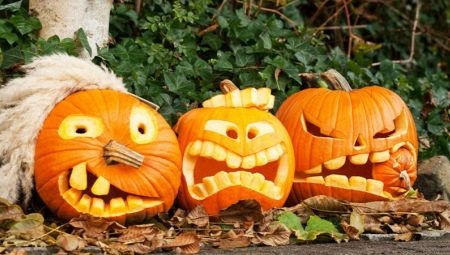
Содержание
- Почему тыква является символом?
- Кто такой Джек и что он сделал?
- Как вырезаются?
- Интересные факты
В ночь с 31 октября на 1 ноября отмечается Хеллоуин. Самая первая ассоциация, которая возникает при упоминании Хеллоуина — это большой овощ ярко-оранжевой расцветки, на котором светится глаза и рот монстра. О том, почему тыква стала основным символом этого удивительного праздника и как создать устрашающие фигурки из этого плода своими руками, мы коротко и расскажем в нашем обзоре.
Почему тыква является символом?
В своем нынешнем виде Хеллоуин считается относительно юным праздником. Однако его корни уходят в далекое прошлое к древним обрядам кельтов Шотландии и Ирландии. Кельтские племена населяли европейские страны свыше 3000 лет назад. Свой год они условно делили на две половины — лето и зиму. Завершение летнего периода и переход в зимний праздновался 31 октября.
Кельты искренне верили, что это особенная ночь, когда все обитатели загробного мира выходят в мир реальный. Чтобы прогнать злых духов, далекие предки современных англичан и американцев наряжались в шкуры диких животных, жгли костры и оставляли на пороге дома овощные плоды с вырезанными на них чудовищными лицами. Изначально для этого брали репу, но постепенно эта роль закрепилась за тыквой. Именно ее нарекли светильником Джека — принято считать, что она защищает жилище, прогоняя от него всех недобрых призраков.
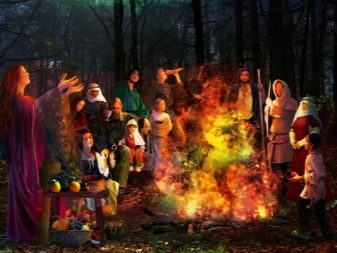
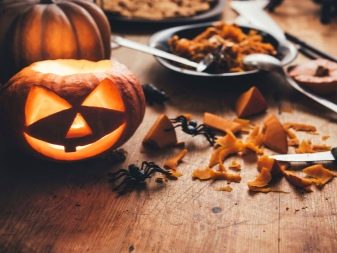
Традиция изготавливать светильники из оранжевых плодов берёт начало от старинного кельтского обычая изготавливать фонари, позволяющие душам умерших отыскать путь к чистилищу. Использование этого плода не случайно, поскольку во все времена он оставался доступным и дешевым. Впервые фонари Джека начали оставлять возле дверей дома в ночь Всех Святых в XIX столетии, уже в XX веке добавился обычай облачаться в костюмы страшных монстров, стучаться в двери домов и выпрашивать угощения с криком: «Сладость или гадость». Эта фраза как нельзя лучше соответствует цели праздника — защититься от злых духов и умилостивить их.
В наши дни Хеллоуин пользуются популярностью далеко за пределами англоговорящих государств. От страшного языческого праздника древних времён до наших дней остались только забавные традиции.
В наши дни Хеллоуин — не более чем повод повеселиться в компании родных и близких людей в атмосфере некоторого мистического шарма.
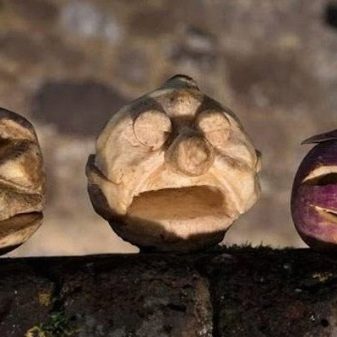
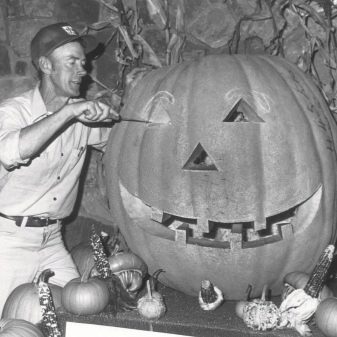
Кто такой Джек и что он сделал?
Почему же хеллоуинскую тыкву называют фонарем Джека? Известна легенда о мужчине, который носил прозвище Скупой Джек. Согласно преданиям однажды он пригласил в бар самого Дьявола. Это был очень жадный и прижимистый человек. Он не желал платить за выпивку, поэтому уговорил нечистого превратится в монетку, чтобы Скупой смог расплатиться ею за напитки. Однако лишь только демон обернулся в деньги, мужчина тут же пожелал оставить монету у себя и положил её возле серебряного крестика, чтобы нечистый не смог вернуть свой истинный облик.
Спустя некоторое время Скупой всё же решил освободить демона. Но потребовал, чтобы нечистый не тревожил его не менее 12 месяцев, а если за это время мужчина умрет — не забирал себе его душу. Спустя год Джек и Дьявол снова встретились. Но мужчина опять сумел заставить демона залезть на высокое дерево, чтобы сорвать сочный плод. Пока Дьявол был на ветках, Скупой вырезал ножом на коре крест, чтобы нечистый не смог спуститься вниз. Ради возвращения свободы Дьявол пообещал Джеку не приходить к нему еще десяток лет.
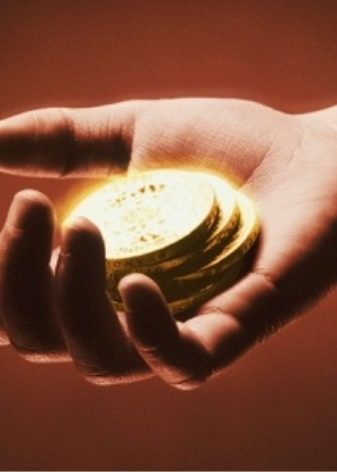
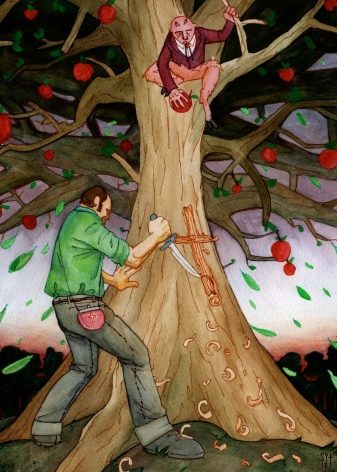
Шли годы, Джек заболел и покинул этот мир. Согласно преданию, Бог повелел не пропускать этого почившего в рай. Но и Дьявол, помня об обещании не брать его душу, не дал Джеку оказаться в аду. Он отпустил Скупого в кромешную мглу с одним только угольком. Чтобы освещать себе дорогу, Джек поместил горящий уголек в вырезанную репу. С того момента он так и ходит по земле.
Именно это предание и породил обычай изготовления фонаря Джека. Жители Шотландии и Ирландии для этого использовали картофель и репу — их размещали возле дверей и окошек, чтобы отпугнуть от своего жилища злобных духов во главе со Скупым Джеком.
Вскоре эмигранты завезли традицию праздновать Хеллоуин в Америку, уже там они заметили, что из тыквы необычный светильник получается гораздо ярче и эффектнее. Именно так тыква и получила статус основного символа празднования Дня Всех Святых.
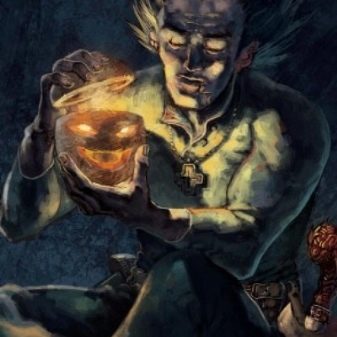
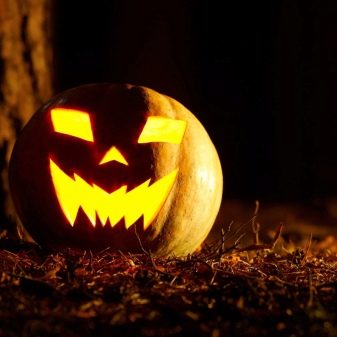
Как вырезаются?
В преддверии необычного торжества прилавки торговых точек, павильонов кафетериев и крупных торговых комплексов постепенно наполняются изображениями привидений в окружении тыкв. Они могут быть пластиковыми, керамическими, стеклянными и настоящими плодами. Не просто так тыква получила титул «Королевы Хеллоуина», представить себе самый мистический день в году без неё попросту невозможно. В наши дни обычай отмечать День Всех Святых и его вечный ярко-оранжевый спутник набирают всё большую популярность. Не так давно традиция распространилась и в нашей стране.
Сегодня рестораны, бары и ночные клубы проводят всевозможные развлекательные программы. С традициями Хеллоуина знакомятся даже в школах и лингвистических центрах, где изучаются английские языки. Ближе к концу октября на прилавках появляются костюмы зомби, духов, привидений, а также тыквы всех видов и размеров. Но если вы планируете у себя дома устроить праздник для детей и взрослых, можно попытаться приготовить тыкву собственноручно. В этом нет абсолютно ничего трудного. Всё, что вам потребуется, — лишь тыква, свечка либо фонарик, крепкий нож и немного фантазии. Остановимся подробнее на том, как выбрать правильный плод и сотворить из него мистический шедевр.
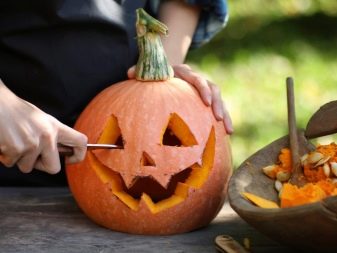
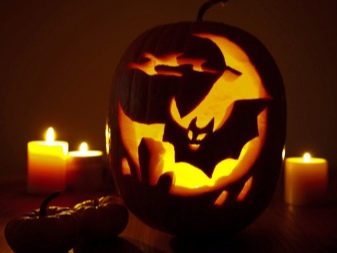
Подготовка
Самое главное при выборе овоща — подобрать здоровый плод без признаков гнили и повреждений, в противном случае прослужит вам такая тыква недолго. Предпочтение лучше отдавать овощам ярко-оранжевых насыщенных расцветок. Обязательно обратите внимание на форму плода. Желательно, чтобы снизу овощ была слегка приплюснутым, так он будет более устойчивым, не будет шататься и падать. Подготовьте свечку. Вам подойдут маленькие, чайные изделия.
Если взять обычную свечу, она начнет опаливать стенки плода изнутри, если свечка заключена в форму — подобной ситуации с ней не произойдет.
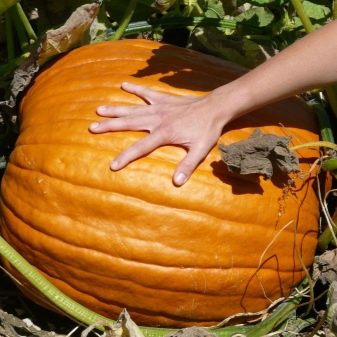
Резка
Создание фонаря Джека не вызовет особых затруднений.
- Начинают со срезания верхушки овоща. Для начала острым ножом проделайте возле хвостика легкий надрез. Выньте всю вырезанную часть.
- Аккуратно ложкой очистите внутреннюю полость тыквы от мякоти и семян, чтобы освободить внутреннее пространство для свечек.
- После того как вы полностью удалите мякоть, ложкой выровняйте стенки и аккуратно срежьте все неровности.
- Впереди самое сложное — сделать лицо хеллоуинского чудища. Чтобы глаза и рот жуткого плода получились по-настоящему страшными и чудовищными, предварительно нарисуйте физиономию ручкой либо приложите готовые шаблоны. Лишь после того, как вы подберете оптимальный вариант, можно браться за нож.
Несколько лайфхаков:
- чтобы тыква-жуть радовала глаз как можно дольше, пройдитесь по местам срезов вазелином либо вазелиновым маслом;
- если вы заметили, что праздничная тыква начала увядать, поместите её в воду на 5-7 часов;
- если вы натрете плод изнутри мускатом, молотой корицей, то фонарь Джека будет не просто загадочно мерцать, но ещё и источать магический запах;
- обязательно предусмотрите несколько небольших отверстий в верхней части тыквы — сделать их можно шилом, это позволит нагретому воздуху беспрепятственно выходить наверх, иначе он начнёт поджаривать мякоть, что со временем приведет к деформации кожицы плода;
- для того чтобы свечки, размещенные внутри плода, горели подольше, на пару-тройку часов их нужно поместить в морозилку.
Финишные работы
Когда вы удалите из тыквы все лишнее, разместите в ней свечки, зажгите и наслаждайтесь своим праздничным шедевром. В завершение можно покрыть тыкву лаком, разрисовать ее, это уже на усмотрение самого мастера. По традиции на Хэллоуин тыкву изображают в виде монстрического лица. Однако в наши дни, когда тыква — не более чем веселая забава, лицу можно придавать какое угодно выражение.
Зачастую даже создают целые тематические композиции. К примеру, оформляют семейку тыкв, состоящую из злых и весёлых плодов. Рядом с ними всегда найдется место испуганным плодам, хохочущим и подмигивающим, неизменный восторг вызывают зубастые мордашки.
Такая композиция наверняка произведет неизгладимое впечатление на всех ваших друзей в Хеллоуин.
Согласно традициям в странах Запада за изготовление тыквы отвечают преимущественно дети. Поэтому нет ничего удивительного в том, что с порога их жилищ зачастую глядят забавные покемоны, миньоны и прочие мультяшные герои. При этом необязательно в точности копировать образ любимого персонажа, будет достаточно одной присущей ему детали.
Так, для Эрни и Берта из мультипликационной эпопеи «Улица Сезам» это будут чубчики, округлые носы и густые брови. Если подобный декор покажется вам чересчур трудным, то можно попросту нарисовать забавную рожицу при помощи акриловых красок.
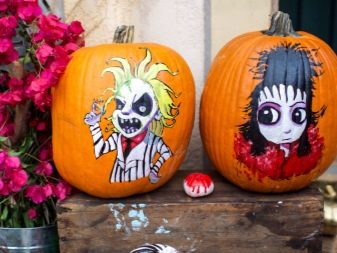
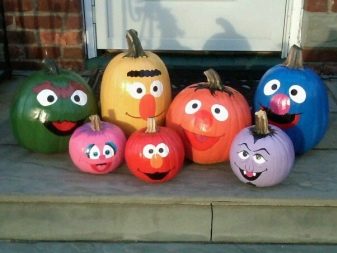
Один из наиболее востребованных образов на Хеллоуин — это мумия, её черты зачастую придают и тыквам. Чтобы создать такую забавную фигурку, совсем необязательно быть специалистом по карвингу. Достаточно только замотать плод бинтом, пририсовать поверх рот и наклеить вырезанные из картона глазки.
Однако если вы собираетесь изобразить именно светящийся фонарь, то вам всё же нужно оформить несколько основных отверстий. Вся остальная подготовительная работа будет такой же, как при создании светильника (вымыть, почистить, убрать мякоть и вырезать мордочку).
Весьма органично праздничная тыква выглядит в образе зомби. Для этого персонажа самое главное — создать видимость вытекающего мозга, именно с ним придется повозиться. Как и при стандартном оформлении тыквы, плод надо тщательно вымыть, очистить и прорезать глаза, рот и нос.
Дальше начинается самое сложное — кожицу в верхней части овоща аккуратно снимают, оставляя небольшой слой мякоти. Затем при помощи любого тонкого предмета, например ручки либо пилочки, изображают складки и витиеватые мозговые извилины. Королева Хеллоуина готова.
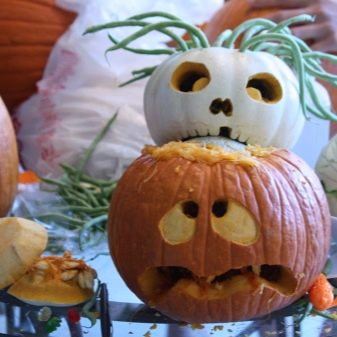
Весьма эффектно выглядит тыква в форме жилища колдуньи. А если у вас есть время, силы и достаточное количество плодов, можно соорудить из овощей целую Ведьминскую улицу. При этом изготовить избушку бывает даже проще, чем фонарь Джека. Достаточно просто нанести на кожицу плода узор и аккуратно вырезать окна, дверцы и прочие элементы композиции.
Не забудьте поставить свечку внутри жуткой тыквы. Загадочный свет, струящийся из окон, будет напоминать вам, что в эту мистическую ночь бодрствуете не только вы.
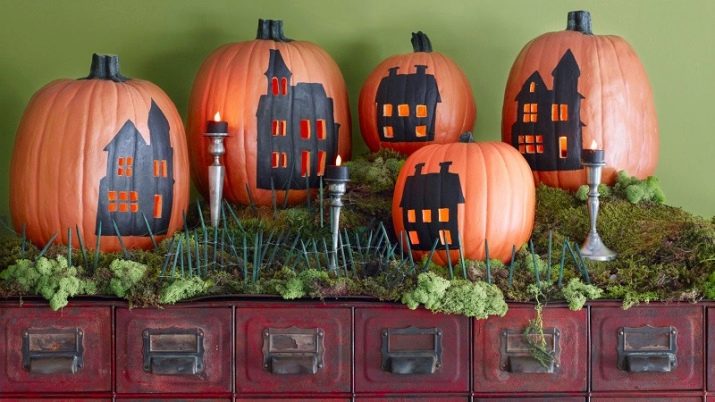
Если все перечисленные идеи кажутся банальными, то попытайтесь изготовить дымящуюся тыкву-жуть, для этого приобретите в аптеке глицерин и подготовьте банку из жести. Как и во всех предыдущих рецептах, плод очищают изнутри, вырезают на нем рожицу и помещают внутрь зажженную свечу. Жестяную банку разрезают надвое, оставив маленькие ножки — у вас должно выйти что-то наподобие аромалампы.
Такой конструкцией прикрывают свечку сверху. В углубление наливают глицерин. По мере нагревания он будет дымиться, создавая по-настоящему демонический эффект. Неплохо смотрится тыква с мерцающим в темноте узором. Вы можете начертить его самостоятельно или воспользоваться шаблоном. Легче всего приготовить бумажный трафарет, закрепить его на тыкве изолентой, а потом пройтись острым шилом по окантовке рисунка — лишь после этого можно браться за нож. Имейте в виду: чем затейливее будет ваш узор, тем более тонкими должны быть стенки хеллоуинской тыквы.
Интересные факты
И в заключение приведем несколько интересных фактов о Хеллоуине и фонариках Джека.
- Первое упоминание о Дне Всех Святых относится приблизительно к 4000 г. до н. э. Это значит, что традиция отмечать Хеллоуин на сегодняшний день существует уже более 6 тыс. лет.
- Основная цветовая гамма Хеллоуина— черно-оранжевая. Чёрный цвет символизирует собой ночь и смерть. А оранжевый олицетворяет собой окончание сбора урожая.
- Абсолютный рекорд по созданию фигур тыквы принадлежит Стивену Кларку. Известно, что он справился с этим заданием всего за 24 сек.
- По подсчетам аналитиков американцы ежегодно тратят на покупки к празднованию Хеллоуина 2 млрд долларов, и это не включая покупки сладостей. Такая статистика позволяет Дню Всех Святых встать в один ряд с крупными фестивалями и выйти в число лидеров в перечне самых коммерческих мероприятий в мире.
- Каждый год в США разыгрывается солидный приз среди авторов наиболее креативного фонаря Джека из оранжевого овоща. Победитель получает 25 тыс. долларов.
- Самым крупным овощем, подготовленным к Хеллоуину, признана тыква массой 1446 фунтов. Она была выращена на ферме в Канаде.
- В городе Бостон был зафиксирован рекорд по числу единовременно зажженных фонарей Джека. Всего там горело 30128 фонарей.
- Согласно некоторым преданиям, если посмотреться в хеллоуинскую полночь в зеркало, можно будет увидеть там собственную смерть. Однако в ряде стран точно таким же способом юные незамужние девушки стараются разглядеть в отражении черты будущего мужа.
Не во всех странах любят этот праздник. Так, жители Австралии и Франции считают, что Хеллоуин— не более чем чрезмерно разрекламированное и негативное влияние американской культуры.