
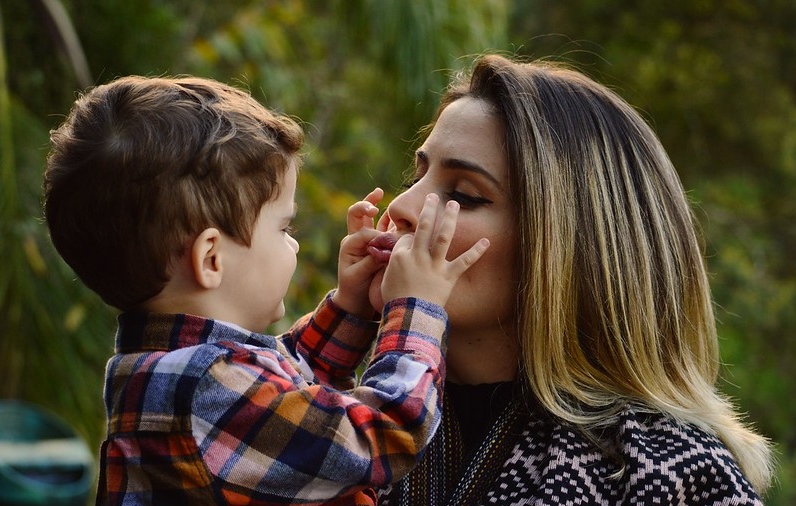
In Russia Mother’s Day was introduced not so long ago. For the first time it was celebrated in Baku in 1988. But it only happened in 1998 when Mother’s Day was officially established by the decree of President Boris Yeltsin. Since that time Mother’s Day has been celebrated on the last Sunday in November.
Mother’s Day is an international holiday. It is celebrated in Great Britain, the USA, Australia, Germany, Italy, Poland and many other countries. It is noteworthy that in every country it is celebrated on various days. The symbols of this day also differ from country to country.
Mother’s Day is one of the most loved holidays. This is the day when all mothers and those women who are going to become mothers receive gifts. This holiday honours motherhood.
Mother is the most important and significant figure in any person’s life. Mother’s contribution to our lives is priceless; her love to her children is endless and unconditional. Our world would not be the same without our mothers.
Forget-me-not is the symbol of Mother’s Day in Russia. Mother’s Day is the day when all mothers are given flowers, cards and chocolates. Many children give handmade keepsakes to their moms on this day. Different events dedicated to Mother’s Day are held across the country.
Перевод на русский язык
В России День матери появился не так давно. Впервые его отпраздновали в Баку в 1988 году. Но лишь в 1998 году День матери был официально утвержден указом президента Бориса Ельцина. С тех пор День матери отмечают в последнее воскресенье ноября.
День матери – международный праздник. Его празднуют в Великобритании, США, Австралии, Германии, Италии, Польше и многих других странах. Стоит отметить, что в каждой стране его празднуют в разные дни. Символы этого дня также отличаются в разных странах.
День матери – один из самых любимых в народе праздников. В этот день все матери и те женщины, которые собираются стать матерями, получают подарки. Этот праздник чтит материнство.
Мама – самый важный и значимый человек в жизни любого из нас. Вклад матери в нашу жизнь бесценен, ее любовь к детям бесконечна и безусловна. Наш мир не был бы таким без наших матерей.
Незабудка – символ Дня матери в России. День матери – это день, когда всем матерям дарят цветы, открытки и конфеты. В этот день многие дети дарят своим мамам небольшие подарочки, сделанные своими руками. На День матери по всей стране проводятся различные мероприятия.
For the originally different religious celebration held in some countries, see Mothering Sunday.
| Mother’s Day | |
|---|---|

Mother’s Day |
|
| Observed by | 40+ countries |
| Type | Worldwide |
| Significance | Honors mothers and motherhood |
| Date | Varies per country |
| Frequency | Annual |
| Related to | Children’s Day, Siblings Day, Father’s Day, Parents’ Day, Grandparents’ Day |
Mother’s Day is a celebration honoring the mother of the family or individual, as well as motherhood, maternal bonds, and the influence of mothers in society. It is celebrated on different days in many parts of the world, most commonly in the months of March or May. It complements similar celebrations, largely pushed by commercial interests, honoring family members, such as Father’s Day, Siblings Day, and Grandparents’ Day.
While some countries have a multi-century history of a day to celebrate mothers, the modern American version of the holiday began in the United States in the early 20th century at the initiative of Anna Jarvis, who organized the first Mother’s Day service of worship and celebration at Andrews Methodist Episcopal Church in Grafton, West Virginia, which serves as the International Mother’s Day Shrine today.[1] It is not directly related to the many traditional celebrations of mothers and motherhood that have existed throughout the world over thousands of years, such as the Greek cult to Cybele, the mother deity Rhea, the Roman festival of Hilaria, or the other Christian ecclesiastical Mothering Sunday celebration (associated with the image of Mother Church).[2][3][4][5] However, in some countries, Mother’s Day is still synonymous with these older traditions.[6]
The American version of Mother’s Day has been criticized for having become too commercialized.[7][8] Jarvis herself, who began the celebration as a liturgical observance, regretted this commercialism and expressed that this was never her intention.[1][9] In response, Constance Adelaide Smith successfully advocated for Mothering Sunday as a commemoration of a broader definition of motherhood in many other parts of the English-speaking world.[10]
Establishment of holiday
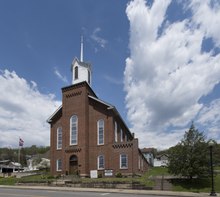
The modern holiday was first celebrated in 1907, when Anna Jarvis held the first Mother’s Day service of worship at Andrews Methodist Episcopal Church in Grafton, West Virginia.[1][11] Andrew’s Methodist Church now holds the International Mother’s Day Shrine.[1] Her campaign to make Mother’s Day a recognized holiday in the United States began in 1905, the year her mother, Ann Reeves Jarvis, died. Ann Jarvis had been a peace activist who cared for wounded soldiers on both sides of the American Civil War, and created Mother’s Day Work Clubs to address public health issues. She and another peace activist and suffragette Julia Ward Howe had been urging for the creation of a «Mother’s Day For Peace» where mothers would ask that their husbands and sons were no longer killed in wars. 40 years before it became an official holiday, Ward Howe had made her Mother’s Day Proclamation in 1870, which called upon mothers of all nationalities to band together to promote the «amicable settlement of international questions, the great and general interests of peace.»[12] Anna Jarvis wanted to honor this and to set aside a day to honor all mothers because she believed a mother is «the person who has done more for you than anyone in the world».[13]
In 1908, the U.S. Congress rejected a proposal to make Mother’s Day an official holiday, joking that they would also have to proclaim a «Mother-in-law’s Day».[14] However, owing to the efforts of Anna Jarvis, by 1911 all U.S. states observed the holiday,[15] with some of them officially recognizing Mother’s Day as a local holiday[16] (the first being West Virginia, Jarvis’ home state, in 1910). In 1914, Woodrow Wilson signed a proclamation designating Mother’s Day, held on the second Sunday in May, as a national holiday to honor mothers.[17]
Although Jarvis, who started Mother’s Day as a liturgical service, was successful in founding the celebration, she became resentful of the commercialization of the holiday. By the early 1920s, Hallmark Cards and other companies had started selling Mother’s Day cards. Jarvis believed that the companies had misinterpreted and exploited the idea of Mother’s Day and that the emphasis of the holiday was on sentiment, not profit. As a result, she organized boycotts of Mother’s Day, and threatened to issue lawsuits against the companies involved.[18] Jarvis argued that people should appreciate and honor their mothers through handwritten letters expressing their love and gratitude, instead of buying gifts and pre-made cards.[17] Jarvis protested at a candy makers’ convention in Philadelphia in 1923, and at a meeting of American War Mothers in 1925. By this time, carnations had become associated with Mother’s Day, and the selling of carnations by the American War Mothers to raise money angered Jarvis, who was arrested for disturbing the peace.[17][18]
In Britain, Constance Adelaide Smith was inspired to advocate for Mothering Sunday, an already-existing Christian ecclesiastical celebration in which the faithful visit the church in which they received the sacrament of baptism, as an equivalent celebration.[19][20][21][22] She referred to medieval traditions of celebrating Mother Church, ‘mothers of earthly homes’, Mary, mother of Jesus, and Mother Nature.[21][10] Her efforts were successful in the British Isles and other parts of the English-speaking world.[23]
Spelling
In 1912, Anna Jarvis trademarked the phrase «Second Sunday in May, Mother’s Day, Anna Jarvis, Founder», and created the Mother’s Day International Association.[24] She specifically noted that «Mother’s» should «be a singular possessive, for each family to honor its own mother, not a plural possessive commemorating all mothers in the world.»[25] This is also the spelling used by U.S. President Woodrow Wilson in his 1914 presidential proclamation, by the U.S. Congress in relevant bills,[26][27] and by various U.S. presidents in their proclamations concerning Mother’s Day.[28]
Dates around the world
While the United States holiday was adopted by some other countries, existing celebrations, held on different dates, honoring motherhood have become described as «Mother’s Day», such as Mothering Sunday in the United Kingdom[6] or, in Greece, the Eastern Orthodox celebration of the presentation of Jesus Christ to the temple (2 February of Julian Calendar). Both the secular and religious Mother Day are present in Greece.[29] Mothering Sunday is often referred to as «Mother’s Day» even though it is an unrelated celebration.[6]
In some countries, the date adopted is one significant to the majority religion, such as Virgin Mary Day in Catholic countries. Other countries selected a date with historical significance. For example, Bolivia’s Mother’s Day is a fixed date, commemorating a battle in which women participated to defend their children.[30]
Some countries, such as Russia, celebrated International Women’s Day instead of Mother’s Day[31] or simply celebrate both holidays, which is the custom in Ukraine. Kyrgyzstan has recently introduced Mother’s Day, but «year on year International Women’s Day is certainly increasing in status».[32]
| Gregorian calendar | ||
|---|---|---|
| Occurrence | Dates | Country |
|
Second Sunday of February |
13 February 2022 |
|
|
3 March |
|
|
|
8 March |
|
|
|
Fourth Sunday in Lent (Mothering Sunday) |
27 March 2022 |
|
|
21 March |
|
|
|
25 March |
|
|
|
7 April (Annunciation day) |
|
|
|
First Sunday of May |
1 May 2022 |
|
|
8 May |
|
|
|
10 May |
|
|
|
Second Sunday of May |
8 May 2022 |
|
|
14 May |
|
|
|
15 May |
|
|
|
19 May |
|
|
|
26 May |
|
|
|
27 May |
|
|
|
Last Sunday of May |
29 May 2022 |
|
|
Last Sunday of May, or first Sunday of June if the last Sunday of May is Pentecost |
29 May 2022 |
|
|
30 May |
|
|
|
1 June |
|
|
|
Second Sunday of June |
12 June 2022 |
|
| 14 June |
|
|
|
First Monday of July |
4 July 2022 |
|
|
12 August |
|
|
|
15 August (Assumption of Mary) |
|
|
|
14 October |
|
|
|
15 October, or following work day |
17 October 2022 |
|
| 20 October |  Vietnam (Vietnamese Women’s Day) Vietnam (Vietnamese Women’s Day)
|
|
|
Third Sunday of October |
16 October 2022 |
|
|
3 November |
|
|
|
16 November |
|
|
|
Last Sunday of November |
|
|
|
8 December (Feast of the Immaculate Conception) |
|
|
|
22 December |
|
|
| Hebrew calendar | ||
| Occurrence | Equivalent Gregorian dates | Country |
| 30 Shevat | Between 30 January and 1 March
1 February 2022 |
|
| Hindu calendar | ||
| Occurrence | Equivalent Gregorian dates | Country |
|
Vaisakha[56] Amavasya (Mata Tirtha Aunsi[57]) |
Between 19 April and 19 May |
|
| Islamic calendar | ||
| Occurrence | Equivalent Gregorian dates | Country |
| 20 Jumada al-Thani | 22 January 2022 13 January 2023 2 January 2024 22 December 2024 |
|
| Vietnamese calendar | ||
| Occurrence | Equivalent Gregorian dates | Country |
| 15th day of seventh month | 12 August 2022 1 August 2023 20 July 2024 |
|


International history and tradition


Mother’s Day gift in 2007

Mother and daughter and Mother’s Day card
In most countries, Mother’s Day is an observance derived from the holiday as it has evolved in the United States, promoted by companies who saw benefit in making it popular.[7] As adopted by other countries and cultures, the holiday has different meanings, is associated with different events (religious, historical or legendary), and is celebrated on different dates.
In some cases, countries already had existing celebrations honoring motherhood, and their celebrations then adopted several external characteristics from the US holiday, such as giving carnations and other presents to one’s mother.
The extent of the celebrations varies greatly. In some countries, it is potentially offensive to one’s mother not to mark Mother’s Day. In others, it is a little-known festival celebrated mainly by immigrants, or covered by the media as a taste of foreign culture.[citation needed]
Religion
In certain traditional branches of Christianity, the holiday is strongly associated with revering the Virgin Mary.[59] In some Catholic, Lutheran and Anglican homes, families have a special shrine on their home altar devoted to the Blessed Virgin Mary.[60] In many Eastern Catholic and Eastern Orthodox Churches, a special prayer service is held in honor of the Theotokos Virgin Mary.[61][62]
In Islam there is no concept of Mother’s Day, but the Quran teaches that children should give priority to loving their mother over their father.[63]
In Hindu tradition, Mother’s Day is called «Mata Tirtha Aunshi» or «Mother Pilgrimage fortnight», and is celebrated in countries with a Hindu population, especially in Nepal, where mothers are honored with special foods. The holiday is observed on the new moon day in the month of Baisakh, i.e., April/May. This celebration is based on the Hindu religion and it pre-dates the creation of the US-inspired celebration by at least a few centuries.[64]
In Buddhism, the festival of Ullambana is derived from the story of Maudgalyayana and his mother.[65]
By country (A–G)
Albania
In Albania, as in a number of Balkan and Eastern European countries, Mother’s Day is celebrated on 8 March, in conjunction with International Women’s Day.[66]
Arab world
Mother’s Day in most Arab countries is celebrated on 21 March. It was introduced in Egypt by journalist Mustafa Amin[67] and was first celebrated in 1956.[68] The practice has since been adopted by other Arab countries.[citation needed]
Argentina
In Argentina, Mother’s Day is celebrated on the third Sunday of October. The holiday was originally celebrated on 11 October, the old liturgical date for the celebration of the Maternity of the Blessed Virgin Mary but after the Second Vatican Council, which moved the Virgin Mary festivity to 1 January, the Mother’s Day started to be celebrated the third Sunday of October because of popular tradition.[51] Argentina is the only country in the world that celebrates Mother’s Day on this date.[69]
Armenia
In Armenia, Mother’s Day is celebrated on 8 March, and on 7 April as Maternity and Beauty Day.
Australia
In Australia, Mother’s Day is celebrated on the second Sunday in May. Australia celebrated Mother’s Day for the first time in 1910 with special church services, however, it was not popularly observed until the 1920s.[70][71] The tradition of giving gifts on Mother’s Day in Australia started in 1924. Sydney woman Janet Heyden was inspired to collect charitable gifts for lonely, old mothers in Newington hospital who had lost husbands and sons during WW1.[72] Because it is autumn in Australia for Mother’s Day, and carnations are a spring flower, white chrysanthemums are the traditional Mother’s Day flower in Australia.[73]
Bangladesh
There is no historical tradition of celebrating Mother’s Day in Bangladesh (Bangla: মা/আম্মু দিবস, Ma/ammu dibosh), and has become popular in the country due to western influences. It is celebrated on the second Sunday of May and is not a public holiday. Mother’s Day was not very popular and in recent times it has been spread more widely by the Millennial and Generation Z communities across the country through social media. Although many religious families do not celebrate it, it is more widespread than ever before. There is a popular phrase used by many parents, including mothers, which is «Every day is Father’s/Mother’s Day so you will love your parents every day.» Most people just wish or pray for their mother, but many from big cities like Dhaka, Chittagong, Khulna, Sylhet, Barishal, Narayangonj, Bogura etc. go to restaurants to celebrate, many also cut cakes. Many others cut cakes at home and/or order meals online. Some children may give small gifts to their mothers.
Belarus
Belarus celebrates Mother’s Day on 14 October. Like other ex-Communist republics, Belarus used to celebrate only International Women’s Day on 8 March. Mother’s Day in Belarus was officially established by the Belarusian government, and it was celebrated for the first time in 1996.[50] The celebration of the Virgin Mary (the holiday of Protection of the Holy Mother of God) is celebrated on the same day.[74]
Bhutan
Mother’s Day in Bhutan is celebrated on 8 May. It was introduced in Bhutan by the Tourism Council of Bhutan.[75]
Belgium
In Belgium, Mother’s Day (Moederdag or Moederkesdag in Dutch and Fête des Mères in French) is celebrated on the second Sunday of May. In the week before this holiday children make little presents at primary school, which they give to their mothers in the early morning of Mother’s Day. Typically, the father will buy croissants and other sweet breads and pastries and bring these to the mother while she is still in bed – the beginning of a day of pampering for the mother. There are also many people who celebrate Mother’s Day on 15 August instead; these are mostly people around Antwerp, who consider that day (Assumption) the classical Mother’s Day and the observance in May an invention for commercial reasons. It was originally established on that day as the result of a campaign by Frans Van Kuyck, a painter and Alderman from Antwerp.[76]
Bolivia
In Bolivia, Mother’s Day is celebrated on 27 May. El Día de la Madre Boliviana was passed into law on 8 November 1927, during the presidency of Hernando Siles Reyes. The date commemorates the Battle of La Coronilla, which took place on 27 May 1812, during the Bolivian War of Independence, in what is now the city of Cochabamba. In this battle, women fighting for the country’s independence were slaughtered by the Spanish army. It is not a public holiday, but all schools hold activities and festivities throughout the day.[30]
Brazil
In Brazil, Mother’s Day is celebrated on the second Sunday of May. The first Mother’s Day in Brazil was promoted by Associação Cristã de Moços de Porto Alegre (Young Men’s Christian Association of Porto Alegre) on 12 May 1918. In 1932, then President Getúlio Vargas made the second Sunday of May the official date for Mother’s Day. In 1947, Archbishop Jaime de Barros Câmara, Cardinal-Archbishop of Rio de Janeiro, decided that this holiday would also be included in the official calendar of the Catholic Church.[citation needed]
Mother’s Day is not an official holiday (see Public holidays in Brazil), but it is widely observed and typically involves spending time with and giving gifts to one’s mother. Because of this, it is considered one of the celebrations most related to consumerism in the country, second only to Christmas Day as the most commercially lucrative holiday.[77]
Canada
- See also Other observances in Canada

Mother’s Day in Canada is celebrated on the second Sunday in May (it is not a public holiday or bank holiday), and typically involves small celebrations and gift-giving to one’s mother, grandmother, or other important female figures in one’s family.[78] Celebratory practices are very similar to those of other western nations. A Québécois tradition is for Québécois men to offer roses or other flowers to the women.[79]
China
Mother’s Day is becoming more popular in China. Carnations are a very popular Mother’s Day gift and the most sold flowers in relation to the day.[80] In 1997 Mother’s Day was set as the day to help poor mothers and to remind people of the poor mothers in rural areas such as China’s western region.[80] In the People’s Daily, the Chinese government’s official newspaper, an article explained that «despite originating in the United States, people in China accept the holiday without hesitation because it is in line with the country’s traditional ethics – respect for the elderly and filial piety towards parents.»[80]
In recent years, the Communist Party member Li Hanqiu began to advocate for the official adoption of Mother’s Day in memory of Meng Mu, the mother of Mèng Zǐ. He formed a non-governmental organization called Chinese Mothers’ Festival Promotion Society, with the support of 100 Confucian scholars and lecturers of ethics.[81][82] Li and the Society want to replace the Western-style gift of carnations with lilies, which, in ancient times, were planted by Chinese mothers when children left home.[82] Mother’s Day remains an unofficial festival, except in a small number of cities.[83]
Czech Republic
In the Czech Republic, Mother’s Day is celebrated every second Sunday in May. It started in former Czechoslovakia in 1923.[44] The promoter of this celebration was Alice Masaryková.[44] After World War II communists replaced Mother’s Day with International Woman’s Day, celebrated on 8 March.[44] The former Czechoslovakia celebrated Women’s Day until the Velvet Revolution in 1989.[44] After the split of the country in 1993, the Czech Republic started celebrating Mother’s Day again.[44]
Egypt
Mother’s Day in Egypt is celebrated on 21 March, the first day of spring in the northern hemisphere. It was introduced in Egypt by journalist Mustafa Amin[67] in his book Smiling America (1943). The idea was overlooked at the time. Later Amin heard the story of a widowed mother who devoted her whole life to raising her son until he became a doctor. The son then married and left without showing any gratitude to his mother. Hearing this, Amin became motivated to promote «Mother’s Day». The idea was first ridiculed by president Gamal Abdel Nasser but he eventually accepted it and Mother’s Day was first celebrated on 21 March 1956. The practice has since been copied by other Arab countries.[84]
When Mustafa Amin was arrested and imprisoned, there were attempts to change the name of the holiday from «Mother’s Day» to «Family Day» as the government wished to prevent the occasion from reminding people of its founder. These attempts were unsuccessful and celebrations continued to be held on that day; classic songs celebrating mothers remain famous to this day.[citation needed]
Ethiopia
Mother’s Day is celebrated for three days in Ethiopia, after the end of the rainy season. It comes in mid-fall where people enjoy a three-day feast called «Antrosht».[85]
For the feast, ingredients will be brought by the children for a traditional hash recipe. The ingredients are divided along genders, with girls bringing spices, vegetables, cheese and butter, while the boys bring a lamb or bull. The mother hands out to the family the hash.[86]
A celebration takes place after the meal. The mothers and daughters anoint themselves using butter on their faces and chests. While honoring their family and heroes, men sing songs.[87]
Estonia
In Estonia, Mother’s Day (emadepäev in Estonian) is celebrated on the second Sunday of May. It is recognized nationally, but is not a public holiday.[88]
Finland
In Finland, Mother’s Day (äitienpäivä in Finnish) is celebrated on the second Sunday of May. It is recognized nationally and is a public holiday. It is usually celebrated at homes where children or grandchildren bring Mother´s day cards that they have drawn to their mothers and grandmothers. Usually, some food, coffee and cakes are served for guests. Grown up children visit their parents’ homes and bring traditionally Mother´s day roses or other flowers accompanied with a Mother´s day card.
The president of Finland honors with medals every year some mothers who have done something exceptional and positive during the year.[89]
France
In France, amidst alarm at the low birth rate, there were attempts in 1896 and 1904 to create a national celebration honoring the mothers of large families.[90] In 1906 ten mothers who had nine children each were given an award recognising «High Maternal Merit» («Haut mérite maternel»).[91] American World War I soldiers fighting in France popularized the US Mother’s Day holiday created by Anna Jarvis. They sent so much mail back to their country for Mother’s Day that the Union Franco-Américaine created a postal card for that purpose.[90] In 1918, also inspired by Jarvis, the town of Lyon wanted to celebrate a «journée des Mères», but instead decided to celebrate a «Journée Nationale des Mères de familles nombreuses.» The holiday was more inspired by anti-depopulation efforts than by the US holiday, with medals awarded to the mothers of large families.[90] The French government made the day official in 1920 as a day for mothers of large families.[92] Since then the French government awards the Médaille de la Famille française to mothers of large families.[93]
In 1941, by an initiative of Philippe Pétain, the wartime Vichy government used the celebration in support of their policy to encourage larger families, but all mothers were now honored, even mothers with smaller families.[92]
In 1950, after the war, the celebration was reinstated. The law of 24 May 1950 required (in Article 1) that the Republic pay official homage to French Mothers. Article 2 stated it should be celebrated on the last Sunday in May as the «Fête des Mères» (except when Pentecost fell on that day, in which case it was moved to the first Sunday in June). Article 3 stated that all expenditure shall be covered from the budget of the Ministry of Public Health and Population.[94]
During the 1950s, the celebration lost all its patriotic and natalist ideologies, and became heavily commercialized.[90]
In 1956, the celebration was given a budget and integrated into the new Code de l’action Sociale et des familles. In 2004 responsibility for the holiday was transferred to the Minister responsible for families.[citation needed]
Georgia
Georgia celebrates Mother’s Day on 3 March. It was declared by the first President of Georgia Zviad Gamsakhurdia in order to replace the International Women Day, and it was officially approved by the Supreme Council in 1991. Nowadays Georgia celebrates both Mother’s Day on 3 March and International Women’s Day on 8 March.[33]
Germany

In the 1920s, Germany had the lowest birthrate in Europe, and the declining trend was continuing. This was attributed to women’s participation in the labor market. At the same time, influential groups in society (politicians of left and right, churchwomen, and feminists) believed that mothers should be honored but could not agree on how to do so. However, all groups strongly agreed on the promotion of the values of motherhood. In 1923, this resulted in the unanimous adoption of Muttertag, the Mother’s Day holiday as imported from America[95] and Norway. The head of the Association of German Florists cited «the inner conflict of our Volk and the loosening of the family» as his reason for introducing the holiday. He expected that the holiday would unite the divided country. In 1925, the Mother’s Day Committee joined the task force for the recovery of the volk, and the holiday stopped depending on commercial interests and began emphasizing the need to increase the population in Germany by promoting motherhood.[96]
The holiday was then seen as a means to encourage women to bear more children, which nationalists saw as a way to rejuvenate the nation. The holiday did not celebrate individual women, but an idealized standard of motherhood. The progressive forces resisted the implementation of the holiday because it was backed by so many conservatives and because they saw it as a way to eliminate the rights of working women. Die Frau, the newspaper of the Federation of German Women’s Associations, refused to recognize the holiday. Many local authorities adopted their own interpretation of the holiday: it would be a day to support economically larger families or single-mother families. The guidelines for the subsidies had eugenics criteria, but there is no indication that social workers ever implemented them in practice, and subsidies were given preferentially to families in economic need rather than to families with more children or «healthier» children.[96]
With the Nazi party in power during 1933–1945, the situation changed radically. The promotion of Mother’s Day increased in many European countries, including the UK and France. From the position of the German Nazi government, the role of mothers was to give healthy children to the German nation. The Nazi party’s intention was to create a pure «Aryan race» according to nazi eugenics. Among other Mother’s Day ideas, the government promoted the death of a mother’s sons in battle as the highest embodiment of patriotic motherhood.[96][97]
The Nazis quickly declared Mother’s Day an official holiday and put it under the control of the NSV (National Socialist People’s Welfare Association) and the NSF (National Socialist Women Organization). This created conflicts with other organizations that resented Nazi control of the holiday, including Catholic and Protestant churches and local women’s organizations. Local authorities resisted the guidelines from the Nazi government and continued assigning resources to families who were in economic need, much to the dismay of the Nazi officials.[96]
In 1938, the government began issuing an award called Mother’s Cross (Mutterkreuz), according to categories that depended on the number of children a mother had. The medal was awarded on Mother’s Day and also on other holidays due to a large number of recipients. The Cross was an effort to encourage women to have more children, and recipients were required to have at least four.[96][97]
By country (H–M)
Hungary
In Hungary, Mother’s Day is celebrated on the first Sunday of May.[98] It was first celebrated in 1925[99] by the Hungarian Red Cross Youth.[100]
India
The modern Mother’s Day has been assimilated into Indian culture[101] and is celebrated every year on the second Sunday of May.[102][103] Indians do not celebrate the occasion as a religious event; its celebration is mostly restricted to urban areas where the occasion has been largely commercialized.[104]
Indonesia
Indonesian Mother’s Day (Indonesian: Hari Ibu) is celebrated nationally on 22 December. The date was made an official holiday by President Sukarno under Presidential Decree No. 316/1953, on the 25th anniversary of the 1928 Indonesian Women Congress. The day originally sought to celebrate the spirit of Indonesian women and to improve the condition of the nation. Today, the meaning of Mother’s Day has changed, and it is celebrated by expressing love and gratitude to mothers. People present gifts to mothers (such as flowers) and hold surprise parties and competitions, which include cooking and kebaya wearing. People also allow mothers a day off from domestic chores.[105]
The holiday is celebrated on the anniversary of the opening day of the first Indonesian Women Congress (Kongres Perempuan Indonesia), which was held from 22 to 25 December 1928.[54][106] The Congress took place in a building called Dalem Jayadipuran, which now serves as the office of the Center of History and Traditional Values Preservation (Balai Pelestarian Sejarah dan Nilai Tradisional) in Brigjen Katamso Street, Yogyakarta. The Congress was attended by 30 feminist organizations from 12 cities in Java and Sumatra. In Indonesia, feminist organizations have existed since 1912, inspired by Indonesian heroines of the 19th century, e.g., Kartini, Martha Christina Tiahahu, Cut Nyak Meutia, Maria Walanda Maramis, Dewi Sartika, Nyai Ahmad Dahlan, Rasuna Said, etc.[54] The Congress intended to improve women’s rights in education and marriage.[107]
Indonesia also celebrates the Kartini Day (Hari Kartini) on 21 April, in memory of activist Raden Ajeng Kartini. This is a celebration of the emancipation of women.[106] The observance was instituted at the 1938 Indonesian Women Congress.[107]
During President Suharto’s New Order (1965–1998), government propaganda used Mother’s Day and Kartini Day to inculcate into women the idea that they should be docile and stay at home.[107]
Iran
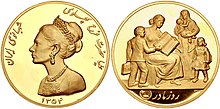
Commemorative gold medal issued in the Pahlavi era on the occasion of Mother’s Day, dated 1975. Obv: Bust of Empress Farah Pahlavi. Rev: Mother and children standing around a seated Farah Pahlavi, holding open book
In Iran, Mother’s Day is celebrated on 20 Jumada al-thani. This is the sixth month in the Islamic calendar (a lunar calendar) and every year the holiday falls on a different day of the Gregorian calendar. This is the birthday anniversary of Fatimah, the Islamic prophet Muhammad’s only daughter according to Shia Islam.[58][108] On this day, banners reading «Ya Fatemeah (O! Fatemeh)» are displayed on «government buildings, private buildings, public streets and car windows.»[58] Mother’s Day was originally observed on 16 December but the date was changed after the Iranian Revolution in 1979. The celebration is both Women’s Day (replacing International Women’s Day) and Mother’s Day.[58][109]
In 1960, the Institute for Women Protection adopted the Western holiday and established it on 25 Azar (16 December), the date the Institute was founded. The Institute’s action had the support of Empress Farah Pahlavi, the wife of the last Shah of Persia, who promoted the construction of maternity clinics in remote parts of the country to commemorate the day.[110] Pahlavi regime used the holiday to promote «gender ideologies» of the regime.[58] The Shah’s government honored and gave awards to women who represented the idealized view of the regime, including mothers who had many healthy children.[110]
According to Shahla Haeri, the Islamic Republic government has used the holiday to «control and channel women’s movements» and to promote role models for the traditional concept of family.[111] Fatimah is seen by these critics as the chosen model of a woman completely dedicated to certain traditionally sanctioned feminine roles.[112] However, supporters of the choice contend that there is much more to her life story than simply such «traditional» roles.[113]
Ireland
In Ireland, Mother’s Day is celebrated on the fourth Sunday of Lent, as in the United Kingdom, and has the same roots in Mothering Sunday. The practice died out in Ireland around the late 18th century but was revived around the 1950s due to Americanisation.[114][115][116]
Israel
The Jewish population of Israel used to celebrate Mother’s Day on Shevat 30 of the Jewish calendar, which falls between 30 January and 1 March. The celebration was set as the same date that Henrietta Szold died (13 February 1945). Henrietta had no biological children, but her organization Youth Aliyah rescued many Jewish children from Nazi Germany and provided for them. She also championed children’s rights. Szold is considered the «mother» of all those children, and that is why her annual remembrance day (יום השנה) was set as Mother’s Day (יוֹם הָאֵם, yom ha’em). The holiday has evolved over time, becoming a celebration of mutual love inside the family, called Family Day (יוֹם הַמִשְּפָּחָה, yom hamishpacha). This holiday is mainly celebrated in preschools with an activity to which parents are invited. Mother’s Day is mainly celebrated by children at kindergartens. There are no longer mutual gifts among members of the family, and there is no longer any commercialization of the celebration. It is not an official holiday.[55]
Italy
Mother’s Day in Italy was celebrated for the first time on 24 December 1933 as the «Day of the mother and the child» (Giornata della madre e del fanciullo). It was instituted by the Opera nazionale maternità e infanzia in order to publicly reward the most prolific Italian women every year.[117]
After World War II, Mother’s Day was first celebrated on 12 May 1957 in Assisi, at the initiative of Reverend Otello Migliosi, the parish priest of the Tordibetto church.[118] This celebration was so popular that in the following year Mother’s Day was adopted throughout Italy. On 18 December 1958, a proposal was presented to the Italian Senate to make the holiday official.[119]
Japan
In Japan, Mother’s Day (母の日, Haha no Hi) was initially commemorated during the Shōwa period as the birthday of Empress Kōjun (mother of Emperor Akihito) on 6 March. This was established in 1931 when the Imperial Women’s Union was organized. In 1937, the first meeting of «Praise Mothers» was held on 8 May, and in 1949 Japanese society adopted the second Sunday of May as the official date for Mother’s Day in Japan. Today, people typically give their mothers gifts of flowers such as red carnations[120] and roses. Giving carnations on Mother’s Day is the most common in Japan.[citation needed]
Kyrgyzstan
In Kyrgyzstan, Mother’s Day is celebrated on 19 May every year. The holiday was first celebrated in 2012.[121] Mothers are also honored on International Women’s Day[122]
This article is about a holiday celebrating mothers and motherhood. For other uses, see Mother’s Day (disambiguation).
Latvia
Mother’s Day in Latvia was celebrated for the first time in 1922. Since 1934, Mother’s Day is celebrated on the second Sunday of May.[123] After the end of the Soviet occupation of Baltic states celebration was resumed in 1992.[124] Mothers are also honored on International Women’s Day.[125]
Lithuania
Mother’s Day in Lithuania was celebrated for the first time in 1928. In Lithuania, Mother’s Day is celebrated on the first Sunday of May.
Malawi
In Malawi, Mother’s Day is a public holiday. The day is observed on 15 October or the following workday. It is celebrated on the UN’s World Rural Women’s Day.
Maldives
In the Maldives, Mother’s Day is celebrated on 13 May. The day is celebrated in different ways. Children give gifts and spend time with their mothers. Daughters give their mothers cards and handmade gifts and sons give their mothers gifts and flowers. Maldivians love to celebrate Mother’s day, and they have it specially written on their calendar.[citation needed]
Malta
The first mention of Mother’s Day in Malta occurred during the Radio Children’s Programmes run by Frans H. Said in May 1961. Within a few years, Mother’s Day became one of the most popular dates in the Maltese calendar. In Malta, this day is commemorated on the second Sunday in May. Mothers are invariably given gifts and invited for lunch, usually at a good quality restaurant.[citation needed]
Mexico
In Mexico, the government of Álvaro Obregón imported the Mother’s Day holiday from the US in 1922, and the newspaper Excélsior held a massive promotional campaign for the holiday that year.[126] The conservative government tried to use the holiday to promote a more conservative role for mothers in families, but that perspective was criticized by the socialists as promoting an unrealistic image of a woman who was not good for much more than breeding.[126]
In the mid-1930s, the leftist government of Lázaro Cárdenas promoted the holiday as a «patriotic festival». The Cárdenas government tried to use the holiday as a vehicle for various efforts: to stress the importance of families as the basis for national development; to benefit from the loyalty that Mexicans felt towards their mothers; to introduce new morals to Mexican women; and to reduce the influence that the church and the Catholic right exerted over women.[127] The government sponsored the holiday in the schools.[127] However, ignoring the strict guidelines from the government, theatre plays were filled with religious icons and themes. Consequently, the «national celebrations» became «religious fiestas» despite the efforts of the government.[127]
Soledad Orozco García, the wife of President Manuel Ávila Camacho, promoted the holiday during the 1940s, resulting in an important state-sponsored celebration.[128] The 1942 celebration lasted a full week and included an announcement that all women could reclaim their pawned sewing machines from the Monte de Piedad at no cost.[128]
Due to Orozco’s promotion, the Catholic National Synarchist Union (UNS) took heed of the holiday around 1941.[129] Shop-owner members of the Party of the Mexican Revolution (now the Institutional Revolutionary Party) observed a custom allowing women from humble classes to pick a free Mother’s Day gift from a shop to bring home to their families. The Synarchists worried that this promoted both materialism and the idleness of lower classes, and in turn, reinforced the systemic social problems of the country.[130] Currently this holiday practice is viewed as very conservative, but the 1940s’ UNS saw Mother’s Day as part of the larger debate on the modernization that was happening at the time.[131] This economic modernization was inspired by US models and was sponsored by the state. The fact that the holiday was originally imported from the US was seen as evidence of an attempt at imposing capitalism and materialism in Mexican society.[131]
The UNS and the clergy of the city of León interpreted the government’s actions as an effort to secularize the holiday and to promote a more active role for women in society. They concluded that the government’s long-term goal was to cause women to abandon their traditional roles at home in order to spiritually weaken men.[131] They also saw the holiday as an attempt to secularize the cult to the Virgin Mary, inside a larger effort to dechristianize several holidays. The government sought to counter these claims by organizing widespread masses and asking religious women to assist with the state-sponsored events in order to «depaganize» them.[132] The clergy preferred to promote 2 July celebration of the Santísima Virgen de la Luz, the patron of León, Guanajuato, in replacement of Mother’s Day.[129] In 1942, at the same time as Soledad’s greatest celebration of Mother’s Day, the clergy organized the 210th celebration of the Virgin Mary with a large parade in León.[132]
There is a consensus among scholars that the Mexican government abandoned its revolutionary initiatives during the 1940s, including its efforts to influence Mother’s Day.[129]
Today the «Día de las Madres» is an unofficial holiday in Mexico held each year on 10 May,[133] the day on which it was first celebrated in Mexico.[134]
In Mexico, to show affection and appreciation to the mother, it is traditional to start the celebration with the famous song «Las Mañanitas», either a cappella, with the help of a mariachi or a contracted trio. Families usually gather to celebrate, trying to spend as much time as possible with mothers to honor them. They bring some dishes and eat together or visit a restaurant.[135]
Myanmar
In Myanmar, Mothers’ Day (the plural form of mother is used as an official title[136]) is celebrated on the full moon day of Pyatho, the tenth month of the Myanmar calendar, which usually falls in January.[137] At the proposal and initiative of U Thukha, who put a lot of effort into founding this day, it was first celebrated in Mandalay on the full moon day of Pyatho in 1995, but it was officially added to the Myanmar calendar in 1997, two years after its first celebration.[138]
People who are away from home, send postcards or phone their mothers to express love and gratitude and those who live with their mother, give her personal service, like bathing or shampooing, and usually take her to pagodas.[139]
By country (N–S)
Nepal
In Nepal, there is a festival equivalent to Mother’s Day, called Mata Tirtha Aunsi («Mother Pilgrimage New Moon»), or Mata Tirtha Puja («Mother Pilgrimage Worship»). It is celebrated according to the lunar calendar. It falls on the last day of the dark fortnight in the month of Baishakh which falls in April–May (in 2015, it will occur on 18 April). The dark fortnight lasts for 15 days from the full moon to the new moon. This festival is observed to commemorate and honor mothers, and it is celebrated by giving gifts to mothers and remembering mothers who are no more.[citation needed]
To honor mothers who have died, it is the tradition to go on a pilgrimage to the Mata Tirtha ponds, located 6 km to the southwest of downtown Kathmandu. The nearby Mata Tirtha village is named after these ponds. Previously, the tradition was observed primarily by the Newar community and other people living in the Kathmandu Valley. Now this festival is widely celebrated across the country.[citation needed]
Many tragic folklore legends have been created, suggesting different reasons why this pond became a pilgrimage site. The most popular version says that, in ancient times, the mother of a shepherd died, and he made offerings to a nearby pond. There he saw the face of his mother in the water, with her hand taking the offerings. Since then, many people have visited the pond, hoping to see their deceased mother’s face. Pilgrims believe that they will bring peace to their mothers’ souls by visiting the sacred place. There are two ponds. The larger one is for ritual bathing. The smaller one is used to «look upon mother’s face», and is fenced by iron bars to prevent people from bathing in it.[citation needed]
Traditionally, in the Kathmandu valley the South-Western corner is reserved for women and women-related rituals, and the North-Eastern is for men and men-related rituals. The worship place for Mata Tirtha Aunsi is located in Mata Tirtha in the South-Western half of the valley, while the worship place for Gokarna Aunsi, the equivalent celebration for deceased fathers is located in Gokarna, Nepal, in the North-Eastern half. This division is reflected in many aspects of the life in Kathmandu valley.[140]
Mother’s Day is known as Aama ko Mukh Herne Din in Nepali, which literally means «day to see mother’s face». In Nepal Bhasa, the festival is known as Mām yā Khwā Swayegu, which can be translated as «to look upon mother’s face».[citation needed]
Netherlands
In the Netherlands, Mother’s Day was introduced as early as 1910 by the Dutch branch of the Salvation Army.[141] The Royal Dutch Society for Horticulture and Botany, a group protecting the interest of Dutch florists, worked to promote the holiday; they hoped to emulate the commercial success achieved by American florists.[142] They were imitating the campaign already underway by florists in Germany and Austria, but they were aware that the traditions had originated in the US.[142]
Florists launched a major promotional effort in 1925. This included the publication of a book of articles written by famous intellectuals, radio broadcasts, newspapers ads, and the collaboration of priests and teachers who wanted to promote the celebration for their own reasons.[142] In 1931 the second Sunday of May was adopted as the official celebration date. In the mid-1930s the slogan Moederdag – Bloemendag (Mother’s Day – Flowers’ Day) was coined, and the phrase was popular for many years.[143] In the 1930s and 1940s «Mother’s Day cakes» were given as gifts in hospitals and to the Dutch Queen, who is known as the «mother of the country».[143] Other trade groups tried to cash in on the holiday and to give new meaning to the holiday in order to promote their own wares as gifts.[143]
Roman Catholic priests complained that the holiday interfered with the honoring of the Virgin Mary, the divine mother, which took place during the whole month of May. In 1926 Mother’s Day was celebrated on 7 July in order to address these complaints.[144] Catholic organizations and priests tried to Christianize the holiday, but those attempts were rendered futile around the 1960s when the church lost influence and the holiday was completely secularized.[144]
In later years, the initial resistance disappeared, and even leftist newspapers stopped their criticism and endorsed Mother’s Day.[145]
In the 1980s, the American origin of the holiday was still not widely known, so feminist groups who opposed the perpetuation of gender roles sometimes claimed that Mother’s Day was invented by Nazis and celebrated on the birthday of Klara Hitler, Hitler’s mother.[146]
New Zealand
In New Zealand, Mother’s Day is celebrated on the second Sunday in May. Mother’s Day is not a public holiday. The New Zealand tradition is to send or give cards and or gifts and at-home youngsters to attempt to serve mothers a variation on breakfast in bed.[147]
Nicaragua
In Nicaragua, the Día de la Madre has been celebrated on 30 May since the early 1940s. The date was chosen by President Anastasio Somoza García because it was the birthday of Casimira Sacasa, his wife’s mother.[49]
North Korea
Mother’s Day is celebrated on 16 November as a public holiday in North Korea. The date takes its significance from the First National Meeting of Mothers held in 1961, for which Kim Il-sung, the leader of the country, published a work called The Duty of Mothers in the Education of Children. The date was designated as Mother’s Day in May 2012 by the Presidium of the Supreme People’s Assembly but only became a public holiday and appeared on the North Korean calendar starting in 2015.[52]
Norway
Mother’s Day was first celebrated on 9 February 1919 and was initially organized by religious institutions. Later it has become a family day, and the mother is often treated to breakfast in bed, flowers and cake.[148][better source needed]
It has gradually become a major commercial event, with special pastries, flowers and other presents offered by retailers. Day-cares and primary schools often encourage children to make cards and other gifts.[citation needed]
Pakistan
In Pakistan, Mother’s Day is celebrated on the second Sunday of May. Media channels celebrate with special shows. Individuals honor their mothers by giving gifts and commemorative articles. Individuals who have lost their mothers pray and pay their respects to their loved ones lost. Schools hold special programs in order to acknowledge the efforts of their mothers.[149]
Panama
In Panama, Mother’s Day is celebrated on 8 December, the same day as the Feast of the Immaculate Conception. This date was suggested in 1930 by the wife of Panama’s President Florencio Harmodio Arosemena. 8 December was adopted as Mother’s Day under Law 69, which was passed the same year.[53]
According to another account, in 1924 the Rotary Club of Panama asked that Mother’s Day be celebrated on 11 May. Politician Aníbal D. Ríos changed the proposal so that the celebration would be held on 8 December. He then established Mother’s Day as a national holiday on that date.[150]
Paraguay
In Paraguay, Mother’s Day is celebrated on 15 May, the same day as the Dia de la Patria, which celebrates the independence of Paraguay.[47] This date was chosen to honor the role played by Juana María de Lara in the events of 14 May 1811 that led to Paraguay’s independence.[151]
In 2008, the Paraguayan Minister of Culture, Bruno Barrios, lamented this coincidence because, in Paraguay, Mother’s Day is much more popular than independence day and the independence celebration goes unnoticed. As a result, Barrios asked that the celebration be moved to the end of the month.[152] A group of young people attempted to gather 20,000 signatures to ask the Parliament to move Mother’s Day.[152] In 2008, the Comisión de festejos (Celebration Committee) of the city of Asunción asked that Mother’s Day be moved to the second Sunday of May.[153]
Philippines
In the Philippines, Mother’s Day is officially celebrated on the second Sunday of May, but it is not a public holiday.[154] Although not a traditional Filipino holiday, the occasion owes its popularity to American Colonial Period influence.
According to a 2008 article by the Philippine News Agency, in 1921 the Ilocos Norte Federation of Women’s Clubs asked to declare the first Monday of December as Mother’s Day «to honor these fabulous women who brought forth God’s children into this world.» In response, Governor-General Charles Yeater issued Circular No. 33 declaring the celebration. In 1937 President Manuel L. Quezon issued Presidential Proclamation No. 213, changing the name of the occasion from «Mother’s Day» to «Parent’s Day» to address the complaints that there wasn’t a «Father’s Day». In 1980 President Ferdinand Marcos issued Presidential Proclamation No. 2037 proclaiming the date as both Mother’s Day and Father’s Day. In 1988 President Corazon Aquino issued Presidential Proclamation No. 266, changing Mother’s Day to the second Sunday of May, and Father’s Day to the third Sunday of June, discontinuing the traditional date.[155] In 1998 President Joseph Estrada returned both celebrations to the first Monday of December.[154]
Portugal
In Portugal, the «Dia da Mãe» («Mother’s Day») is an unofficial holiday held each year on the first Sunday of May (sometimes coinciding with Labour Day). In the weeks leading up to this Sunday, school children spend a few hours a day preparing a gift for their mothers, aided by their school teachers. In general, mothers receive gifts from their family members and this day is meant to be celebrated with the whole family.
It used to be celebrated on 8 December, the same date as the Conception of the Virgin celebration.[citation needed]
Romania
In Romania, Mother’s Day has been celebrated on the first Sunday of May since 2010. Law 319/2009 made both Mother’s Day and Father’s Day official holidays in Romania. The measure was passed thanks to campaign efforts from the Alliance Fighting Discrimination Against Fathers (TATA).[40] Previously, Mother’s Day was celebrated on 8 March, as part of International Women’s Day (a tradition dating back to when Romania was part of the Eastern bloc). Today, Mother’s Day and International Women’s Day are two separate holidays, with International Women’s Day being held on its original date of 8 March.[citation needed]
Russia
Traditionally Russia had celebrated International Women’s Day and Mother’s Day on 8 March, an inheritance from the Soviet Union, and a public holiday.[156]
Women’s Day was first celebrated on the last Sunday in February in 1913 in Russia.[157]
In 1917, demonstrations marking International Women’s Day in Saint Petersburg on the last Sunday in February (which fell on 8 March on the Gregorian calendar) initiated the February Revolution. Following the October Revolution later that year, the Bolshevik Alexandra Kollontai persuaded Vladimir Lenin to make it an official holiday in the Soviet Union, and it was established, but was a working day until 1965.[citation needed]
On 8 May 1965, by the decree of the Presidium of the Supreme Soviet, International Women’s Day was declared a non-working day in the Soviet Union «in commemoration of the outstanding merits of Soviet women in communistic construction, in the defense of their Fatherland during the Great Patriotic War, in their heroism and selflessness at the front and in the rear, and also marking the great contribution of women to strengthening friendship between peoples, and the struggle for peace. But still, women’s day must be celebrated as are other holidays.»[158]
Samoa
In Samoa, Mother’s Day is celebrated on the second Sunday in May, and as a recognised national holiday on the Monday following.
Singapore
In Singapore, Mother’s Day is celebrated on the second Sunday of May. It is not recognized as a holiday by the government.
Slovakia
Czechoslovakia celebrated only Women’s Day until the Velvet Revolution in 1989. After the country split in 1993, Slovakia started celebrating both Women’s Day and Mother’s Day. The politicization of Women’s Day has affected the official status of Mother’s Day. Center-right parties want Mother’s Day to replace Women’s Day, and social-democrats want to make Women’s Day an official holiday. Currently, both days are festive, but they are not «state holidays». In the Slovak Republic, Mother’s Day is celebrated every second Sunday in May.[44]
South Africa
In South Africa, Mother’s Day is celebrated on the second Sunday of May. It is not recognized as a holiday by the government. The tradition is to give cards and gifts and to serve mothers breakfast in bed or to go out to lunch together as a family.
South Sudan
In South Sudan, Mother’s Day is celebrated on the first Monday in July. The president Salva Kiir Mayardit proclaimed Mother’s Day as the first Monday in July after handing over from Sudan. Children in South Sudan are presenting mothers with gifts and flowers. The first Mother’s Day was held in that country on 2 July 2012.[citation needed]
Spain
In Spain, Mother’s Day or Día de la Madre is celebrated on the first Sunday of May. The weeks leading up to this Sunday, school children spend a few hours a day preparing a gift for their mothers, aided by their school teachers. In general, mothers receive gifts from their family members & this day is meant to be celebrated with the whole family. It is also said to be celebrated in May, as May is the month dedicated to the Virgin Mary (mother of Jesus) according to Catholicism. The idea of a month dedicated specifically to Mary can be traced back to baroque times. Although it wasn’t always held during May, Mary Month included thirty daily spiritual exercises honoring Mary.[159]
In 1925 the Valencian poet Julio Menéndez García published a Hymn to Mother in a pamphlet in which he proposed the celebration of Mother’s Day in all Spanish-speaking countries.[160] The official declaration was never produced, but at that time the initiative was adopted at a local level on different dates; thus, for example, in Madrid, Mother’s Day was celebrated on 4 October 1926.[161]
In 1939 the Youth Front of FET y de las JONS party, promoted the celebration of Mother’s Day coinciding with the feast of the Immaculate Conception, on 8 December.
In the early 1960s, on the initiative of a chain of department stores (Galerías Preciados), which copied the custom established in Cuba, Mother’s Day was also celebrated on the first Sunday of May (El Corte Inglés, the great competitor of Galerías Preciados, celebrated the holiday in December). The two dates, May and December, coexisted until 1965 when the ecclesiastical authorities chose to celebrate the festival in May, within the month consecrated to the Virgin, to recover the authentic character of the Day of the Immaculate Conception.[162]
Sri Lanka
In Sri Lanka, Mother’s Day is celebrated on the second Sunday of May.
Sweden
In Sweden, Mother’s Day was first celebrated in 1919, by an initiative of the author Cecilia Bååth-Holmberg. It took several decades for the day to be widely recognized. Swedes born in the early nineteen hundreds typically did not celebrate the day because of the common belief that the holiday was invented strictly for commercial purposes. This was in contrast to Father’s Day, which has been widely celebrated in Sweden since the late 1970s. Mother’s Day in Sweden is celebrated on the last Sunday in May. A later date was chosen to allow everyone to go outside and pick flowers.[citation needed]
Switzerland
In Switzerland, the «règle de Pentecôte» law allows Mother’s Day to be celebrated a week late if the holiday falls on the same day as Pentecost. In 2008, merchants declined to move the date.[163]
By country (T–Z)
Taiwan
In Taiwan, Mother’s Day is celebrated on the second Sunday of the month of May, coinciding with Buddha’s birthday and the traditional ceremony of «washing the Buddha». In 1999 the Taiwanese government established the second Sunday of May as Buddha’s birthday, so they would be celebrated in the same day.[164][165]
Since 2006,[166] the Tzu Chi, the largest charity organization in Taiwan, celebrates the Tzu Chi Day, Mother’s Day and Buddha’s birthday all together, as part of a unified celebration and religious observance.[167][168][169]
Thailand
Mother’s day in Thailand is celebrated on the birthday of the Queen Mother of Thailand, Sirikit (12 August).[170][171] The holiday was first celebrated around the 1980s as part of the campaign by the Prime Minister of Thailand Prem Tinsulanonda to promote Thailand’s Royal family.[172] Father’s Day is celebrated on the late King Bhumibol Adulyadej’s birthday.[172]
Ukraine
Ukraine celebrates Mother’s Day (Ukrainian: День Матері) on the second Sunday of May. In Ukraine, Mother’s Day officially became a holiday in 1999[173] and has been celebrated since 2000. Ukrainian society also celebrates International Women’s Day, a holiday adopted under the Soviet Union that remained a tradition in Ukraine after its collapse.[citation needed]
United Kingdom

Balloons outside, in the week before Mother’s Day 2008
The United Kingdom celebrates Mother’s Day on the Fourth Sunday in Lent (19 March 2023).[174] In the United Kingdom, the holiday has its roots in the religious Mothering Sunday celebration and was originally unrelated to the international Mother’s Day holiday.[6] Most historians believe that Mothering Sunday evolved from a medieval practice of visiting one’s mother church annually on Laetare Sunday.[175]
United States
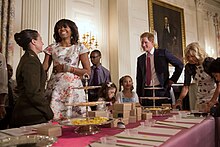

Handmade Mother’s Day gifts
The United States celebrates Mother’s Day on the second Sunday in May. In 1872 Julia Ward Howe called for women to join in support of disarmament and asked for 2 June 1872, to be established as a «Mother’s Day for Peace». Her 1870 «Appeal to womanhood throughout the world» is sometimes referred to as Mother’s Day Proclamation. But Howe’s day was not for honouring mothers but for organizing pacifist mothers against war. In the 1880s and 1890s there were several further attempts to establish an American «Mother’s Day», but these did not succeed beyond the local level.[176]
In the United States, Mother’s Day remains one of the biggest days for sales of flowers, greeting cards, and the like; Mother’s Day is also the biggest holiday for long-distance telephone calls.[177] Moreover, churchgoing is also popular on Mother’s Day, yielding the highest church attendance after Christmas Eve and Easter. Many worshippers celebrate the day with carnations, coloured if the mother is living and white if she is dead.[11][178]
Mother’s Day continues to be one of the most commercially successful U.S. occasions.[179]
It is possible that the holiday would have withered over time without the support and continuous promotion of the florist industries and other commercial industries. Other Protestant holidays from the same time, such as Children’s Day and Temperance Sunday, do not have the same level of popularity.[180]
See also
- International Mother’s Day Shrine
- International Women’s Day
- Father’s Day
- List of films set around Mother’s Day
- May crowning
- Why Mom Deserves a Diamond contest
Notes
Footnotes
Citations
Enstam, Elizabeth York. «The Dallas equal suffrage association, political style, and popular culture: grassroots strategies of the Woman Suffrage Movement, 1913–1919.» Journal of Southern History 68.4 (2002):817+. Student Resources in Context. Web. 14 November 2014.
References
- ^ a b c d O’Reilly, Andrea (6 April 2010). Encyclopedia of Motherhood. Sage Publications (CA). p. 602. ISBN 978-1-4522-6629-9.
She organized the first official Mother’s Day service at Andrews Methodist Church in Grafton, West Virginia, on the morning of May 10, 1908. That same afternoon, 15,000 people attended a Mother’s Day service at the Wanamaker Store Auditorium in Philadelphia, which she also organized. Jarvis chose the second Sunday in May for Mother’s Day to mark the anniversary of her mother’s death and selected her mother’s favorite flower, the white carnation, as the day’s official emblem.
- ^ L. James Grold (April 1968), «Mother’s Day», American Journal of Psychiatry, 124 (10): 1456–1458, doi:10.1176/ajp.124.10.1456, PMID 5643668,
Mother’s Day, conceived by Anna Jarvis to honor unselfish mothers (…) Although there is no direct lineal descent to our modern Mother’s Day custom, secular and religious motherhood have existed for thousands of years before 10 May 1908: the first church – St. Andrew’s in Grafton, West Virginia – responded to her request for a Sunday service honoring mothers . Cybele (…)
- ^ Tuleja, Tad (1999), Curious Customs: The Stories Behind 296 Popular American Rituals, Galahad Books, p. 167, ISBN 978-1578660704,
Although attempts have been made to link Mother’s Day to ancient cults of the mother goddess, especially the worship of Cybele, the association is more conceptual than historic. Mother’s Day is a modern, American invention.
- ^ Robert J. Myers, Hallmark Cards (1972), Celebrations; the complete book of American holidays, Doubleday, p. 143, ISBN 9780385076777,
Our observance of Mother’s Day is little more than half a century old [this was written in 1972], yet the nature of the holiday makes it seem as if it had its roots in prehistoric times. Many antiquarians, holiday enthusiasts, and students of folklore have claimed to find the source of Mother’s Day in the ancient spring festivals dedicated to the mother goddess, particularly the worship of Cybele.
- ^ Helsloot 2007, p. 208 «The American origin of the Day, however, was duly acknowledged. ‘The idea is imported,. America led the way.'»
- ^ a b c d Mothering Sunday, BBC, retrieved 4 March 2010
- ^ a b «Mother’s Day 2016: Which countries celebrate it on 8 May – and why?». The Independent. 8 May 2016.
- ^ Mother’s Day 2017, The Daily Telegraph
- ^ Trammell, Kendall. «Mother’s Day founder later came to regret it». CNN. Retrieved 13 May 2018.
- ^ a b Dunning, Andrew (26 March 2017). «The medieval origins of Mothering Sunday». Medieval manuscripts blog. The British Library.
- ^ a b Kaag, John; Cleary, Skye C. (10 May 2018). «Nietzsche Wishes You an Ambivalent Mother’s Day». The Paris Review. Retrieved 13 May 2018.
- ^ Matthew (8 May 2015). «History of Mother’s Day as a Day of Peace: Julia Ward Howe». The Peace Alliance. Retrieved 10 May 2020.
- ^ «Engaging Families – U.S. Department of Education». www2.ed.gov. 14 December 2017.
- ^ Panati, Charles (2016). Panati’s Extraordinary Origins of Everyday Things. Book Sales. p. 59. ISBN 978-0785834373.
- ^ Antolini, Katharine Lane (2010). «Jarvis, Anna». Encyclopedia of Motherhood. Sage. p. 602. ISBN 978-1412968461.
- ^ Connie Park Rice; Marie Tedesco (2015). Women of the Mountain South: Identity, Work, and Activism. Ohio University Press. pp. 29–. ISBN 978-0-8214-4522-8.
- ^ a b c Lois M. Collins (6 May 2014). «Mother’s Day 100-year history a colorful tale of love, anger and civic unrest». Deseret News. Archived from the original on 12 May 2019. Retrieved 7 May 2014.
- ^ a b «Hallmark celebrates 100th year of Mother’s Day, started by a woman who grew to despise it». kansas.com. Archived from the original on 5 July 2014. Retrieved 7 May 2014.
- ^ Diller, Harriett (1990). Celebrations That Matter: A Year-Round Guide to Making Holidays Meaningful. Augsburg. p. 35. ISBN 978-0-8066-2498-3.
In England, Mothering Sunday is a day to honor both your mother church and your own mother. In the past, young people working away from home visited their mothers and the churches where they were baptized on Mothering Sunday.
- ^ Pearson, Sharon Ely; Szoke, Robyn (2009). The Prayer Book Guide to Christian Education, Third Edition. Church Publishing. p. 49. ISBN 978-0-8192-2337-1.
Mothering Sunday – In England children away from home at school or work were permitted to go home to visit their mothers and/or to visit their cathedral or mother church on this fourth Sunday of Lent. Today, many cathedrals and «mother» churches invite all who had been baptized there to return «home» to worship.
- ^ a b Smith, C. Penswick (1921). The Revival of Mothering Sunday. London: SPCK.
- ^ Smith, Constance Penswick (1926). A short history of Mothering Sunday (mid-Lent) (3 ed.). Nottingham.
- ^ Moyse, Cordelia. «Smith, Constance Adelaide [pseud. C. Penswick Smith]». Oxford Dictionary of National Biography (online ed.). Oxford University Press. doi:10.1093/ref:odnb/103415. (Subscription or UK public library membership required.)
- ^ Compare footnote 51 in LaRossa, Ralph (1997). The Modernization of Fatherhood: A Social and Political History. University of Chicago Press. p. 272. ISBN 978-0226469041. Retrieved 28 April 2016.
Technically, at least, Mother’s Day was ‘owned’ by Jarvis. She managed not only to incorporate the Mother’s Day International Association but also to register ‘Second Sunday in May, Mother’s Day, Anna Jarvis, Founder,’ as the organization’s trademark.
- ^ Louisa Taylor, Canwest News Service (11 May 2008). «Mother’s Day creator likely ‘spinning in her grave’«. The Vancouver Sun. Canada. Archived from the original on 14 May 2008. Retrieved 7 July 2008.
- ^ House Vote No. 274 (7 May 2008) H. Res. 1113: Celebrating the role of mothers in the United States and supporting the goals and ideals of Mother’s Day (Vote On Passage)
- ^ House Vote No. 275 (7 May 2008) Table Motion to Reconsider: H RES 1113 Celebrating the role of mothers in the United States and supporting the goals and ideals of Mother’s Day
- ^ Presidential proclamations from The American Presidency Project:
- 71 – Proclamation 2083 – Mother’s Day Proclamation, Franklin D. Roosevelt, 3 May 1934.
- Proclamation 3535 Mother’s Day, 1963 John F. Kennedy, 26 April 1963.
- Proclamation 3583 – Mother’s Day, 1964 Lyndon B. Johnson, 23 April 1964
- Proclamation 4437 – Mother’s Day, 1976, Gerald Ford, 5 May 1976.
- Proclamation 5801 – Mother’s Day, 1988 Archived 24 September 2015 at the Wayback Machine, Ronald Reagan, 26 April 1988.
- Proclamation 6133 – Mother’s Day, 1990, George Bush, 10 May 1990
- Proclamation 6559 – Mother’s Day, 1993, Bill Clinton, 7 May 1993.
- Proclamation 8253 – Mother’s Day, 2008, George W. Bush, 8 May 2008.
- ^ Ebaugh, Helen Rose; Chafetz, Janet Saltzman (2000). Religion & the New Immigrants: Continuities & Adaptations in Immigrant Congregations. AltaMira Press. p. 357. ISBN 0742503909. Retrieved 9 July 2019.
- ^ a b c Sources for Bolivia:
- «27 de mayo: madres que inspiran valentía». Los Tiempos (in Spanish). 27 May 2009. Archived from the original on 11 June 2009.
- «El Día de la Madre se nutre con la Virgen», La Razón (La Paz) (in Spanish), 27 May 2006, archived from the original on 5 November 2008
- ^ Robert A. Saunders; Vlad Strukov (2010), Historical Dictionary of the Russian Federation, Historical Dictionaries of Europe, Historical dictionaries of French history, vol. 78 (illustrated ed.), Scarecrow Press, p. 246, ISBN 978-0810854758
- ^ «About International Women’s Day». International Women’s Day.
- ^ a b «Bidzina Ivanishvili Congratulates Mothers on Mother’s Day». News Agency InterPressNews (IPN). 3 March 2013. Archived from the original on 22 September 2020.
- ^ a b Ngo, Dong (25 June 2009). «Latest U.S. export to Vietnam: Mother’s Day». CNET. Retrieved 7 May 2016.
- ^ a b Allen, Emily; Macphail, Cameron (6 March 2016). «Mother’s Day 2016: Everything you need to know about Mothering Sunday 2016». The Daily Telegraph. Archived from the original on 12 January 2022. Retrieved 6 March 2016.
- ^ a b c d e f g h i j k Sawwan, Ameenah A. (23 March 2016). «A Special Note to Syrian Mothers on Mother’s Day». News Deeply. Archived from the original on 3 June 2016. Retrieved 8 May 2016.
- ^ John MacIntyre (2005), The amazing mom book: real facts, tender tales, and thoughts from the heart about the most important person on Earth, Sourcebooks, p. 7, ISBN 978-1402203558,
Lebanon in the first day of Spring.
- ^ a b «Lamis’ Story – International Women’s Day 2015». Medical Aid for Palestinians. 21 March 2015. Archived from the original on 17 September 2016. Retrieved 8 May 2016.
- ^ El Hamid, Ashraf Abd (22 March 2018). «Why the Arab world celebrates Mother’s Day on March 21». english.alarabiya.net. Retrieved 9 July 2019.
- ^ a b «Romania Celebrates Fathers’ Day On Second Sunday Of May». Mediafax. Bucharest. 4 May 2010. Archived from the original on 29 November 2014. Retrieved 8 May 2016.
- ^ «Días Nacionales en Chile». 8 March 2009. Retrieved 8 April 2013.
- ^ Xinhua from China Daily (16 May 2006). «It’s Mother’s Day». SCUEC online. Archived from the original on 5 March 2009.
- ^ «Principales efemérides. Mes Mayo». Unión de Periodistas de Cuba. Archived from the original on 9 June 2008. Retrieved 7 June 2008.
- ^ a b c d e f g h Mixed emotions on Women’s Day in Eastern Europe, euractiv.com, 9 March 2010, archived from the original on 11 March 2010
- ^ «Calendario Cívico Escolar». Dirección Regional de Educación de Lima Metropolitana. Archived from the original on 9 September 2015. Retrieved 7 June 2008.
- ^ Kabita Maharana (9 May 2014). «Mother’s Day 2014 to be Celebrated in US and other Countries: Best Quotes to Say ‘Thank You’ to Mum». International Business Times. Retrieved 11 May 2014.
- ^ a b Ministerio de Educación y Cultura de Paraguay, Día de la Madre (in Spanish), archived from the original on 7 July 2012, retrieved 10 March 2010
- ^ Sources:
* «Haiti: Main Holidays». discoverhaiti.com. Archived from the original on 14 October 2008. Retrieved 8 July 2008.
* «6310.- Fêtes et Jours Fériés en Haiti» (in French). Archived from the original on 1 April 2008. Retrieved 8 July 2008. - ^ a b Lic. Pedro Rafael Díaz Figueroa (27 May 1999), «El origen del Día de la Madre», El Nuevo Diario, archived from the original on 14 May 2010
- ^ a b The Council of Ministers of the Republic of Belarus (14 October 2009), Support for mothers remains the key priority of Belarus’ social policy, archived from the original on 30 March 2014, retrieved 7 June 2013
- ^ a b Padre Fabián Castro (3 October 2010). «El día de la madre en el mundo y en la Argentina» (in Spanish). padrefabian.com.ar. Retrieved 13 May 2013.
La cuestión tiene que ver con el calendario litúrgico que la Iglesia Católica utilizaba antes de la reforma producto del Concilio Vaticano II. Allí el 11 de octubre era la festividad de la Maternidad de la Virgen María. (Actualmente se celebra el 1 de enero). Con este motivo era costumbre argentina pasar la celebración litúrgica al domingo anterior o siguiente al 11. Con el lento correr de los años la tradición popular fue fijando como el tercer domingo de octubre la celebración de la Madre y las madres.
- ^ a b Lee Sang Yong (16 December 2014). «North Korea’s Official 2015 Calendar Revealed». Daily NK. Retrieved 13 January 2017.
- ^ a b editorial (8 December 2001), «Bendita Madre», Crítica (in Spanish), archived from the original on 27 September 2011
- ^ a b c seenthing (21 December 2010), Sejarah Perayaan Nasional Hari Ibu 22 Desembe, archived from the original on 22 December 2015, retrieved 8 May 2011
- ^ a b Sources for Israel
:http://www.ynet.co.il/articles/0,7340,L-4801172,00.html - ^ Zhai, Yun Tan (7 May 2016). «Celebrating Mother’s Day? Make Sure You Have The Date Right». NPR. Retrieved 7 May 2016.
- ^ «Mata Tirtha Aunsi today». República. Kathmandu: Nepal Republic Media. 6 May 2016. Archived from the original on 7 May 2016. Retrieved 8 May 2016.
- ^ a b c d e Wendy S. DeBano (2009), «Singing against Silence: Celebrating Women and Music and the Fourth Jasmine Festival», in Laudan Nooshin (ed.), Music and the Play of Power in the Middle East, North Africa and Central Asia, Soas Musicology Series (illustrated ed.), Ashgate Publishing, p. 234 (footnote 18), ISBN 978-0754634577,
In 2002, Fatemeh’s birthday celebration (observed according to the hejri calendar) fell on Thursday 29 August (20 Jamādi 1423) (…) Fatemeh’s birth date is also currently used to mark Mother’s Day in Iran, ritually recollecting, emphasising and reinscribing her role as a loyal mother, wife, and daughter. Prior to the revolution, Mother’s Day was used to promote the gender ideologies of the Pahlavi regime.
- ^ Cordelia Candelaria; Peter J. García (2004). Encyclopedia of Latino popular culture (illustrated ed.). Greenwood Publishing Group. p. 375. ISBN 978-0313332104.
- ^ The Lutheran Standard, Volume 27. Augsburg Publishing House. 1987. p. 23.
- ^ Kennedy, Jon; Schroedel, Jenny; Schroedel, John (2011). Jesus and Mary. East Bridgewater, MA: Adams Media. p. 397. ISBN 978-1572157491.
- ^ «Orthodox Tradition and Mary : University of Dayton, Ohio». udayton.edu. Retrieved 8 May 2021.
- ^ «Islams Women – Status of Mothers in Islam». islamswomen.com. Archived from the original on 26 March 2016. Retrieved 25 March 2016.
- ^ Bennett, James W. (28 April 2014). «The Story of Nepali Mother’s Day». The Transglobalist. Retrieved 12 May 2019.
- ^ Teiser, Stephen F. (1988). The Ghost Festival in Medieval China. Princeton, New Jersey: Princeton University Press. p. 114. ISBN 978-0-691-02677-0.
- ^ «When is Mother’s Day in Albania? What day is Mother’s Day in Albania?». researchmaniacs.com. Retrieved 7 May 2022.
- ^ a b Jehl, Douglas (16 April 1997). «Mustafa Amin, Liberal Editor Jailed by Nasser, Dies at 83». The New York Times. Retrieved 10 March 2013.
- ^ «Mother’s Day in the Arab World».
- ^ Baby Professor (2017). A Special Day for Mommies: Origin of Mother’s Day – Holiday Book for Kids. Speedy Publishing LLC. p. 34. ISBN 978-1541910553. Retrieved 8 July 2019.
- ^ MOTHERS’ DAY. (1910, June 20). Leader (Orange, NSW : 1899–1945), p. 2. http://nla.gov.au/nla.news-article252410359
- ^ «MOTHERS’ DAY.» (1910, June 14). The Daily Telegraph (Sydney, NSW : 1883–1930), p. 5. http://nla.gov.au/nla.news-article239408160
- ^ Where Women’s Interests Meet (1924, May 1). The Sun (Sydney, NSW : 1910–1954), p. 13 (FINAL EXTRA). http://nla.gov.au/nla.news-article223394162
- ^ Traditional Mother’s Day flower in Australia. April 2021. https://www.giftsaustralia.com.au/mothers-day
- ^ «Belarus celebrates Mother’s Day for 15th time. The President congratulated the Belarusian mothers.», Belteleradio, 14 October 2010, archived from the original on 29 September 2014
- ^ «Bhutan celebrates Mother’s Day for 5th time.», Bhutanbroadcastingserviceradio, 8 May 2010
- ^ Taes, Sofie (11 May 2019). «the roots and guises of ‘Mother’s Day’«. Europeana (CC By-SA). Retrieved 13 May 2019.
- ^ «Dia das Mães: shoppings têm promoções especiais». 11 May 2012. Archived from the original on 6 June 2012. Retrieved 13 May 2012.
- ^ Gullion, Katherine (8 May 2019). «Opinion – Mother’s & Father’s Day are exclusionary». CBC.ca. Retrieved 8 July 2019.
- ^ «Mother’s Day Celebrations Around the World». DadShop. Retrieved 6 March 2022.
- ^ a b c «Mother’s Day Popular in China». People’s Daily. 14 May 2001.
- ^ people.com.cn, sina.com.cn (17 June 2008). «Researchers and Experts Propose a Chinese Mother’s Day». All-China Women’s Federation. Archived from the original on 5 March 2009.
- ^ a b «Do we need our own Mother’s Day?». China Daily. 16 May 2007.
- ^ Le, Karen (6 May 2020). «Is There Mother’s Day in China?». Dumpling Connection. Retrieved 7 May 2022.
- ^ Meky, Shounaz (21 March 2017). «How Egypt introduced Mother’s Day to the Arab world». english.alarabiya.net. Retrieved 8 July 2019.
- ^ «Mother’s Day – Holidays». History.com. Retrieved 13 April 2016.
- ^ «Happy Mother’s Day Birtukan!». HuffPost. 17 May 2010. Retrieved 13 April 2016.
- ^ «Mothers Day History ~ The Complete History of Mother’s Day». Mothers Day Central. Archived from the original on 3 March 2016. Retrieved 13 April 2016.
- ^ «Pühade ja tähtpäevade seadus». Retrieved 3 March 2012.
- ^ «Äitienpäivä 2020 — Juhlapyhät.fi». 7 February 2011.
- ^ a b c d Histoire de la fête des mères et celle de «l’Union fraternelle des pères de familles méritants d’Artas», Union des Familles en Europe, archived from the original on 29 April 2011, retrieved 7 May 2011
- ^ Artas, berceau de la Fête des mères, mairie d’Artas
- ^ a b Luc Capdevila (CRHISCO – University of Rennes 2), Fabrice Virgili (IHTP – CNRS), «Guerre, femmes et nation en France (1939–1945) Archived 28 July 2011 at the Wayback Machine», in IRICE.
- ^ «France honours parents who raise large families». The Connexion. 1 March 2016. Retrieved 9 July 2019.
- ^ «Loi no 50-577 du 24 mai 1950 relative à la Fête des mères» [Law No. 50-577 of 24 May 1950 relating to Mother’s Day] (in French). JORF. Retrieved 30 December 2017.
- ^ Weindling, Paul (1993). Health, Race & German Politics Between National Unification & Nazism. Cambridge University Press. p. 423. ISBN 052142397X. Retrieved 9 July 2019.
- ^ a b c d e Michelle Mouton (2007), «From Mother’s Day to Forced Sterilization», From nurturing the Nation to Purifying the Volk: Weimar and Nazi family policy, 1918–1945, Publications of the German Historical Institute (illustrated ed.), Cambridge University Press, pp. 107–152, ISBN 978-0-521-86184-7
- ^ a b Ann Taylor Allen (February 1995), «Reviewed work(s): Muttertag und Mutterkreuz: Der Kult um die «Deutsche Mutter» im Nationalsozialismus, by Irmgard Weyrather», American Historical Review, Frankfurt A.m, 100 (1): 186–187, doi:10.2307/2168063, JSTOR 2168063
- ^ «The origins and traditions of Mother’s Day – Hungarian mothers run the world». Daily New Hungary. 5 May 2019. Retrieved 16 July 2022.
- ^ Kolba, Gergely (5 May 2019). «The origins & traditions of Mother’s Day – Hungarian mothers run the world». dailynewshungary.com. Retrieved 9 July 2019.
- ^ «How to Celebrate Mother’s Day in Hungary». Archived from the original on 17 July 2020. Retrieved 14 July 2020.
- ^ TTN (13 March 2004). «Social change in India discussed». The Times of India. Archived from the original on 27 October 2012.
- ^ «Mother’s Day 2019 Date: When is mother’s day in India 2019?». The Indian Express. 10 May 2019. Retrieved 11 May 2019.
- ^ «When is Mother’s Day 2019? Date, Significance, History and Importance of Mother’s Day». The Times of India. 10 May 2019. Retrieved 11 May 2019.
- ^ Doctor, Vikram (11 May 2019). «Why retailers love mothers so much». The Economic Times. Retrieved 11 May 2019.
- ^ Wardhani, Lynda K. (22 December 2010). «In observance of Mother’s Day». The Jakarta Post.[permanent dead link]
- ^ a b Bulbeck, Chilla (2009). Sex, love and feminism in the Asia Pacific: a cross-cultural study of young people’s attitudes. ASAA women in Asia. London New York: Routledge. ISBN 978-0415470063. Preview.
- ^ a b c Kathryn Robinson (2009), Gender, Islam and Democracy in Indonesia, ASAA women in Asia, Routledge, pp. 3, 36, 44, 72, ISBN 9781134118830
- ^ «Ahmadinejad highlights women’s significant role in society». Presidency of The Islamic Republic of Iran News Service. 24 June 2008. Archived from the original on 16 May 2009. Retrieved 19 July 2008.
(…) the occasion of the Mother’s Day marking the birthday anniversary of Hazrat Fatemeh Zahra (SA), the beloved daughter of Prophet Mohammad. The day fell on 23 June [2008]
- ^ Shahla Haeri (1993). «Obedience versus Autonomy: Women and Fundamentalism in Iran and Pakistan». In Martin E. Marty; R. Scott Appleby; Helen Hardacre; Everett Mendelsohn (eds.). Fundamentalisms and Society: Reclaiming the Sciences, the Family, and Education. The Fundamentalism Project. Vol. 2 (2 ed.). University of Chicago Press. p. 197. ISBN 978-0226508801.
The more women try to engage the fundamentalists in their own discourse, negotiating and bargaining over their rights (Islamic or otherwise), the more frequently has the Islamic regime emphasized the ideal, the Fatimah model, the quintessential obedient woman. The fundamentalist regime in Iran has yet to resolve its central dilemma regarding the role of women and male-female relationships: should women emulate a Zainab – autonomous and assertive – or a Fatimah – obedient and submissive? Given the logic of an Islamic marriage and the worldview it implies, the fundamentalist regime has shown a marked preference for the latter. Thus Woman’s Day and Mother’s Day in Iran are celebrated on the occasion of Fatimah’s birth.
- ^ a b Firoozeh Kashani-Sabet (2011), Conceiving Citizens: Women and the Politics of Motherhood in Iran (illustrated ed.), Oxford University Press, pp. 201–206, ISBN 978-0195308860
- ^ Shahla Haeri (2009), «Women, Religion, and Political Agency in Iran», in Ali Gheissari (ed.), Contemporary Iran:Economy, Society (illustrated ed.), Oxford University Press, p. 137, ISBN 978-0195378481,
Such [feminist] gatherings would not have been so remarkable had they not happened against the backdrop of the regime’s ceaseless effort to discourage, even harass, women activists and their supporters. Within the narrative of Islamization, the state’s argument has been, all along, that such gatherings are representative of the culture of imperialism, and hence are subversive and against the public good and the moral order. Above all, the Islamic State has tried hard to co-opt women by appropriating the terminology and language: «protecting women,» «respect for women,» «gender complementarity.» Accordingly, in order to accommodate, and yet control and channel women’s movements and activities, the state commemorates the birthday of Fatemeh, the Prophet Muhammad’s daughter, as a national woman’s/mother’s day.
- ^ Mahdi, Ali Akbar (2003). «Iranian Women: Between Islamization and Globalization». Iran Encountering Globalization: Problems and Prospects. Ali Mohammadi. London and New York: Routledge/Curzon. ISBN 978-0-415-30827-4. Archived from the original (DOC) on 1 September 2006.
This Shia vision of family is based on a nostalgic and idealistic notion of Imam Ali’s family in which Fatima Zahra (the Prophet Mohammad’s daughter) dedicated herself to both her husband and Islamic cause. Other role models for women often cited by the officials and ideologues of the IRI are Khadijah, the prophet Mohammad’s wife, and Zaynab, daughter of the first Shi’i (sic) Imam Ali. In fact, the IRI [Islamic Republic of Iran] replaced the universal Mother’s Day with Fatima Zahar’s (sic) birthday.
- ^ «The Shiite Interpretation of the Status of Women». Institute for Advanced Study. Retrieved 11 October 2017.
- ^ «How to have an Irish Mother’s Day». IrishCentral.com. 12 May 2019.
- ^ «When is Mother’s Day 2020 in Ireland?». mothers-day.site.
- ^ «Mother’s Day in Ireland». discoveringireland.com.
- ^ de Ceglia, F. P.; Dibattista, L. (2013). Il bello della scienza. Intersezioni tra storia, scienza e arte (in Italian). Milan: Angeli. p. 102. ISBN 978-8856849530.
- ^ Anonymous (1 April 2010), «La Festa DeLLa Mamma», Italian America (in Italian), archived from the original on 12 May 2013 (registration required)
- ^ Raul Zaccari – together with Senators Bellisario, Baldini, Restagno, Piasenti, Benedetti and Zannini. Senato della Repubblica, 78ª Seduta Pubblica, 18 dicembre 1958. «Istituzione de la festa della Mamma.» (Annunzio di presentazione di disegni di legge)
- ^ Bologna, Caroline (9 May 2018). «Mother’s Day Traditions Around The World». huffingtonpost.ca. Retrieved 9 July 2019.
- ^ Светлана Моисеева (17 May 2013). «Президент поздравил кыргызстанцев с Днем матери». Вечерный Бишкек.
19 мая народ Кыргызстана отмечает День матери. Эта памятная дата установлена только в прошлом году, но сразу стала для кыргызстанцев одной из любимых.
- ^ «About International Women’s Day». International Women’s Day. Retrieved 15 February 2017.
- ^ Apollo.lv (13 May 2012). «Šodien sveicam Māmiņas!». Apollo.lv India. Archived from the original on 17 July 2012.
Mātes dienu Latvijā sāka svinēt 1922. gadā, bet ar 1934. gadu tika noteikts, ka šī diena svinama katra maija otrajā svētdienā līdzīgi kā citās Eiropas valstīs. 1938. gadā pēc prezidenta Kārļa Ulmaņa ierosinājuma Mātes dienu sāka dēvēt par Ģimenes dienu, uzsverot mātes lielo lomu ģimenes pavarda veidošanā un uzturēšanā.
- ^ Latvijā atzīmē Mātes dienu Archived 30 March 2014 at the Wayback Machine TVNET
- ^ «National Holidays». Latvia.eu. 2015. Archived from the original on 4 September 2019. Retrieved 9 July 2019.
- ^ a b Newcomer, p. 133
- ^ a b c Sherman, p. 44
- ^ a b Newcomer, pp. 133–134
- ^ a b c Newcomer, p. 134
- ^ Newcomer, 134–135
- ^ a b c Newcomer, 135–136
- ^ a b Newcomer, 136–139
- ^ The History of Mother’s Day from The Legacy Project, a Legacy Center (Canada) website
- ^ «When Is Mother’s Day Celebrated In Mexico?». 7 May 2016. Archived from the original on 11 October 2016. Retrieved 28 September 2016.
- ^ Thompson, Jennifer Trainer (2008). The Joy of Family Traditions: A Season-by-Season Companion to Celebrations, Holidays, & Special Occasions. Celestial Arts. ISBN 978-1587611148. Retrieved 10 July 2019.
- ^ ဘီဘီစီ (18 January 2011). «မြန်မာနိုင်ငံမှာ အမေများနေ့ ကျင်းပ» [Mothers’ day is held in Myanmar.]. BBC Myanmar (in Burmese). Retrieved 19 May 2020.
- ^ Yee Mon (27 January 2016). «Myanmar Mother’s Day Review». Yangon Life. Archived from the original on 4 August 2020. Retrieved 18 May 2020.
- ^ The New Light of Myanmar (5 January 2019). «Yangon University confers Doctor of Letters on Reactor Sayadaw of International Theravada Buddhist Missionary University, Sayagyi U Thukha». Retrieved 18 May 2020.
Because of his organization, the Fullmoon Day of Pyatho has been observed as Mothers» Day since 1997.
- ^ မုဒိတာ (တောင်သာ) (5 January 2019). «ပြာသိုလပြည့် အမေများနေ့» [Mothers’ day, the full moon of Pyatho.]. Myanmar Digital News. Archived from the original on 5 August 2020. Retrieved 18 May 2020.
- ^ J. C. Heesterman; Albert W. Van den Hoek; Dirk H. A. Kolff; Marianne S. Oort (1992). Ritual, State, and History in South Asia: Essays in Honour of J.C. Heesterman. Brill. p. 786. ISBN 978-90-04-09467-3.
- ^ Helsloot 2007, p. 206
- ^ a b c Helsloot 2007, p. 208
- ^ a b c Helsloot 2007, p. 209
- ^ a b Helsloot 2007, p. 210
- ^ Helsloot 2007, p. 213
- ^ Helsloot 2007, p. 211
- ^ «The history of mother’s day». 31 January 2009.
- ^ «Mother’s Day in Norway». 11 May 2010. Retrieved 26 May 2015.
- ^ «World marks Mother’s Day with Utmost Love, Respect». ARY News. 17 May 2016. Retrieved 12 June 2017.
- ^ Penny de Henríquez (9 December 2005), «Origins. La celebración del Día de la Madre», La Prensa (in Spanish), archived from the original on 5 May 2011, retrieved 4 March 2010
- ^ Session of the Honorable Cámara de Senadores. Señor Senador Diego Abente Brun (in Spanish), p. 25[permanent dead link]
- ^ a b «Buscan que se cambie fecha del día de la madre», Radio Viva 90.1 FM Paraguay, 14 May 2008[permanent dead link]
- ^ Municipality of Asuncion (27 July 2008), Hoy miércoles 27 de agosto se inician las acciones de la Comisión de Festejos por el Bicentenario, con una retreta en la Plaza de los Héroes, archived from the original on 10 May 2009
- ^ a b «Proclamation No. 58, s. 1998». Official Gazette. 11 December 1998. Retrieved 1 December 2014.
- ^ Content Manager 03 (1 December 2014). «The First Monday of December is Mother’s Day and Father’s Day». Malacañan Palace (official residence of the President of the Philippines). Archived from the original on 8 December 2014. Retrieved 3 December 2014.
- ^ Постановление ЦК ВКП(б). (8 March 1966). К советским женщинам, обращение ЦК КПСС в связи с Международным днём 8 Марта. (DjVu). Советское искусство (in Russian). p. 4. Retrieved 22 March 2013.
- ^ «About International Women’s Day». International Women’s Day. Retrieved 8 November 2016.
- ^ Балаховская, Л. Г. (1969–1978). Международный женский день 8 марта.. In Введенский, Борис (ed.). «Большая советская энциклопедия» (БСЭ) (in Russian). Москва: Советская энциклопедия. Archived from the original on 20 July 2012.
- ^ «Why is May the Month of Mary?». National Catholic Register. Retrieved 2 March 2018.
- ^ Diario de Valencia, 25 September 1925
- ^ La Opinión: diario independiente de la mañana, 4 October 1926.
- ^ Nueva Alcarria, 5 December 1964.
- ^ Fleurop-Interflora (Suisse) (22 April 2008), La Fête des Mères 2008 ne sera pas reportée (in French)
- ^ Camaron Kao (14 May 2012), «Thousands of believers mark Buddha’s birthday», China Post, archived from the original on 16 June 2013
- ^ Ko Shu-Ling (9 May 2011). «Sakyamuni Buddha birthday celebrated». Taipei Times.
The legislature approved a proposal in 1999 to designate the birthday of Sakyamuni Buddha – which falls on the eighth day of the fourth month of the lunar calendar – a national holiday and to celebrate the special occasion concurrently with International Mother’s Day, which is celebrated on the second Sunday of May.
- ^ «300,000 Attend Buddha Day Ceremonies in 34 Countries». Tzu Chi. 15 May 2012. Archived from the original on 23 May 2012.
- ^ «Tzu Chi Foundation to stage Mother’s Day event», Taipei Times, 4 May 2008
- ^ Caroline Hong (23 May 2004), «Cultural center performs ‘bathing Buddha’ ceremony», Taipei Times
- ^ unsigned (15 May 2006), «Taiwan Quick Take: Tzu Chi celebrates birthday», Taipei Times, p. 3
- ^ «Police chief returns earlier for Mother’s Day». MCOT news. Thai News Agency. 10 August 2012. Archived from the original on 23 July 2011.
(…) an audience with Her Majesty Queen Sirikit on Tuesday on the occasion of her birthday, which is also observed as National Mother’s Day.
- ^ Handwerk, Brian (9 May 2014). «Mother’s Day Turns 100: Its Surprisingly Dark History». National Geographic. Retrieved 9 July 2019.
- ^ a b Paul M. Handley (2006). The King Never Smiles: a biography of Thailand’s Bhumibol Adulyadej. Yale University Press. p. 288. ISBN 9780300106824. (online version)
- ^ «Украз Президента України. Про День Матері» (in Ukrainian). zakon2.rada.gov.ua.
- ^ «Mother’s Day: When is it celebrated and where did it come from?». BBC. 14 March 2021. Retrieved 10 April 2021.
- ^ Higdon, David Leon (1972). «The Wife of Bath and Refreshment Sunday». Papers on Language and Literature. 8 (2): 199–201.
- ^ Bernhard, Virginia (2002). «Mother’s Day». In Joseph M. Hawes; Elizabeth F. Shores (eds.). The family in America: an encyclopedia (3, illustrated ed.). ABC-CLIO. p. 714. ISBN 978-1576072325.
- ^ Barbara Mikkelson, «We love you – call collect». Snopes.com. Retrieved 2010.03.08.
- ^ J. Ellsworth Kalas (2009). Preaching the Calendar: Celebrating Holidays and Holy Days. Westminster John Knox Press. ISBN 978-0664227142.
Church attendance on this day is likely to be third only to Christmas Eve and Easter. Some worshipers still celebrate with carnations, colored if the mother is living and white if she is deceased.
- ^ «Mother’s Day Dining Fact Sheet». National Restaurant Association. 28 April 2006. Archived from the original on 27 June 2017. Retrieved 29 December 2018.
Mother’s Day is the most popular day of the year to dine out, with 38 percent of consumers reporting doing so
- ^ Leigh, p. 256
General
- Schmidt, Leigh Eric (1997). Princeton University Press (ed.). Consumer Rites: The Buying and Selling of American Holidays (reprint, illustrated ed.). pp. 256–275. ISBN 978-0-691-01721-1.
- Larossa, Ralph (1997). University of Chicago Press (ed.). The Modernization of Fatherhood: A Social and Political History (illustrated ed.). University of Chicago Press. pp. 90, 170–192. ISBN 978-0-226-46904-1.
Ann Jarvis OR Anna Jarvis mother’s day.
- Helsloot, John (2007), «10. Vernacular Authenticity: Negotiating Mother’s Day and Father’s Day in the Netherlands», in Margry, Peter Jan; Roodenburg, Herman (eds.), Reframing Dutch Culture: Between Otherness and Authenticity, Progress in European Ethnology (illustrated ed.), Ashgate Publishing, pp. 6–7, 203–224, ISBN 978-0-7546-4705-8
- Newcomer, Daniel (2004). Reconciling Modernity: Urban State Formation in 1940s León, Mexico (illustrated ed.). University of Nebraska Press. pp. 132–139. ISBN 978-0803233492.
- Sherman, John W. (1997). The Mexican Right: The End of Revolutionary Reform, 1929–1940 (illustrated ed.). Greenwood Publishing Group. p. 44. ISBN 978-0275957360.
External links
 Media related to Mother’s Day at Wikimedia Commons
- Anna Jarvis: The woman who regretted creating Mother’s Day, By Vibeke Venema BBC Stories, 10 May 2020.
 Media related to Mother’s Day at Wikimedia Commons
Представлено сочинение на английском языке День матери/ Mother’s Day с переводом на русский язык.
| Mother’s Day | День матери |
| Mother is the most important person in the life of everyone. She gave us the life, she devoted all her life and time to us, she was always near to feed us and take care of us. So for me one of the best holidays is Mother’s Day. | Мама – самый главный человек в жизни каждого. Она дала нам жизнь, посвятила нам всю свою жизнь и время, всегда была рядом, чтобы покормить нас и позаботиться. Поэтому для меня один из самых лучших праздников – День Матери. |
| In Russia we usually celebrate this day on the last Sunday of November. We usually give our mothers flowers and some little presents, some people take their mothers to a restaurant for dinner, we also say very nice words to them. Of course it is not the only day when we should say our mothers about our love and gratitude for everything she has done for us. | В России этот праздник обычно отмечается в последнее воскресенье ноября. Мы дарим мамам цветы, маленькие подарки, некоторые приглашают маму в ресторан на обед, мы обычно говорим им приятные слова. Конечно, это не единственный день, когда мы должны говорить мамам о своей любви и благодарности за все, что она для нас делала. |
| In America Mother’s Day comes on the second Sunday in May. As well as in Russia, in America it is not a national holiday. The holiday was suggested by Anna Jarvis. In 1907, the day was celebrated in a church in Philadelphia. A member of that church had the Sunday morning service to honour her own mother. More and more churches in cities started having a special day to honour mothers. Since 1914, the whole country has celebrated Mother’s day. There is a tradition to wear a red or pink flower if one’s mother is living and a white flower if one’s mother is dead. This wonderful holiday is also celebrated in China, Japan, Canada and most of the European countries. | В Америке День Матери отмечают во второе воскресенье мая. Так же как и в России, это не национальный праздник. Он был предложен Энн Джарвис. В 1907 году этот праздник отметили в церкви в Филадельфии. Член церкви провел утреннюю воскресную службу в честь своей матери. С тех пор больше и больше церквей стали выделять специальный день, чтобы почтить своих матерей. С 1914 года вся страна отмечает День Матери. Существует традиция носить красный или розовый цветок, если ваша мать жива и белый, если ее уже нет с нами. Этот замечательный праздник отмечают также в Китае, Японии, Канаде и других Европейских странах. |
У каждого из нас есть важный человек, которому мы должны быть благодарны всю жизнь. Этот важный человек – наша мама. Она дала нам много любви, терпения, хорошее воспитание и самый важный ее подарок – жизнь. И в память об этом по всему миру отмечают день Матери (Mother’s Day).

Содержание
- Сочинение Mother’s Day
- Вариант 1
- Вариант 2
- Вариант 3
- Слова по теме Mother’s day
Сочинение Mother’s Day
Вариант 1
Mother is the most important person in the life of everyone. She gave us the life, she devoted all her life and time to us, she was always near to feed us and take care of us. So for me one of the best holidays is Mother’s Day.
In Russia we usually celebrate this day on the last Sunday of November. We usually give our mothers flowers and some little presents, some people take their mothers to a restaurant for dinner, we also say very nice words to them. Of course it is not the only day when we should say our mothers about our love and gratitude for everything she has done for us.
In America Mother’s Day comes on the second Sunday in May. As well as in Russia, in America it is not a national holiday. The holiday was suggested by Anna Jarvis. In 1907, the day was celebrated in a church in Philadelphia. A member of that church had the Sunday morning service to honour her own mother. More and more churches in cities started having a special day to honour mothers. Since 1914, the whole country has celebrated Mother’s day. There is a tradition to wear a red or pink flower if one’s mother is living and a white flower if one’s mother is dead. This wonderful holiday is also celebrated in China, Japan, Canada and most of the European countries.
Перевод
Мама – самый главный человек в жизни каждого. Она дала нам жизнь, посвятила нам всю свою жизнь и время, всегда была рядом, чтобы покормить нас и позаботиться. Поэтому для меня один из самых лучших праздников – День Матери.
В России этот праздник обычно отмечается в последнее воскресенье ноября. Мы дарим мамам цветы, маленькие подарки, некоторые приглашают маму в ресторан на обед, мы обычно говорим им приятные слова. Конечно, это не единственный день, когда мы должны говорить мамам о своей любви и благодарности за все, что она для нас делала.
В Америке День Матери отмечают во второе воскресенье мая. Так же как и в России, это не национальный праздник. Он был предложен Энн Джарвис. В 1907 году этот праздник отметили в церкви в Филадельфии. Член церкви провел утреннюю воскресную службу в честь своей матери. С тех пор больше и больше церквей стали выделять специальный день, чтобы почтить своих матерей. С 1914 года вся страна отмечает День Матери. Существует традиция носить красный или розовый цветок, если ваша мать жива и белый, если ее уже нет с нами. Этот замечательный праздник отмечают также в Китае, Японии, Канаде и других Европейских странах.
Вариант 2
Mother’s Day comes on the second Sunday in May. It is a day when Americans honour their mothers. It is not a national holiday. Mother’s Day is an American national observance in honour of motherhood. The holiday, suggested by Anna Jarvis of Philadelphia, was set (1914) by an act of Congress for annual celebration. It is also observed in England and Germany. In 1907, the day was celebrated in a church in Philadelphia, Pensylvania. A member of that church planned the Sunday morning service to honour her own mother. More and more churches in cities and states set aside the day to honour mothers. Since 1914, the whole country has ob-served mother’s day. Most mothers like to celebrate the day with family reunions. Many people send their mothers a card or a gift. Some people take their mothers to a restaurant for dinner. It is a custom to wear a red or pink flower if one’s mother is living. It is the custom to wear a white flower if one’s mother is dead.
Перевод
День матери отмечается во второе воскресенье мая. Это день, когда американцы чтят своих матерей. Это не национальный праздник. День матери – это национальная дань американцев материнству. Праздник, предложенный Анной Джарвис из Филадельфии, в 1914 г. Актом Конгресса было установлено ежегодным. Его также придерживаются в Англии и Германии. В 1907 г. День матери отмечался в церкви Филадельфии – Пенсильвания. Настоятель этой церкви запланировал проведение службы на честь своей матери. Много церквей городов и штатов были в стороне от того, чтобы чествовать матерей. С 1914 г. вся страна отмечала День матери. Большая часть матерей любит праздновать этот день с всей семьей. Многие люди посылают своим матерям открытку или подарок. Некоторые ведут своих матерей в ресторан обедать. Существует обычай носить красные или розовые цветы, если матери живы. И обычай носить белые цветы, если мать умерла.
Вариант 3
Mother’s Day is held on the second Sunday in May of every year. It’s one of the most important commercial holidays in the nation. The holiday is over one hundred years old and was officially declared a federal holiday in 1914. Originally, the holiday was celebrated by hanging a flag to recognize the mothers who had a child who died in war. Today, it has no association with war whatsoever. Mother’s Day is completely apolitical.
Mother’s Day is, just as the name implies, a celebration of everything to do with mothers. It’s common for people to buy expensive gifts for their mothers or, at the very least, to send them a card showing their appreciation. Mother’s Day cards have become among the most commercially successful items associated with the holiday. It’s one of the times of year where card companies are just swamped, more so than other occasions.
In the United States, children will sometimes really go over the top for their mothers on this holiday. This is particularly true of sons. In families where there is more than one son, it’s not uncommon for all of them to compete to get the best gift for their mother. This is truly a day where motherhood is venerated in the United States.
While motherhood is the main theme behind Mother’s Day, people in the United States only celebrate this holiday for their own mothers. It’s rare for people to give Mother’s Day gifts to anybody but their own mother. Some families may include the grandmothers in the celebrations but, by and large, this is a holiday celebrated within the nuclear family. The International Mother’s Day Shrine is an historic landmark in the United States where the inaugural Mother’s Day celebration was held.
Перевод
День матери отмечается во второе воскресенье мая каждого года. Это один из самых важных коммерческих праздников в стране. Празднику более ста лет, и он был официально объявлен федеральным праздником в 1914 году. Изначально праздник отмечался вывешиванием флагов, чтобы признать матерей, у которых дети погибли на войне. Сегодня у него нет никакой связи с войной. День Матери полностью аполитичен.
День матери, как и следует из названия, является празднованием всего, что связано с матерью. Люди обычно покупают дорогие подарки своим матерям или, по крайней мере, отправляют им открытку с благодарностью. Открытки «День матери» стали одними из самых коммерчески успешных предметов, связанных с этим праздником. Это одно из времен года, когда открыточные компании просто завалены, по сравнению с другими случаями.
В Соединенных Штатах дети иногда «идут в атаку» на своих матерей в этот праздник. Это особенно касается сыновей. В семьях, где более одного сына, не редко устраиваются соревнования, кто подарит лучший подарок своей матери. Это день, когда материнство действительно почитается в Соединенных Штатах.
Хотя материнство является главной темой Дня матери, люди в Соединенных Штатах празднуют этот праздник только со своими матерями. Люди редко дарят подарки ко Дню матери кому-то другому, кроме своей собственной матери. В некоторых семьях могут присутствовать бабушки на торжествах, но, по большому счету, это праздник, отмечаемый в близкой семье.
Храм в честь Международного дня матери является исторической вехой в Соединенных Штатах, где состоялось празднование инаугурации Матери.
Слова по теме Mother’s day
- possible [ˈpɒsɪb(ə)l] — возможный;
- to thank [θæŋk] — благодарить;
- everywhere [ˈevrɪ veri] — везде, повсюду;
- try to be — стараться.
- to honor [ˈɒnə®] — чествовать;
- almost [ˈɔːlməʊst] — почти.
Mother’s Day is a holiday honoring motherhood that is observed in different forms throughout the world. In the United States, Mother’s Day 2022 will occur on Sunday, May 8. The American incarnation of Mother’s Day was created by Anna Jarvis in 1908 and became an official U.S. holiday in 1914. Jarvis would later denounce the holiday’s commercialization and spent the latter part of her life trying to remove it from the calendar. While dates and celebrations vary, Mother’s Day traditionally involves presenting moms with flowers, cards and other gifts.
WATCH: Women’s History Documentaries on HISTORY Vault
History of Mother’s Day
Celebrations of mothers and motherhood can be traced back to the ancient Greeks and Romans, who held festivals in honor of the mother goddesses Rhea and Cybele, but the clearest modern precedent for Mother’s Day is the early Christian festival known as “Mothering Sunday.”
Once a major tradition in the United Kingdom and parts of Europe, this celebration fell on the fourth Sunday in Lent and was originally seen as a time when the faithful would return to their “mother church”—the main church in the vicinity of their home—for a special service.
Over time the Mothering Sunday tradition shifted into a more secular holiday, and children would present their mothers with flowers and other tokens of appreciation. This custom eventually faded in popularity before merging with the American Mother’s Day in the 1930s and 1940s.
Ann Reeves Jarvis and Julia Ward Howe
The origins of Mother’s Day as celebrated in the United States date back to the 19th century. In the years before the Civil War, Ann Reeves Jarvis of West Virginia helped start “Mothers’ Day Work Clubs» to teach local women how to properly care for their children.
These clubs later became a unifying force in a region of the country still divided over the Civil War. In 1868 Jarvis organized “Mothers’ Friendship Day,” at which mothers gathered with former Union and Confederate soldiers to promote reconciliation.
Another precursor to Mother’s Day came from the abolitionist and suffragette Julia Ward Howe. In 1870 Howe wrote the “Mother’s Day Proclamation,” a call to action that asked mothers to unite in promoting world peace. In 1873 Howe campaigned for a “Mother’s Peace Day” to be celebrated every June 2.
Other early Mother’s Day pioneers include Juliet Calhoun Blakely, a temperance activist who inspired a local Mother’s Day in Albion, Michigan, in the 1870s. The duo of Mary Towles Sasseen and Frank Hering, meanwhile, both worked to organize a Mothers’ Day in the late 19th and early 20th centuries. Some have even called Hering “the father of Mothers’ Day.”
Anna Jarvis Turns Mother’s Day Into a National Holiday
The official Mother’s Day holiday arose in the 1900s as a result of the efforts of Anna Jarvis, daughter of Ann Reeves Jarvis. Following her mother’s 1905 death, Anna Jarvis conceived of Mother’s Day as a way of honoring the sacrifices mothers made for their children.
Scroll to Continue
After gaining financial backing from a Philadelphia department store owner named John Wanamaker, in May 1908 she organized the first official Mother’s Day celebration at a Methodist church in Grafton, West Virginia. That same day also saw thousands of people attend a Mother’s Day event at one of Wanamaker’s retail stores in Philadelphia.
Following the success of her first Mother’s Day, Jarvis—who remained unmarried and childless her whole life—resolved to see her holiday added to the national calendar. Arguing that American holidays were biased toward male achievements, she started a massive letter writing campaign to newspapers and prominent politicians urging the adoption of a special day honoring motherhood.
By 1912 many states, towns and churches had adopted Mother’s Day as an annual holiday, and Jarvis had established the Mother’s Day International Association to help promote her cause. Her persistence paid off in 1914 when President Woodrow Wilson signed a measure officially establishing the second Sunday in May as Mother’s Day.
READ MORE: Why the Founder of Mother’s Day Turned Against It
Jarvis Decries Commercialized Mother’s Day
Anna Jarvis had originally conceived of Mother’s Day as a day of personal celebration between mothers and families. Her version of the day involved wearing a white carnation as a badge and visiting one’s mother or attending church services. But once Mother’s Day became a national holiday, it was not long before florists, card companies and other merchants capitalized on its popularity.
While Jarvis had initially worked with the floral industry to help raise Mother’s Day’s profile, by 1920 she had become disgusted with how the holiday had been commercialized. She outwardly denounced the transformation and urged people to stop buying Mother’s Day flowers, cards and candies.
Jarvis eventually resorted to an open campaign against Mother’s Day profiteers, speaking out against confectioners, florists and even charities. She also launched countless lawsuits against groups that had used the name “Mother’s Day,” eventually spending most of her personal wealth in legal fees. By the time of her death in 1948 Jarvis had disowned the holiday altogether, and even actively lobbied the government to see it removed from the American calendar.
Mother’s Day Around the World
While versions of Mother’s Day are celebrated worldwide, traditions vary depending on the country. In Thailand, for example, Mother’s Day is always celebrated in August on the birthday of the current queen, Sirikit.
Another alternate observance of Mother’s Day can be found in Ethiopia, where families gather each fall to sing songs and eat a large feast as part of Antrosht, a multi-day celebration honoring motherhood.
In the United States, Mother’s Day continues to be celebrated by presenting mothers and other women with gifts and flowers, and it has become one of the biggest holidays for consumer spending. Families also celebrate by giving mothers a day off from activities like cooking or other household chores.
At times, Mother’s Day has also been a date for launching political or feminist causes. In 1968 Coretta Scott King, wife of Martin Luther King, Jr., used Mother’s Day to host a march in support of underprivileged women and children. In the 1970s women’s groups also used the holiday as a time to highlight the need for equal rights and access to childcare.
READ MORE: Feminism’s Long History
Today, the traditional festival of Mothers Day in England is a great time. On this day children give flowers, sweets, cards and presents to their mother to show their love and care.
The first history of
Mother’s Day
dates back to the ancient spring festival in Greece. The Greeks
celedrated
the festival in honour of
godness
Rhea
(
Рэя
)
,
wife of
Cronus
(
Кронос
)
and the
mother
of many gods.
Mother’s Day
in England people celebrate in March
,
April or May, because
Mother’s Day
celebrations take place on the fourth Sunday in the month of
Lent
(
пост
), so the date for
Mother’s Day
changes every year.
Ресурсы:
http://www.calend.ru/img/content/i0/416_24.gif
http://www.mothersdaycelebration.com/mothers-day-history.html
http://en.wikipedia.org/wiki/Mother’s_Day
http://www.dieterich.k12.il.us/holidays/Mothers_Day/mothers.gif
http://www.oyepictures.com/o/mothers_day/mothers_day_003.gif
http://www.thedailyrock.com/wp-content/uploads/mothers-day.jpg
http://mashondaloyal.com/wp-content/uploads/2012/05/Mothers+Day+Subway+Art+8×10.jpg
http://grandforksgourmet.areavoices.com/files/2012/05/mothers-day-pictures-10.gif
http://schooltwinning.files.wordpress.com/2008/05/mothers-day-0011.jpg
http://www.jucoolimages.com/images/motherday/mothersday_20.gif
http://www.clipartheaven.com/clipart/holidays/mothers-day/kids-mothers-day-clipart.gif
http://0.tqn.com/d/webclipart/1/0/I/X/amom9.gif
http://i.123g.us/c/emay_mothersday_happy/card/110891.gif
http://www.webdesignhot.com/wp-content/uploads/2012/05/Happy-Mothers-Day-with-Hearts.jpg
http://www.ziggityzoom.com/sites/default/files/styles/activity_full/public/Mothers_Day_poem.jpg?itok=18YantBy
http://img.ehowcdn.com/article-new/ehow/images/a00/0f/s5/celebrate-mothers-day-800×800.jpg
http://i910.photobucket.com/albums/ac304/alteredartifacts/free%20printables/mother.jpg
http://2.bp.blogspot.com/-Yzu7Kw2gg5o/TekQINCuWbI/AAAAAAAAAfM/jlbYHEbUGdw/s1600/Joy+of+Motherhood.jpg
http://www.goodlightscraps.com/content/mothers-day/mothers-day-38.gif
http://www.graphics18.com/wp-content/uploads/2009/05/happy-mothers-day-21.gif
http://www.desiglitters.com/wp-content/uploads/2009/10/Family-18.gif
http://img.whynotgif.com/mothers-day/mothers-day-160.gif
http://www.adobeps.ru/images/frames/24.jpg
http://greekroman.ru/img/rea.jpg
http://ps-info.ru/material/ramki/4/img/4-b.jpg
http://mithology.ru/Kibela.html
http://mithology.ru/kibela.jpg
http://www.mamamasi.ru/img/prazdniki/den-materi-225×330.jpg
http://www.heidelbergbakery.com/files/images/mothers%20day%20cake.jpg
http://londonmania.ru
«
Mother’s Day
»
Today
people celebrate Mothers
Day in many countries : the USA, the UK, India, Denmark, Finland, Italy, Turkey, Australia, Mexico, Canada, China, Japan and Belgium.
People give their mothers
flowers
,
presents
and
cards
and thank them for all their love and care.
В Англии (
England
)
традиция праздновать День матери (
Mother’s Day
) началась в самом начале 17 века. В четвертое воскресенье поста люди стали праздновать Воскресенье матери (
Mothering Sunday
). Это был праздник всех матерей Англии. По мере распространение христианства в Европе, это воскресенье стало праздником Матери Церкви
(
Mother Church
).
Со временем церковный праздник слился воедино с праздником светским. Так как это было время богатых аристократов и огромных особняков, большая часть прислуги работала и жила в домах своих хозяев. В Воскресенье матери (
Mothering Sunday
) все слуги получали выходной, они возвращались в свои семьи, чтобы провести этот день со своими матерями. В этот день полагалось навещать матерей и приносить им в подарок «материнский торт» (
Simnel
Cakes
) в обмен на материнское благословление.
Children write poems and draw cards for their mothers.
In
250
BC in Rome there were religious holidays in honour of godness
Cybele
(
Кибела
). These religious holidays lasted 3 days in Match.
Mothering Sunday
sometimes has the name of
Simnel
Sunday
because of the tradition of baking
Simnel
cakes
. It is a special fruit cake with 12 balls of
marzipan
(
марципан
).
They are the symbols of 12 Zodiac signs. The name of this cake comes from a
latin
flour sort.
Сочинение на тему «День матери»на английском языке с переводом на русский язык |
|
Mother’s Day |
День матери |
|
Mother is the most important person in everyone’s life. Her care and love protect a child from the birth and stay with him or her forever. Mothers are happy for our achievements more than anyone else and, at the same time, always are ready to support us in difficult situations or to give a useful advice. While we are children, love and trust to the mother are boundless, but later she becomes also the closest friend. Therefore, almost all the cultures have a special holiday in honor of mothers – Mother’s Day. |
Мама – самый важный человек в жизни каждого. Её забота и любовь защищают ребёнка с рождения и остаются с ним или с ней навсегда. Матери рады нашим достижениям больше, чем кто-либо другой, и в то же время всегда готовы поддержать нас в сложных ситуациях или дать полезный совет. Пока мы дети, любовь и доверие к матери безграничны, но позже она становится ещё и ближайшим другом. Поэтому почти во всех культурах есть особый праздник в честь мам – День матери. |
|
This holiday is celebrated on different dates because its time and sense depend on traditions and history of a nation. The most countries celebrate Mother’s Day on the second Sunday of May (the USA, Italy, Japan, Denmark, etc.), but there are other variants: the last Sunday of November in Russia, the fourth Sunday of Lent in the United Kingdom. Although everywhere people congratulate their mothers personally or by telephone, give flowers and greeting cards to them, the ways of celebrating are various. For example, the Catholic cultures strongly associate this holiday with the worship of the Virgin Mary, so in Italy and Spain people go to church with their mothers. The British bake the traditional fruit cake called Simnel. The German present to their mothers a dozen of red roses with a small souvenir. |
Этот праздник отмечается в разные дни, потому что его время и смысл зависят от традиций и истории того или иного народа. В большинстве стран День матери отмечают во второе воскресенье мая (в США, Италии, Японии, Дании и т.д.), но есть другие варианты: последнее воскресенье ноября в России, четвёртое воскресенье Великого поста в Великобритании. Хотя повсюду люди поздравляют своих матерей лично или по телефону, дарят им цветы и открытки, способы праздновать различны. Например, в католических культурах этот праздник прочно ассоциируется с почитанием Девы Марии, так что в Италии и Испании люди идут со своими матерями в церковь. Британцы пекут традиционный фруктовый торт, который называется Симнел. Немцы дарят матерям дюжину красных роз с небольшим сувениром. |
|
Mother’s Day exists in my country as well. It is a warm and soulful holiday for all ages, not only for children: mothers enjoy presents and flowers, visit congratulatory events, and, of course, spend time with loved ones. |
День матери существует и в моей стране. Это тёплый и душевный праздник для всех возрастов, не только для детей: мамы наслаждаются подарками и цветами, посещают поздравительные мероприятия и, конечно, проводят время с близкими. |
Mother’s
Day.
Выполнила:
Главатских Елена
The history of celebrating Mother’s Day
goes back to ancient times. Then one of the first founders of this holiday were
the Greeks, who worshipped the goddess of earth and fertility Gaia; the Romans,
who worshipped Cybele; as well as the Celts, who honored the goddess Bridget.
In Medieval Europe, the 4th Sunday of Lent
was made Mother’s Sunday. In those troubled times, many poor people worked and
lived with their employers and did not have the opportunity to be at home
often. On this holiday, they were given a day off to visit their mothers and
spend the whole day with them. Over time, this date has changed its meaning,
combining two holidays into one.
Social activist Julia Ward Howe was one of
the founders of modern Mother’s Day. She wrote the Mother’s Day Proclamation in
1870. After that, she held rallies every year in Boston about this holiday.
Probably, 1907 was the most significant
year for Mother’s Day. A teacher from West Virginia, Ann Jarvis, arranged an
official ceremony in memory of her deceased mother because of a sense of guilt
before her mother, because she believed that she did not express her love for
her enough. Ann wrote to all the officials asking them to set an official day
for celebrating Mother’s Day. In the state of Virginia, Mother’s Day was
officially celebrated for the first time in 1910. And already in 1911, this
holiday was celebrated all over America, Canada, Japan, Africa, China.
In Russia, Mother’s Day has been
officially celebrated since 1998, paying special attention to those mothers who
have achieved success in education. Festive concerts are held all over the
country.
At all times, this holiday was considered
the kindest and most beautiful. From childhood to old age, we carry the image
of our mothers, who will always forgive, understand, regret and love, no matter
what. With sincere gratitude on this day, you need to congratulate your mothers
for their endless care, love and inexhaustible patience. All male
representatives congratulate not only their mothers, but also their wives for
giving them the happiness of fatherhood. It is advisable on this day to give
everything that will please mothers, for example, it can be flowers, nice
little things, crafts with your own hands, postcards, souvenirs. Do not forget
about tenderness, attentiveness and affectionate words.
«Mother’s Day»
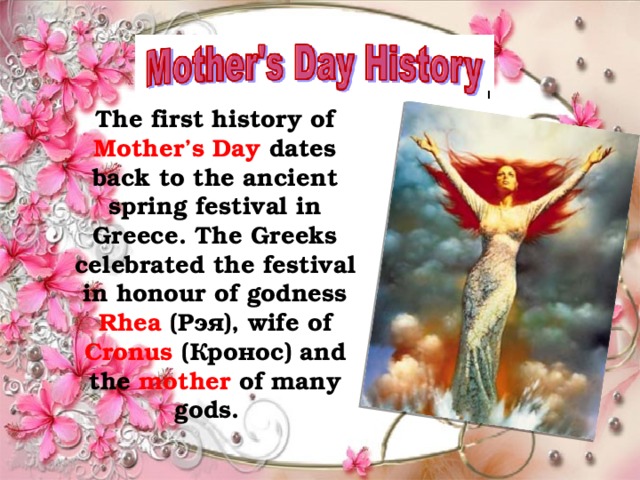
The first history of Mother’s Day dates back to the ancient spring festival in Greece. The Greeks celebrated the festival in honour of godness Rhea (Рэя), wife of Cronus (Кронос) and the mother of many gods.
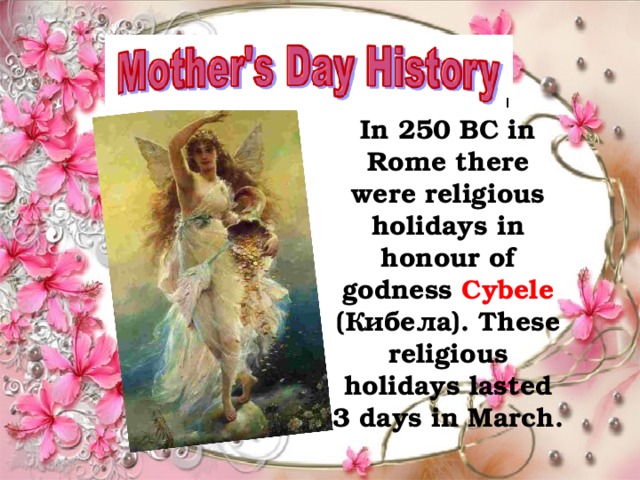
In 250 BC in Rome there were religious holidays in honour of godness Cybele (Кибела). These religious holidays lasted 3 days in March.
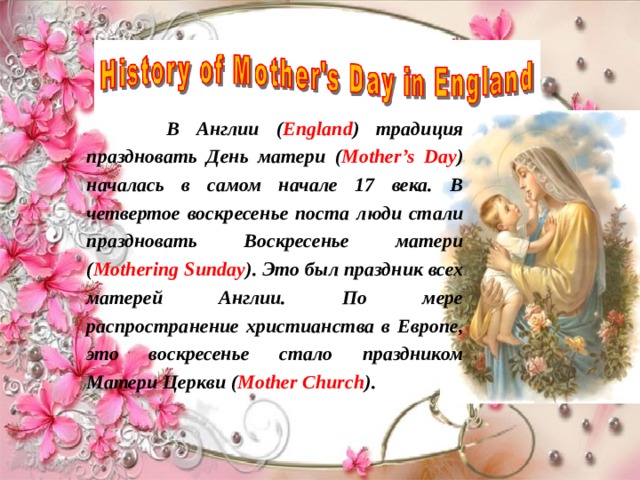
В Англии ( England ) традиция праздновать День матери ( Mother’s Day ) началась в самом начале 17 века. В четвертое воскресенье поста люди стали праздновать Воскресенье матери ( Mothering Sunday ). Это был праздник всех матерей Англии. По мере распространение христианства в Европе, это воскресенье стало праздником Матери Церкви ( Mother Church ).
Со временем церковный праздник слился воедино с праздником светским. Так как это было время богатых аристократов и огромных особняков, большая часть прислуги работала и жила в домах своих хозяев. В Воскресенье матери ( Mothering Sunday ) все слуги получали выходной, они возвращались в свои семьи, чтобы провести этот день со своими матерями. В этот день полагалось навещать матерей и приносить им в подарок «материнский торт» ( Simnel Cakes ) в обмен на материнское благословление.
Today people celebrate Mothers Day in many countries : the USA, the UK, India, Denmark, Finland, Italy, Turkey, Australia, Mexico, Canada, China, Japan and Belgium. People give their mothers flowers , presents and cards and thank them for all their love and care.
Mother’s Day in England people celebrate in March, April or May, because Mother’s Day celebrations take place on the fourth Sunday in the month of Lent (пост), so the date for Mother’s Day changes every year.
Today, the traditional festival of Mothers Day in England is a great time. On this day children give flowers, sweets, cards and presents to their mother to show their love and care.

Mothering Sunday sometimes has the name of Simnel Sunday because of the tradition of baking Simnel cakes . It is a special fruit cake with 12 balls of marzipan (марципан). They are the symbols of 12 Zodiac signs. The name of this cake comes from a latin flour sort.
Children write poems and draw cards for their mothers.
Questions
- When did the tradition to celebrate Mother’s Day begin?
- What people have been doing on this day?
- When do people celebrate Mother’s Day in England?
- What do people do on this day now?
Mother’s Day (Elementary)
День матери — международный праздник в честь матерей (Mother’s Day) . В этот день принято поздравлять матерей и беременных женщин, в отличие от Международного женского дня, когда поздравления принимают все представительницы женского пола.
В разных странах этот день приходится на разные даты. Хотите узнать как отмечают этот праздник в Великобритании?
Warm up activity
Do you know anything about the traditions of celebrating Mother’s Day in Britain?
When is it celebrated?
Reading
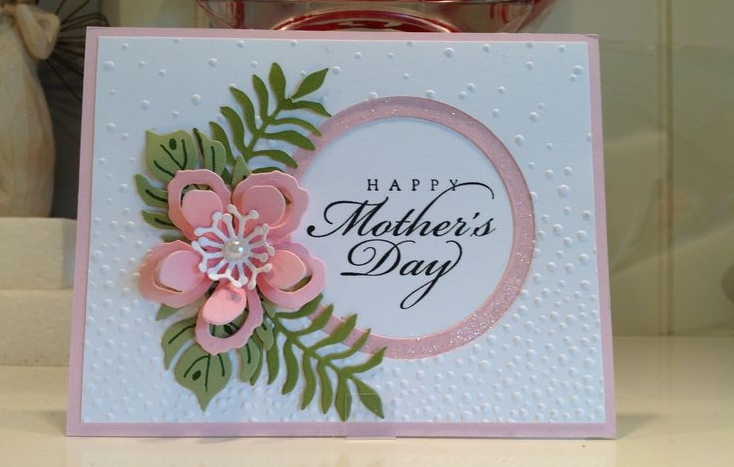
The best present for Moms on Mother’s day is a self-made greeting card.
Read an article and find out interesting facts about Mother’s Day
At the beginning of the 17th century in England on the fourth Sunday of Lent people began to celebrate Mother’s Sunday (Mothering Sunday). It was a holiday of all mothers of England. With the spread of Christianity in Europe, this Sunday was the feast of the Mother of the Church — the spiritual force that gives life and protects from evil.
Over time the Church festival blended together with a secular holiday. As it was a time of rich aristocrats and huge mansions, most of the servants worked and lived in the homes of their owners. On this day all the servants got a day off, they returned to their families to spend the day with their mothers. Festive atmosphere of this day was added by a special cake, called «mother cake». On this day it was supposed to visit mothers and bring them a cake gift in exchange for the mother’s blessing.
Nowadays mother’s Day is pretty calm. Women rest, and their men do housework and cook dinner. Traditionally on this day people serve the Simnel cake (simnel cake), decorated with 12 marzipan balls. The tradition of 12 balls came from pre-Christian times, they symbolize the 12 signs of the zodiac. The name of this cake comes from the Latin name of fine flour (simila). These cakes were baked and sold in England and France on Sundays during Lent. In France, they often baked cakes decorated with a cross of icing with the same recipe.
Sometimes men invite their wives to restaurants to celebrate the event. Children give flowers, cards and other gifts to mothers. It is necessary to congratulate your mother, and wherever they are on this day, daughters and sons call their only closest relatives and family, send them a postcard, letter or electronic message on mother’s Day. Even if you don’t live in England, write or call your parents!
Answer the questions:
When did people begin to celebrate Mother’s Day?
What did people exchange “mother cake” for?
What do people bake on this day?
How do children and family congratulate their mothers?
Listening
Watch the videos on Mother’s Day in the UK
The History of Mother’s Day
A Brief History of Mother’s Day
Discuss the following:
When do you celebrate Mother’s Day in your country?
What do you usually bring your mother as a gift?
Continue the statement “ Mother is a person who …..”
Подпишитесь на наши новые статьи
При отправке возникла ошибка