
Праздники Афродиты принадлежат к числу древнейших на северных берегах Понта. Колонисты, прибывшие сюда из Милета, соблюдали ритуалы, принятые у святилища Афродиты Урании (Небесной), существовавшего в их метрополии уже в VII в. до н. э. Там на скалистом холме над морем высился архаический храм и алтарь богини, остатки которых найдены археологами в конце XX в.[189] Храм Афродиты славился за пределами Милета в эллинистическое время, как можно заключить по стихам из идиллии Феокрита «Прялка» (XVIII, 4). В ней поэт обращается к Зевсу с просьбой, чтобы его морское путешествие в Милет прошло благополучно, когда он отправится к другу в «славный Нелеев град, где в зеленой тени меж тростников виден Киприды храм»[190].
Афродита олицетворяла богиню любви и красоты, которой подвластно все живое: звери, люди и боги, за исключением девственных Афины, Артемиды и Гестии (Hom. Hymn. IV, 1-44). Рожденная из морской пены Афродита считалась также покровительницей мореходов, и ее храмы часто строили на возвышеннности у морского побережья; так их поставили в Милете и в боспорских городах Китее и Нимфее[191]. В народной этимологии имя Афродиты производилось от слова ????? – пена. Это отражено в гомеровском гимне (VI, 3-10) при описании рождения богини из морской пены около Кипра:
Тогда по волнам многозвучным
В пене воздушной пригнало ее дуновенье Зефира
Влажною силой своею. И Оры в златых диадемах,
Радостно встретив богиню, нетленной одели одеждой.
Голову ей увенчали сработанным тонко
Чудно прекрасным венцом и в проколы ушные
Серьги из золотомеди и ценного золота вдели;
Шею прекрасную вместе с серебряно-белою грудью
Ей золотым ожерельем обвили.[192]
Два замечательных аттических фигурных лекифа конца V в. до н. э., найденные в Фанагории и в Пантикапее, иллюстрируют стихи древнего поэта[193]. Афродита представлена в створках перламутровой раковины, плывущей по голубым волнам. На голове богини золотая диадема, шею окружают два золотых ожерелья, а грудь обвита крупными золотыми бусинами, нанизанными на тонкую ленту (рис. 22). Это одно из множества изображений богини на предметах античного искусства, найденных в Северном Причерноморье, показывает, что здесь знали миф о рождении Афродиты из моря.
На Боспоре, в Борисфене и в Ольвии сейчас известны места, где проходили праздники Афродиты. Ее древнейший теменос с храмом и алтарем открыт на Березани[194].Там в середине VI в. до н. э. борисфениты выстроили небольшой антовый храм в традициях милетской архитектуры (рис. 23)[195]. На его развалинах обнаружен набор посвятительных терракот, аналогичный найденному у храма богини в Милете[196]. Это косвенно свидетельствует о сходстве праздника в колонии с его образцом в метрополии.
В Ольвии праздники Афродиты проходили на Западном теменосе и в святилище, находившемся в юго-восточной части города. От последнего уцелела яма-ботрос, куда зарывали поврежденные и вышедшие из употребления ритуальные предметы и дары. Среди них оказались фрагменты трех сосудов V в. до н. э. с надписями-посвящениями Афродите и редчайшая терракотовая плитка с рельефным раскрашенным изображением женской фигуры на синем фоне. Женщина в коротком красном хитоне, украшенном белым орнаментом, танцует перед ложем, аккомпанируя пляске стуком находящихся в ее руках кроталов. Вероятно, это изображение танца, исполнявшегося на празднике Афродиты. Судя по характерным небольшим отверстиям в верхней части плитки, она висела в святилище, пока не разбилась, и тогда ее отправили в ботрос[197].
Другое святилище Афродиты находилось в северо-восточной части Западного теменоса. Уже в VI в. до н. э. оно имело ограду, в V в. до н. э. ольвиополиты поставили там монументальный алтарь для жертвоприношений, а в IV—III вв. до н. э. построили портик и новые алтари[198]. Посвятительные граффити и некоторые изображения свидетельствуют, что здесь справляли праздники в честь Афродиты и Гермеса, считавшегося ее мужем в некоторых вариантах мифов о богине. В дар богам приносили изготовленные в местной мастерской свинцовые рельефы с фигурами Афродиты, Гермеса и их сына Приапа; их считали покровителями семьи[199]. Недавно в Ольвии найдена форма для отливки подобных рельефов[200]. Семь ботросов на территории святилища показывают, сколь многочисленные посвящения подносились этим богам, и говорят о популярности праздников в их честь среди ольвиополитов.
В Элладе Афродита и Гермес зачастую составляли единую пару богов. В эпиграмме, включенной в надпись с острова Книда, Гермес сообщает, что он «явился сюда как спутник Афродиты» (SEG. 861), а Павсаний (VIII, 31, 3), описывая достопримечательности Мегаполиса в Аркадии, упоминает в святилище Афродиты два древних ксоана, представлявших деревянные изваяния богини и Гермеса. Возможно, такой культ с соответствующими праздниками существовал и на Боспоре. Там найдены мраморное изображение Гермеса (двуликая герма), посвященная боспорянином Демархом Афродите Урании в IV в. до н. э. (КБН. 1111), а также расписные вазы с фигурами Афродиты, Гермеса и Эрота, которого, как и Приапа, иногда называли их сыном (Cic. De nat. Deor. 23, 59-60)[201]. К перечисленным изображениям следует добавить фигуры этих богов, вырезанные на инталиях, и терракотовые статуэтки[202]; все они указывают на то, что во время местных праздников Афродиты вспоминали ее мифических сыновей Приапа и особенно часто Эрота, ставшего в эллинистический период постоянным спутником богини.
Главные праздники Афродиты на Боспоре посвящались богине с эпиклезой Урания. Они проходили в нескольких боспорских городах, а самые многолюдные, собиравшие участников из разных частей государства, справляли в главном ее святилище на азиатской части Боспора. В ряде боспорских надписей Афродита Урания имеет определение «владычица Апатура» (КБН. 31, 35, 75, 971, 1111); так называлось место на Таманском полуострове, где находилось ее святилище. Подобными сакральными наименованиями обладали широко почитавшиеся в Ольвии Ахилл, властитель острова Левки (Pind. Nem. IV, 49; IPE I2. 326, 672), и Мать богов, владычица Гилеи[203]. Возможно, милетские колонисты, отправляясь к северным берегам Понта, призвали Афродиту Уранию в свои помощницы и на новой родине продолжали поклоняться ей как покровительнице мореплавания[204].
Святилище Афродиты Апатуры на азиатской стороне Боспора упоминается в сочинениях нескольких античных авторов (Strab. XII, 2, 10; Plin. NH. VI, 18; Ptol. V, 8, 2; Steph. Byz. s. v. ’??????????). Сведения в словаре Стефана Византийского, по его собственным словам, почерпнуты из «Землеописания» Гекатея Милетского и поэтому относятся к рубежу VI-V вв. до н. э. Гекатей писал о заливе Апатур; он получил свое наименование от находившегося около него святилища и был одной из бухт современного Таманского залива, называвшегося в древности Корокондамским озером. К настоящему времени бухта и остатки святилища, по-видимому, исчезли вследствие интенсивного процесса абразии берегов. Исходя из разноречивых данных античных источников, современные исследователи локализуют святилище в окрестностях Фанагории или Гермонассы[205].
В классический и в эллинистический периоды праздники Афродиты Урании, владычицы Апатура, справляли во многих городах Боспора; достоверно известно о филиалах главного святилища в Пантикапее и в Фанагории, где стоял храм богини (Strab. XI, 2, 10; С 495)[206]. В фанагорийском святилище находился храм Афродиты и посвященные ей статуи (КБН. 971, 972). Пантикапейские почитатели Афродиты объединялись в религиозные союзы-фиасы, в функции которых входило и устройство праздников.
Из надписи II в. до н. э. можно узнать, что один такой союз возглавлял синагог Феокрит, сын Деметрия, в фиас входили Паппий, Стратон, Каллистрат и другие, чьи имена плохо сохранились или вовсе утрачены, и поэтому невозможно установить количество его членов (КБН. 75). Они посвятили Афродите Урании Апатуре стелу с рельефным изображением богини на фронтоне, венчающем памятник (рис. 24). Вероятно, рельеф повторяет скульптурное украшение фронтона какого-то боспорского храма Афродиты[207]. Эта стела, наверное, наряду с другими подобными украшала пантикапейское святилище, где проходили праздники Афродиты. В начале надписи сказано, что члены фиаса сделали свое посвящение за царя Перисада, его мать царицу Камасарию и ее мужа Аргота. По предположению В. П. Яйленко, фиас, появившийся на Боспоре еще в конце IV в. до н. э., поддерживал культ правящего монарха, а ритуалы и празднества этого культа находились под эгидой пантикапейского храма Афродиты Урании Апатуры[208].
Археологические материалы из боспорского города Кепы на Таманском полуострове показывают, что там со времени возникновения города вплоть до I в. до н. э. культ Афродиты был ведущим[209], и соответственно праздники богини были главными городскими торжествами. Здесь археологи нашли одно из лучших в Северном Причерноморье мраморных изваяний Афродиты (рис. 25) и фрагмент находившегося в святилище сосуда с именем жреца богини Мольпагора. В конце VI в. до н. э. по его вине разбился килик, посвященный Афродите, и тогда он принес взамен два килика, о чем написал на ножке одного из них[210]. Наверное, из этого сосуда Мольпагор совершал возлияния на празднике богини, во время которого как жрец играл ведущую роль.
В эпоху эллинизма мужчины из царского рода, как уже говорилось выше, играли ведущую роль на праздниках Аполлона, а женщины, связанные узами родства с правящей боспорской династией, становились жрицами Афродиты и исполняли различные ритуалы на ее праздниках. Одно из свидетельств об этом содержится в посвящении Афродите на мраморной базе статуи из Кеп. В. П. Яйленко наиболее удачно восстановил частично утраченную там надпись: «(такая-то, дочь такого-то) исполнявшая обязанности жрицы, жена Спартока, посвятила при архонте Перисаде, сыне Левкона, Афродите». Здесь имеются в виду Перисад I и его внук Спарток IV, правивший в начале III до н. э.; сама же надпись сделана в последние годы царствования Перисада, умершего в 310 г. до н. э.[211]
Другая жрица Афродиты из царского рода участвовала в праздниках богини в Нимфее. Она упомянута в граффито, начертанном на стенах местного святилища богини[212]. Большой культовый архитектурный ансамбль на трех террасах склона возвели в первой половине III до н. э. с расчетом, чтобы святилище было видно из нимфейской гавани и с кораблей, приближающихся с моря[213]. Здесь Афродиту почитали как покровительницу мореплавания, поэтому ее поклонники рисовали на стенах святилища разнообразные суда, писали просьбы о счастливом плавании и отмечали даты выхода кораблей в море. На праздники Афродиты несли фиалки, а вино для жертвоприношений доставляли не только местные жители, но и приезжие[214].
В центральном святилище боспорского города Китея Афродиту тоже чтили в ее морской ипостаси; поэтому ей приносили в дар раковины, устрицы, мидии и убивали во время жертвоприношений морских чаек[215]. А в Пантикапее на праздниках бога морей Посейдона вспоминали также Афродиту в ее морской ипостаси (КБН. 30).
Поклонники Афродиты носили перстни с ее изображением; их обязательно надевали при торжественных нарядах, в которых шли на праздники богини. Несколько подобных перстней с резными инталиями обнаружены в боспорских некрополях[216]. Серебряный перстень IV в. до н. э. с изображением Афродиты вместе двумя эротами, найденный в женском погребении[217], а также ряд посвятительных граффити IV—II вв. до н. э.[218] указывают, что в Херсонесе также проводили праздники этой богини. Возможно, в эллинистический период херсонеситы построили храм Афродиты, но определенное свидетельство о таком храме сохранилось лишь для римского времени (IPE I2. 440).
В конце II—I в. до н. э. праздники Афродиты на Боспоре становились все менее значимыми; на какое-то время их вообще перестали справлять даже в Апатуре, ставшим, по словам Плиния (NH. IV, 18), почти заброшенным, а в Кепах святилище богини лежало в руинах. Вероятно, исчезновению этих праздников способствовала деятельность Митридата Эвпатора, который ввел на Боспоре новый календарь и тем самым изменил всю систему главных местных праздников, сделав ее аналогичной существовавшей в Понте и Вифинии[219]. Ближайшие преемники Митридата на Боспоре также были родом из Понта и продолжали поддерживать новую систему праздников. Положение изменилось в I в. н. э.; тогда святилище Апатур возродилось и просуществовало до конца античности[220], а прежние праздники Афродиты вновь появились и в других боспорских городах, о чем свидетельствует надпись из Гермонассы о восстановлении портиков святилища Афродиты Апатуриады (КБН. 1045).
Эпиклеза Афродиты Апатура встречается не только в боспорских надписях, но и в посвятительных граффити Борисфена и Ольвии[221], что указывает на существование в милетских колониях Северного Причерноморья праздника Апатурий. Его отмечали афиняне и почти все ионийцы; Геродот (I, 147) писал, что из ионийцев лишь жители Эфеса и Колофона не празднуют Апатурии. В милетском календаре месяц Апатурион приходился на октябрь – ноябрь, поэтому праздник с соответствующим названием в Северном Причерноморье справляли осенью, ведь здешние милетские колонии пользовались календарем метрополии[222].
Название праздника Апатурии первоначально, по-видимому, означало «совместный общий праздник отцов фратрии»[223]. Можно с большой долей вероятности предположить, что принятое у ионийцев деление общества на родовые филы, внутри которых выделялось несколько фратрий (братств), существовало также в полисах Северного Причерноморья по крайней мере в начальный период их жизни. Сохранились сведения о филах в некоторых милетских колониях; например, в Истрии названия фил совпадали с милетскими[224]. Все члены фратрии полагали, что они происходят от одного предка. В классический период фратрии стали утрачивать свое политическое значение, но сохраняли роль организации граждан по родственному и религиозному принципу. Некоторые праздники, в том числе Апатурии, каждая фратрия отмечала по отдельности, а на многие государственные торжества фратрии или целые филы выделяли своих представителей на праздничные агоны; чаще всего состязались хоры, составленные из детей и взрослых граждан, принадлежавших к разным филам.
Проведение Апатурий давало повод для ежегодных встреч всех членов фратрии, которые могли жить в разных частях государства. О том, как проходил праздник, известно в основном по его описаниям в Афинах[225]. Там Апатурии справляли осенью в месяце Пианепсионе в течение трех дней. Сначала члены фратрии собирались на совместную праздничную трапезу, а на другой день совершали жертвоприношения. Последний день посвящался детям и подросткам, отцы представляли фратрии детей, родившихся в законном браке после предыдущих Апатурий, и каждый совершал жертвоприношение по определенным для данной фратрии правилам. В таких случаях обычно приносили в жертву овцу или козу, а затем вносили имя ребенка в особые списки; они служили основанием для официального принятия мальчика в равноправные члены братства после совершеннолетия, когда его вновь представляли фратрии и совершали традиционное жертвоприношение. Если кто-нибудь оспаривал законность происхождения ребенка и протестовал против его членства в фратрии, то этот человек отводил от алтаря жертвенное животное, и путем голосования решалось, можно ли внести данного ребенка в список.
Третий день афинских Апатурий включал также состязание мальчиков, читавших наизусть стихи разных поэтов, за что лучшие декламаторы получали награды (Plat. Tim. 21 b). Еще один обряд этого дня состоял в том, что подростки определенного возраста переходили из положения детей в разряд юношей эфебов, обязанных служить в ополчении родины. Они подносили Гераклу большой сосуд с вином и посвящали отрезанный локон своих волос (символ выхода из детства) тому божеству, которому посвящались Апатурии. В разных греческих полисах это были Зевс, Афина, Дионис, а в Северном Причерноморье – Афродита.
В Элладе, а также на Боспоре греки считали, что наименование праздника происходит от слова обман – (?????, и объясняли его происхождение различными рассказами о неких хитростях-обманах, давших повод для названия Апатурий. Таков был, например, миф об обмане, принесшем победу будущему афинскому царю Меланфу в поединке с беотийцем Ксанфом, в память о чем будто-бы справлялись афинские Апатурии[226]. Краткое изложение сюжета боспорского храмового мифа включено в «Географию» Страбона (XI, 2, 10): «Когда на Афродиту здесь напали гиганты, она позвала на помощь Геракла и спрятала его в какой-то пещере; затем, принимая гигантов поодиночке, она отдавала своих врагов Гераклу, чтобы он коварно с обманом убил их». Вероятно, на праздниках боспоряне исполняли написанные на этот сюжет гимны и, может быть, даже разыгрывали драматические сцены, как на других греческих празднествах.
Боспорский миф является вариантом широко известного предания о борьбе богов и гигантов. Его содержание неоднократно анализировалось в научной литературе[227]; наиболее убедительной представляется интерпретация, предложенная Г. А. Кошеленко: исследователь связал местный рассказ с основными концепциями греческого мировоззрения и выделил в нем специфические локальные черты[228].
Миф о борьбе богов и гигантов, закончившийся гибелью последних, рассказывали во всей греческой ойкумене. Судя по изображениям на привозных аттических чернофигурных вазах[229], этот миф в классическом варианте (Apollod. Bibl. I, 6 , 1-2) издавна знали в городах Северного Причерноморья. Однако, его локальная боспорская ветвь сильно отличается от основной версии, так как противниками гигантов выступает не группа богов во главе с Зевсом и Афиной, а только одна Афродита.
Она не играла заметной роли в прочих более широко распространенных вариантах; из сохранившихся литературных источников нельзя даже понять, с каким из гигантов сражалась Афродита, а в сцене гигантомахии на рельефах Парфенона богиня занимает скромное место[230].
Для расправы с гигантами богам оказалась необходимой помощь Геракла. Он участвует и в боспорском мифе, но победа достается ему не в жестокой битве, многократно изображенной античными художниками, а в результате обманных действий Афродиты. Как считали боспоряне, хитрая уловка богини дала повод для ее эпиклезы Апатура, понимавшейся по похожему звучанию слова в значении «обманчивая».
В процессе колонизации у греков появлялись мифы о том, что на освоенных ими землях некогда жили или совершали подвиги эллинские боги или герои. Таким образом оправдывалось право эллинов на владение новыми территориями[231]. Среди главных персонажей подобных мифов часто присутствовал Геракл, ставший своеобразным символом колонизации, борцом с варварами и героем, обозначившим границы расселения греков по всему миру[232]. Из северопричерноморских мифов такого рода лучше всего известно записанное Геродотом (IV, 8-10) предание о происхождении скифов от брака Геракла со змееногой богиней[233].
К числу подобных мифов относится и боспорский рассказ об Афродите и Геракле. Здесь в роли местного хтонического начала выступают гиганты, а уничтожившие их богиня и герой утверждают право эллинов на земли у Боспора Киммерийского. По мнению Г. А. Кошеленко, в мифе также отразились институты того ионийского общества, из которого вышли боспоряне: организация граждан по фратриям и древние ритуалы перехода из одной возрастной группы в другую[234].
Многочисленные изображения Афродиты, найденные в Северном Причерноморье, показывают, какой эту богиню представляли местные греки. В VI-V в. до н. э. ее всегда изображали одетой в длинный хитон и гиматий; она либо стоит, либо сидит на троне, иногда летит на лебеде. В Нижнем Побужье и на Боспоре найдено немало привозных архаических статуэток Афродиты с голубем, служившие приношениями богине[235]. Чаще всего это фигурные лекифы, использовавшиеся во время праздничных ритуалов: на голове статуэтки находится горлышко, в которое наливали благовония. На лице Афродиты играет так называемая архаическая улыбка, длинные волосы локонами вьются вдоль шеи и спины; одна рука опущена, а другая придерживает на груди голубя – символ неба и эпиклезы богини Урания. Редкий образец статуэтки Афродиты Урании IV в. до н. э. найден в Китее: голову богини венчает калаф с надетой на него диадемой, к этому сложному головному убору прикреплены крылья большой птицы, наверное, лебедя[236].
В традиционном виде Афродита Урания Апатура продолжала существовать в воображении боспорян и в эллинистический период, когда в Элладе иконографический образ богини претерпел значительные изменения. Афродита Урания, летящая на лебеде, представлена на круглой золотой подвеске конца IV – начала III в. до н. э., найденной при раскопках дома на Елисаветовском городище на Нижнем Дону[237]. Судя по низкому качеству оттиска рельефа, он исполнен с помощью многократно использовавшейся формы, так что перед нами предмет массового производства. Афродита представлена сидящей боком на лебеде с распростертыми крыльями; она одета в хитон и развевающийся во время полета плащ, который придерживает одной рукой. Медальон имеет петельку для подвешивания, поэтому его могли либо носить в качестве украшения, либо подарить в святилище и повесить на стенку рядом с другими дарами.
Тот же сюжет украшает верхнюю часть упомянутой выше стелы II в. до н. э., посвященной богине членами ее фиаса в Пантикапее: Афродита сидит на летящем лебеде, держа в руке скипетр, справа находится небольшая фигурка Эрота, а по бокам две Ники (рис. 24). Вероятно, это одно из многих вольных повторений скульптуры, исполненной в мастерской Фидия[238].
С конца V в. до н. э. и особенно в период эллинизма Афродита во всей греческой ойкумене стала в первую очередь олицетворять богиню любви и красоты. Знаменитые скульпторы и живописцы начали ее изображать сначала полуобнаженной, затем и совершенно нагой. Особенно прославилась мраморная статуя Праксителя, стоявшая в храме на острове Книде. Плиний (NH. XXXVI, 20), назвавший ее лучшей скульптурой в мире, писал, что многие отправлялись на Книд только для того, чтобы увидеть это гениальное произведение. Глядя на статую, все понимали, почему в знаменитом мифе о суде Париса Афродита победила Афину и Геру. Философ Платон под впечатлением от творения Праксителя написал две эпиграммы:
В Книд чрез пучину морскую пришла Киферея-Киприда,
Чтобы взглянуть на свою новую статую там,
И, осмотрев ее всю, на открытом стоящую месте,
скрикнула: « Где же нагой видел Пракситель меня?»
Нет, не Пракситель тебя, не резец изваял, а сама ты
Нам показалась такой, как ты была на суде[239].
Не меньшей славой пользовалась картина Апеллеса, нарисовавшего Афродиту Анадиомену (выходящую из моря). Леонид Тарентский (III в. до н. э.) так описал эту картину:
Киприду, вставшую из лона вод
И мокрую еще от пены, Апеллес
Не написал здесь, нет! – воспроизвел живой,
Во всей ее пленительной красе. Смотри:
Вот руки подняла, чтоб выжать волосы,
И взор уже сверкает страстью нежною,
И – знак расцвета – грудь кругла, как яблоко.
Афина и жена Кронида говорят:
«О Зевс, побеждены мы будем в споре с ней»[240].
Вдохновленный картиной Апеллеса, скульптор Полихарм сделал статую Афродиты Анадиомены. Как и произведение Праксителя, она в разнообразных вольных копиях воспроизводилась в течение нескольких столетий. Особенно часто эти изваяния повторяли в мелких статуэтках и рельефах, широко распространенных почти во всех греческих государствах, в том числе и в Северном Причерноморье. Среди них круглый терракотовый медальон из Китея иллюстрирует слова Леонида Тарентского о том, что Апеллес нарисовал богиню в момент, когда она, выйдя из моря, выжимала мокрые волосы[241].
Традиционный образ Афродиты Анадиомены представлен на импортной терракотовой статуэтке из пантикапейского некрополя[242]. В Ольвии и на Боспоре найдены различные варианты Анадиомены, достаточно далеко отступившие от оригинала и изображающие ее на фоне покрывала или раковины[243]. Многочисленные статуэтки Афродиты с дельфином (символом моря) у ног также относят к типу Анадиомены[244]. Обнаженная богиня обычно имеет разнообразные украшения: серьги, ожерелья, ленты, скрепленные на груди круглым медальоном, браслеты на руках, а иногда и на ногах.
Изменения в образе Афродиты не могли не отразиться на характере ее культа и праздников в ее честь. Наверное, богиню с эпиклезой ??????? (сладкая, милая или приветливая) прославляли как олицетворение любви и красоты на ее ольвийском празднике, во время которого совершались жертвоприношения на посвященном ей алтаре (НО. 69). При этом ольвиополиты продолжали справлять праздники Афродиты как покровительницы мореплавания (НО. 68; IPE I2. 168), имевшей эпиклезы ?????? (морская) и ??????? (обеспечивающая счастливое плавание). В III в. до н. э. ольвийский жрец Афродиты Понтии Агрот поставил мраморный алтарь и украсил святилище посвященным богине золотым венком (НО. 68).
Итак, праздники Афродиты проходили во всех греческих государствах Северного Причерноморья, но особо важную роль они приобрели на Боспоре. Там женщины из царского рода становились жрицами богини, а культ боспорских царей осуществлялся под ее эгидой. Афродита Урания Апатура была патронессой широко распространенного у ионийцев праздника Апатурий, справлявшегося в Ольвии и на Боспоре, начиная с архаического периода. Лапидарные надписи и граффити указывают на то, что на многих праздниках Афродиту прославляли как покровительницу мореплавания. Терракоты, фрагменты каменных скульптур и изображения на ювелирных украшениях свидетельствуют, что в Северном Причерноморье, как и во всем греческом мире, Афродиту считали богиней любви и красоты. Это, наверное, особенно в эллинистический период, отражалось и на характере ее празднеств, приобретавших новые черты по сравнению с теми, которые принесли колонисты из метрополии.
Перейти к содержанию

Боги Греции
Праздники Афродиты
В данной реконструкции Аттического календаря, даты примерно соответствуют современному Григорианскому. Дни праздников ежегодно пересчитываются с учетом фаз луны и дополнительным месяцем (Посидео́н). Технология расчёта принадлежит Профессору Университета Западной Аттики Markos Dendrinos.
Праздники Афродиты
Афродизии — праздник Афродиты — 4 Гекатомбеон (02 июля 2022 года)
Этот фестиваль проводился в честь Афродиты Пандемос, богини чувственного удовольствия. Эпитет “Пандемос” противопоставлен эпитету “Урания” (небесная).
Праздники Эроса
Эротидии — Праздник Эрота — 4 Мунихиона (05 апреля 2022 года)
Эротидии являются древнегреческим праздником-фестивалем. Они пышно праздновались в Феспиях, и были посвящены богу страстной, чувственной любви (если точнее
| Aphrodite | |
|---|---|
|
Goddess of love, beauty, and sexuality |
|
| Member of the Twelve Olympians | |
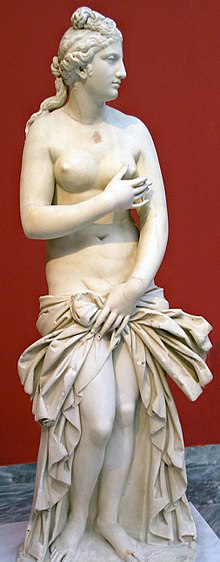
Aphrodite Pudica (Roman copy of 2nd century AD), National Archaeological Museum, Athens |
|
| Abode | Mount Olympus |
| Planet | Venus |
| Animals | dolphin, sparrow, dove, swan, hare, goose, bee, fish, butterfly |
| Symbol | rose, seashell, pearl, mirror, girdle, anemone, lettuce, narcissus |
| Tree | myrrh, myrtle, apple, pomegranate |
| Day | Friday (hēméra Aphrodítēs) |
| Personal information | |
| Parents | Zeus and Dione (according to Homer)[1] Uranus (according to Hesiod)[2] |
| Siblings | The Titans, the Hecatoncheires, the Cyclopes, The Meliae, the Erinyes, the Giants (as daughter of Uranus) or Aeacus, Angelos, Apollo, Ares, Artemis, Athena, Dionysus, Eileithyia, Enyo, Eris, Ersa, Hebe, Helen of Troy, Hephaestus, Heracles, Hermes, Minos, Pandia, Persephone, Perseus, Rhadamanthus, the Graces, the Horae, the Litae, the Muses, the Moirai (as daughter of Zeus) |
| Consort | Hephaestus (divorced) Ares (unmarried consort) |
| Children | Eros, Phobos, Deimos, Harmonia, Pothos, Anteros, Himeros, Hermaphroditus, Rhodos, Eryx, Peitho, The Graces, Priapus, Aeneas |
| Equivalents | |
| Roman equivalent | Venus |
| Norse equivalent | Freyja |
| Etruscan equivalent | Turan |
| Hinduism equivalent | Rati |
| Canaanite equivalent | Astarte |
| Babylonian equivalent | Ishtar |
| Sumerian equivalent | Inanna |
| Zoroastrian equivalent | Anahita |
| Egyptian equivalent | Hathor |
Aphrodite ( AF-rə-DY-tee; Greek: Ἀφροδίτη, translit. Aphrodítē; Attic Greek pronunciation: [a.pʰro.dǐː.tɛː], Koine Greek: [a.ɸroˈdi.te̝], Modern Greek: [a.froˈði.ti]) is an ancient Greek goddess associated with love, lust, beauty, pleasure, passion, and procreation. She was syncretized with the Roman goddess Venus. Aphrodite’s major symbols include myrtles, roses, doves, sparrows, and swans. The cult of Aphrodite was largely derived from that of the Phoenician goddess Astarte, a cognate of the East Semitic goddess Ishtar, whose cult was based on the Sumerian cult of Inanna. Aphrodite’s main cult centers were Cythera, Cyprus, Corinth, and Athens. Her main festival was the Aphrodisia, which was celebrated annually in midsummer. In Laconia, Aphrodite was worshipped as a warrior goddess. She was also the patron goddess of prostitutes, an association which led early scholars to propose the concept of «sacred prostitution» in Greco-Roman culture, an idea which is now generally seen as erroneous.
In Hesiod’s Theogony, Aphrodite is born off the coast of Cythera from the foam (ἀφρός, aphrós) produced by Uranus’s genitals, which his son Cronus had severed and thrown into the sea. In Homer’s Iliad, however, she is the daughter of Zeus and Dione. Plato, in his Symposium, asserts that these two origins actually belong to separate entities: Aphrodite Ourania (a transcendent, «Heavenly» Aphrodite) and Aphrodite Pandemos (Aphrodite common to «all the people»).[3] Aphrodite had many other epithets, each emphasizing a different aspect of the same goddess, or used by a different local cult. Thus she was also known as Cytherea (Lady of Cythera) and Cypris (Lady of Cyprus), because both locations claimed to be the place of her birth.
In Greek mythology, Aphrodite was married to Hephaestus, the god of fire, blacksmiths and metalworking. Aphrodite was frequently unfaithful to him and had many lovers; in the Odyssey, she is caught in the act of adultery with Ares, the god of war. In the First Homeric Hymn to Aphrodite, she seduces the mortal shepherd Anchises. Aphrodite was also the surrogate mother and lover of the mortal shepherd Adonis, who was killed by a wild boar. Along with Athena and Hera, Aphrodite was one of the three goddesses whose feud resulted in the beginning of the Trojan War and she plays a major role throughout the Iliad. Aphrodite has been featured in Western art as a symbol of female beauty and has appeared in numerous works of Western literature. She is a major deity in modern Neopagan religions, including the Church of Aphrodite, Wicca, and Hellenismos.
Etymology
Hesiod derives Aphrodite from aphrós (ἀφρός) «sea-foam»,[4] interpreting the name as «risen from the foam»,[5][4] but most modern scholars regard this as a spurious folk etymology.[4][6] Early modern scholars of classical mythology attempted to argue that Aphrodite’s name was of Greek or Indo-European origin, but these efforts have now been mostly abandoned.[6] Aphrodite’s name is generally accepted to be of non-Greek, probably Semitic, origin, but its exact derivation cannot be determined.[6][7]
Scholars in the late nineteenth and early twentieth centuries, accepting Hesiod’s «foam» etymology as genuine, analyzed the second part of Aphrodite’s name as *-odítē «wanderer»[8] or *-dítē «bright».[9][10] More recently, Michael Janda, also accepting Hesiod’s etymology, has argued in favor of the latter of these interpretations and claims the story of a birth from the foam as an Indo-European mytheme.[11][12] Similarly, Krzysztof Tomasz Witczak proposes an Indo-European compound *abʰor- «very» and *dʰei- «to shine», also referring to Eos,[13] and Daniel Kölligan has interpreted her name as «shining up from the mist/foam».[14] Other scholars have argued that these hypotheses are unlikely since Aphrodite’s attributes are entirely different from those of both Eos and the Vedic deity Ushas.[15][16]
A number of improbable non-Greek etymologies have also been suggested. One Semitic etymology compares Aphrodite to the Assyrian barīrītu, the name of a female demon that appears in Middle Babylonian and Late Babylonian texts.[17] Hammarström[18] looks to Etruscan, comparing (e)prθni «lord», an Etruscan honorific loaned into Greek as πρύτανις.[19][7][20] This would make the theonym in origin an honorific, «the lady».[19][7] Most scholars reject this etymology as implausible,[19][7][20] especially since Aphrodite actually appears in Etruscan in the borrowed form Apru (from Greek Aphrō, clipped form of Aphrodite).[7] The medieval Etymologicum Magnum (c. 1150) offers a highly contrived etymology, deriving Aphrodite from the compound habrodíaitos (ἁβροδίαιτος), «she who lives delicately», from habrós and díaita. The alteration from b to ph is explained as a «familiar» characteristic of Greek «obvious from the Macedonians».[21]
Origins
Near Eastern love goddess

Late second-millennium BC nude figurine of Ishtar from Susa, showing her wearing a crown and clutching her breasts

Early fifth-century BC statue of Aphrodite from Cyprus, showing her wearing a cylinder crown and holding a dove
The cult of Aphrodite in Greece was imported from, or at least influenced by, the cult of Astarte in Phoenicia,[22][23][24][25] which, in turn, was influenced by the cult of the Mesopotamian goddess known as «Ishtar» to the East Semitic peoples and as «Inanna» to the Sumerians.[26][24][25] Pausanias states that the first to establish a cult of Aphrodite were the Assyrians, followed by the Paphians of Cyprus and then the Phoenicians at Ascalon. The Phoenicians, in turn, taught her worship to the people of Cythera.[27]
Aphrodite took on Inanna-Ishtar’s associations with sexuality and procreation.[28] Furthermore, she was known as Ourania (Οὐρανία), which means «heavenly»,[29] a title corresponding to Inanna’s role as the Queen of Heaven.[29][30] Early artistic and literary portrayals of Aphrodite are extremely similar on Inanna-Ishtar.[28] Like Inanna-Ishtar, Aphrodite was also a warrior goddess;[28][23][31] the second-century AD Greek geographer Pausanias records that, in Sparta, Aphrodite was worshipped as Aphrodite Areia, which means «warlike».[32][33] He also mentions that Aphrodite’s most ancient cult statues in Sparta and on Cythera showed her bearing arms.[32][33][34][28] Modern scholars note that Aphrodite’s warrior-goddess aspects appear in the oldest strata of her worship[35] and see it as an indication of her Near Eastern origins.[35][36]
Nineteenth century classical scholars had a general aversion to the idea that ancient Greek religion was at all influenced by the cultures of the Near East,[37] but, even Friedrich Gottlieb Welcker, who argued that Near Eastern influence on Greek culture was largely confined to material culture,[37] admitted that Aphrodite was clearly of Phoenician origin.[37] The significant influence of Near Eastern culture on early Greek religion in general, and on the cult of Aphrodite in particular,[38] is now widely recognized as dating to a period of orientalization during the eighth century BC,[38] when archaic Greece was on the fringes of the Neo-Assyrian Empire.[39]
Indo-European dawn goddess
Some early comparative mythologists opposed to the idea of a Near Eastern origin argued that Aphrodite originated as an aspect of the Greek dawn goddess Eos[40][41] and that she was therefore ultimately derived from the Proto-Indo-European dawn goddess *Haéusōs (properly Greek Eos, Latin Aurora, Sanskrit Ushas).[40][41] Most modern scholars have now rejected the notion of a purely Indo-European Aphrodite,[6][42][16][43] but it is possible that Aphrodite, originally a Semitic deity, may have been influenced by the Indo-European dawn goddess.[43] Both Aphrodite and Eos were known for their erotic beauty and aggressive sexuality[41] and both had relationships with mortal lovers.[41] Both goddesses were associated with the colors red, white, and gold.[41] Michael Janda etymologizes Aphrodite’s name as an epithet of Eos meaning «she who rises from the foam [of the ocean]»[12] and points to Hesiod’s Theogony account of Aphrodite’s birth as an archaic reflex of Indo-European myth.[12] Aphrodite rising out of the waters after Cronus defeats Uranus as a mytheme would then be directly cognate to the Rigvedic myth of Indra defeating Vrtra, liberating Ushas.[11][12] Another key similarity between Aphrodite and the Indo-European dawn goddess is her close kinship to the Greek sky deity,[43] since both of the main claimants to her paternity (Zeus and Uranus) are sky deities.[44]
Forms and epithets


Aphrodite’s most common cultic epithet was Ourania, meaning «heavenly»,[48][49] but this epithet almost never occurs in literary texts, indicating a purely cultic significance.[50] Another common name for Aphrodite was Pandemos («For All the Folk»).[51] In her role as Aphrodite Pandemos, Aphrodite was associated with Peithō (Πείθω), meaning «persuasion»,[52] and could be prayed to for aid in seduction.[52] The character of Pausanias in Plato’s Symposium, takes differing cult-practices associated with different epithets of the goddess to claim that Ourania and Pandemos are, in fact, separate goddesses. He asserts that Aphrodite Ourania is the celestial Aphrodite, born from the sea foam after Cronus castrated Uranus, and the older of the two goddesses. According to the Symposium, Aphrodite Ourania is the inspiration of male homosexual desire, specifically the ephebic eros, and pederasty. Aphrodite Pandemos, by contrast, is the younger of the two goddesses: the common Aphrodite, born from the union of Zeus and Dione, and the inspiration of heterosexual desire and sexual promiscuity, the «lesser» of the two loves.[53][54] Paphian (Παφία), was one of her epithets, after the Paphos in Cyprus where she had emerged from the sea at her birth.[55]
Among the Neoplatonists and, later, their Christian interpreters, Ourania is associated with spiritual love, and Pandemos with physical love (desire). A representation of Ourania with her foot resting on a tortoise came to be seen as emblematic of discretion in conjugal love; it was the subject of a chryselephantine sculpture by Phidias for Elis, known only from a parenthetical comment by the geographer Pausanias.[56]
One of Aphrodite’s most common literary epithets is Philommeidḗs (φιλομμειδής),[57] which means «smile-loving»,[57] but is sometimes mistranslated as «laughter-loving».[57] This epithet occurs throughout both of the Homeric epics and the First Homeric Hymn to Aphrodite.[57] Hesiod references it once in his Theogony in the context of Aphrodite’s birth,[58] but interprets it as «genital-loving» rather than «smile-loving».[58] Monica Cyrino notes that the epithet may relate to the fact that, in many artistic depictions of Aphrodite, she is shown smiling.[58] Other common literary epithets are Cypris and Cythereia,[59] which derive from her associations with the islands of Cyprus and Cythera respectively.[59]
On Cyprus, Aphrodite was sometimes called Eleemon («the merciful»).[49] In Athens, she was known as Aphrodite en kopois («Aphrodite of the Gardens»).[49] At Cape Colias, a town along the Attic coast, she was venerated as Genetyllis «Mother».[49] The Spartans worshipped her as Potnia «Mistress», Enoplios «Armed», Morpho «Shapely», Ambologera «She who Postpones Old Age».[49] Across the Greek world, she was known under epithets such as Melainis «Black One», Skotia «Dark One», Androphonos «Killer of Men», Anosia «Unholy», and Tymborychos «Gravedigger»,[47] all of which indicate her darker, more violent nature.[47]
She had the epithet Automata because, according to Servius, she was the source of spontaneous love.[60]
A male version of Aphrodite known as Aphroditus was worshipped in the city of Amathus on Cyprus.[45][46][47] Aphroditus was depicted with the figure and dress of a woman,[45][46] but had a beard,[45][46] and was shown lifting his dress to reveal an erect phallus.[45][46] This gesture was believed to be an apotropaic symbol,[61] and was thought to convey good fortune upon the viewer.[61] Eventually, the popularity of Aphroditus waned as the mainstream, fully feminine version of Aphrodite became more popular,[46] but traces of his cult are preserved in the later legends of Hermaphroditus.[46]
Worship
Classical period

Aphrodite’s main festival, the Aphrodisia, was celebrated across Greece, but particularly in Athens and Corinth. In Athens, the Aphrodisia was celebrated on the fourth day of the month of Hekatombaion in honor of Aphrodite’s role in the unification of Attica.[62][63] During this festival, the priests of Aphrodite would purify the temple of Aphrodite Pandemos on the southwestern slope of the Acropolis with the blood of a sacrificed dove.[64] Next, the altars would be anointed[64] and the cult statues of Aphrodite Pandemos and Peitho would be escorted in a majestic procession to a place where they would be ritually bathed.[65] Aphrodite was also honored in Athens as part of the Arrhephoria festival.[66] The fourth day of every month was sacred to Aphrodite.[67]
Pausanias records that, in Sparta, Aphrodite was worshipped as Aphrodite Areia, which means «warlike».[32][33] This epithet stresses Aphrodite’s connections to Ares, with whom she had extramarital relations.[32][33] Pausanias also records that, in Sparta[32][33] and on Cythera, a number of extremely ancient cult statues of Aphrodite portrayed her bearing arms.[34][49] Other cult statues showed her bound in chains.[49]
Aphrodite was the patron goddess of prostitutes of all varieties,[68][49] ranging from pornai (cheap street prostitutes typically owned as slaves by wealthy pimps) to hetairai (expensive, well-educated hired companions, who were usually self-employed and sometimes provided sex to their customers).[69] The city of Corinth was renowned throughout the ancient world for its many hetairai,[70] who had a widespread reputation for being among the most skilled, but also the most expensive, prostitutes in the Greek world.[70] Corinth also had a major temple to Aphrodite located on the Acrocorinth[70] and was one of the main centers of her cult.[70] Records of numerous dedications to Aphrodite made by successful courtesans have survived in poems and in pottery inscriptions.[69] References to Aphrodite in association with prostitution are found in Corinth as well as on the islands of Cyprus, Cythera, and Sicily.[71] Aphrodite’s Mesopotamian precursor Inanna-Ishtar was also closely associated with prostitution.[72][73][71]
Scholars in the nineteenth and twentieth centuries believed that the cult of Aphrodite may have involved ritual prostitution,[73][71] an assumption based on ambiguous passages in certain ancient texts, particularly a fragment of a skolion by the Boeotian poet Pindar,[74] which mentions prostitutes in Corinth in association with Aphrodite.[74] Modern scholars now dismiss the notion of ritual prostitution in Greece as a «historiographic myth» with no factual basis.[75]
Hellenistic and Roman periods
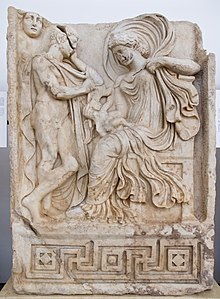
Greek relief from Aphrodisias, depicting a Roman-influenced Aphrodite sitting on a throne holding an infant while the shepherd Anchises stands beside her.
During the Hellenistic period, the Greeks identified Aphrodite with the ancient Egyptian goddesses Hathor and Isis.[76][77][78] Aphrodite was the patron goddess of the Lagid queens[79] and Queen Arsinoe II was identified as her mortal incarnation.[79] Aphrodite was worshipped in Alexandria[79] and had numerous temples in and around the city.[79] Arsinoe II introduced the cult of Adonis to Alexandria and many of the women there partook in it.[79] The Tessarakonteres, a gigantic catamaran galley designed by Archimedes for Ptolemy IV Philopator, had a circular temple to Aphrodite on it with a marble statue of the goddess herself.[79] In the second century BC, Ptolemy VIII Physcon and his wives Cleopatra II and Cleopatra III dedicated a temple to Aphrodite Hathor at Philae.[79] Statuettes of Aphrodite for personal devotion became common in Egypt starting in the early Ptolemaic times and extending until long after Egypt became a Roman province.[79]
The ancient Romans identified Aphrodite with their goddess Venus,[80] who was originally a goddess of agricultural fertility, vegetation, and springtime.[80] According to the Roman historian Livy, Aphrodite and Venus were officially identified in the third century BC[81] when the cult of Venus Erycina was introduced to Rome from the Greek sanctuary of Aphrodite on Mount Eryx in Sicily.[81] After this point, Romans adopted Aphrodite’s iconography and myths and applied them to Venus.[81] Because Aphrodite was the mother of the Trojan hero Aeneas in Greek mythology[81] and Roman tradition claimed Aeneas as the founder of Rome,[81] Venus became venerated as Venus Genetrix, the mother of the entire Roman nation.[81] Julius Caesar claimed to be directly descended from Aeneas’s son Iulus[82] and became a strong proponent of the cult of Venus.[82] This precedent was later followed by his nephew Augustus and the later emperors claiming succession from him.[82]
This syncretism greatly impacted Greek worship of Aphrodite.[83] During the Roman era, the cults of Aphrodite in many Greek cities began to emphasize her relationship with Troy and Aeneas.[83] They also began to adopt distinctively Roman elements,[83] portraying Aphrodite as more maternal, more militaristic, and more concerned with administrative bureaucracy.[83] She was claimed as a divine guardian by many political magistrates.[83] Appearances of Aphrodite in Greek literature also vastly proliferated, usually showing Aphrodite in a characteristically Roman manner.[84]
Mythology
Birth

Birth of Venus from a shell, c. 50–79 AD, fresco from Pompeii
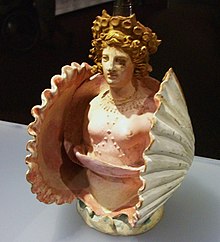

Aphrodite is usually said to have been born near her chief center of worship, Paphos, on the island of Cyprus, which is why she is sometimes called «Cyprian», especially in the poetic works of Sappho. The Sanctuary of Aphrodite Paphia, marking her birthplace, was a place of pilgrimage in the ancient world for centuries.[85] Other versions of her myth have her born near the island of Cythera, hence another of her names, «Cytherea».[86] Cythera was a stopping place for trade and culture between Crete and the Peloponesus,[87] so these stories may preserve traces of the migration of Aphrodite’s cult from the Middle East to mainland Greece.[88]
According to the version of her birth recounted by Hesiod in his Theogony,[89][90] Cronus severed Uranus’ genitals and threw them behind him into the sea.[90][91][92] The foam from his genitals gave rise to Aphrodite[4] (hence her name, which Hesiod interprets as «foam-arisen»),[4] while the Giants, the Erinyes (furies), and the Meliae emerged from the drops of his blood.[90][91] Hesiod states that the genitals «were carried over the sea a long time, and white foam arose from the immortal flesh; with it a girl grew.» Hesiod’s account of Aphrodite’s birth following Uranus’s castration is probably derived from The Song of Kumarbi,[93][94] an ancient Hittite epic poem in which the god Kumarbi overthrows his father Anu, the god of the sky, and bites off his genitals, causing him to become pregnant and give birth to Anu’s children, which include Ishtar and her brother Teshub, the Hittite storm god.[93][94]
In the Iliad,[95] Aphrodite is described as the daughter of Zeus and Dione.[4] Dione’s name appears to be a feminine cognate to Dios and Dion,[4] which are oblique forms of the name Zeus.[4] Zeus and Dione shared a cult at Dodona in northwestern Greece.[4] In Theogony, Hesiod describes Dione as an Oceanid,[96] but Apollodorus makes her the thirteenth Titan, child of Gaia and Uranus.[97]
Marriage

First-century AD Roman fresco of Mars and Venus from Pompeii
Aphrodite is consistently portrayed as a nubile, infinitely desirable adult, having had no childhood.[98] She is often depicted nude.[99] In the Iliad, Aphrodite is the apparently unmarried consort of Ares, the god of war,[100] and the wife of Hephaestus is a different goddess named Charis.[101] Likewise, in Hesiod’s Theogony, Aphrodite is unmarried and the wife of Hephaestus is Aglaea, the youngest of the three Charites.[101]
In Book Eight of the Odyssey,[102] however, the blind singer Demodocus describes Aphrodite as the wife of Hephaestus and tells how she committed adultery with Ares during the Trojan War.[101][103] The sun-god Helios saw Aphrodite and Ares having sex in Hephaestus’s bed and warned Hephaestus, who fashioned a net of gold.[103] The next time Ares and Aphrodite had sex together, the net trapped them both.[103] Hephaestus brought all the gods into the bedchamber to laugh at the captured adulterers,[104] but Apollo, Hermes, and Poseidon had sympathy for Ares[105] and Poseidon agreed to pay Hephaestus for Ares’s release.[106] Humiliated, Aphrodite returned to Cyprus, where she was attended by the Charites.[106] This narrative probably originated as a Greek folk tale, originally independent of the Odyssey.[107] In a much later interpolated detail, Ares put the young soldier Alectryon, by their door to warn them of Helios’s arrival as Helios would tell Hephaestus of Aphrodite’s infidelity if the two were discovered, but Alectryon fell asleep on guard duty.[108] Helios discovered the two and alerted Hephaestus, as Ares in rage turned Alectryon into a rooster, which always crows at dawn when the sun is about to rise announcing its arrival.[109]
After exposing them, Hephaestus asks Zeus for his wedding gifts and dowry to be returned to him;[110] by the time of the Trojan War, he is married to Charis/Aglaea, one of the Graces, apparently divorced from Aphrodite.[101][111] Afterwards, it was generally Ares who was regarded as the husband or official consort of the goddess; on the François Vase, the two arrive at the wedding of Peleus and Thetis on the same chariot, as do Zeus with Hera and Poseidon with Amphitrite; moreover poets such as Pindar and Aeschylus explicitly refer to Ares as Aphrodite’s husband.[112]
Later stories were invented to explain Aphrodite’s marriage to Hephaestus. In the most famous story, Zeus hastily married Aphrodite to Hephaestus in order to prevent the other gods from fighting over her.[113] In another version of the myth, Hephaestus gave his mother Hera a golden throne, but when she sat on it, she became trapped and he refused to let her go until she agreed to give him Aphrodite’s hand in marriage.[114] Hephaestus was overjoyed to be married to the goddess of beauty, and forged her beautiful jewelry, including a strophion (στρόφιον) known as the kestos himas (κεστὸς ἱμάς),[115] a saltire-shaped undergarment (usually translated as «girdle»),[116] which accentuated her breasts[117] and made her even more irresistible to men.[116] Such strophia were commonly used in depictions of the Near Eastern goddesses Ishtar and Atargatis.[116]
Attendants
Aphrodite is almost always accompanied by Eros, the god of lust and sexual desire.[120] In his Theogony, Hesiod describes Eros as one of the four original primeval forces born at the beginning of time,[120] but, after the birth of Aphrodite from the sea foam, he is joined by Himeros and, together, they become Aphrodite’s constant companions.[121] In early Greek art, Eros and Himeros are both shown as idealized handsome youths with wings.[122] The Greek lyric poets regarded the power of Eros and Himeros as dangerous, compulsive, and impossible for anyone to resist.[123] In modern times, Eros is often seen as Aphrodite’s son,[124] but this is actually a comparatively late innovation.[125] A scholion on Theocritus’s Idylls remarks that the sixth-century BC poet Sappho had described Eros as the son of Aphrodite and Uranus,[126] but the first surviving reference to Eros as Aphrodite’s son comes from Apollonius of Rhodes’s Argonautica, written in the third century BC, which makes him the son of Aphrodite and Ares.[127] Later, the Romans, who saw Venus as a mother goddess, seized on this idea of Eros as Aphrodite’s son and popularized it,[127] making it the predominant portrayal in works on mythology until the present day.[127]
Aphrodite’s main attendants were the three Charites, whom Hesiod identifies as the daughters of Zeus and Eurynome and names as Aglaea («Splendor»), Euphrosyne («Good Cheer»), and Thalia («Abundance»).[128] The Charites had been worshipped as goddesses in Greece since the beginning of Greek history, long before Aphrodite was introduced to the pantheon.[101] Aphrodite’s other set of attendants was the three Horae (the «Hours»),[101] whom Hesiod identifies as the daughters of Zeus and Themis and names as Eunomia («Good Order»), Dike («Justice»), and Eirene («Peace»).[129] Aphrodite was also sometimes accompanied by Harmonia, her daughter by Ares, and Hebe, the daughter of Zeus and Hera.[130]
The fertility god Priapus was usually considered to be Aphrodite’s son by Dionysus,[131][132] but he was sometimes also described as her son by Hermes, Adonis, or even Zeus.[131] A scholion on Apollonius of Rhodes’s Argonautica[133] states that, while Aphrodite was pregnant with Priapus, Hera envied her and applied an evil potion to her belly while she was sleeping to ensure that the child would be hideous.[131] In another version, Hera cursed Aphrodite’s unborn son because he had been fathered by Zeus.[134] When Aphrodite gave birth, she was horrified to see that the child had a massive, permanently erect penis, a potbelly, and a huge tongue.[131] Aphrodite abandoned the infant to die in the wilderness, but a herdsman found him and raised him, later discovering that Priapus could use his massive penis to aid in the growth of plants.[131]
Anchises

The First Homeric Hymn to Aphrodite (Hymn 5), which was probably composed sometime in the mid-seventh century BC,[135] describes how Zeus once became annoyed with Aphrodite for causing deities to fall in love with mortals,[135] so he caused her to fall in love with Anchises, a handsome mortal shepherd who lived in the foothills beneath Mount Ida near the city of Troy.[135] Aphrodite appears to Anchises in the form of a tall, beautiful, mortal virgin while he is alone in his home.[136] Anchises sees her dressed in bright clothing and gleaming jewelry, with her breasts shining with divine radiance.[137] He asks her if she is Aphrodite and promises to build her an altar on top of the mountain if she will bless him and his family.[138]
Aphrodite lies and tells him that she is not a goddess, but the daughter of one of the noble families of Phrygia.[138] She claims to be able to understand the Trojan language because she had a Trojan nurse as a child and says that she found herself on the mountainside after she was snatched up by Hermes while dancing in a celebration in honor of Artemis, the goddess of virginity.[138] Aphrodite tells Anchises that she is still a virgin[138] and begs him to take her to his parents.[138] Anchises immediately becomes overcome with mad lust for Aphrodite and swears that he will have sex with her.[138] Anchises takes Aphrodite, with her eyes cast downwards, to his bed, which is covered in the furs of lions and bears.[139] He then strips her naked and makes love to her.[139]
After the lovemaking is complete, Aphrodite reveals her true divine form.[140] Anchises is terrified, but Aphrodite consoles him and promises that she will bear him a son.[140] She prophesies that their son will be the demigod Aeneas, who will be raised by the nymphs of the wilderness for five years before going to Troy to become a nobleman like his father.[141] The story of Aeneas’s conception is also mentioned in Hesiod’s Theogony and in Book II of Homer’s Iliad.[141][142]
Adonis

Attic red-figure aryballos by Aison (c. 410 BC) showing Aphrodite consorting with Adonis, who is seated and playing the lyre, while Eros stands behind him
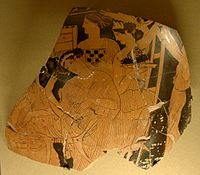
Fragment of an Attic red-figure wedding vase (c. 430–420 BC), showing women climbing ladders up to the roofs of their houses carrying «gardens of Adonis»
The myth of Aphrodite and Adonis is probably derived from the ancient Sumerian legend of Inanna and Dumuzid.[143][144][145] The Greek name Ἄδωνις (Adōnis, Greek pronunciation: [ádɔːnis]) is derived from the Canaanite word ʼadōn, meaning «lord».[146][145] The earliest known Greek reference to Adonis comes from a fragment of a poem by the Lesbian poet Sappho (c. 630 – c. 570 BC), in which a chorus of young girls asks Aphrodite what they can do to mourn Adonis’s death.[147] Aphrodite replies that they must beat their breasts and tear their tunics.[147] Later references flesh out the story with more details.[148] According to the retelling of the story found in the poem Metamorphoses by the Roman poet Ovid (43 BC – 17/18 AD), Adonis was the son of Myrrha, who was cursed by Aphrodite with insatiable lust for her own father, King Cinyras of Cyprus, after Myrrha’s mother bragged that her daughter was more beautiful than the goddess.[149] Driven out after becoming pregnant, Myrrha was changed into a myrrh tree, but still gave birth to Adonis.[150]
Aphrodite found the baby and took him to the underworld to be fostered by Persephone.[151] She returned for him once he was grown and discovered him to be strikingly handsome.[151] Persephone wanted to keep Adonis, resulting in a custody battle between the two goddesses over whom should rightly possess Adonis.[151] Zeus settled the dispute by decreeing that Adonis would spend one third of the year with Aphrodite, one third with Persephone, and one third with whomever he chose.[151] Adonis chose to spend that time with Aphrodite.[151] Then, one day, while Adonis was hunting, he was wounded by a wild boar and bled to death in Aphrodite’s arms.[151] In a semi-mocking work, the Dialogues of the Gods, the satirical author Lucian comedically relates how a frustrated Aphrodite complains to the moon goddess Selene about her son Eros making Persephone fall in love with Adonis and now she has to share him with her.[152]
In different versions of the story, the boar was either sent by Ares, who was jealous that Aphrodite was spending so much time with Adonis, or by Artemis, who wanted revenge against Aphrodite for having killed her devoted follower Hippolytus.[153] In another version, Apollo in fury changed himself into a boar and killed Adonis because Aphrodite had blinded his son Erymanthus when he stumbled upon Aphrodite naked as she was bathing after intercourse with Adonis.[154] The story also provides an etiology for Aphrodite’s associations with certain flowers.[153] Reportedly, as she mourned Adonis’s death, she caused anemones to grow wherever his blood fell and declared a festival on the anniversary of his death.[151] In one version of the story, Aphrodite injured herself on a thorn from a rose bush and the rose, which had previously been white, was stained red by her blood.[153] According to Lucian’s On the Syrian Goddess,[102] each year during the festival of Adonis, the Adonis River in Lebanon (now known as the Abraham River) ran red with blood.[151]
The myth of Adonis is associated with the festival of the Adonia, which was celebrated by Greek women every year in midsummer.[145] The festival, which was evidently already celebrated in Lesbos by Sappho’s time, seems to have first become popular in Athens in the mid-fifth century BC.[145] At the start of the festival, the women would plant a «garden of Adonis», a small garden planted inside a small basket or a shallow piece of broken pottery containing a variety of quick-growing plants, such as lettuce and fennel, or even quick-sprouting grains such as wheat and barley.[145] The women would then climb ladders to the roofs of their houses, where they would place the gardens out under the heat of the summer sun.[145] The plants would sprout in the sunlight but wither quickly in the heat.[155] Then the women would mourn and lament loudly over the death of Adonis,[156] tearing their clothes and beating their breasts in a public display of grief.[156]
Divine favoritism
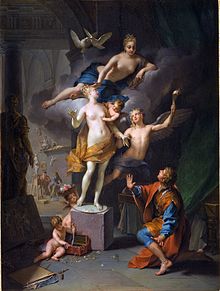
Pygmalion and Galatea (1717) by Jean Raoux, showing Aphrodite bringing the statue to life
In Hesiod’s Works and Days, Zeus orders Aphrodite to make Pandora, the first woman, physically beautiful and sexually attractive,[157] so that she may become «an evil men will love to embrace».[158] Aphrodite «spills grace» over Pandora’s head[157] and equips her with «painful desire and knee-weakening anguish», thus making her the perfect vessel for evil to enter the world.[159] Aphrodite’s attendants, Peitho, the Charites, and the Horae, adorn Pandora with gold and jewelry.[160]
According to one myth, Aphrodite aided Hippomenes, a noble youth who wished to marry Atalanta, a maiden who was renowned throughout the land for her beauty, but who refused to marry any man unless he could outrun her in a footrace.[161][162] Atalanta was an exceedingly swift runner and she beheaded all of the men who lost to her.[161][162] Aphrodite gave Hippomenes three golden apples from the Garden of the Hesperides and instructed him to toss them in front of Atalanta as he raced her.[161][163] Hippomenes obeyed Aphrodite’s order[161] and Atalanta, seeing the beautiful, golden fruits, bent down to pick up each one, allowing Hippomenes to outrun her.[161][163] In the version of the story from Ovid’s Metamorphoses, Hippomenes forgets to repay Aphrodite for her aid,[164][161] so she causes the couple to become inflamed with lust while they are staying at the temple of Cybele.[161] The couple desecrate the temple by having sex in it, leading Cybele to turn them into lions as punishment.[164][161]
The myth of Pygmalion is first mentioned by the third-century BC Greek writer Philostephanus of Cyrene,[165][166] but is first recounted in detail in Ovid’s Metamorphoses.[165] According to Ovid, Pygmalion was an exceedingly handsome sculptor from the island of Cyprus, who was so sickened by the immorality of women that he refused to marry.[167][168] He fell madly and passionately in love with the ivory cult statue he was carving of Aphrodite and longed to marry it.[167][169] Because Pygmalion was extremely pious and devoted to Aphrodite,[167][170] the goddess brought the statue to life.[167][170] Pygmalion married the girl the statue became and they had a son named Paphos, after whom the capital of Cyprus received its name.[167][170] Pseudo-Apollodorus later mentions «Metharme, daughter of Pygmalion, king of Cyprus».[171]
Anger myths
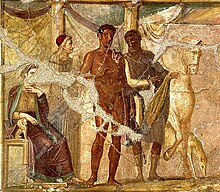
First-century AD Roman fresco from Pompeii showing the virgin Hippolytus spurning the advances of his stepmother Phaedra, whom Aphrodite caused to fall in love with him in order to bring about his tragic death.[172]
Aphrodite generously rewarded those who honored her, but also punished those who disrespected her, often quite brutally.[173] A myth described in Apollonius of Rhodes’s Argonautica and later summarized in the Bibliotheca of Pseudo-Apollodorus tells how, when the women of the island of Lemnos refused to sacrifice to Aphrodite, the goddess cursed them to stink horribly so that their husbands would never have sex with them.[174] Instead, their husbands started having sex with their Thracian slave-girls.[174] In anger, the women of Lemnos murdered the entire male population of the island, as well as all the Thracian slaves.[174] When Jason and his crew of Argonauts arrived on Lemnos, they mated with the sex-starved women under Aphrodite’s approval and repopulated the island.[174] From then on, the women of Lemnos never disrespected Aphrodite again.[174]
In Euripides’s tragedy Hippolytus, which was first performed at the City Dionysia in 428 BC, Theseus’s son Hippolytus worships only Artemis, the goddess of virginity, and refuses to engage in any form of sexual contact.[174] Aphrodite is infuriated by his prideful behavior[175] and, in the prologue to the play, she declares that, by honoring only Artemis and refusing to venerate her, Hippolytus has directly challenged her authority.[176] Aphrodite therefore causes Hippolytus’s stepmother, Phaedra, to fall in love with him, knowing Hippolytus will reject her.[177] After being rejected, Phaedra commits suicide and leaves a suicide note to Theseus telling him that she killed herself because Hippolytus attempted to rape her.[177] Theseus prays to Poseidon to kill Hippolytus for his transgression.[178] Poseidon sends a wild bull to scare Hippolytus’s horses as he is riding by the sea in his chariot, causing the horses to bolt and smash the chariot against the cliffs, dragging Hippolytus to a bloody death across the rocky shoreline.[178] The play concludes with Artemis vowing to kill Aphrodite’s own mortal beloved (presumably Adonis) in revenge.[179]
Glaucus of Corinth angered Aphrodite by refusing to let his horses for chariot racing mate, since doing so would hinder their speed.[180] During the chariot race at the funeral games of King Pelias, Aphrodite drove his horses mad and they tore him apart.[181] Polyphonte was a young woman who chose a virginal life with Artemis instead of marriage and children, as favoured by Aphrodite. Aphrodite cursed her, causing her to have children by a bear. The resulting offspring, Agrius and Oreius, were wild cannibals who incurred the hatred of Zeus. Ultimately, he transformed all the members of the family into birds of ill omen.[182]
According to Apollodorus, a jealous Aphrodite cursed Eos, the goddess of dawn, to be perpetually in love and have insatiable sexual desire because Eos once had lain with Aphrodite’s sweetheart Ares, the god of war.[183]
According to Ovid in his Metamorphoses (book 10.238 ff.), Propoetides who are the daughters of Propoetus from the city of Amathus on the island of Cyprus denied Aphrodite’s divinity and failed to worship her properly. Therefore, Aphrodite turned them into the world’s first prostitutes.[184] According to Diodorus Siculus, when the Rhodian sea nymphe Halia’s six sons by Poseidon arrogantly refused to let Aphrodite land upon their shore, the goddess cursed them with insanity. In their madness, they raped Halia. As punishment, Poseidon buried them in the island’s sea-caverns.[185]
Xanthius, a descendent of Bellerophon, had two children: Leucippus and an unnamed daughter. Through the wrath of Aphrodite (reasons unknown), Leucippus fell in love with his own sister. They started a secret relationship but the girl was already betrothed to another man and he went on to inform her father Xanthius, without telling him the name of the seducer. Xanthius went straight to his daughter’s chamber, where she was together with Leucippus right at the moment. On hearing him enter, she tried to escape, but Xanthius hit her with a dagger, thinking that he was slaying the seducer, and killed her. Leucippus, failing to recognize his father at first, slew him. When the truth was revealed, he had to leave the country and took part in colonization of Crete and the lands in Asia Minor.[186]
Queen Cenchreis of Cyprus, wife of King Cinyras, bragged that her daughter Myrrha was more beautiful than Aphrodite. Therefore, Myrrha was cursed by Aphrodite with insatiable lust for her own father, King Cinyras of Cyprus and he slept with her unknowingly in the dark. she eventually transformed into the myrrh tree and gave birth to Adonis in this form.[187][149][150][188] Cinyras also had three other daughters: Braesia, Laogora, and Orsedice. These girls by the wrath of Aphrodite (reasons unknown) cohabited with foreigners and ended their life in Egypt.[189]
The Muse Clio derided the goddess’ own love for Adonis. Therefore, Clio fell in love with Pierus, son of Magnes and bore Hyacinth.[190]
Aegiale was a daughter of Adrastus and Amphithea and was married to Diomedes. Because of anger of Aphrodite, whom Diomedes had wounded in the war against Troy, she had multiple lovers, including a certain Hippolytus.[191][192] when Aegiale went so far as to threaten his life, he fled to Italy.[192][193] According to Stesichorus and Hesiod while Tyndareus sacrificing to the gods he forgot Aphrodite, therefore goddess made his daughters twice and thrice wed and deserters of their husbands. Timandra deserted Echemus and went and came to Phyleus and Clytaemnestra deserted Agamemnon and lay with Aegisthus who was a worse mate for her and eventually killed her husband with her lover and finally, Helen of Troy deserted Menelaus under the influence of Aphrodite for Paris and her unfaitfulness eventually causes the War of Troy.[194] As a result of her actions, Aphrodite caused the War of Troy in order to take Priam’s kingdom and pass it down to her descendants.[195]
In one of the versions of the legend, Pasiphae did not make offerings to the goddess Venus [Aphrodite]. Because of this Venus [Aphrodite] inspired in her an unnatural love for a bull[196] or she cursed her because she was Helios’s daughter who revealed her adultery to Hephaestus.[197][198] For Helios’ own tale-telling, she cursed him with uncontrollable lust over the mortal princess Leucothoe, which led to him abandoning his then-lover Clytie, leaving her heartbroken.[199]
Lysippe was the mother of Tanais by Berossos. Her son only venerated Ares and was fully devoted to war, neglecting love and marriage. Aphrodite cursed him with falling in love with his own mother. Preferring to die rather than give up his chastity, he threw himself into the river Amazonius, which was subsequently renamed Tanais.[200]
According to Hyginus, At the behest of Zeus, Orpheus’s mother, the Muse Calliope, judged the dispute between the goddesses Aphrodite and Persephone over Adonis and decided that both shall possess him half of the year. This enraged Venus [Aphrodite], because she had not been granted what she thought was her right. Therefore, Venus [Aphrodite] inspired love for Orpheus in the women of Thrace, causing them to tear him apart as each of them sought Orpheus for herself.[201]
Aphrodite personally witnessed the young huntress Rhodopis swear eternal devotion and chastity to Artemis when she joined her group. Aphrodite then summoned her son Eros, and convinced him that such lifestyle was an insult to them both. So under her command, Eros made Rhodopis and Euthynicus, another young hunter who had shunned love and romance just like her, to fall in love with each other. Despite their chaste life, Rhodopis and Euthynicus withdrew to some cavern where they violated their vows. Artemis was not slow to take notice after seeing Aphrodite laugh, so she changed Rhodopis into a fountain as a punishment.[202][203]
Judgment of Paris and Trojan War

The myth of the Judgement of Paris is mentioned briefly in the Iliad,[204] but is described in depth in an epitome of the Cypria, a lost poem of the Epic Cycle,[205] which records that all the gods and goddesses as well as various mortals were invited to the marriage of Peleus and Thetis (the eventual parents of Achilles).[204] Only Eris, goddess of discord, was not invited.[205] She was annoyed at this, so she arrived with a golden apple inscribed with the word καλλίστῃ (kallistēi, «for the fairest»), which she threw among the goddesses.[206] Aphrodite, Hera, and Athena all claimed to be the fairest, and thus the rightful owner of the apple.[206]
The goddesses chose to place the matter before Zeus, who, not wanting to favor one of the goddesses, put the choice into the hands of Paris, a Trojan prince.[206] After bathing in the spring of Mount Ida where Troy was situated, the goddesses appeared before Paris for his decision.[206] In the extant ancient depictions of the Judgement of Paris, Aphrodite is only occasionally represented nude, and Athena and Hera are always fully clothed.[207] Since the Renaissance, however, Western paintings have typically portrayed all three goddesses as completely naked.[207]
All three goddesses were ideally beautiful and Paris could not decide between them, so they resorted to bribes.[206] Hera tried to bribe Paris with power over all Asia and Europe,[206] and Athena offered wisdom, fame and glory in battle,[206] but Aphrodite promised Paris that, if he were to choose her as the fairest, she would let him marry the most beautiful woman on earth.[208] This woman was Helen, who was already married to King Menelaus of Sparta.[208] Paris selected Aphrodite and awarded her the apple.[208] The other two goddesses were enraged and, as a direct result, sided with the Greeks in the Trojan War.[208]
Aphrodite plays an important and active role throughout the entirety of Homer’s Iliad.[209] In Book III, she rescues Paris from Menelaus after he foolishly challenges him to a one-on-one duel.[210] She then appears to Helen in the form of an old woman and attempts to persuade her to have sex with Paris,[211] reminding her of his physical beauty and athletic prowess.[212] Helen immediately recognizes Aphrodite by her beautiful neck, perfect breasts, and flashing eyes[213] and chides the goddess, addressing her as her equal.[214] Aphrodite sharply rebukes Helen, reminding her that, if she vexes her, she will punish her just as much as she has favored her already.[215] Helen demurely obeys Aphrodite’s command.[215]
In Book V, Aphrodite charges into battle to rescue her son Aeneas from the Greek hero Diomedes.[216] Diomedes recognizes Aphrodite as a «weakling» goddess[216] and, thrusting his spear, nicks her wrist through her «ambrosial robe».[217] Aphrodite borrows Ares’s chariot to ride back to Mount Olympus.[218] Zeus chides her for putting herself in danger,[218][219] reminding her that «her specialty is love, not war.»[218] According to Walter Burkert, this scene directly parallels a scene from Tablet VI of the Epic of Gilgamesh in which Ishtar, Aphrodite’s Akkadian precursor, cries to her mother Antu after the hero Gilgamesh rejects her sexual advances, but is mildly rebuked by her father Anu.[220] In Book XIV of the Iliad, during the Dios Apate episode, Aphrodite lends her kestos himas to Hera for the purpose of seducing Zeus and distracting him from the combat while Poseidon aids the Greek forces on the beach.[221] In the Theomachia in Book XXI, Aphrodite again enters the battlefield to carry Ares away after he is wounded.[218][222]
Offspring

Sometimes poets and dramatists recounted ancient traditions, which varied, and sometimes they invented new details; later scholiasts might draw on either or simply guess.[223][224] Thus while Aeneas and Phobos were regularly described as offspring of Aphrodite, others listed here such as Priapus and Eros were sometimes said to be children of Aphrodite but with varying fathers and sometimes given other mothers or none at all.
| Offspring | Father |
|---|---|
| Aeneas, Lyrus/Lyrnus[225] | Anchises |
| Phobos,[226] Deimos,[226] Harmonia,[130][226] the Erotes (Eros,[227][121] Anteros,[b] Himeros,[121] Pothos)[226] | Ares[101][226] |
| Hymenaios, Iacchus, Priapus,[131] the Charites (Graces: Aglaea, Euphrosyne, Thalia) | Dionysus |
| Hermaphroditos,[228] Priapus[131] | Hermes |
| Rhodos[229] | Poseidon |
| Beroe, Golgos,[230] Priapus (rarely)[131] | Adonis[151][153] |
| Eryx,[231] Meligounis and several more unnamed daughters[232] | Butes[233][234] |
| Astynous[235] | Phaethon[236] |
| Priapus[134] | Zeus |
| Peitho[237] | unknown |
Iconography
Symbols
Rich-throned immortal Aphrodite,
scheming daughter of Zeus, I pray you,
with pain and sickness, Queen, crush not my heart,
but come, if ever in the past you heard my voice from afar and hearkened,
and left your father’s halls and came, with gold
chariot yoked; and pretty sparrows
brought you swiftly across the dark earth
fluttering wings from heaven through the air.
Aphrodite’s most prominent avian symbol was the dove,[239] which was originally an important symbol of her Near Eastern precursor Inanna-Ishtar.[240][241] (In fact, the ancient Greek word for «dove», peristerá, may be derived from a Semitic phrase peraḥ Ištar, meaning «bird of Ishtar».[240][241]) Aphrodite frequently appears with doves in ancient Greek pottery[239] and the temple of Aphrodite Pandemos on the southwest slope of the Athenian Acropolis was decorated with relief sculptures of doves with knotted fillets in their beaks.[242] Votive offerings of small, white, marble doves were also discovered in the temple of Aphrodite at Daphni.[242] In addition to her associations with doves, Aphrodite was also closely linked with sparrows[239] and she is described riding in a chariot pulled by sparrows in Sappho’s «Ode to Aphrodite».[242] According to myth, the dove was originally a nymph named Peristera who helped Aphrodite win in a flower-picking contest over her son Eros; for this Eros turned her into a dove, but Aphrodite took the dove under her wing and made it her sacred bird.[243][244]
Because of her connections to the sea, Aphrodite was associated with a number of different types of water fowl,[245] including swans, geese, and ducks.[245] Aphrodite’s other symbols included the sea, conch shells, and roses.[246] The rose and myrtle flowers were both sacred to Aphrodite.[247] A myth explaining the origin of Aphrodite’s connection to myrtle goes that originally the myrtle was a maiden, Myrina, a dedicated priestess of Aphrodite. When her previous betrothed carried her away from the temple to marry her, Myrina killed him, and Aphrodite turned her into a myrtle, forever under her protection.[248] Her most important fruit emblem was the apple,[249] and in myth, she turned Melus, childhood friend and kin-in-law to Adonis, into an apple after he took his own life, mourning over Adonis’ death. Likewise, Melus’s wife Pelia was turned into a dove.[250] She was also associated with pomegranates,[251] possibly because the red seeds suggested sexuality[252] or because Greek women sometimes used pomegranates as a method of birth control.[252] In Greek art, Aphrodite is often also accompanied by dolphins and Nereids.[253]
In classical art

A scene of Aphrodite rising from the sea appears on the back of the Ludovisi Throne (c. 460 BC),[256] which was probably originally part of a massive altar that was constructed as part of the Ionic temple to Aphrodite in the Greek polis of Locri Epizephyrii in Magna Graecia in southern Italy.[256] The throne shows Aphrodite rising from the sea, clad in a diaphanous garment, which is drenched with seawater and clinging to her body, revealing her upturned breasts and the outline of her navel.[257] Her hair hangs dripping as she reaches to two attendants standing barefoot on the rocky shore on either side of her, lifting her out of the water.[257] Scenes with Aphrodite appear in works of classical Greek pottery,[258] including a famous white-ground kylix by the Pistoxenos Painter dating the between c. 470 and 460 BC, showing her riding on a swan or goose.[258]
In c. 364/361 BC, the Athenian sculptor Praxiteles carved the marble statue Aphrodite of Knidos,[259][255] which Pliny the Elder later praised as the greatest sculpture ever made.[259] The statue showed a nude Aphrodite modestly covering her pubic region while resting against a water pot with her robe draped over it for support.[260][261] The Aphrodite of Knidos was the first full-sized statue to depict Aphrodite completely naked[262] and one of the first sculptures that was intended to be viewed from all sides.[263][262] The statue was purchased by the people of Knidos in around 350 BC[262] and proved to be tremendously influential on later depictions of Aphrodite.[263] The original sculpture has been lost,[259][261] but written descriptions of it as well several depictions of it on coins are still extant[264][259][261] and over sixty copies, small-scale models, and fragments of it have been identified.[264]
The Greek painter Apelles of Kos, a contemporary of Praxiteles, produced the panel painting Aphrodite Anadyomene (Aphrodite Rising from the Sea).[254] According to Athenaeus, Apelles was inspired to paint the painting after watching the courtesan Phryne take off her clothes, untie her hair, and bathe naked in the sea at Eleusis.[254] The painting was displayed in the Asclepeion on the island of Kos.[254] The Aphrodite Anadyomene went unnoticed for centuries,[254] but Pliny the Elder records that, in his own time, it was regarded as Apelles’s most famous work.[254]
During the Hellenistic and Roman periods, statues depicting Aphrodite proliferated;[265] many of these statues were modeled at least to some extent on Praxiteles’s Aphrodite of Knidos.[265] Some statues show Aphrodite crouching naked;[266] others show her wringing water out of her hair as she rises from the sea.[266] Another common type of statue is known as Aphrodite Kallipygos, the name of which is Greek for «Aphrodite of the Beautiful Buttocks»;[266] this type of sculpture shows Aphrodite lifting her peplos to display her buttocks to the viewer while looking back at them from over her shoulder.[266] The ancient Romans produced massive numbers of copies of Greek sculptures of Aphrodite[265] and more sculptures of Aphrodite have survived from antiquity than of any other deity.[266]
-

The Ludovisi Throne (possibly c. 460 BC) is believed to be a classical Greek bas-relief, although it has also been alleged to be a 19th-century forgery.
-

Attic white-ground red-figured kylix of Aphrodite riding a swan (c. 46-470) found at Kameiros (Rhodes)
-

Red-figure vase painting of Aphrodite and Phaon (c. 420-400 BC)
-

Apuleian vase painting of Zeus plotting with Aphrodite to seduce Leda while Eros sits on her arm (c. 330 BC)
-

Aphrodite Leaning Against a Pillar (third century BC)
-

Aphrodite Binding Her Hair (second century BC)
-

Greek sculpture group of Aphrodite, Eros, and Pan (c. 100 BC)
-
-

-


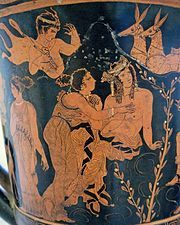
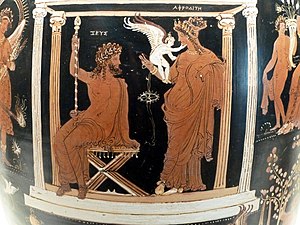


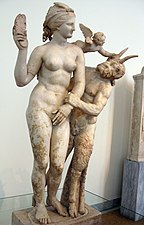


Post-classical culture

Fifteenth century manuscript illumination of Venus, sitting on a rainbow, with her devotees offering her their hearts
Middle Ages
Early Christians frequently adapted pagan iconography to suit Christian purposes.[267][268][269] In the Early Middle Ages, Christians adapted elements of Aphrodite/Venus’s iconography and applied them to Eve and prostitutes,[268] but also female saints and even the Virgin Mary.[268] Christians in the east reinterpreted the story of Aphrodite’s birth as a metaphor for baptism;[270] in a Coptic stele from the sixth century AD, a female orant is shown wearing Aphrodite’s conch shell as a sign that she is newly baptized.[270] Throughout the Middle Ages, villages and communities across Europe still maintained folk tales and traditions about Aphrodite/Venus[271] and travelers reported a wide variety of stories.[271] Numerous Roman mosaics of Venus survived in Britain, preserving memory of the pagan past.[246] In North Africa in the late fifth century AD, Fulgentius of Ruspe encountered mosaics of Aphrodite[246] and reinterpreted her as a symbol of the sin of Lust,[246] arguing that she was shown naked because «the sin of lust is never cloaked»[246] and that she was often shown «swimming» because «all lust suffers shipwreck of its affairs.»[246] He also argued that she was associated with doves and conchs because these are symbols of copulation,[246] and that she was associated with roses because «as the rose gives pleasure, but is swept away by the swift movement of the seasons, so lust is pleasant for a moment, but is swept away forever.»[246]
While Fulgentius had appropriated Aphrodite as a symbol of Lust,[272] Isidore of Seville (c. 560–636) interpreted her as a symbol of marital procreative sex[272] and declared that the moral of the story of Aphrodite’s birth is that sex can only be holy in the presence of semen, blood, and heat, which he regarded as all being necessary for procreation.[272] Meanwhile, Isidore denigrated Aphrodite/Venus’s son Eros/Cupid as a «demon of fornication» (daemon fornicationis).[272] Aphrodite/Venus was best known to Western European scholars through her appearances in Virgil’s Aeneid and Ovid’s Metamorphoses.[273] Venus is mentioned in the Latin poem Pervigilium Veneris («The Eve of Saint Venus»), written in the third or fourth century AD,[274] and in Giovanni Boccaccio’s Genealogia Deorum Gentilium.[275]
Since the Late Middle Ages. the myth of the Venusberg (German; French Mont de Vénus, «Mountain of Venus») – a subterranean realm ruled by Venus, hidden underneath Christian Europe – became a motif of European folklore rendered in various legends and epics. In German folklore of the 16th century, the narrative becomes associated with the minnesinger Tannhäuser, and in that form the myth was taken up in later literature and opera.
Art
Aphrodite is the central figure in Sandro Botticelli’s painting Primavera, which has been described as «one of the most written about, and most controversial paintings in the world»,[276] and «one of the most popular paintings in Western art».[277] The story of Aphrodite’s birth from the foam was a popular subject matter for painters during the Italian Renaissance,[278] who were attempting to consciously reconstruct Apelles of Kos’s lost masterpiece Aphrodite Anadyomene based on the literary ekphrasis of it preserved by Cicero and Pliny the Elder.[279] Artists also drew inspiration from Ovid’s description of the birth of Venus in his Metamorphoses.[279] Sandro Botticelli’s The Birth of Venus (c. 1485) was also partially inspired by a description by Poliziano of a relief on the subject.[279] Later Italian renditions of the same scene include Titian’s Venus Anadyomene (c. 1525)[279] and Raphael’s painting in the Stufetta del cardinal Bibbiena (1516).[279] Titian’s biographer Giorgio Vasari identified all of Titian’s paintings of naked women as paintings of «Venus»,[280] including an erotic painting from c. 1534, which he called the Venus of Urbino, even though the painting does not contain any of Aphrodite/Venus’s traditional iconography and the woman in it is clearly shown in a contemporary setting, not a classical one.[280]


Jacques-Louis David’s final work was his 1824 magnum opus, Mars Being Disarmed by Venus,[282] which combines elements of classical, Renaissance, traditional French art, and contemporary artistic styles.[282] While he was working on the painting, David described it, saying, «This is the last picture I want to paint, but I want to surpass myself in it. I will put the date of my seventy-five years on it and afterwards I will never again pick up my brush.»[283] The painting was exhibited first in Brussels and then in Paris, where over 10,000 people came to see it.[283] Jean-Auguste-Dominique Ingres’s painting Venus Anadyomene was one of his major works.[284] Louis Geofroy described it as a «dream of youth realized with the power of maturity, a happiness that few obtain, artists or others.»[284] Théophile Gautier declared: «Nothing remains of the marvelous painting of the Greeks, but surely if anything could give the idea of antique painting as it was conceived following the statues of Phidias and the poems of Homer, it is M. Ingres’s painting: the Venus Anadyomene of Apelles has been found.»[284] Other critics dismissed it as a piece of unimaginative, sentimental kitsch,[284] but Ingres himself considered it to be among his greatest works and used the same figure as the model for his later 1856 painting La Source.[284]
Paintings of Venus were favorites of the late nineteenth-century Academic artists in France.[285][286] In 1863, Alexandre Cabanel won widespread critical acclaim at the Paris Salon for his painting The Birth of Venus, which the French emperor Napoleon III immediately purchased for his own personal art collection.[287] Édouard Manet’s 1865 painting Olympia parodied the nude Venuses of the Academic painters, particularly Cabanel’s Birth of Venus.[288] In 1867, the English Academic painter Frederic Leighton displayed his Venus Disrobing for the Bath at the academy.[289] The art critic J. B. Atkinson praised it, declaring that «Mr Leighton, instead of adopting corrupt Roman notions regarding Venus such as Rubens embodied, has wisely reverted to the Greek idea of Aphrodite, a goddess worshipped, and by artists painted, as the perfection of female grace and beauty.»[290] A year later, the English painter Dante Gabriel Rossetti, a founding member of the Pre-Raphaelite Brotherhood, painted Venus Verticordia (Latin for «Aphrodite, the Changer of Hearts»), showing Aphrodite as a nude red-headed woman in a garden of roses.[289] Though he was reproached for his outré subject matter,[289] Rossetti refused to alter the painting and it was soon purchased by J. Mitchell of Bradford.[290] In 1879, William Adolphe Bouguereau exhibited at the Paris Salon his own Birth of Venus,[287] which imitated the classical tradition of contrapposto and was met with widespread critical acclaim, rivalling the popularity of Cabanel’s version from nearly two decades prior.[287]
-

-

Mars and Venus Surprised by Vulcan (1827) by Alexandre Charles Guillemot
-

-

-

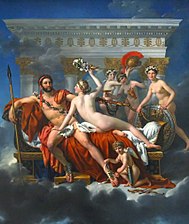

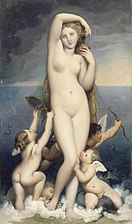
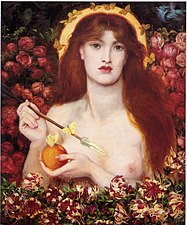

Literature
William Shakespeare’s erotic narrative poem Venus and Adonis (1593), a retelling of the courtship of Aphrodite and Adonis from Ovid’s Metamorphoses,[291][292] was the most popular of all his works published within his own lifetime.[293][294] Six editions of it were published before Shakespeare’s death (more than any of his other works)[294] and it enjoyed particularly strong popularity among young adults.[293] In 1605, Richard Barnfield lauded it,[294] declaring that the poem had placed Shakespeare’s name «in fames immortall Booke».[294] Despite this, the poem has received mixed reception from modern critics;[293] Samuel Taylor Coleridge defended it,[293] but Samuel Butler complained that it bored him[293] and C. S. Lewis described an attempted reading of it as «suffocating».[293]
Aphrodite appears in Richard Garnett’s short story collection The Twilight of the Gods and Other Tales (1888),[295] in which the gods’ temples have been destroyed by Christians.[296] Stories revolving around sculptures of Aphrodite were common in the late nineteenth and early twentieth centuries.[297] Examples of such works of literature include the novel The Tinted Venus: A Farcical Romance (1885) by Thomas Anstey Guthrie and the short story The Venus of Ille (1887) by Prosper Mérimée,[298] both of which are about statues of Aphrodite that come to life.[298] Another noteworthy example is Aphrodite in Aulis by the Anglo-Irish writer George Moore,[299] which revolves around an ancient Greek family who moves to Aulis.[300] The French writer Pierre Louÿs titled his erotic historical novel Aphrodite: mœurs antiques (1896) after the Greek goddess.[301] The novel enjoyed widespread commercial success,[301] but scandalized French audiences due to its sensuality and its decadent portrayal of Greek society.[301]
In the early twentieth century, stories of Aphrodite were used by feminist poets,[302] such as Amy Lowell and Alicia Ostriker.[303] Many of these poems dealt with Aphrodite’s legendary birth from the foam of the sea.[302] Other feminist writers, including Claude Cahun, Thit Jensen, and Anaïs Nin also made use of the myth of Aphrodite in their writings.[304] Ever since the publication of Isabel Allende’s book Aphrodite: A Memoir of the Senses in 1998, the name «Aphrodite» has been used as a title for dozens of books dealing with all topics even superficially connected to her domain.[305] Frequently these books do not even mention Aphrodite,[305] or mention her only briefly, but make use of her name as a selling point.[306]
Modern worship
In 1938, Gleb Botkin, a Russian immigrant to the United States, founded the Church of Aphrodite, a neopagan religion centered around the worship of a mother goddess, whom its practitioners identified as Aphrodite.[307][308] The Church of Aphrodite’s theology was laid out in the book In Search of Reality, published in 1969, two years before Botkin’s death.[309] The book portrayed Aphrodite in a drastically different light than the one in which the Greeks envisioned her,[309] instead casting her as «the sole Goddess of a somewhat Neoplatonic Pagan monotheism».[309] It claimed that the worship of Aphrodite had been brought to Greece by the mystic teacher Orpheus,[309] but that the Greeks had misunderstood Orpheus’s teachings and had not realized the importance of worshipping Aphrodite alone.[309]
Aphrodite is a major deity in Wicca,[310][311] a contemporary nature-based syncretic Neopagan religion.[312] Wiccans regard Aphrodite as one aspect of the Goddess[311] and she is frequently invoked by name during enchantments dealing with love and romance.[313][314] Wiccans regard Aphrodite as the ruler of human emotions, erotic spirituality, creativity, and art.[310] As one of the twelve Olympians, Aphrodite is a major deity within Hellenismos (Hellenic Polytheistic Reconstructionism),[315][316] a Neopagan religion which seeks to authentically revive and recreate the religion of ancient Greece in the modern world.[317][better source needed] Unlike Wiccans, Hellenists are usually strictly polytheistic or pantheistic.[318][better source needed] Hellenists venerate Aphrodite primarily as the goddess of romantic love,[316][better source needed] but also as a goddess of sexuality, the sea, and war.[316][better source needed] Her many epithets include «Sea Born», «Killer of Men», «She upon the Graves», «Fair Sailing», and «Ally in War».[316][better source needed]
Genealogy
| Aphrodite’s family tree [319] | ||||||||||||||||||||||||||||||||||||||||||||||||||||||||||||||||||||||||||||||||||||||||||||||||||||||||||||||||||||||||||||||||||||||||||||||||||||||||||||||||||||||||||||||||||||||||||||||||||||||||||||||||||||||||||||||||||||||||||||||||||||||||||||||||||||||||||||||||||||||||||||||||||||||||||||||||||||||||||||||||||||||||||||||||||||||||||||||||||||||||||||||||||||||||||||||||||||||||||||||||||||||||||||||||||||||||||||||||||||||||||||||||||||||||||||||||||||||||||||||||||||||||||||||||||||||||||||||||||||||
|---|---|---|---|---|---|---|---|---|---|---|---|---|---|---|---|---|---|---|---|---|---|---|---|---|---|---|---|---|---|---|---|---|---|---|---|---|---|---|---|---|---|---|---|---|---|---|---|---|---|---|---|---|---|---|---|---|---|---|---|---|---|---|---|---|---|---|---|---|---|---|---|---|---|---|---|---|---|---|---|---|---|---|---|---|---|---|---|---|---|---|---|---|---|---|---|---|---|---|---|---|---|---|---|---|---|---|---|---|---|---|---|---|---|---|---|---|---|---|---|---|---|---|---|---|---|---|---|---|---|---|---|---|---|---|---|---|---|---|---|---|---|---|---|---|---|---|---|---|---|---|---|---|---|---|---|---|---|---|---|---|---|---|---|---|---|---|---|---|---|---|---|---|---|---|---|---|---|---|---|---|---|---|---|---|---|---|---|---|---|---|---|---|---|---|---|---|---|---|---|---|---|---|---|---|---|---|---|---|---|---|---|---|---|---|---|---|---|---|---|---|---|---|---|---|---|---|---|---|---|---|---|---|---|---|---|---|---|---|---|---|---|---|---|---|---|---|---|---|---|---|---|---|---|---|---|---|---|---|---|---|---|---|---|---|---|---|---|---|---|---|---|---|---|---|---|---|---|---|---|---|---|---|---|---|---|---|---|---|---|---|---|---|---|---|---|---|---|---|---|---|---|---|---|---|---|---|---|---|---|---|---|---|---|---|---|---|---|---|---|---|---|---|---|---|---|---|---|---|---|---|---|---|---|---|---|---|---|---|---|---|---|---|---|---|---|---|---|---|---|---|---|---|---|---|---|---|---|---|---|---|---|---|---|---|---|---|---|---|---|---|---|---|---|---|---|---|---|---|---|---|---|---|---|---|---|---|---|---|---|---|---|---|---|---|---|---|---|---|---|---|---|---|---|---|---|---|---|---|---|---|---|---|---|---|---|---|---|---|---|---|---|---|---|---|---|---|---|---|---|---|---|---|---|---|---|---|---|---|---|---|---|---|---|---|---|---|---|---|---|---|---|---|---|---|---|---|---|---|---|---|---|---|---|---|---|---|---|---|---|---|---|---|---|---|---|---|---|---|---|---|---|---|---|---|---|---|---|---|---|---|---|---|---|---|---|---|---|---|---|---|---|---|---|---|---|---|---|---|---|---|---|---|---|---|---|---|---|---|
|
See also
- Anchises
- Cupid
- Girdle of Aphrodite
- History of nude art
- Lakshmi, rose from the ocean like Aphrodite and has 8-pointed star like Ishtar
Explanatory notes
- ^ Museo Archeologico Nazionale (Napoli). «so-called Venus in a bikini.» Cir.campania.beniculturali.it.
The statuette portrays Aphrodite on the point of untying the laces of the sandal on her left foot, under which a small Eros squats, touching the sole of her shoe with his right hand. The Goddess is leaning with her left arm (the hand is missing) against a figure of Priapus standing, naked and bearded, positioned on a small cylindrical altar while, next to her left thigh, there is a tree trunk over which the garment of the Goddess is folded. Aphrodite, almost completely naked, wears only a sort of costume, consisting of a corset held up by two pairs of straps and two short sleeves on the upper part of her arm, from which a long chain leads to her hips and forms a star-shaped motif at the level of her navel. The ‘bikini’, for which the statuette is famous, is obtained by the masterly use of the technique of gilding, also employed on her groin, in the pendant necklace and in the armilla on Aphrodite’s right wrist, as well as on Priapus’ phallus. Traces of the red paint are evident on the tree trunk, on the short curly hair gathered back in a bun and on the lips of the Goddess, as well as on the heads of Priapus and the Eros. Aphrodite’s eyes are made of glass paste, while the presence of holes at the level of the ear-lobes suggest the existence of precious metal ear-rings which have since been lost. An interesting insight into the female ornaments of Roman times, the statuette, probably imported from the area of Alexandria, reproduces with a few modifications the statuary type of Aphrodite untying her sandal, known from copies in bronze and terracotta.
For extensive research and a bibliography on the subject, see: de Franciscis 1963, p. 78, tav. XCI; Kraus 1973, nn. 270–71, pp. 194–95; Pompei 1973, n. 132; Pompeji 1973, n. 199, pp. 142 e 144; Pompeji 1974, n. 281, pp. 148–49; Pompeii A.D. 79 1976, p. 83 e n. 218; Pompeii A.D. 79 1978, I, n. 208, pp. 64–65, II, n. 208, p. 189; Döhl, Zanker 1979, p. 202, tav. Va; Pompeii A.D. 79 1980, p. 79 e n. 198; Pompeya 1981, n. 198, p. 107; Pompeii lives 1984, fig. 10, p. 46; Collezioni Museo 1989, I, 2, n. 254, pp. 146–47; PPM II, 1990, n. 7, p. 532; Armitt 1993, p. 240; Vésuve 1995, n. 53, pp. 162–63; Vulkan 1995, n. 53, pp. 162–63; LIMC VIII, 1, 1997, p. 210, s.v. Venus, n. 182; LIMC VIII, 2, 1997, p. 144; LIMC VIII, 1, 1997, p. 1031, s.v. Priapos, n. 15; LIMC VIII, 2, 1997, p. 680; Romana Pictura 1998, n. 153, p. 317 e tav. a p. 245; Cantarella 1999, p. 128; De Caro 1999, pp. 100–01; De Caro 2000, p. 46 e tav. a p. 62; Pompeii 2000, n. 1, p. 62.
- ^ Anteros was originally born from the sea alongside Aphrodite; only later became her son.
Citations
- ^ Homer, Iliad 5.370.
- ^ Hesiod, Theogony, 188–90.
- ^ This claim is made at Symposium 180e. It is hard to interpret the role of the various speeches in the dialogue and their relationship to what Plato actually thought; therefore, it is controversial whether Plato, in fact, believed this claim about Aphrodite. See Frisbee Sheffield, «The Role of the Earlier Speeches in the «Symposium»: Plato’s Endoxic Method?» in J. H. Lesher, Debra Nails & Frisbee C. C. Sheffield (eds.), Plato’s Symposium: Issues in Interpretation and Reception. Harvard University Press (2006).
- ^ a b c d e f g h i Cyrino 2010, p. 14.
- ^ Hesiod, Theogony, 190–97.
- ^ a b c d West 2000, pp. 134–38.
- ^ a b c d e Beekes 2009, p. 179.
- ^ Paul Kretschmer, «Zum pamphylischen Dialekt», Zeitschrift für vergleichende Sprachforschung auf dem Gebiet der Indogermanischen Sprachen 33 (1895): 267.
- ^ Ernst Maaß, «Aphrodite und die hl. Pelagia», Neue Jahrbücher für das klassische Altertum 27 (1911): 457–68.
- ^ Vittore Pisani, «Akmon e Dieus», Archivio glottologico italiano 24 (1930): 65–73.
- ^ a b Janda 2005, pp. 349–60.
- ^ a b c d Janda 2010, p. 65.
- ^ Witczak 1993, pp. 115–23.
- ^ Kölligan, Daniel (2007). «Aphrodite of the Dawn: Indo-European Heritage in Greek Divine Epithets and Theonyms». Letras Clássicas. 11 (11): 105–34. doi:10.11606/issn.2358-3150.v0i11p105-134.
- ^ Penglase 1994, p. 164.
- ^ a b Boedeker 1974, pp. 15–16.
- ^ Chicago Assyrian Dictionary, vol. 2, p. 111.
- ^ M. Hammarström, «Griechisch-etruskische Wortgleichungen», Glotta: Zeitschrift für griechische und lateinische Sprache 11 (1921): 215–16.
- ^ a b c Frisk 1960, p. 196f.
- ^ a b West 2000, p. 134.
- ^ Etymologicum Magnum, Ἀφροδίτη.
- ^ Breitenberger 2007, pp. 8–12.
- ^ a b Cyrino 2010, pp. 49–52.
- ^ a b Puhvel 1987, p. 27.
- ^ a b Marcovich 1996, pp. 43–59.
- ^ Burkert 1985, pp. 152–53.
- ^ Pausanias, Description of Greece, I. XIV.7
- ^ a b c d Breitenberger 2007, p. 8.
- ^ a b Breitenberger 2007, pp. 10–11.
- ^ Penglase 1994, p. 162.
- ^ Penglase 1994, p. 163.
- ^ a b c d e Cyrino 2010, pp. 51–52.
- ^ a b c d e Budin 2010, pp. 85–86, 96, 100, 102–03, 112, 123, 125.
- ^ a b Graz 1984, p. 250.
- ^ a b Iossif & Lorber 2007, p. 77.
- ^ Penglase 1994, pp. 162–63.
- ^ a b c Konaris 2016, p. 169.
- ^ a b Burkert 1998, pp. 1–6.
- ^ Burkert 1998, pp. 1–41.
- ^ a b Dumézil 1934.
- ^ a b c d e Cyrino 2010, p. 24.
- ^ Penglase 1994, pp. 162–64.
- ^ a b c Cyrino 2010, pp. 24–25.
- ^ Cyrino 2010, p. 25.
- ^ a b c d e Bullough & Bullough 1993, p. 29.
- ^ a b c d e f g Clark 2015, p. 381.
- ^ a b c d Kerényi 1951, p. 81.
- ^ Cyrino 2010, p. 28.
- ^ a b c d e f g h Kerényi 1951, p. 80.
- ^ Cyrino 2010, pp. 28–29.
- ^ Cyrino 2010, p. 35.
- ^ a b Cyrino 2010, pp. 35–38.
- ^ Plato, Symposium 181a-d.
- ^ Richard L. Hunter, Plato’s Symposium, Oxford University Press: 2004, pp. 44–47
- ^ «Suda, π, 825».
- ^ Pausanias, Periegesis vi.25.1; Aphrodite Pandemos was represented in the same temple riding on a goat, symbol of purely carnal rut: «The meaning of the tortoise and of the he-goat I leave to those who care to guess,» Pausanias remarks. The image was taken up again after the Renaissance: see Andrea Alciato, Emblemata / Les emblemes (1584).
- ^ a b c d Cyrino 2010, p. 39.
- ^ a b c Cyrino 2010, pp. 39–40.
- ^ a b Cyrino 2010, p. 27.
- ^ Lewis Richard Farnell (1896). The Cults of the Greek States. Clarendon Press. p. 666.
- ^ a b Koloski-Ostrow & Lyons 2000, pp. 230–31.
- ^ Rosenzweig 2004, pp. 15–16.
- ^ Simon 1983, pp. 49–50.
- ^ a b Simon 1983, p. 48.
- ^ Simon 1983, pp. 48–49.
- ^ Simon 1983, pp. 47–48.
- ^ Simon 1983, p. 49.
- ^ Cyrino 2010, p. 40.
- ^ a b Cyrino 2010, pp. 40–41.
- ^ a b c d Cyrino 2010, pp. 41–42.
- ^ a b c Marcovich 1996, p. 49.
- ^ Black & Green 1992, p. 109.
- ^ a b Burkert 1985, p. 153.
- ^ a b Cyrino 2010, pp. 41–43.
- ^ Cyrino 2010, p. 43.
- ^ Witt 1997, p. 125.
- ^ Dunand 2007, p. 258.
- ^ Larousse Desk Reference Encyclopedia, The Book People, Haydock, 1995, p. 215.
- ^ a b c d e f g h Dunand 2007, p. 257.
- ^ a b Cyrino 2010, pp. 127–28.
- ^ a b c d e f Cyrino 2010, p. 128.
- ^ a b c Cyrino 2010, pp. 128–29.
- ^ a b c d e Cyrino 2010, p. 130.
- ^ Cyrino 2010, pp. 130–31.
- ^ [1] Archived 11 May 2006 at the Wayback Machine
- ^ Homer, Odyssey viii. 288; Herodotus i. 105; Pausanias iii. 23. § 1; Anacreon v. 9; Horace, Carmina i. 4. 5.
- ^ Cyrino 2010, p. 21.
- ^ Cyrino 2010, pp. 20–21.
- ^ Hesiod, Theogony 191–192.
- ^ a b c Kerényi 1951, p. 69.
- ^ a b Graves 1960, p. 37.
- ^ Cyrino 2010, pp. 13–14.
- ^ a b Cyrino 2010, p. 29.
- ^ a b Puhvel 1987, p. 25.
- ^ Homer, Iliad 5.370 and xx. 105
- ^ Cyrino 2010, pp. 14–15.
- ^ Apollodorus, 1.1.3
- ^ Cyrino 2010, pp. 53–61.
- ^ Cyrino 2010, pp. 73–78.
- ^ Cyrino 2010, pp. 50, 72.
- ^ a b c d e f g Cyrino 2010, p. 72.
- ^ a b Kerényi 1951, p. 279.
- ^ a b c Kerényi 1951, p. 72.
- ^ Kerényi 1951, pp. 72–73.
- ^ Kerényi 1951, pp. 73–74.
- ^ a b Kerényi 1951, p. 74.
- ^ Anderson 2000, pp. 131–32.
- ^ Gallagher, David (2009-01-01). Avian and Serpentine. Brill Rodopi. ISBN 978-90-420-2709-1.
- ^ Lucian, Gallus 3, see also scholiast on Aristophanes, Birds 835; Eustathius, Ad Odysseam 1.300; Ausonius, 26.2.27; Libanius, Progymnasmata 2.26.
- ^ Homer, Odyssey 8.267 ff
- ^ Homer, Iliad 18.382
- ^ Hard, p. 202
- ^ Stuttard 2016, p. 86.
- ^ Slater 1968, pp. 199–200.
- ^ Bonner 1949, p. 1.
- ^ a b c Bonner 1949, pp. 1–6.
- ^ Bonner 1949, pp. 1–2.
- ^ «The Satala Aphrodite». British Museum. Archived from the original on 11 April 2020.
- ^ Nersessian, Vrej (2001). «Bronze Head of Aphrodite/Anahit». Treasures from the Ark: 1700 Years of Armenian Christian Art. Los Angeles: J. Paul Getty Museum. pp. 114–115. ISBN 9780892366392.
- ^ a b Cyrino 2010, p. 44.
- ^ a b c Cyrino 2010, pp. 44–45.
- ^ Cyrino 2010, p. 45.
- ^ Cyrino 2010, pp. 45–46.
- ^ Cyrino 2010, p. 47.
- ^ Cyrino 2010, pp. 47–48.
- ^ Cyrino 2010, p. 48.
- ^ a b c Cyrino 2010, pp. 48–49.
- ^ Cyrino 2010, pp. 71–72.
- ^ Cyrino 2010, pp. 72–73.
- ^ a b Cyrino 2010, p. 73.
- ^ a b c d e f g h Kerényi 1951, p. 176.
- ^ Powell 2012, p. 214.
- ^ Kerényi 1951, p. 283.
- ^ a b «Priapus.» Suda On Line. Tr. Ross Scaife. 10 August 2014. Entry.
- ^ a b c Cyrino 2010, p. 89.
- ^ Cyrino 2010, p. 90.
- ^ Cyrino 2010, pp. 90–91.
- ^ a b c d e f Cyrino 2010, p. 91.
- ^ a b Cyrino 2010, p. 92.
- ^ a b Cyrino 2010, pp. 92–93.
- ^ a b Cyrino 2010, p. 93.
- ^ Hesiod, Theogony 1008–10; Homer, Iliad 2.819–21.
- ^ West 1997, p. 57.
- ^ Kerényi 1951, p. 67.
- ^ a b c d e f Cyrino 2010, p. 97.
- ^ Burkert 1985, pp. 176–77.
- ^ a b West 1997, pp. 530–31.
- ^ Cyrino 2010, p. 95.
- ^ a b Kerényi 1951, p. 75.
- ^ a b Kerényi 1951, pp. 75–76.
- ^ a b c d e f g h i Kerényi 1951, p. 76.
- ^ Lucian, Dialogues of the Gods Aphrodite and the Moon
- ^ a b c d Cyrino 2010, p. 96.
- ^ Cameron 2004, p. 152: Some translations erroneously add Apollo as one of the men Aphrodite had sex with before Erymanthus saw her.
- ^ Cyrino 2010, pp. 97–98.
- ^ a b Cyrino 2010, p. 98.
- ^ a b Cyrino 2010, p. 81.
- ^ Cyrino 2010, p. 80.
- ^ Cyrino 2010, pp. 81–82.
- ^ Cyrino 2010, pp. 82–83.
- ^ a b c d e f g h Ruck & Staples 2001, pp. 64–70.
- ^ a b McKinley 2001, p. 43.
- ^ a b Wasson 1968, p. 128.
- ^ a b McKinley 2001, pp. 43–44.
- ^ a b Clark 2015, pp. 90–91.
- ^ Clement, Exhortation to the Greeks, 4
- ^ a b c d e Clark 2015, p. 91.
- ^ Powell 2012, p. 215.
- ^ Powell 2012, pp. 215–17.
- ^ a b c Powell 2012, p. 217.
- ^ Apollodorus, 3.14.3.
- ^ Cyrino 2010, pp. 98–103.
- ^ Cyrino 2010, pp. 98–99.
- ^ a b c d e f Cyrino 2010, p. 99.
- ^ Cyrino 2010, p. 100.
- ^ Cyrino 2010, pp. 100–01.
- ^ a b Cyrino 2010, p. 101.
- ^ a b Cyrino 2010, p. 102.
- ^ Cyrino 2010, pp. 102–03.
- ^ Vergil, Georgics 3.266–88, with Servius’s note to line 268; Hand, The Routledge Handbook of Greek Mythology, pp. 432, 663.
- ^ Hyginus, Fabulae 250.3, 273.11; Pausanias, Guide to Greece 6.20.19
- ^ Antoninus Liberalis, Metamorphoses, 21
- ^ Apollodorus, 1.4.4.
- ^ «Ovid’s Metamorphoses, book 10, English Translation».
- ^ Diodorus Siculus, Bibliotheca historica 5.55.4–7
- ^ Parthenius, Erotica Pathemata 5
- ^ Ovid, Metamorphoses 10.298–518
- ^ Hansen 2004, pp. 289–90.
- ^ Pseudo-Apollodorus, 3.14.3; 3.9.1 for Laodice.
- ^ Apollodorus, Bibliotheca 1.3.3.
- ^ Scholia on Iliad 5.411
- ^ a b Tzetzes on Lycophron 610.
- ^ Ovid, Metamorphoses 14.476
- ^ «APHRODITE MYTHS 7 WRATH — Greek Mythology».
- ^ Pierre Grimal, The Dictionary of Classical Mythology, s.v. «Aineias»
- ^ Hyginus, Fabulae 40
- ^ Seneca, Phaedra 124
- ^ Scholia on Euripides’ Hippolytus 47.
- ^ Ovid, Metamorphoses 4.192–270; Hard, p. 45
- ^ Pseudo-Plutarch, On Rivers, 14
- ^ Hyginus, Astronomica 2.7.4
- ^ Strelan, Rick (1996). «Paul, Artemis, and the Jews in Ephesus». Beihefte zur Zeitschrift für die neutestamentliche Wissenschaft. Berlin, New York City: De Gruyter. 80: 75. ISSN 0171-6441.
- ^ Futre Pinheiro, Marília P.; Bierl, Anton; Beck, Roger (October 29, 2013). Intende, Lector — Echoes of Myth, Religion and Ritual in the Ancient Novel. Berlin, Boston: De Gruyter. p. 18. ISBN 978-3-11-031181-5.
- ^ a b Walcot 1977, p. 31.
- ^ a b Walcot 1977, pp. 31–32.
- ^ a b c d e f g Walcot 1977, p. 32.
- ^ a b Bull 2005, pp. 346–47.
- ^ a b c d Walcot 1977, pp. 32–33.
- ^ Cyrino 2010, p. 85.
- ^ Cyrino 2010, pp. 85–86.
- ^ Cyrino 2010, pp. 35–36, 86–87.
- ^ Cyrino 2010, pp. 36, 86–87.
- ^ Cyrino 2010, p. 87.
- ^ Cyrino 2010, pp. 87–88.
- ^ a b Cyrino 2010, p. 88.
- ^ a b Cyrino 2010, p. 49.
- ^ Cyrino 2010, pp. 49–50.
- ^ a b c d Cyrino 2010, p. 50.
- ^ Burkert 2005, p. 300.
- ^ Burkert 2005, pp. 299–300.
- ^ Cyrino 2010, p. 36.
- ^ Homer, Iliad 21.416–17.
- ^ Bremmer, Jan N. (1996). «mythology». In Hornblower & Spawforth (ed.). The Oxford Classical Dictionary (Third ed.). Oxford: Oxford University Press. pp. 1018–1020. ISBN 019866172X.
- ^ Reeve, Michael D. (1996). «scholia». In Hornblower & Spawforth (ed.). The Oxford Classical Dictionary (Third ed.). Oxford: Oxford University Press. p. 1368. ISBN 019866172X.
- ^ Smith, William (1861). Dictionary of Greek and Roman biography and mythology. Walton and Maberly. p. 168.
- ^ a b c d e Kerényi 1951, p. 71.
- ^ Eros is usually mentioned as the son of Aphrodite but in other versions he is a parentless primordial.
- ^ Diodorus Siculus, 4.6.5: «… Hermaphroditus, as he has been called, who was born of Hermes and Aphrodite and received a name which is a combination of those of both his parents.»
- ^ Pindar, Olympian 7.14 makes her the daughter of Aphrodite, but does not mention any father. Herodorus, fr. 62 Fowler (Fowler 2001, p. 253), apud schol. Pindar Olympian 7.24–5; Fowler 2013, p. 591 make her the daughter of Aphrodite and Poseidon.
- ^ Graves, Robert (1960). The Greek Myths. London: Penguin Books. pp. 70. ISBN 9780140171990.
- ^ Diodorus Siculus, 4.23.2
- ^ Hesychius of Alexandria s. v. Μελιγουνίς: «Meligounis: this is what the island Lipara was called. Also one of the daughters of Aphrodite.»
- ^ Apollodorus, 1.9.25.
- ^ Servius on Aeneid, 1.574, 5.24
- ^ Apollodorus, 3.14.3.
- ^ Hesiod, Theogony 986–90; Pausanias, Description of Greece, 1.3.1 (using the name «Hemera» for Eos)
- ^ Gantz 1996, p. 104.
- ^ West 2008, p. 36.
- ^ a b c Cyrino 2010, pp. 121–122.
- ^ a b Lewis & Llewellyn-Jones 2018, p. 335.
- ^ a b Botterweck & Ringgren 1990, p. 35.
- ^ a b c Cyrino 2010, p. 122.
- ^ Pepin, Ronald E. (2008). The Vatican Mythographers. New York City: Fordham University Press. p. 76. ISBN 978-0-8232-2892-8.
- ^ De Gubernatis, Angelo (1872). Zoological Mythology: Or, The Legends of Animals. Vol. 2. Trübner & Company. p. 305. ISBN 9780598541062.
- ^ a b Cyrino 2010, pp. 120–123.
- ^ a b c d e f g h Tinkle 1996, p. 81.
- ^ Cyrino 2010, pp. 63, 96.
- ^ Pepin, Ronald E. (2008). The Vatican Mythographers. New York City: Fordham University Press. p. 117. ISBN 978-0-8232-2892-8.
- ^ Cyrino 2010, p. 64.
- ^ Smith, William (1861), Dictionary of Greek and Roman Biography and Mythology, Walton and Maberly, s.v [Melus.
- ^ Cyrino 2010, p. 63.
- ^ a b Cyrino 2010, pp. 63–64.
- ^ Cyrino 2010, pp. 123–124.
- ^ a b c d e f Havelock 2007, p. 86.
- ^ a b Cyrino 2010, pp. 76–77.
- ^ a b Cyrino 2010, p. 106.
- ^ a b Cyrino 2010, pp. 106–107.
- ^ a b Cyrino 2010, p. 124.
- ^ a b c d Grant 1989, p. 224.
- ^ Grant 1989, p. 225.
- ^ a b c Cyrino 2010, p. 77.
- ^ a b c Cyrino 2010, p. 76.
- ^ a b Grant 1989, pp. 224–225.
- ^ a b Palagia & Pollitt 1996, p. 98.
- ^ a b c Cyrino 2010, pp. 77–78.
- ^ a b c d e Cyrino 2010, p. 78.
- ^ Taylor 1993, pp. 96–97.
- ^ a b c Tinkle 1996, p. 80.
- ^ Link 1995, pp. 43–45.
- ^ a b Taylor 1993, p. 97.
- ^ a b Tinkle 1996, pp. 80–81.
- ^ a b c d Tinkle 1996, p. 82.
- ^ Tinkle 1996, pp. 106–08.
- ^ Tinkle 1996, pp. 107–08.
- ^ Tinkle 1996, p. 108.
- ^ Fossi 1998, p. 5.
- ^ Cunningham & Reich 2009, p. 282.
- ^ Ames-Lewis 2000, pp. 193–95.
- ^ a b c d e Ames-Lewis 2000, p. 193.
- ^ a b Tinagli 1997, p. 148.
- ^ Ames-Lewis 2000, p. 194.
- ^ a b Bordes 2005, p. 189.
- ^ a b Hill 2007, p. 155.
- ^ a b c d e Tinterow 1999, p. 358.
- ^ McPhee 1986, pp. 66–67.
- ^ Gay 1998, p. 128.
- ^ a b c McPhee 1986, p. 66.
- ^ Gay 1998, p. 129.
- ^ a b c Smith 1996, pp. 145–46.
- ^ a b Smith 1996, p. 146.
- ^ Lákta 2017, pp. 56–58.
- ^ Cyrino 2010, p. 131.
- ^ a b c d e f Lákta 2017, p. 58.
- ^ a b c d Hiscock 2017, p. unpaginated.
- ^ Clark 2015, pp. 354–55.
- ^ Clark 2015, p. 355.
- ^ Clark 2015, p. 364.
- ^ a b Clark 2015, pp. 361–62.
- ^ Clark 2015, p. 363.
- ^ Clark 2015, pp. 363–64.
- ^ a b c Brooks & Alden 1980, pp. 836–44.
- ^ a b Clark 2015, p. 369.
- ^ Clark 2015, pp. 369–71.
- ^ Clark 2015, pp. 372–74.
- ^ a b Cyrino 2010, pp. 134–35.
- ^ Cyrino 2010, p. 135.
- ^ Clifton 2006, p. 139.
- ^ Pizza & Lewis 2009, pp. 327–28.
- ^ a b c d e Clifton 2006, p. 141.
- ^ a b Gallagher 2005, pp. 109–10.
- ^ a b Sabin 2010, p. 125.
- ^ Sabin 2010, pp. 3–4.
- ^ Gallagher 2005, p. 110.
- ^ Sabin 2010, p. 124.
- ^ World, Matthew Brunwasser PRI’s The; Olympus, Mount (20 June 2013). «The Greeks who worship the ancient gods». BBC News.
- ^ a b c d Alexander 2007, p. 23.
- ^ Alexander 2007, p. 9.
- ^ Alexander 2007, pp. 22–23.
- ^ This chart is based upon Hesiod’s Theogony, unless otherwise noted.
- ^ According to Homer, Iliad 1.570–579, 14.338, Odyssey 8.312, Hephaestus was apparently the son of Hera and Zeus, see Gantz, p. 74.
- ^ According to Hesiod, Theogony 927–929, Hephaestus was produced by Hera alone, with no father, see Gantz, p. 74.
- ^ According to Hesiod’s Theogony 886–890, of Zeus’ children by his seven wives, Athena was the first to be conceived, but the last to be born; Zeus impregnated Metis then swallowed her, later Zeus himself gave birth to Athena «from his head», see Gantz, pp. 51–52, 83–84.
- ^ According to Hesiod, Theogony 183–200, Aphrodite was born from Uranus’ severed genitals, see Gantz, pp. 99–100.
- ^ According to Homer, Aphrodite was the daughter of Zeus (Iliad 3.374, 20.105; Odyssey 8.308, 320) and Dione (Iliad 5.370–71), see Gantz, pp. 99–100.
General and cited references
- Homer, The Iliad with an English Translation by A.T. Murray, PhD in two volumes. Cambridge, MA, Harvard University Press; London, William Heinemann, Ltd. 1924. Online version at the Perseus Digital Library.
- Hesiod, Theogony, in The Homeric Hymns and Homerica with an English Translation by Hugh G. Evelyn-White, Cambridge, MA., Harvard University Press; London, William Heinemann Ltd. 1914. Online version at the Perseus Digital Library.
- Evelyn-White, Hugh, The Homeric Hymns and Homerica with an English Translation by Hugh G. Evelyn-White. Homeric Hymns. Cambridge, Massachusetts, Harvard University Press; London, William Heinemann Ltd. 1914.
- Pindar, Odes, Diane Arnson Svarlien. 1990. Online version at the Perseus Digital Library.
- Euripides, The Complete Greek Drama’, edited by Whitney J. Oates and Eugene O’Neill, Jr. in two volumes. 2. The Phoenissae, translated by E. P. Coleridge. New York. Random House. 1938.
- Apollonius Rhodius, Argonautica translated by Robert Cooper Seaton (1853–1915), R. C. Loeb Classical Library Volume 001. London, William Heinemann Ltd, 1912. Online version at the Topos Text Project.
- Apollodorus, Apollodorus, The Library, with an English Translation by Sir James George Frazer, F.B.A., F.R.S. in 2 Volumes. Cambridge, MA, Harvard University Press; London, William Heinemann Ltd. 1921. Online version at the Perseus Digital Library.
- Pausanias, Pausanias Description of Greece with an English Translation by W.H.S. Jones, Litt.D., and H.A. Ormerod, M.A., in 4 Volumes. Cambridge, MA, Harvard University Press; London, William Heinemann Ltd. 1918. Online version at the Perseus Digital Library.
- Diodorus Siculus, Bibliotheca Historica. Vol 1-2. Immanel Bekker. Ludwig Dindorf. Friedrich Vogel. in aedibus B. G. Teubneri. Leipzig. 1888–1890. Greek text available at the Perseus Digital Library.
- Ovid, Metamorphoses. Translated by A. D. Melville; introduction and notes by E. J. Kenney. Oxford: Oxford University Press. 2008. ISBN 978-0-19-953737-2.
- Hyginus, Gaius Julius, The Myths of Hyginus. Edited and translated by Mary A. Grant, Lawrence: University of Kansas Press, 1960.
- Gaius Julius Hyginus, Astronomica from The Myths of Hyginus translated and edited by Mary Grant. University of Kansas Publications in Humanistic Studies. Online version at the Topos Text Project.
- Ames-Lewis, Francis (2000), The Intellectual Life of the Early Renaissance Artist, New Haven, Connecticut: Yale University Press, ISBN 0-300-09295-4
- Alexander, Timothy Jay (2007), Hellenismos Today (First ed.), Lulu Press, Inc., ISBN 978-1-4303-1427-1
- Anderson, Graham (2000), Fairytale in the Ancient World, London: Routledge, pp. 131–32, ISBN 978-0-415-23702-4
- Arscott, Caroline; Scott, Katie, eds. (2000), Manifestations of Venus: Art and Sexuality, Critical Perspectives in Art History, Manchester: Manchester University Press, ISBN 978-0719055225
- Black, Jeremy; Green, Anthony (1992), Gods, Demons and Symbols of Ancient Mesopotamia: An Illustrated Dictionary, London: The British Museum Press, ISBN 0-7141-1705-6
- Boedeker, Deborah (1974), Aphrodite’s Entry into Greek Epic, Leiden, Germany: Brill, pp. 15–16[ISBN missing]
- Beekes, Robert S. P. (2009), Etymological Dictionary of Greek, vol. 1, Leiden and Boston: Brill, ISBN 978-90-04-17418-4
- Bonner, Campbell (1949), «KESTOS IMAS and the Saltire of Aphrodite», The American Journal of Philology, The Johns Hopkins University Press, 70 (1): 1–6, doi:10.2307/290961, JSTOR 290961
- Bordes, Philippe (2005), Jacques-Louis David: Empire to Exile, New Haven, Connecticut: Yale University, ISBN 0-300-10447-2
- Botterweck, G. Johannes; Ringgren, Helmer (1990), Theological Dictionary of the Old Testament, vol. VI, Grand Rapids, Michigan: Wm. B. Eerdmans Publishing Co., ISBN 0-8028-2330-0
- Breitenberger, Barbara (2007), Aphrodite and Eros: The Development of Greek Erotic Mythology, New York and London, ISBN 978-0-415-96823-2
- Brooks, Richard A.; Alden, Douglas W. (1980), A Critical Bibliography of French Literature, vol. 6, Syracuse, New York: Syracuse University Press, ISBN 0-8156-2207-4
- Bull, Malcolm (2005), The Mirror of the Gods: How Renaissance Artists Rediscovered the Pagan Gods, Oxford: Oxford University Press, ISBN 0-19-521923-6
- Bullough, Vern L.; Bullough, Bonnie (1993), Cross Dressing, Sex, and Gender (reprint ed.), Philadelphia: University of Pennsylvania Press, p. 29, ISBN 978-0812214314
- Budin, Stephanie L. (2010), «Aphrodite Enoplion», in Smith, Amy C.; Pickup, Sadie (eds.), Brill’s Companion to Aphrodite, Brill’s Companions in Classical Studies, Leiden, The Netherlands: Brill Publishers, pp. 85–86, 96, 100, 102–03, 112, 123, 125, ISBN 978-9047444503
- Burkert, Walter (1985), Greek Religion, Cambridge, Massachusetts: Harvard University Press, ISBN 0-674-36281-0
- Burkert, Walter (1998) [1992], The Orientalizing Revolution: Near Eastern Influence on Greek Culture in the Early Archaic Age, Harvard University Press, ISBN 978-0674643642
- Burkert, Walter (2005), «Chapter Twenty: Near Eastern Connections», in Foley, John Miles (ed.), A Companion to Ancient Epic, New York and London: Blackwell Publishing, ISBN 978-1-4051-0524-8
- Cameron, Alan (2004). Greek Mythography in the Roman World. New York City, New York: Oxford University Press. ISBN 0-19-517121-7.
- Clark, Nora (2015), Aphrodite and Venus in Myth and Mimesis, Cambridge, England: Cambridge Scholars Publishing, ISBN 978-1-4438-7127-3
- Clifton, Chas S. (2006), Her Hidden Children: The Rise of Wicca and Paganism in America, Lanham, Maryland: AltaMira Press, ISBN 978-0-7591-0201-9
- Cunningham, Lawrence S.; Reich, John Jay (2009), Culture & Values, Volume II: A Survey of the Humanities with Readings, Cengage Learning, ISBN 978-0-495-56926-8
- Cyrino, Monica S. (2010), Aphrodite, Gods and Heroes of the Ancient World, New York and London: Routledge, ISBN 978-0-415-77523-6
- Delcourt, Marie (1961), Hermaphrodite: Myths and Rites of the Bisexual Figure in Classical Antiquity, translated by Nicholson, Jennifer, London: Studio Books, p. 27
- Dumézil, Georges (1934), Ouranos-Vàruna: Ètude de mythologie compáree indo-européene, Paris: Maisonneuve[ISBN missing]
- Dunand, Françoise (2007), «The Religious System in Alexandria», in Ogden, Daniel (ed.), A Companion to Greek Religion, Malden, Massachusetts, Oxford, England, and Victoria, Australia: Blackwell Publishing, pp. 253–63, ISBN 978-1-4051-2054-8
- Fossi, Gloria (1998), Botticelli. Primavera. (Inglese ed.), Giunti Editore Firenze Italy, ISBN 978-88-09-21459-0
- Frisk, Hjalmar (1960), Griechisches etymologisches Wörterbuch, vol. 1, Heidelberg: Carl Winter, pp. 196 f
- Gallagher, Ann-Marie (2005), The Wicca Bible: The Definitive Guide to Magic and the Craft, New York: Sterling Publishing Co., Inc., ISBN 1-4027-3008-X
- Gantz, Timothy (1996), Early Greek Myth: A Guide to Literary and Artistic Sources, Johns Hopkins University Press, ISBN 978-0-8018-5360-9
- Gay, Peter (1998), Pleasure Wars: The Bourgeois Experience: Victoria to Freud, New York and London: W. W. Norton and Company, ISBN 0-393-31827-3
- Grant, Michael (1989), The Classical Greeks, History of Civilization, New York: Charles Schribner’s Sons, ISBN 0-684-19126-1
- Graves, Robert (1960) [1955], The Greek Myths, London: Penguin, ISBN 978-0241952740
- Graz, F. (1984), Eck, W. (ed.), «Women, War, and Warlike Divinities», Zeitschrift für Papyrologie und Epigraphik, Bonn: Dr. Rudolf Habelt GmbH, 55 (55): 250, JSTOR 20184039
- Hansen, William (2004), Handbook of Classical Mythology, Saint Barbara: ABC-Clio, ISBN 978-1576072264
- Hard, Robin, The Routledge Handbook of Greek Mythology: Based on H.J. Rose’s «Handbook of Greek Mythology», Psychology Press, 2004, ISBN 9780415186360. Google Books.
- Havelock, Christine Mitchell (2007) [1995], The Aphrodite of Knidos and Her Successors: A Historical Review of the Female Nude in Greek Art, Ann Arbor: University of Michigan Press, ISBN 978-0-472-03277-8
- Hill, Laban Carrick (2007), A Brush With Napoleon: An Encounter With Jacques-Louis David, Art Encounters, New York: Watson-Guptill Publications, ISBN 978-0-8230-0417-1
- Hiscock, Andrew (2017), ««Suppose thou dost defend me from what is past»: Shakespeare’s Venus and Adonis and The Rape of Lucrece and the appetite for ancient memory», in Hiscock, Andrew; Wilder, Lina Perkins (eds.), The Routledge Handbook of Shakespeare and Memory, New York and London: Routledge, ISBN 978-1-315-74594-7
- Iossif, Panagiotis; Lorber, Catharine (2007), «Laodikai and the Goddess Nikephoros», L’Antiquité Classique, 76: 77, doi:10.3406/antiq.2007.2618, ISSN 0770-2817, JSTOR 41665635
- Janda, Michael (2005), Elysion. Entstehung und Entwicklung der griechischen Religion, Innsbruck: Institut für Sprachen und Literaturen, ISBN 978-3851247022
- Janda, Michael (2010), Die Musik nach dem Chaos: der Schöpfungsmythos der europäischen Vorzeit, Innsbruck: Institut für Sprachen und Literaturen, ISBN 978-3851242270
- Konaris, Michael D. (2016), The Greek Gods in Modern Scholarship: Interpretation and Belief in Nineteenth Century and Early Twentieth Century Germany and Britain, Oxford: Oxford University Press, ISBN 978-0-19-873789-6
- Kerényi, Karl (1951), The Gods of the Greeks, London: Thames and Hudson, ISBN 0-500-27048-1
- Koloski-Ostrow, Ann Olga; Lyons, Claire L. (2000), Naked Truths: Women, Sexuality, and Gender in Classical Art and Archaeology, New York and London: Routledge, pp. 230–31, ISBN 0415217520
- Lákta, Peter (2017), ««All Adonises Must Die»: Shakespeare’s Venus and Adonis and the episodic imaginary», in Marrapodi, Michele (ed.), Shakespeare and the Visual Arts: The Italian Influence, New York and London: Routledge, ISBN 978-1-315-21225-8
- Lewis, Sian; Llewellyn-Jones, Lloyd (2018), The Culture of Animals in Antiquity: A Sourcebook with Commentaries, New York and London: Routledge, ISBN 978-1-315-20160-3
- Link, Luther (1995), The Devil: A Mask Without a Face, London: Reaktion Books, ISBN 0-948462-67-1
- Marcovich, Miroslav (1996), «From Ishtar to Aphrodite», Journal of Aesthetic Education, 39 (2): 43–59, doi:10.2307/3333191, JSTOR 3333191
- McKinley, Kathryn L. (2001), Reading the Ovidian Heroine: «Metamorphoses» Commentaries 1100-1618, Leiden, The Netherlands: Brill, ISBN 90-04-11796-2
- McPhee, Peter (1986), Proceedings of the Fifth George Rudé Seminar in French History, Wellington, New Zealand: Victoria University of Wellington, History Department
- Palagia, Olga; Pollitt, J. J. (1996), Personal Styles in Greek Sculpture, Cambridge: Cambridge University Press, ISBN 0-521-65738-5
- Penglase, Charles (1994), Greek Myths and Mesopotamia: Parallels and Influence in the Homeric Hymns and Hesiod, New York: Routledge, ISBN 0-415-15706-4
- Pizza, Murphy; Lewis, James R. (2009), Handbook of Contemporary Paganism, Leiden, The Netherlands: Brill, ISBN 978-90-04-16373-7
- Powell, Barry B. (2012) [2004], «Myths of Aphrodite, Artemis, Athena», Classical Myth (Seventh ed.), London: Pearson, pp. 211–35, ISBN 978-0-205-17607-6
- Puhvel, Jaan (1987), Comparative Mythology, Baltimore, Maryland: Johns Hopkins University Press, ISBN 0-8018-3938-6
- Pirenne-Delforge, Vinciane (1994), L’Aphrodite grecque: contribution à l’étude de ses cultes et de sa personnalité dans le panthéon archaïque et classique, Athènes: Centre international d’étude de la religion grecque antique (Kernos. Supplément ; 4
- Rosenzweig, Rachel (2004), Worshipping Aphrodite: Art and Cult in Classical Athens, Ann Arbor: University of Michigan Press, ISBN 0-472-11332-1
- Ruck, Carl; Staples, Blaise Daniel (2001), The Apples of Apollo: Pagan and Christian Mysteries of the Eucharist, Durham, North Carolina: Carolina Academic Press, pp. 64–70, ISBN 0-89089-924-X
- Sabin, Thea (2010), Wicca for Beginners: Fundamentals of Philosophy & Practice, Woodbury, Minnesota: Llewellyn Worldwide, ISBN 978-0-7387-1775-3
- Simon, Erika (1983), Festivals of Attica: An Archaeological Companion, Madison: University of Wisconsin Press, ISBN 0-299-09184-8
- Slater, Philip Elliot (1968), The Glory of Hera: Greek Mythology and the Greek Family, Princeton, New Jersey: Princeton University Press, ISBN 0-691-00222-3
- Smith, Alison (1996), The Victorian Nude: Sexuality, Morality, and Art, Manchester: Manchester University Press, ISBN 0-7190-4403-0
- Stuttard, David (2016), Greek Mythology: A Traveler’s Guide, London and New York: Thames and Hudson, ISBN 978-0500518328
- Taylor, Joan E. (1993), Christians and the Holy Places: The Myth of Jewish-Christian Origins, Oxford: Oxford University Press, ISBN 0-19-814785-6
- Tinagli, Paola (1997), Women in Italian Renaissance Art: Gender, Representation and Identity, Manchester: Manchester University Press, ISBN 0-7190-4054-X
- Tinkle, Theresa (1996), Medieval Venuses and Cupids: Sexuality, Hermeneutics, and English Poetry, Stanford, California: Stanford University Press, ISBN 978-0804725156
- Tinterow, Gary (1999), «Paris, 1841-1867», Portraits by Ingres: Image of an Epoch, New York: The Metropolitan Museum of Art, ISBN 0-87099-891-9
- Walcot, P. (April 1977), «The Judgement of Paris», Greece & Rome, Cambridge: Cambridge University Press, 24 (1): 31–39, doi:10.1017/S0017383500019616, JSTOR 642687, S2CID 162573370
- Wasson, R. Gordon (1968), Soma: Divine Mushroom of Immortality, San Diego, California: Harcourt Brace Jovanovich, p. 128, ISBN 0-15-683800-1
- West, M. L. (2008) [1993], Greek Lyric Poetry: A New Translation by M. L. West, Oxford: Oxford University Press, ISBN 978-0-19-954039-6
- West, M. L. (1997), The East Face of Helicon: West Asiatic Elements in Greek Poetry and Myth, Oxford, England: Clarendon Press, p. 57, ISBN 0-19-815221-3
- West, M. L. (2000), «The Name of Aphrodite», Glotta, Göttingen, Germany: Vandenhoeck & Ruprecht (GmbH & Co. KG), 76 (1./2. H): 134–38, JSTOR 40267103
- Witczak, Krzysztof Tomasz [in Polish] (1993), Lambert Isebaert (ed.), «Greek Aphrodite and her Indo-European origins», Miscellanea Linguistica Graeco-Latina, Namur: Société des études classiques: 115–23[ISBN missing]
- Witt, Reginald Eldred (1997), Isis in the Ancient World, Baltimore, Maryland: Johns Hopkins University Press, ISBN 0-8018-5642-6
- Wunderlich, Hans Georg (1987), The Secret of Crete, translated by Winston, R., p. 134[ISBN missing]
External links

Look up Ἀφροδίτη in Wiktionary, the free dictionary.

Wikimedia Commons has media related to Aphrodite.
- APHRODITE from The Theoi Project information from classical literature, Greek and Roman art
- The Glory which Was Greece from a Female Perspective
- Sappho’s Hymn to Aphrodite, with a brief explanation
| Aphrodite | |
|---|---|
|
Goddess of love, beauty, and sexuality |
|
| Member of the Twelve Olympians | |
|
Aphrodite Pudica (Roman copy of 2nd century AD), National Archaeological Museum, Athens |
|
| Abode | Mount Olympus |
| Planet | Venus |
| Animals | dolphin, sparrow, dove, swan, hare, goose, bee, fish, butterfly |
| Symbol | rose, seashell, pearl, mirror, girdle, anemone, lettuce, narcissus |
| Tree | myrrh, myrtle, apple, pomegranate |
| Day | Friday (hēméra Aphrodítēs) |
| Personal information | |
| Parents | Zeus and Dione (according to Homer)[1] Uranus (according to Hesiod)[2] |
| Siblings | The Titans, the Hecatoncheires, the Cyclopes, The Meliae, the Erinyes, the Giants (as daughter of Uranus) or Aeacus, Angelos, Apollo, Ares, Artemis, Athena, Dionysus, Eileithyia, Enyo, Eris, Ersa, Hebe, Helen of Troy, Hephaestus, Heracles, Hermes, Minos, Pandia, Persephone, Perseus, Rhadamanthus, the Graces, the Horae, the Litae, the Muses, the Moirai (as daughter of Zeus) |
| Consort | Hephaestus (divorced) Ares (unmarried consort) |
| Children | Eros, Phobos, Deimos, Harmonia, Pothos, Anteros, Himeros, Hermaphroditus, Rhodos, Eryx, Peitho, The Graces, Priapus, Aeneas |
| Equivalents | |
| Roman equivalent | Venus |
| Norse equivalent | Freyja |
| Etruscan equivalent | Turan |
| Hinduism equivalent | Rati |
| Canaanite equivalent | Astarte |
| Babylonian equivalent | Ishtar |
| Sumerian equivalent | Inanna |
| Zoroastrian equivalent | Anahita |
| Egyptian equivalent | Hathor |
Aphrodite ( AF-rə-DY-tee; Greek: Ἀφροδίτη, translit. Aphrodítē; Attic Greek pronunciation: [a.pʰro.dǐː.tɛː], Koine Greek: [a.ɸroˈdi.te̝], Modern Greek: [a.froˈði.ti]) is an ancient Greek goddess associated with love, lust, beauty, pleasure, passion, and procreation. She was syncretized with the Roman goddess Venus. Aphrodite’s major symbols include myrtles, roses, doves, sparrows, and swans. The cult of Aphrodite was largely derived from that of the Phoenician goddess Astarte, a cognate of the East Semitic goddess Ishtar, whose cult was based on the Sumerian cult of Inanna. Aphrodite’s main cult centers were Cythera, Cyprus, Corinth, and Athens. Her main festival was the Aphrodisia, which was celebrated annually in midsummer. In Laconia, Aphrodite was worshipped as a warrior goddess. She was also the patron goddess of prostitutes, an association which led early scholars to propose the concept of «sacred prostitution» in Greco-Roman culture, an idea which is now generally seen as erroneous.
In Hesiod’s Theogony, Aphrodite is born off the coast of Cythera from the foam (ἀφρός, aphrós) produced by Uranus’s genitals, which his son Cronus had severed and thrown into the sea. In Homer’s Iliad, however, she is the daughter of Zeus and Dione. Plato, in his Symposium, asserts that these two origins actually belong to separate entities: Aphrodite Ourania (a transcendent, «Heavenly» Aphrodite) and Aphrodite Pandemos (Aphrodite common to «all the people»).[3] Aphrodite had many other epithets, each emphasizing a different aspect of the same goddess, or used by a different local cult. Thus she was also known as Cytherea (Lady of Cythera) and Cypris (Lady of Cyprus), because both locations claimed to be the place of her birth.
In Greek mythology, Aphrodite was married to Hephaestus, the god of fire, blacksmiths and metalworking. Aphrodite was frequently unfaithful to him and had many lovers; in the Odyssey, she is caught in the act of adultery with Ares, the god of war. In the First Homeric Hymn to Aphrodite, she seduces the mortal shepherd Anchises. Aphrodite was also the surrogate mother and lover of the mortal shepherd Adonis, who was killed by a wild boar. Along with Athena and Hera, Aphrodite was one of the three goddesses whose feud resulted in the beginning of the Trojan War and she plays a major role throughout the Iliad. Aphrodite has been featured in Western art as a symbol of female beauty and has appeared in numerous works of Western literature. She is a major deity in modern Neopagan religions, including the Church of Aphrodite, Wicca, and Hellenismos.
Etymology
Hesiod derives Aphrodite from aphrós (ἀφρός) «sea-foam»,[4] interpreting the name as «risen from the foam»,[5][4] but most modern scholars regard this as a spurious folk etymology.[4][6] Early modern scholars of classical mythology attempted to argue that Aphrodite’s name was of Greek or Indo-European origin, but these efforts have now been mostly abandoned.[6] Aphrodite’s name is generally accepted to be of non-Greek, probably Semitic, origin, but its exact derivation cannot be determined.[6][7]
Scholars in the late nineteenth and early twentieth centuries, accepting Hesiod’s «foam» etymology as genuine, analyzed the second part of Aphrodite’s name as *-odítē «wanderer»[8] or *-dítē «bright».[9][10] More recently, Michael Janda, also accepting Hesiod’s etymology, has argued in favor of the latter of these interpretations and claims the story of a birth from the foam as an Indo-European mytheme.[11][12] Similarly, Krzysztof Tomasz Witczak proposes an Indo-European compound *abʰor- «very» and *dʰei- «to shine», also referring to Eos,[13] and Daniel Kölligan has interpreted her name as «shining up from the mist/foam».[14] Other scholars have argued that these hypotheses are unlikely since Aphrodite’s attributes are entirely different from those of both Eos and the Vedic deity Ushas.[15][16]
A number of improbable non-Greek etymologies have also been suggested. One Semitic etymology compares Aphrodite to the Assyrian barīrītu, the name of a female demon that appears in Middle Babylonian and Late Babylonian texts.[17] Hammarström[18] looks to Etruscan, comparing (e)prθni «lord», an Etruscan honorific loaned into Greek as πρύτανις.[19][7][20] This would make the theonym in origin an honorific, «the lady».[19][7] Most scholars reject this etymology as implausible,[19][7][20] especially since Aphrodite actually appears in Etruscan in the borrowed form Apru (from Greek Aphrō, clipped form of Aphrodite).[7] The medieval Etymologicum Magnum (c. 1150) offers a highly contrived etymology, deriving Aphrodite from the compound habrodíaitos (ἁβροδίαιτος), «she who lives delicately», from habrós and díaita. The alteration from b to ph is explained as a «familiar» characteristic of Greek «obvious from the Macedonians».[21]
Origins
Near Eastern love goddess
Late second-millennium BC nude figurine of Ishtar from Susa, showing her wearing a crown and clutching her breasts
Early fifth-century BC statue of Aphrodite from Cyprus, showing her wearing a cylinder crown and holding a dove
The cult of Aphrodite in Greece was imported from, or at least influenced by, the cult of Astarte in Phoenicia,[22][23][24][25] which, in turn, was influenced by the cult of the Mesopotamian goddess known as «Ishtar» to the East Semitic peoples and as «Inanna» to the Sumerians.[26][24][25] Pausanias states that the first to establish a cult of Aphrodite were the Assyrians, followed by the Paphians of Cyprus and then the Phoenicians at Ascalon. The Phoenicians, in turn, taught her worship to the people of Cythera.[27]
Aphrodite took on Inanna-Ishtar’s associations with sexuality and procreation.[28] Furthermore, she was known as Ourania (Οὐρανία), which means «heavenly»,[29] a title corresponding to Inanna’s role as the Queen of Heaven.[29][30] Early artistic and literary portrayals of Aphrodite are extremely similar on Inanna-Ishtar.[28] Like Inanna-Ishtar, Aphrodite was also a warrior goddess;[28][23][31] the second-century AD Greek geographer Pausanias records that, in Sparta, Aphrodite was worshipped as Aphrodite Areia, which means «warlike».[32][33] He also mentions that Aphrodite’s most ancient cult statues in Sparta and on Cythera showed her bearing arms.[32][33][34][28] Modern scholars note that Aphrodite’s warrior-goddess aspects appear in the oldest strata of her worship[35] and see it as an indication of her Near Eastern origins.[35][36]
Nineteenth century classical scholars had a general aversion to the idea that ancient Greek religion was at all influenced by the cultures of the Near East,[37] but, even Friedrich Gottlieb Welcker, who argued that Near Eastern influence on Greek culture was largely confined to material culture,[37] admitted that Aphrodite was clearly of Phoenician origin.[37] The significant influence of Near Eastern culture on early Greek religion in general, and on the cult of Aphrodite in particular,[38] is now widely recognized as dating to a period of orientalization during the eighth century BC,[38] when archaic Greece was on the fringes of the Neo-Assyrian Empire.[39]
Indo-European dawn goddess
Some early comparative mythologists opposed to the idea of a Near Eastern origin argued that Aphrodite originated as an aspect of the Greek dawn goddess Eos[40][41] and that she was therefore ultimately derived from the Proto-Indo-European dawn goddess *Haéusōs (properly Greek Eos, Latin Aurora, Sanskrit Ushas).[40][41] Most modern scholars have now rejected the notion of a purely Indo-European Aphrodite,[6][42][16][43] but it is possible that Aphrodite, originally a Semitic deity, may have been influenced by the Indo-European dawn goddess.[43] Both Aphrodite and Eos were known for their erotic beauty and aggressive sexuality[41] and both had relationships with mortal lovers.[41] Both goddesses were associated with the colors red, white, and gold.[41] Michael Janda etymologizes Aphrodite’s name as an epithet of Eos meaning «she who rises from the foam [of the ocean]»[12] and points to Hesiod’s Theogony account of Aphrodite’s birth as an archaic reflex of Indo-European myth.[12] Aphrodite rising out of the waters after Cronus defeats Uranus as a mytheme would then be directly cognate to the Rigvedic myth of Indra defeating Vrtra, liberating Ushas.[11][12] Another key similarity between Aphrodite and the Indo-European dawn goddess is her close kinship to the Greek sky deity,[43] since both of the main claimants to her paternity (Zeus and Uranus) are sky deities.[44]
Forms and epithets
Aphrodite’s most common cultic epithet was Ourania, meaning «heavenly»,[48][49] but this epithet almost never occurs in literary texts, indicating a purely cultic significance.[50] Another common name for Aphrodite was Pandemos («For All the Folk»).[51] In her role as Aphrodite Pandemos, Aphrodite was associated with Peithō (Πείθω), meaning «persuasion»,[52] and could be prayed to for aid in seduction.[52] The character of Pausanias in Plato’s Symposium, takes differing cult-practices associated with different epithets of the goddess to claim that Ourania and Pandemos are, in fact, separate goddesses. He asserts that Aphrodite Ourania is the celestial Aphrodite, born from the sea foam after Cronus castrated Uranus, and the older of the two goddesses. According to the Symposium, Aphrodite Ourania is the inspiration of male homosexual desire, specifically the ephebic eros, and pederasty. Aphrodite Pandemos, by contrast, is the younger of the two goddesses: the common Aphrodite, born from the union of Zeus and Dione, and the inspiration of heterosexual desire and sexual promiscuity, the «lesser» of the two loves.[53][54] Paphian (Παφία), was one of her epithets, after the Paphos in Cyprus where she had emerged from the sea at her birth.[55]
Among the Neoplatonists and, later, their Christian interpreters, Ourania is associated with spiritual love, and Pandemos with physical love (desire). A representation of Ourania with her foot resting on a tortoise came to be seen as emblematic of discretion in conjugal love; it was the subject of a chryselephantine sculpture by Phidias for Elis, known only from a parenthetical comment by the geographer Pausanias.[56]
One of Aphrodite’s most common literary epithets is Philommeidḗs (φιλομμειδής),[57] which means «smile-loving»,[57] but is sometimes mistranslated as «laughter-loving».[57] This epithet occurs throughout both of the Homeric epics and the First Homeric Hymn to Aphrodite.[57] Hesiod references it once in his Theogony in the context of Aphrodite’s birth,[58] but interprets it as «genital-loving» rather than «smile-loving».[58] Monica Cyrino notes that the epithet may relate to the fact that, in many artistic depictions of Aphrodite, she is shown smiling.[58] Other common literary epithets are Cypris and Cythereia,[59] which derive from her associations with the islands of Cyprus and Cythera respectively.[59]
On Cyprus, Aphrodite was sometimes called Eleemon («the merciful»).[49] In Athens, she was known as Aphrodite en kopois («Aphrodite of the Gardens»).[49] At Cape Colias, a town along the Attic coast, she was venerated as Genetyllis «Mother».[49] The Spartans worshipped her as Potnia «Mistress», Enoplios «Armed», Morpho «Shapely», Ambologera «She who Postpones Old Age».[49] Across the Greek world, she was known under epithets such as Melainis «Black One», Skotia «Dark One», Androphonos «Killer of Men», Anosia «Unholy», and Tymborychos «Gravedigger»,[47] all of which indicate her darker, more violent nature.[47]
She had the epithet Automata because, according to Servius, she was the source of spontaneous love.[60]
A male version of Aphrodite known as Aphroditus was worshipped in the city of Amathus on Cyprus.[45][46][47] Aphroditus was depicted with the figure and dress of a woman,[45][46] but had a beard,[45][46] and was shown lifting his dress to reveal an erect phallus.[45][46] This gesture was believed to be an apotropaic symbol,[61] and was thought to convey good fortune upon the viewer.[61] Eventually, the popularity of Aphroditus waned as the mainstream, fully feminine version of Aphrodite became more popular,[46] but traces of his cult are preserved in the later legends of Hermaphroditus.[46]
Worship
Classical period
Aphrodite’s main festival, the Aphrodisia, was celebrated across Greece, but particularly in Athens and Corinth. In Athens, the Aphrodisia was celebrated on the fourth day of the month of Hekatombaion in honor of Aphrodite’s role in the unification of Attica.[62][63] During this festival, the priests of Aphrodite would purify the temple of Aphrodite Pandemos on the southwestern slope of the Acropolis with the blood of a sacrificed dove.[64] Next, the altars would be anointed[64] and the cult statues of Aphrodite Pandemos and Peitho would be escorted in a majestic procession to a place where they would be ritually bathed.[65] Aphrodite was also honored in Athens as part of the Arrhephoria festival.[66] The fourth day of every month was sacred to Aphrodite.[67]
Pausanias records that, in Sparta, Aphrodite was worshipped as Aphrodite Areia, which means «warlike».[32][33] This epithet stresses Aphrodite’s connections to Ares, with whom she had extramarital relations.[32][33] Pausanias also records that, in Sparta[32][33] and on Cythera, a number of extremely ancient cult statues of Aphrodite portrayed her bearing arms.[34][49] Other cult statues showed her bound in chains.[49]
Aphrodite was the patron goddess of prostitutes of all varieties,[68][49] ranging from pornai (cheap street prostitutes typically owned as slaves by wealthy pimps) to hetairai (expensive, well-educated hired companions, who were usually self-employed and sometimes provided sex to their customers).[69] The city of Corinth was renowned throughout the ancient world for its many hetairai,[70] who had a widespread reputation for being among the most skilled, but also the most expensive, prostitutes in the Greek world.[70] Corinth also had a major temple to Aphrodite located on the Acrocorinth[70] and was one of the main centers of her cult.[70] Records of numerous dedications to Aphrodite made by successful courtesans have survived in poems and in pottery inscriptions.[69] References to Aphrodite in association with prostitution are found in Corinth as well as on the islands of Cyprus, Cythera, and Sicily.[71] Aphrodite’s Mesopotamian precursor Inanna-Ishtar was also closely associated with prostitution.[72][73][71]
Scholars in the nineteenth and twentieth centuries believed that the cult of Aphrodite may have involved ritual prostitution,[73][71] an assumption based on ambiguous passages in certain ancient texts, particularly a fragment of a skolion by the Boeotian poet Pindar,[74] which mentions prostitutes in Corinth in association with Aphrodite.[74] Modern scholars now dismiss the notion of ritual prostitution in Greece as a «historiographic myth» with no factual basis.[75]
Hellenistic and Roman periods
Greek relief from Aphrodisias, depicting a Roman-influenced Aphrodite sitting on a throne holding an infant while the shepherd Anchises stands beside her.
During the Hellenistic period, the Greeks identified Aphrodite with the ancient Egyptian goddesses Hathor and Isis.[76][77][78] Aphrodite was the patron goddess of the Lagid queens[79] and Queen Arsinoe II was identified as her mortal incarnation.[79] Aphrodite was worshipped in Alexandria[79] and had numerous temples in and around the city.[79] Arsinoe II introduced the cult of Adonis to Alexandria and many of the women there partook in it.[79] The Tessarakonteres, a gigantic catamaran galley designed by Archimedes for Ptolemy IV Philopator, had a circular temple to Aphrodite on it with a marble statue of the goddess herself.[79] In the second century BC, Ptolemy VIII Physcon and his wives Cleopatra II and Cleopatra III dedicated a temple to Aphrodite Hathor at Philae.[79] Statuettes of Aphrodite for personal devotion became common in Egypt starting in the early Ptolemaic times and extending until long after Egypt became a Roman province.[79]
The ancient Romans identified Aphrodite with their goddess Venus,[80] who was originally a goddess of agricultural fertility, vegetation, and springtime.[80] According to the Roman historian Livy, Aphrodite and Venus were officially identified in the third century BC[81] when the cult of Venus Erycina was introduced to Rome from the Greek sanctuary of Aphrodite on Mount Eryx in Sicily.[81] After this point, Romans adopted Aphrodite’s iconography and myths and applied them to Venus.[81] Because Aphrodite was the mother of the Trojan hero Aeneas in Greek mythology[81] and Roman tradition claimed Aeneas as the founder of Rome,[81] Venus became venerated as Venus Genetrix, the mother of the entire Roman nation.[81] Julius Caesar claimed to be directly descended from Aeneas’s son Iulus[82] and became a strong proponent of the cult of Venus.[82] This precedent was later followed by his nephew Augustus and the later emperors claiming succession from him.[82]
This syncretism greatly impacted Greek worship of Aphrodite.[83] During the Roman era, the cults of Aphrodite in many Greek cities began to emphasize her relationship with Troy and Aeneas.[83] They also began to adopt distinctively Roman elements,[83] portraying Aphrodite as more maternal, more militaristic, and more concerned with administrative bureaucracy.[83] She was claimed as a divine guardian by many political magistrates.[83] Appearances of Aphrodite in Greek literature also vastly proliferated, usually showing Aphrodite in a characteristically Roman manner.[84]
Mythology
Birth
Birth of Venus from a shell, c. 50–79 AD, fresco from Pompeii
Aphrodite is usually said to have been born near her chief center of worship, Paphos, on the island of Cyprus, which is why she is sometimes called «Cyprian», especially in the poetic works of Sappho. The Sanctuary of Aphrodite Paphia, marking her birthplace, was a place of pilgrimage in the ancient world for centuries.[85] Other versions of her myth have her born near the island of Cythera, hence another of her names, «Cytherea».[86] Cythera was a stopping place for trade and culture between Crete and the Peloponesus,[87] so these stories may preserve traces of the migration of Aphrodite’s cult from the Middle East to mainland Greece.[88]
According to the version of her birth recounted by Hesiod in his Theogony,[89][90] Cronus severed Uranus’ genitals and threw them behind him into the sea.[90][91][92] The foam from his genitals gave rise to Aphrodite[4] (hence her name, which Hesiod interprets as «foam-arisen»),[4] while the Giants, the Erinyes (furies), and the Meliae emerged from the drops of his blood.[90][91] Hesiod states that the genitals «were carried over the sea a long time, and white foam arose from the immortal flesh; with it a girl grew.» Hesiod’s account of Aphrodite’s birth following Uranus’s castration is probably derived from The Song of Kumarbi,[93][94] an ancient Hittite epic poem in which the god Kumarbi overthrows his father Anu, the god of the sky, and bites off his genitals, causing him to become pregnant and give birth to Anu’s children, which include Ishtar and her brother Teshub, the Hittite storm god.[93][94]
In the Iliad,[95] Aphrodite is described as the daughter of Zeus and Dione.[4] Dione’s name appears to be a feminine cognate to Dios and Dion,[4] which are oblique forms of the name Zeus.[4] Zeus and Dione shared a cult at Dodona in northwestern Greece.[4] In Theogony, Hesiod describes Dione as an Oceanid,[96] but Apollodorus makes her the thirteenth Titan, child of Gaia and Uranus.[97]
Marriage
First-century AD Roman fresco of Mars and Venus from Pompeii
Aphrodite is consistently portrayed as a nubile, infinitely desirable adult, having had no childhood.[98] She is often depicted nude.[99] In the Iliad, Aphrodite is the apparently unmarried consort of Ares, the god of war,[100] and the wife of Hephaestus is a different goddess named Charis.[101] Likewise, in Hesiod’s Theogony, Aphrodite is unmarried and the wife of Hephaestus is Aglaea, the youngest of the three Charites.[101]
In Book Eight of the Odyssey,[102] however, the blind singer Demodocus describes Aphrodite as the wife of Hephaestus and tells how she committed adultery with Ares during the Trojan War.[101][103] The sun-god Helios saw Aphrodite and Ares having sex in Hephaestus’s bed and warned Hephaestus, who fashioned a net of gold.[103] The next time Ares and Aphrodite had sex together, the net trapped them both.[103] Hephaestus brought all the gods into the bedchamber to laugh at the captured adulterers,[104] but Apollo, Hermes, and Poseidon had sympathy for Ares[105] and Poseidon agreed to pay Hephaestus for Ares’s release.[106] Humiliated, Aphrodite returned to Cyprus, where she was attended by the Charites.[106] This narrative probably originated as a Greek folk tale, originally independent of the Odyssey.[107] In a much later interpolated detail, Ares put the young soldier Alectryon, by their door to warn them of Helios’s arrival as Helios would tell Hephaestus of Aphrodite’s infidelity if the two were discovered, but Alectryon fell asleep on guard duty.[108] Helios discovered the two and alerted Hephaestus, as Ares in rage turned Alectryon into a rooster, which always crows at dawn when the sun is about to rise announcing its arrival.[109]
After exposing them, Hephaestus asks Zeus for his wedding gifts and dowry to be returned to him;[110] by the time of the Trojan War, he is married to Charis/Aglaea, one of the Graces, apparently divorced from Aphrodite.[101][111] Afterwards, it was generally Ares who was regarded as the husband or official consort of the goddess; on the François Vase, the two arrive at the wedding of Peleus and Thetis on the same chariot, as do Zeus with Hera and Poseidon with Amphitrite; moreover poets such as Pindar and Aeschylus explicitly refer to Ares as Aphrodite’s husband.[112]
Later stories were invented to explain Aphrodite’s marriage to Hephaestus. In the most famous story, Zeus hastily married Aphrodite to Hephaestus in order to prevent the other gods from fighting over her.[113] In another version of the myth, Hephaestus gave his mother Hera a golden throne, but when she sat on it, she became trapped and he refused to let her go until she agreed to give him Aphrodite’s hand in marriage.[114] Hephaestus was overjoyed to be married to the goddess of beauty, and forged her beautiful jewelry, including a strophion (στρόφιον) known as the kestos himas (κεστὸς ἱμάς),[115] a saltire-shaped undergarment (usually translated as «girdle»),[116] which accentuated her breasts[117] and made her even more irresistible to men.[116] Such strophia were commonly used in depictions of the Near Eastern goddesses Ishtar and Atargatis.[116]
Attendants
Aphrodite is almost always accompanied by Eros, the god of lust and sexual desire.[120] In his Theogony, Hesiod describes Eros as one of the four original primeval forces born at the beginning of time,[120] but, after the birth of Aphrodite from the sea foam, he is joined by Himeros and, together, they become Aphrodite’s constant companions.[121] In early Greek art, Eros and Himeros are both shown as idealized handsome youths with wings.[122] The Greek lyric poets regarded the power of Eros and Himeros as dangerous, compulsive, and impossible for anyone to resist.[123] In modern times, Eros is often seen as Aphrodite’s son,[124] but this is actually a comparatively late innovation.[125] A scholion on Theocritus’s Idylls remarks that the sixth-century BC poet Sappho had described Eros as the son of Aphrodite and Uranus,[126] but the first surviving reference to Eros as Aphrodite’s son comes from Apollonius of Rhodes’s Argonautica, written in the third century BC, which makes him the son of Aphrodite and Ares.[127] Later, the Romans, who saw Venus as a mother goddess, seized on this idea of Eros as Aphrodite’s son and popularized it,[127] making it the predominant portrayal in works on mythology until the present day.[127]
Aphrodite’s main attendants were the three Charites, whom Hesiod identifies as the daughters of Zeus and Eurynome and names as Aglaea («Splendor»), Euphrosyne («Good Cheer»), and Thalia («Abundance»).[128] The Charites had been worshipped as goddesses in Greece since the beginning of Greek history, long before Aphrodite was introduced to the pantheon.[101] Aphrodite’s other set of attendants was the three Horae (the «Hours»),[101] whom Hesiod identifies as the daughters of Zeus and Themis and names as Eunomia («Good Order»), Dike («Justice»), and Eirene («Peace»).[129] Aphrodite was also sometimes accompanied by Harmonia, her daughter by Ares, and Hebe, the daughter of Zeus and Hera.[130]
The fertility god Priapus was usually considered to be Aphrodite’s son by Dionysus,[131][132] but he was sometimes also described as her son by Hermes, Adonis, or even Zeus.[131] A scholion on Apollonius of Rhodes’s Argonautica[133] states that, while Aphrodite was pregnant with Priapus, Hera envied her and applied an evil potion to her belly while she was sleeping to ensure that the child would be hideous.[131] In another version, Hera cursed Aphrodite’s unborn son because he had been fathered by Zeus.[134] When Aphrodite gave birth, she was horrified to see that the child had a massive, permanently erect penis, a potbelly, and a huge tongue.[131] Aphrodite abandoned the infant to die in the wilderness, but a herdsman found him and raised him, later discovering that Priapus could use his massive penis to aid in the growth of plants.[131]
Anchises
The First Homeric Hymn to Aphrodite (Hymn 5), which was probably composed sometime in the mid-seventh century BC,[135] describes how Zeus once became annoyed with Aphrodite for causing deities to fall in love with mortals,[135] so he caused her to fall in love with Anchises, a handsome mortal shepherd who lived in the foothills beneath Mount Ida near the city of Troy.[135] Aphrodite appears to Anchises in the form of a tall, beautiful, mortal virgin while he is alone in his home.[136] Anchises sees her dressed in bright clothing and gleaming jewelry, with her breasts shining with divine radiance.[137] He asks her if she is Aphrodite and promises to build her an altar on top of the mountain if she will bless him and his family.[138]
Aphrodite lies and tells him that she is not a goddess, but the daughter of one of the noble families of Phrygia.[138] She claims to be able to understand the Trojan language because she had a Trojan nurse as a child and says that she found herself on the mountainside after she was snatched up by Hermes while dancing in a celebration in honor of Artemis, the goddess of virginity.[138] Aphrodite tells Anchises that she is still a virgin[138] and begs him to take her to his parents.[138] Anchises immediately becomes overcome with mad lust for Aphrodite and swears that he will have sex with her.[138] Anchises takes Aphrodite, with her eyes cast downwards, to his bed, which is covered in the furs of lions and bears.[139] He then strips her naked and makes love to her.[139]
After the lovemaking is complete, Aphrodite reveals her true divine form.[140] Anchises is terrified, but Aphrodite consoles him and promises that she will bear him a son.[140] She prophesies that their son will be the demigod Aeneas, who will be raised by the nymphs of the wilderness for five years before going to Troy to become a nobleman like his father.[141] The story of Aeneas’s conception is also mentioned in Hesiod’s Theogony and in Book II of Homer’s Iliad.[141][142]
Adonis
Attic red-figure aryballos by Aison (c. 410 BC) showing Aphrodite consorting with Adonis, who is seated and playing the lyre, while Eros stands behind him
Fragment of an Attic red-figure wedding vase (c. 430–420 BC), showing women climbing ladders up to the roofs of their houses carrying «gardens of Adonis»
The myth of Aphrodite and Adonis is probably derived from the ancient Sumerian legend of Inanna and Dumuzid.[143][144][145] The Greek name Ἄδωνις (Adōnis, Greek pronunciation: [ádɔːnis]) is derived from the Canaanite word ʼadōn, meaning «lord».[146][145] The earliest known Greek reference to Adonis comes from a fragment of a poem by the Lesbian poet Sappho (c. 630 – c. 570 BC), in which a chorus of young girls asks Aphrodite what they can do to mourn Adonis’s death.[147] Aphrodite replies that they must beat their breasts and tear their tunics.[147] Later references flesh out the story with more details.[148] According to the retelling of the story found in the poem Metamorphoses by the Roman poet Ovid (43 BC – 17/18 AD), Adonis was the son of Myrrha, who was cursed by Aphrodite with insatiable lust for her own father, King Cinyras of Cyprus, after Myrrha’s mother bragged that her daughter was more beautiful than the goddess.[149] Driven out after becoming pregnant, Myrrha was changed into a myrrh tree, but still gave birth to Adonis.[150]
Aphrodite found the baby and took him to the underworld to be fostered by Persephone.[151] She returned for him once he was grown and discovered him to be strikingly handsome.[151] Persephone wanted to keep Adonis, resulting in a custody battle between the two goddesses over whom should rightly possess Adonis.[151] Zeus settled the dispute by decreeing that Adonis would spend one third of the year with Aphrodite, one third with Persephone, and one third with whomever he chose.[151] Adonis chose to spend that time with Aphrodite.[151] Then, one day, while Adonis was hunting, he was wounded by a wild boar and bled to death in Aphrodite’s arms.[151] In a semi-mocking work, the Dialogues of the Gods, the satirical author Lucian comedically relates how a frustrated Aphrodite complains to the moon goddess Selene about her son Eros making Persephone fall in love with Adonis and now she has to share him with her.[152]
In different versions of the story, the boar was either sent by Ares, who was jealous that Aphrodite was spending so much time with Adonis, or by Artemis, who wanted revenge against Aphrodite for having killed her devoted follower Hippolytus.[153] In another version, Apollo in fury changed himself into a boar and killed Adonis because Aphrodite had blinded his son Erymanthus when he stumbled upon Aphrodite naked as she was bathing after intercourse with Adonis.[154] The story also provides an etiology for Aphrodite’s associations with certain flowers.[153] Reportedly, as she mourned Adonis’s death, she caused anemones to grow wherever his blood fell and declared a festival on the anniversary of his death.[151] In one version of the story, Aphrodite injured herself on a thorn from a rose bush and the rose, which had previously been white, was stained red by her blood.[153] According to Lucian’s On the Syrian Goddess,[102] each year during the festival of Adonis, the Adonis River in Lebanon (now known as the Abraham River) ran red with blood.[151]
The myth of Adonis is associated with the festival of the Adonia, which was celebrated by Greek women every year in midsummer.[145] The festival, which was evidently already celebrated in Lesbos by Sappho’s time, seems to have first become popular in Athens in the mid-fifth century BC.[145] At the start of the festival, the women would plant a «garden of Adonis», a small garden planted inside a small basket or a shallow piece of broken pottery containing a variety of quick-growing plants, such as lettuce and fennel, or even quick-sprouting grains such as wheat and barley.[145] The women would then climb ladders to the roofs of their houses, where they would place the gardens out under the heat of the summer sun.[145] The plants would sprout in the sunlight but wither quickly in the heat.[155] Then the women would mourn and lament loudly over the death of Adonis,[156] tearing their clothes and beating their breasts in a public display of grief.[156]
Divine favoritism
Pygmalion and Galatea (1717) by Jean Raoux, showing Aphrodite bringing the statue to life
In Hesiod’s Works and Days, Zeus orders Aphrodite to make Pandora, the first woman, physically beautiful and sexually attractive,[157] so that she may become «an evil men will love to embrace».[158] Aphrodite «spills grace» over Pandora’s head[157] and equips her with «painful desire and knee-weakening anguish», thus making her the perfect vessel for evil to enter the world.[159] Aphrodite’s attendants, Peitho, the Charites, and the Horae, adorn Pandora with gold and jewelry.[160]
According to one myth, Aphrodite aided Hippomenes, a noble youth who wished to marry Atalanta, a maiden who was renowned throughout the land for her beauty, but who refused to marry any man unless he could outrun her in a footrace.[161][162] Atalanta was an exceedingly swift runner and she beheaded all of the men who lost to her.[161][162] Aphrodite gave Hippomenes three golden apples from the Garden of the Hesperides and instructed him to toss them in front of Atalanta as he raced her.[161][163] Hippomenes obeyed Aphrodite’s order[161] and Atalanta, seeing the beautiful, golden fruits, bent down to pick up each one, allowing Hippomenes to outrun her.[161][163] In the version of the story from Ovid’s Metamorphoses, Hippomenes forgets to repay Aphrodite for her aid,[164][161] so she causes the couple to become inflamed with lust while they are staying at the temple of Cybele.[161] The couple desecrate the temple by having sex in it, leading Cybele to turn them into lions as punishment.[164][161]
The myth of Pygmalion is first mentioned by the third-century BC Greek writer Philostephanus of Cyrene,[165][166] but is first recounted in detail in Ovid’s Metamorphoses.[165] According to Ovid, Pygmalion was an exceedingly handsome sculptor from the island of Cyprus, who was so sickened by the immorality of women that he refused to marry.[167][168] He fell madly and passionately in love with the ivory cult statue he was carving of Aphrodite and longed to marry it.[167][169] Because Pygmalion was extremely pious and devoted to Aphrodite,[167][170] the goddess brought the statue to life.[167][170] Pygmalion married the girl the statue became and they had a son named Paphos, after whom the capital of Cyprus received its name.[167][170] Pseudo-Apollodorus later mentions «Metharme, daughter of Pygmalion, king of Cyprus».[171]
Anger myths
First-century AD Roman fresco from Pompeii showing the virgin Hippolytus spurning the advances of his stepmother Phaedra, whom Aphrodite caused to fall in love with him in order to bring about his tragic death.[172]
Aphrodite generously rewarded those who honored her, but also punished those who disrespected her, often quite brutally.[173] A myth described in Apollonius of Rhodes’s Argonautica and later summarized in the Bibliotheca of Pseudo-Apollodorus tells how, when the women of the island of Lemnos refused to sacrifice to Aphrodite, the goddess cursed them to stink horribly so that their husbands would never have sex with them.[174] Instead, their husbands started having sex with their Thracian slave-girls.[174] In anger, the women of Lemnos murdered the entire male population of the island, as well as all the Thracian slaves.[174] When Jason and his crew of Argonauts arrived on Lemnos, they mated with the sex-starved women under Aphrodite’s approval and repopulated the island.[174] From then on, the women of Lemnos never disrespected Aphrodite again.[174]
In Euripides’s tragedy Hippolytus, which was first performed at the City Dionysia in 428 BC, Theseus’s son Hippolytus worships only Artemis, the goddess of virginity, and refuses to engage in any form of sexual contact.[174] Aphrodite is infuriated by his prideful behavior[175] and, in the prologue to the play, she declares that, by honoring only Artemis and refusing to venerate her, Hippolytus has directly challenged her authority.[176] Aphrodite therefore causes Hippolytus’s stepmother, Phaedra, to fall in love with him, knowing Hippolytus will reject her.[177] After being rejected, Phaedra commits suicide and leaves a suicide note to Theseus telling him that she killed herself because Hippolytus attempted to rape her.[177] Theseus prays to Poseidon to kill Hippolytus for his transgression.[178] Poseidon sends a wild bull to scare Hippolytus’s horses as he is riding by the sea in his chariot, causing the horses to bolt and smash the chariot against the cliffs, dragging Hippolytus to a bloody death across the rocky shoreline.[178] The play concludes with Artemis vowing to kill Aphrodite’s own mortal beloved (presumably Adonis) in revenge.[179]
Glaucus of Corinth angered Aphrodite by refusing to let his horses for chariot racing mate, since doing so would hinder their speed.[180] During the chariot race at the funeral games of King Pelias, Aphrodite drove his horses mad and they tore him apart.[181] Polyphonte was a young woman who chose a virginal life with Artemis instead of marriage and children, as favoured by Aphrodite. Aphrodite cursed her, causing her to have children by a bear. The resulting offspring, Agrius and Oreius, were wild cannibals who incurred the hatred of Zeus. Ultimately, he transformed all the members of the family into birds of ill omen.[182]
According to Apollodorus, a jealous Aphrodite cursed Eos, the goddess of dawn, to be perpetually in love and have insatiable sexual desire because Eos once had lain with Aphrodite’s sweetheart Ares, the god of war.[183]
According to Ovid in his Metamorphoses (book 10.238 ff.), Propoetides who are the daughters of Propoetus from the city of Amathus on the island of Cyprus denied Aphrodite’s divinity and failed to worship her properly. Therefore, Aphrodite turned them into the world’s first prostitutes.[184] According to Diodorus Siculus, when the Rhodian sea nymphe Halia’s six sons by Poseidon arrogantly refused to let Aphrodite land upon their shore, the goddess cursed them with insanity. In their madness, they raped Halia. As punishment, Poseidon buried them in the island’s sea-caverns.[185]
Xanthius, a descendent of Bellerophon, had two children: Leucippus and an unnamed daughter. Through the wrath of Aphrodite (reasons unknown), Leucippus fell in love with his own sister. They started a secret relationship but the girl was already betrothed to another man and he went on to inform her father Xanthius, without telling him the name of the seducer. Xanthius went straight to his daughter’s chamber, where she was together with Leucippus right at the moment. On hearing him enter, she tried to escape, but Xanthius hit her with a dagger, thinking that he was slaying the seducer, and killed her. Leucippus, failing to recognize his father at first, slew him. When the truth was revealed, he had to leave the country and took part in colonization of Crete and the lands in Asia Minor.[186]
Queen Cenchreis of Cyprus, wife of King Cinyras, bragged that her daughter Myrrha was more beautiful than Aphrodite. Therefore, Myrrha was cursed by Aphrodite with insatiable lust for her own father, King Cinyras of Cyprus and he slept with her unknowingly in the dark. she eventually transformed into the myrrh tree and gave birth to Adonis in this form.[187][149][150][188] Cinyras also had three other daughters: Braesia, Laogora, and Orsedice. These girls by the wrath of Aphrodite (reasons unknown) cohabited with foreigners and ended their life in Egypt.[189]
The Muse Clio derided the goddess’ own love for Adonis. Therefore, Clio fell in love with Pierus, son of Magnes and bore Hyacinth.[190]
Aegiale was a daughter of Adrastus and Amphithea and was married to Diomedes. Because of anger of Aphrodite, whom Diomedes had wounded in the war against Troy, she had multiple lovers, including a certain Hippolytus.[191][192] when Aegiale went so far as to threaten his life, he fled to Italy.[192][193] According to Stesichorus and Hesiod while Tyndareus sacrificing to the gods he forgot Aphrodite, therefore goddess made his daughters twice and thrice wed and deserters of their husbands. Timandra deserted Echemus and went and came to Phyleus and Clytaemnestra deserted Agamemnon and lay with Aegisthus who was a worse mate for her and eventually killed her husband with her lover and finally, Helen of Troy deserted Menelaus under the influence of Aphrodite for Paris and her unfaitfulness eventually causes the War of Troy.[194] As a result of her actions, Aphrodite caused the War of Troy in order to take Priam’s kingdom and pass it down to her descendants.[195]
In one of the versions of the legend, Pasiphae did not make offerings to the goddess Venus [Aphrodite]. Because of this Venus [Aphrodite] inspired in her an unnatural love for a bull[196] or she cursed her because she was Helios’s daughter who revealed her adultery to Hephaestus.[197][198] For Helios’ own tale-telling, she cursed him with uncontrollable lust over the mortal princess Leucothoe, which led to him abandoning his then-lover Clytie, leaving her heartbroken.[199]
Lysippe was the mother of Tanais by Berossos. Her son only venerated Ares and was fully devoted to war, neglecting love and marriage. Aphrodite cursed him with falling in love with his own mother. Preferring to die rather than give up his chastity, he threw himself into the river Amazonius, which was subsequently renamed Tanais.[200]
According to Hyginus, At the behest of Zeus, Orpheus’s mother, the Muse Calliope, judged the dispute between the goddesses Aphrodite and Persephone over Adonis and decided that both shall possess him half of the year. This enraged Venus [Aphrodite], because she had not been granted what she thought was her right. Therefore, Venus [Aphrodite] inspired love for Orpheus in the women of Thrace, causing them to tear him apart as each of them sought Orpheus for herself.[201]
Aphrodite personally witnessed the young huntress Rhodopis swear eternal devotion and chastity to Artemis when she joined her group. Aphrodite then summoned her son Eros, and convinced him that such lifestyle was an insult to them both. So under her command, Eros made Rhodopis and Euthynicus, another young hunter who had shunned love and romance just like her, to fall in love with each other. Despite their chaste life, Rhodopis and Euthynicus withdrew to some cavern where they violated their vows. Artemis was not slow to take notice after seeing Aphrodite laugh, so she changed Rhodopis into a fountain as a punishment.[202][203]
Judgment of Paris and Trojan War
The myth of the Judgement of Paris is mentioned briefly in the Iliad,[204] but is described in depth in an epitome of the Cypria, a lost poem of the Epic Cycle,[205] which records that all the gods and goddesses as well as various mortals were invited to the marriage of Peleus and Thetis (the eventual parents of Achilles).[204] Only Eris, goddess of discord, was not invited.[205] She was annoyed at this, so she arrived with a golden apple inscribed with the word καλλίστῃ (kallistēi, «for the fairest»), which she threw among the goddesses.[206] Aphrodite, Hera, and Athena all claimed to be the fairest, and thus the rightful owner of the apple.[206]
The goddesses chose to place the matter before Zeus, who, not wanting to favor one of the goddesses, put the choice into the hands of Paris, a Trojan prince.[206] After bathing in the spring of Mount Ida where Troy was situated, the goddesses appeared before Paris for his decision.[206] In the extant ancient depictions of the Judgement of Paris, Aphrodite is only occasionally represented nude, and Athena and Hera are always fully clothed.[207] Since the Renaissance, however, Western paintings have typically portrayed all three goddesses as completely naked.[207]
All three goddesses were ideally beautiful and Paris could not decide between them, so they resorted to bribes.[206] Hera tried to bribe Paris with power over all Asia and Europe,[206] and Athena offered wisdom, fame and glory in battle,[206] but Aphrodite promised Paris that, if he were to choose her as the fairest, she would let him marry the most beautiful woman on earth.[208] This woman was Helen, who was already married to King Menelaus of Sparta.[208] Paris selected Aphrodite and awarded her the apple.[208] The other two goddesses were enraged and, as a direct result, sided with the Greeks in the Trojan War.[208]
Aphrodite plays an important and active role throughout the entirety of Homer’s Iliad.[209] In Book III, she rescues Paris from Menelaus after he foolishly challenges him to a one-on-one duel.[210] She then appears to Helen in the form of an old woman and attempts to persuade her to have sex with Paris,[211] reminding her of his physical beauty and athletic prowess.[212] Helen immediately recognizes Aphrodite by her beautiful neck, perfect breasts, and flashing eyes[213] and chides the goddess, addressing her as her equal.[214] Aphrodite sharply rebukes Helen, reminding her that, if she vexes her, she will punish her just as much as she has favored her already.[215] Helen demurely obeys Aphrodite’s command.[215]
In Book V, Aphrodite charges into battle to rescue her son Aeneas from the Greek hero Diomedes.[216] Diomedes recognizes Aphrodite as a «weakling» goddess[216] and, thrusting his spear, nicks her wrist through her «ambrosial robe».[217] Aphrodite borrows Ares’s chariot to ride back to Mount Olympus.[218] Zeus chides her for putting herself in danger,[218][219] reminding her that «her specialty is love, not war.»[218] According to Walter Burkert, this scene directly parallels a scene from Tablet VI of the Epic of Gilgamesh in which Ishtar, Aphrodite’s Akkadian precursor, cries to her mother Antu after the hero Gilgamesh rejects her sexual advances, but is mildly rebuked by her father Anu.[220] In Book XIV of the Iliad, during the Dios Apate episode, Aphrodite lends her kestos himas to Hera for the purpose of seducing Zeus and distracting him from the combat while Poseidon aids the Greek forces on the beach.[221] In the Theomachia in Book XXI, Aphrodite again enters the battlefield to carry Ares away after he is wounded.[218][222]
Offspring
Sometimes poets and dramatists recounted ancient traditions, which varied, and sometimes they invented new details; later scholiasts might draw on either or simply guess.[223][224] Thus while Aeneas and Phobos were regularly described as offspring of Aphrodite, others listed here such as Priapus and Eros were sometimes said to be children of Aphrodite but with varying fathers and sometimes given other mothers or none at all.
| Offspring | Father |
|---|---|
| Aeneas, Lyrus/Lyrnus[225] | Anchises |
| Phobos,[226] Deimos,[226] Harmonia,[130][226] the Erotes (Eros,[227][121] Anteros,[b] Himeros,[121] Pothos)[226] | Ares[101][226] |
| Hymenaios, Iacchus, Priapus,[131] the Charites (Graces: Aglaea, Euphrosyne, Thalia) | Dionysus |
| Hermaphroditos,[228] Priapus[131] | Hermes |
| Rhodos[229] | Poseidon |
| Beroe, Golgos,[230] Priapus (rarely)[131] | Adonis[151][153] |
| Eryx,[231] Meligounis and several more unnamed daughters[232] | Butes[233][234] |
| Astynous[235] | Phaethon[236] |
| Priapus[134] | Zeus |
| Peitho[237] | unknown |
Iconography
Symbols
Rich-throned immortal Aphrodite,
scheming daughter of Zeus, I pray you,
with pain and sickness, Queen, crush not my heart,
but come, if ever in the past you heard my voice from afar and hearkened,
and left your father’s halls and came, with gold
chariot yoked; and pretty sparrows
brought you swiftly across the dark earth
fluttering wings from heaven through the air.
Aphrodite’s most prominent avian symbol was the dove,[239] which was originally an important symbol of her Near Eastern precursor Inanna-Ishtar.[240][241] (In fact, the ancient Greek word for «dove», peristerá, may be derived from a Semitic phrase peraḥ Ištar, meaning «bird of Ishtar».[240][241]) Aphrodite frequently appears with doves in ancient Greek pottery[239] and the temple of Aphrodite Pandemos on the southwest slope of the Athenian Acropolis was decorated with relief sculptures of doves with knotted fillets in their beaks.[242] Votive offerings of small, white, marble doves were also discovered in the temple of Aphrodite at Daphni.[242] In addition to her associations with doves, Aphrodite was also closely linked with sparrows[239] and she is described riding in a chariot pulled by sparrows in Sappho’s «Ode to Aphrodite».[242] According to myth, the dove was originally a nymph named Peristera who helped Aphrodite win in a flower-picking contest over her son Eros; for this Eros turned her into a dove, but Aphrodite took the dove under her wing and made it her sacred bird.[243][244]
Because of her connections to the sea, Aphrodite was associated with a number of different types of water fowl,[245] including swans, geese, and ducks.[245] Aphrodite’s other symbols included the sea, conch shells, and roses.[246] The rose and myrtle flowers were both sacred to Aphrodite.[247] A myth explaining the origin of Aphrodite’s connection to myrtle goes that originally the myrtle was a maiden, Myrina, a dedicated priestess of Aphrodite. When her previous betrothed carried her away from the temple to marry her, Myrina killed him, and Aphrodite turned her into a myrtle, forever under her protection.[248] Her most important fruit emblem was the apple,[249] and in myth, she turned Melus, childhood friend and kin-in-law to Adonis, into an apple after he took his own life, mourning over Adonis’ death. Likewise, Melus’s wife Pelia was turned into a dove.[250] She was also associated with pomegranates,[251] possibly because the red seeds suggested sexuality[252] or because Greek women sometimes used pomegranates as a method of birth control.[252] In Greek art, Aphrodite is often also accompanied by dolphins and Nereids.[253]
In classical art
A scene of Aphrodite rising from the sea appears on the back of the Ludovisi Throne (c. 460 BC),[256] which was probably originally part of a massive altar that was constructed as part of the Ionic temple to Aphrodite in the Greek polis of Locri Epizephyrii in Magna Graecia in southern Italy.[256] The throne shows Aphrodite rising from the sea, clad in a diaphanous garment, which is drenched with seawater and clinging to her body, revealing her upturned breasts and the outline of her navel.[257] Her hair hangs dripping as she reaches to two attendants standing barefoot on the rocky shore on either side of her, lifting her out of the water.[257] Scenes with Aphrodite appear in works of classical Greek pottery,[258] including a famous white-ground kylix by the Pistoxenos Painter dating the between c. 470 and 460 BC, showing her riding on a swan or goose.[258]
In c. 364/361 BC, the Athenian sculptor Praxiteles carved the marble statue Aphrodite of Knidos,[259][255] which Pliny the Elder later praised as the greatest sculpture ever made.[259] The statue showed a nude Aphrodite modestly covering her pubic region while resting against a water pot with her robe draped over it for support.[260][261] The Aphrodite of Knidos was the first full-sized statue to depict Aphrodite completely naked[262] and one of the first sculptures that was intended to be viewed from all sides.[263][262] The statue was purchased by the people of Knidos in around 350 BC[262] and proved to be tremendously influential on later depictions of Aphrodite.[263] The original sculpture has been lost,[259][261] but written descriptions of it as well several depictions of it on coins are still extant[264][259][261] and over sixty copies, small-scale models, and fragments of it have been identified.[264]
The Greek painter Apelles of Kos, a contemporary of Praxiteles, produced the panel painting Aphrodite Anadyomene (Aphrodite Rising from the Sea).[254] According to Athenaeus, Apelles was inspired to paint the painting after watching the courtesan Phryne take off her clothes, untie her hair, and bathe naked in the sea at Eleusis.[254] The painting was displayed in the Asclepeion on the island of Kos.[254] The Aphrodite Anadyomene went unnoticed for centuries,[254] but Pliny the Elder records that, in his own time, it was regarded as Apelles’s most famous work.[254]
During the Hellenistic and Roman periods, statues depicting Aphrodite proliferated;[265] many of these statues were modeled at least to some extent on Praxiteles’s Aphrodite of Knidos.[265] Some statues show Aphrodite crouching naked;[266] others show her wringing water out of her hair as she rises from the sea.[266] Another common type of statue is known as Aphrodite Kallipygos, the name of which is Greek for «Aphrodite of the Beautiful Buttocks»;[266] this type of sculpture shows Aphrodite lifting her peplos to display her buttocks to the viewer while looking back at them from over her shoulder.[266] The ancient Romans produced massive numbers of copies of Greek sculptures of Aphrodite[265] and more sculptures of Aphrodite have survived from antiquity than of any other deity.[266]
-
The Ludovisi Throne (possibly c. 460 BC) is believed to be a classical Greek bas-relief, although it has also been alleged to be a 19th-century forgery.
-
Attic white-ground red-figured kylix of Aphrodite riding a swan (c. 46-470) found at Kameiros (Rhodes)
-
Red-figure vase painting of Aphrodite and Phaon (c. 420-400 BC)
-
Apuleian vase painting of Zeus plotting with Aphrodite to seduce Leda while Eros sits on her arm (c. 330 BC)
-
Aphrodite Leaning Against a Pillar (third century BC)
-
Aphrodite Binding Her Hair (second century BC)
-
Greek sculpture group of Aphrodite, Eros, and Pan (c. 100 BC)
-
-
-
Post-classical culture
Fifteenth century manuscript illumination of Venus, sitting on a rainbow, with her devotees offering her their hearts
Middle Ages
Early Christians frequently adapted pagan iconography to suit Christian purposes.[267][268][269] In the Early Middle Ages, Christians adapted elements of Aphrodite/Venus’s iconography and applied them to Eve and prostitutes,[268] but also female saints and even the Virgin Mary.[268] Christians in the east reinterpreted the story of Aphrodite’s birth as a metaphor for baptism;[270] in a Coptic stele from the sixth century AD, a female orant is shown wearing Aphrodite’s conch shell as a sign that she is newly baptized.[270] Throughout the Middle Ages, villages and communities across Europe still maintained folk tales and traditions about Aphrodite/Venus[271] and travelers reported a wide variety of stories.[271] Numerous Roman mosaics of Venus survived in Britain, preserving memory of the pagan past.[246] In North Africa in the late fifth century AD, Fulgentius of Ruspe encountered mosaics of Aphrodite[246] and reinterpreted her as a symbol of the sin of Lust,[246] arguing that she was shown naked because «the sin of lust is never cloaked»[246] and that she was often shown «swimming» because «all lust suffers shipwreck of its affairs.»[246] He also argued that she was associated with doves and conchs because these are symbols of copulation,[246] and that she was associated with roses because «as the rose gives pleasure, but is swept away by the swift movement of the seasons, so lust is pleasant for a moment, but is swept away forever.»[246]
While Fulgentius had appropriated Aphrodite as a symbol of Lust,[272] Isidore of Seville (c. 560–636) interpreted her as a symbol of marital procreative sex[272] and declared that the moral of the story of Aphrodite’s birth is that sex can only be holy in the presence of semen, blood, and heat, which he regarded as all being necessary for procreation.[272] Meanwhile, Isidore denigrated Aphrodite/Venus’s son Eros/Cupid as a «demon of fornication» (daemon fornicationis).[272] Aphrodite/Venus was best known to Western European scholars through her appearances in Virgil’s Aeneid and Ovid’s Metamorphoses.[273] Venus is mentioned in the Latin poem Pervigilium Veneris («The Eve of Saint Venus»), written in the third or fourth century AD,[274] and in Giovanni Boccaccio’s Genealogia Deorum Gentilium.[275]
Since the Late Middle Ages. the myth of the Venusberg (German; French Mont de Vénus, «Mountain of Venus») – a subterranean realm ruled by Venus, hidden underneath Christian Europe – became a motif of European folklore rendered in various legends and epics. In German folklore of the 16th century, the narrative becomes associated with the minnesinger Tannhäuser, and in that form the myth was taken up in later literature and opera.
Art
Aphrodite is the central figure in Sandro Botticelli’s painting Primavera, which has been described as «one of the most written about, and most controversial paintings in the world»,[276] and «one of the most popular paintings in Western art».[277] The story of Aphrodite’s birth from the foam was a popular subject matter for painters during the Italian Renaissance,[278] who were attempting to consciously reconstruct Apelles of Kos’s lost masterpiece Aphrodite Anadyomene based on the literary ekphrasis of it preserved by Cicero and Pliny the Elder.[279] Artists also drew inspiration from Ovid’s description of the birth of Venus in his Metamorphoses.[279] Sandro Botticelli’s The Birth of Venus (c. 1485) was also partially inspired by a description by Poliziano of a relief on the subject.[279] Later Italian renditions of the same scene include Titian’s Venus Anadyomene (c. 1525)[279] and Raphael’s painting in the Stufetta del cardinal Bibbiena (1516).[279] Titian’s biographer Giorgio Vasari identified all of Titian’s paintings of naked women as paintings of «Venus»,[280] including an erotic painting from c. 1534, which he called the Venus of Urbino, even though the painting does not contain any of Aphrodite/Venus’s traditional iconography and the woman in it is clearly shown in a contemporary setting, not a classical one.[280]
Jacques-Louis David’s final work was his 1824 magnum opus, Mars Being Disarmed by Venus,[282] which combines elements of classical, Renaissance, traditional French art, and contemporary artistic styles.[282] While he was working on the painting, David described it, saying, «This is the last picture I want to paint, but I want to surpass myself in it. I will put the date of my seventy-five years on it and afterwards I will never again pick up my brush.»[283] The painting was exhibited first in Brussels and then in Paris, where over 10,000 people came to see it.[283] Jean-Auguste-Dominique Ingres’s painting Venus Anadyomene was one of his major works.[284] Louis Geofroy described it as a «dream of youth realized with the power of maturity, a happiness that few obtain, artists or others.»[284] Théophile Gautier declared: «Nothing remains of the marvelous painting of the Greeks, but surely if anything could give the idea of antique painting as it was conceived following the statues of Phidias and the poems of Homer, it is M. Ingres’s painting: the Venus Anadyomene of Apelles has been found.»[284] Other critics dismissed it as a piece of unimaginative, sentimental kitsch,[284] but Ingres himself considered it to be among his greatest works and used the same figure as the model for his later 1856 painting La Source.[284]
Paintings of Venus were favorites of the late nineteenth-century Academic artists in France.[285][286] In 1863, Alexandre Cabanel won widespread critical acclaim at the Paris Salon for his painting The Birth of Venus, which the French emperor Napoleon III immediately purchased for his own personal art collection.[287] Édouard Manet’s 1865 painting Olympia parodied the nude Venuses of the Academic painters, particularly Cabanel’s Birth of Venus.[288] In 1867, the English Academic painter Frederic Leighton displayed his Venus Disrobing for the Bath at the academy.[289] The art critic J. B. Atkinson praised it, declaring that «Mr Leighton, instead of adopting corrupt Roman notions regarding Venus such as Rubens embodied, has wisely reverted to the Greek idea of Aphrodite, a goddess worshipped, and by artists painted, as the perfection of female grace and beauty.»[290] A year later, the English painter Dante Gabriel Rossetti, a founding member of the Pre-Raphaelite Brotherhood, painted Venus Verticordia (Latin for «Aphrodite, the Changer of Hearts»), showing Aphrodite as a nude red-headed woman in a garden of roses.[289] Though he was reproached for his outré subject matter,[289] Rossetti refused to alter the painting and it was soon purchased by J. Mitchell of Bradford.[290] In 1879, William Adolphe Bouguereau exhibited at the Paris Salon his own Birth of Venus,[287] which imitated the classical tradition of contrapposto and was met with widespread critical acclaim, rivalling the popularity of Cabanel’s version from nearly two decades prior.[287]
-
-
Mars and Venus Surprised by Vulcan (1827) by Alexandre Charles Guillemot
-
-
-
Literature
William Shakespeare’s erotic narrative poem Venus and Adonis (1593), a retelling of the courtship of Aphrodite and Adonis from Ovid’s Metamorphoses,[291][292] was the most popular of all his works published within his own lifetime.[293][294] Six editions of it were published before Shakespeare’s death (more than any of his other works)[294] and it enjoyed particularly strong popularity among young adults.[293] In 1605, Richard Barnfield lauded it,[294] declaring that the poem had placed Shakespeare’s name «in fames immortall Booke».[294] Despite this, the poem has received mixed reception from modern critics;[293] Samuel Taylor Coleridge defended it,[293] but Samuel Butler complained that it bored him[293] and C. S. Lewis described an attempted reading of it as «suffocating».[293]
Aphrodite appears in Richard Garnett’s short story collection The Twilight of the Gods and Other Tales (1888),[295] in which the gods’ temples have been destroyed by Christians.[296] Stories revolving around sculptures of Aphrodite were common in the late nineteenth and early twentieth centuries.[297] Examples of such works of literature include the novel The Tinted Venus: A Farcical Romance (1885) by Thomas Anstey Guthrie and the short story The Venus of Ille (1887) by Prosper Mérimée,[298] both of which are about statues of Aphrodite that come to life.[298] Another noteworthy example is Aphrodite in Aulis by the Anglo-Irish writer George Moore,[299] which revolves around an ancient Greek family who moves to Aulis.[300] The French writer Pierre Louÿs titled his erotic historical novel Aphrodite: mœurs antiques (1896) after the Greek goddess.[301] The novel enjoyed widespread commercial success,[301] but scandalized French audiences due to its sensuality and its decadent portrayal of Greek society.[301]
In the early twentieth century, stories of Aphrodite were used by feminist poets,[302] such as Amy Lowell and Alicia Ostriker.[303] Many of these poems dealt with Aphrodite’s legendary birth from the foam of the sea.[302] Other feminist writers, including Claude Cahun, Thit Jensen, and Anaïs Nin also made use of the myth of Aphrodite in their writings.[304] Ever since the publication of Isabel Allende’s book Aphrodite: A Memoir of the Senses in 1998, the name «Aphrodite» has been used as a title for dozens of books dealing with all topics even superficially connected to her domain.[305] Frequently these books do not even mention Aphrodite,[305] or mention her only briefly, but make use of her name as a selling point.[306]
Modern worship
In 1938, Gleb Botkin, a Russian immigrant to the United States, founded the Church of Aphrodite, a neopagan religion centered around the worship of a mother goddess, whom its practitioners identified as Aphrodite.[307][308] The Church of Aphrodite’s theology was laid out in the book In Search of Reality, published in 1969, two years before Botkin’s death.[309] The book portrayed Aphrodite in a drastically different light than the one in which the Greeks envisioned her,[309] instead casting her as «the sole Goddess of a somewhat Neoplatonic Pagan monotheism».[309] It claimed that the worship of Aphrodite had been brought to Greece by the mystic teacher Orpheus,[309] but that the Greeks had misunderstood Orpheus’s teachings and had not realized the importance of worshipping Aphrodite alone.[309]
Aphrodite is a major deity in Wicca,[310][311] a contemporary nature-based syncretic Neopagan religion.[312] Wiccans regard Aphrodite as one aspect of the Goddess[311] and she is frequently invoked by name during enchantments dealing with love and romance.[313][314] Wiccans regard Aphrodite as the ruler of human emotions, erotic spirituality, creativity, and art.[310] As one of the twelve Olympians, Aphrodite is a major deity within Hellenismos (Hellenic Polytheistic Reconstructionism),[315][316] a Neopagan religion which seeks to authentically revive and recreate the religion of ancient Greece in the modern world.[317][better source needed] Unlike Wiccans, Hellenists are usually strictly polytheistic or pantheistic.[318][better source needed] Hellenists venerate Aphrodite primarily as the goddess of romantic love,[316][better source needed] but also as a goddess of sexuality, the sea, and war.[316][better source needed] Her many epithets include «Sea Born», «Killer of Men», «She upon the Graves», «Fair Sailing», and «Ally in War».[316][better source needed]
Genealogy
| Aphrodite’s family tree [319] | ||||||||||||||||||||||||||||||||||||||||||||||||||||||||||||||||||||||||||||||||||||||||||||||||||||||||||||||||||||||||||||||||||||||||||||||||||||||||||||||||||||||||||||||||||||||||||||||||||||||||||||||||||||||||||||||||||||||||||||||||||||||||||||||||||||||||||||||||||||||||||||||||||||||||||||||||||||||||||||||||||||||||||||||||||||||||||||||||||||||||||||||||||||||||||||||||||||||||||||||||||||||||||||||||||||||||||||||||||||||||||||||||||||||||||||||||||||||||||||||||||||||||||||||||||||||||||||||||||||||
|---|---|---|---|---|---|---|---|---|---|---|---|---|---|---|---|---|---|---|---|---|---|---|---|---|---|---|---|---|---|---|---|---|---|---|---|---|---|---|---|---|---|---|---|---|---|---|---|---|---|---|---|---|---|---|---|---|---|---|---|---|---|---|---|---|---|---|---|---|---|---|---|---|---|---|---|---|---|---|---|---|---|---|---|---|---|---|---|---|---|---|---|---|---|---|---|---|---|---|---|---|---|---|---|---|---|---|---|---|---|---|---|---|---|---|---|---|---|---|---|---|---|---|---|---|---|---|---|---|---|---|---|---|---|---|---|---|---|---|---|---|---|---|---|---|---|---|---|---|---|---|---|---|---|---|---|---|---|---|---|---|---|---|---|---|---|---|---|---|---|---|---|---|---|---|---|---|---|---|---|---|---|---|---|---|---|---|---|---|---|---|---|---|---|---|---|---|---|---|---|---|---|---|---|---|---|---|---|---|---|---|---|---|---|---|---|---|---|---|---|---|---|---|---|---|---|---|---|---|---|---|---|---|---|---|---|---|---|---|---|---|---|---|---|---|---|---|---|---|---|---|---|---|---|---|---|---|---|---|---|---|---|---|---|---|---|---|---|---|---|---|---|---|---|---|---|---|---|---|---|---|---|---|---|---|---|---|---|---|---|---|---|---|---|---|---|---|---|---|---|---|---|---|---|---|---|---|---|---|---|---|---|---|---|---|---|---|---|---|---|---|---|---|---|---|---|---|---|---|---|---|---|---|---|---|---|---|---|---|---|---|---|---|---|---|---|---|---|---|---|---|---|---|---|---|---|---|---|---|---|---|---|---|---|---|---|---|---|---|---|---|---|---|---|---|---|---|---|---|---|---|---|---|---|---|---|---|---|---|---|---|---|---|---|---|---|---|---|---|---|---|---|---|---|---|---|---|---|---|---|---|---|---|---|---|---|---|---|---|---|---|---|---|---|---|---|---|---|---|---|---|---|---|---|---|---|---|---|---|---|---|---|---|---|---|---|---|---|---|---|---|---|---|---|---|---|---|---|---|---|---|---|---|---|---|---|---|---|---|---|---|---|---|---|---|---|---|---|---|---|---|---|---|---|---|---|---|---|---|---|---|---|---|---|---|---|---|---|---|---|---|---|---|---|---|---|---|---|---|---|---|---|---|---|---|---|---|---|---|
|
See also
- Anchises
- Cupid
- Girdle of Aphrodite
- History of nude art
- Lakshmi, rose from the ocean like Aphrodite and has 8-pointed star like Ishtar
Explanatory notes
- ^ Museo Archeologico Nazionale (Napoli). «so-called Venus in a bikini.» Cir.campania.beniculturali.it.
The statuette portrays Aphrodite on the point of untying the laces of the sandal on her left foot, under which a small Eros squats, touching the sole of her shoe with his right hand. The Goddess is leaning with her left arm (the hand is missing) against a figure of Priapus standing, naked and bearded, positioned on a small cylindrical altar while, next to her left thigh, there is a tree trunk over which the garment of the Goddess is folded. Aphrodite, almost completely naked, wears only a sort of costume, consisting of a corset held up by two pairs of straps and two short sleeves on the upper part of her arm, from which a long chain leads to her hips and forms a star-shaped motif at the level of her navel. The ‘bikini’, for which the statuette is famous, is obtained by the masterly use of the technique of gilding, also employed on her groin, in the pendant necklace and in the armilla on Aphrodite’s right wrist, as well as on Priapus’ phallus. Traces of the red paint are evident on the tree trunk, on the short curly hair gathered back in a bun and on the lips of the Goddess, as well as on the heads of Priapus and the Eros. Aphrodite’s eyes are made of glass paste, while the presence of holes at the level of the ear-lobes suggest the existence of precious metal ear-rings which have since been lost. An interesting insight into the female ornaments of Roman times, the statuette, probably imported from the area of Alexandria, reproduces with a few modifications the statuary type of Aphrodite untying her sandal, known from copies in bronze and terracotta.
For extensive research and a bibliography on the subject, see: de Franciscis 1963, p. 78, tav. XCI; Kraus 1973, nn. 270–71, pp. 194–95; Pompei 1973, n. 132; Pompeji 1973, n. 199, pp. 142 e 144; Pompeji 1974, n. 281, pp. 148–49; Pompeii A.D. 79 1976, p. 83 e n. 218; Pompeii A.D. 79 1978, I, n. 208, pp. 64–65, II, n. 208, p. 189; Döhl, Zanker 1979, p. 202, tav. Va; Pompeii A.D. 79 1980, p. 79 e n. 198; Pompeya 1981, n. 198, p. 107; Pompeii lives 1984, fig. 10, p. 46; Collezioni Museo 1989, I, 2, n. 254, pp. 146–47; PPM II, 1990, n. 7, p. 532; Armitt 1993, p. 240; Vésuve 1995, n. 53, pp. 162–63; Vulkan 1995, n. 53, pp. 162–63; LIMC VIII, 1, 1997, p. 210, s.v. Venus, n. 182; LIMC VIII, 2, 1997, p. 144; LIMC VIII, 1, 1997, p. 1031, s.v. Priapos, n. 15; LIMC VIII, 2, 1997, p. 680; Romana Pictura 1998, n. 153, p. 317 e tav. a p. 245; Cantarella 1999, p. 128; De Caro 1999, pp. 100–01; De Caro 2000, p. 46 e tav. a p. 62; Pompeii 2000, n. 1, p. 62.
- ^ Anteros was originally born from the sea alongside Aphrodite; only later became her son.
Citations
- ^ Homer, Iliad 5.370.
- ^ Hesiod, Theogony, 188–90.
- ^ This claim is made at Symposium 180e. It is hard to interpret the role of the various speeches in the dialogue and their relationship to what Plato actually thought; therefore, it is controversial whether Plato, in fact, believed this claim about Aphrodite. See Frisbee Sheffield, «The Role of the Earlier Speeches in the «Symposium»: Plato’s Endoxic Method?» in J. H. Lesher, Debra Nails & Frisbee C. C. Sheffield (eds.), Plato’s Symposium: Issues in Interpretation and Reception. Harvard University Press (2006).
- ^ a b c d e f g h i Cyrino 2010, p. 14.
- ^ Hesiod, Theogony, 190–97.
- ^ a b c d West 2000, pp. 134–38.
- ^ a b c d e Beekes 2009, p. 179.
- ^ Paul Kretschmer, «Zum pamphylischen Dialekt», Zeitschrift für vergleichende Sprachforschung auf dem Gebiet der Indogermanischen Sprachen 33 (1895): 267.
- ^ Ernst Maaß, «Aphrodite und die hl. Pelagia», Neue Jahrbücher für das klassische Altertum 27 (1911): 457–68.
- ^ Vittore Pisani, «Akmon e Dieus», Archivio glottologico italiano 24 (1930): 65–73.
- ^ a b Janda 2005, pp. 349–60.
- ^ a b c d Janda 2010, p. 65.
- ^ Witczak 1993, pp. 115–23.
- ^ Kölligan, Daniel (2007). «Aphrodite of the Dawn: Indo-European Heritage in Greek Divine Epithets and Theonyms». Letras Clássicas. 11 (11): 105–34. doi:10.11606/issn.2358-3150.v0i11p105-134.
- ^ Penglase 1994, p. 164.
- ^ a b Boedeker 1974, pp. 15–16.
- ^ Chicago Assyrian Dictionary, vol. 2, p. 111.
- ^ M. Hammarström, «Griechisch-etruskische Wortgleichungen», Glotta: Zeitschrift für griechische und lateinische Sprache 11 (1921): 215–16.
- ^ a b c Frisk 1960, p. 196f.
- ^ a b West 2000, p. 134.
- ^ Etymologicum Magnum, Ἀφροδίτη.
- ^ Breitenberger 2007, pp. 8–12.
- ^ a b Cyrino 2010, pp. 49–52.
- ^ a b Puhvel 1987, p. 27.
- ^ a b Marcovich 1996, pp. 43–59.
- ^ Burkert 1985, pp. 152–53.
- ^ Pausanias, Description of Greece, I. XIV.7
- ^ a b c d Breitenberger 2007, p. 8.
- ^ a b Breitenberger 2007, pp. 10–11.
- ^ Penglase 1994, p. 162.
- ^ Penglase 1994, p. 163.
- ^ a b c d e Cyrino 2010, pp. 51–52.
- ^ a b c d e Budin 2010, pp. 85–86, 96, 100, 102–03, 112, 123, 125.
- ^ a b Graz 1984, p. 250.
- ^ a b Iossif & Lorber 2007, p. 77.
- ^ Penglase 1994, pp. 162–63.
- ^ a b c Konaris 2016, p. 169.
- ^ a b Burkert 1998, pp. 1–6.
- ^ Burkert 1998, pp. 1–41.
- ^ a b Dumézil 1934.
- ^ a b c d e Cyrino 2010, p. 24.
- ^ Penglase 1994, pp. 162–64.
- ^ a b c Cyrino 2010, pp. 24–25.
- ^ Cyrino 2010, p. 25.
- ^ a b c d e Bullough & Bullough 1993, p. 29.
- ^ a b c d e f g Clark 2015, p. 381.
- ^ a b c d Kerényi 1951, p. 81.
- ^ Cyrino 2010, p. 28.
- ^ a b c d e f g h Kerényi 1951, p. 80.
- ^ Cyrino 2010, pp. 28–29.
- ^ Cyrino 2010, p. 35.
- ^ a b Cyrino 2010, pp. 35–38.
- ^ Plato, Symposium 181a-d.
- ^ Richard L. Hunter, Plato’s Symposium, Oxford University Press: 2004, pp. 44–47
- ^ «Suda, π, 825».
- ^ Pausanias, Periegesis vi.25.1; Aphrodite Pandemos was represented in the same temple riding on a goat, symbol of purely carnal rut: «The meaning of the tortoise and of the he-goat I leave to those who care to guess,» Pausanias remarks. The image was taken up again after the Renaissance: see Andrea Alciato, Emblemata / Les emblemes (1584).
- ^ a b c d Cyrino 2010, p. 39.
- ^ a b c Cyrino 2010, pp. 39–40.
- ^ a b Cyrino 2010, p. 27.
- ^ Lewis Richard Farnell (1896). The Cults of the Greek States. Clarendon Press. p. 666.
- ^ a b Koloski-Ostrow & Lyons 2000, pp. 230–31.
- ^ Rosenzweig 2004, pp. 15–16.
- ^ Simon 1983, pp. 49–50.
- ^ a b Simon 1983, p. 48.
- ^ Simon 1983, pp. 48–49.
- ^ Simon 1983, pp. 47–48.
- ^ Simon 1983, p. 49.
- ^ Cyrino 2010, p. 40.
- ^ a b Cyrino 2010, pp. 40–41.
- ^ a b c d Cyrino 2010, pp. 41–42.
- ^ a b c Marcovich 1996, p. 49.
- ^ Black & Green 1992, p. 109.
- ^ a b Burkert 1985, p. 153.
- ^ a b Cyrino 2010, pp. 41–43.
- ^ Cyrino 2010, p. 43.
- ^ Witt 1997, p. 125.
- ^ Dunand 2007, p. 258.
- ^ Larousse Desk Reference Encyclopedia, The Book People, Haydock, 1995, p. 215.
- ^ a b c d e f g h Dunand 2007, p. 257.
- ^ a b Cyrino 2010, pp. 127–28.
- ^ a b c d e f Cyrino 2010, p. 128.
- ^ a b c Cyrino 2010, pp. 128–29.
- ^ a b c d e Cyrino 2010, p. 130.
- ^ Cyrino 2010, pp. 130–31.
- ^ [1] Archived 11 May 2006 at the Wayback Machine
- ^ Homer, Odyssey viii. 288; Herodotus i. 105; Pausanias iii. 23. § 1; Anacreon v. 9; Horace, Carmina i. 4. 5.
- ^ Cyrino 2010, p. 21.
- ^ Cyrino 2010, pp. 20–21.
- ^ Hesiod, Theogony 191–192.
- ^ a b c Kerényi 1951, p. 69.
- ^ a b Graves 1960, p. 37.
- ^ Cyrino 2010, pp. 13–14.
- ^ a b Cyrino 2010, p. 29.
- ^ a b Puhvel 1987, p. 25.
- ^ Homer, Iliad 5.370 and xx. 105
- ^ Cyrino 2010, pp. 14–15.
- ^ Apollodorus, 1.1.3
- ^ Cyrino 2010, pp. 53–61.
- ^ Cyrino 2010, pp. 73–78.
- ^ Cyrino 2010, pp. 50, 72.
- ^ a b c d e f g Cyrino 2010, p. 72.
- ^ a b Kerényi 1951, p. 279.
- ^ a b c Kerényi 1951, p. 72.
- ^ Kerényi 1951, pp. 72–73.
- ^ Kerényi 1951, pp. 73–74.
- ^ a b Kerényi 1951, p. 74.
- ^ Anderson 2000, pp. 131–32.
- ^ Gallagher, David (2009-01-01). Avian and Serpentine. Brill Rodopi. ISBN 978-90-420-2709-1.
- ^ Lucian, Gallus 3, see also scholiast on Aristophanes, Birds 835; Eustathius, Ad Odysseam 1.300; Ausonius, 26.2.27; Libanius, Progymnasmata 2.26.
- ^ Homer, Odyssey 8.267 ff
- ^ Homer, Iliad 18.382
- ^ Hard, p. 202
- ^ Stuttard 2016, p. 86.
- ^ Slater 1968, pp. 199–200.
- ^ Bonner 1949, p. 1.
- ^ a b c Bonner 1949, pp. 1–6.
- ^ Bonner 1949, pp. 1–2.
- ^ «The Satala Aphrodite». British Museum. Archived from the original on 11 April 2020.
- ^ Nersessian, Vrej (2001). «Bronze Head of Aphrodite/Anahit». Treasures from the Ark: 1700 Years of Armenian Christian Art. Los Angeles: J. Paul Getty Museum. pp. 114–115. ISBN 9780892366392.
- ^ a b Cyrino 2010, p. 44.
- ^ a b c Cyrino 2010, pp. 44–45.
- ^ Cyrino 2010, p. 45.
- ^ Cyrino 2010, pp. 45–46.
- ^ Cyrino 2010, p. 47.
- ^ Cyrino 2010, pp. 47–48.
- ^ Cyrino 2010, p. 48.
- ^ a b c Cyrino 2010, pp. 48–49.
- ^ Cyrino 2010, pp. 71–72.
- ^ Cyrino 2010, pp. 72–73.
- ^ a b Cyrino 2010, p. 73.
- ^ a b c d e f g h Kerényi 1951, p. 176.
- ^ Powell 2012, p. 214.
- ^ Kerényi 1951, p. 283.
- ^ a b «Priapus.» Suda On Line. Tr. Ross Scaife. 10 August 2014. Entry.
- ^ a b c Cyrino 2010, p. 89.
- ^ Cyrino 2010, p. 90.
- ^ Cyrino 2010, pp. 90–91.
- ^ a b c d e f Cyrino 2010, p. 91.
- ^ a b Cyrino 2010, p. 92.
- ^ a b Cyrino 2010, pp. 92–93.
- ^ a b Cyrino 2010, p. 93.
- ^ Hesiod, Theogony 1008–10; Homer, Iliad 2.819–21.
- ^ West 1997, p. 57.
- ^ Kerényi 1951, p. 67.
- ^ a b c d e f Cyrino 2010, p. 97.
- ^ Burkert 1985, pp. 176–77.
- ^ a b West 1997, pp. 530–31.
- ^ Cyrino 2010, p. 95.
- ^ a b Kerényi 1951, p. 75.
- ^ a b Kerényi 1951, pp. 75–76.
- ^ a b c d e f g h i Kerényi 1951, p. 76.
- ^ Lucian, Dialogues of the Gods Aphrodite and the Moon
- ^ a b c d Cyrino 2010, p. 96.
- ^ Cameron 2004, p. 152: Some translations erroneously add Apollo as one of the men Aphrodite had sex with before Erymanthus saw her.
- ^ Cyrino 2010, pp. 97–98.
- ^ a b Cyrino 2010, p. 98.
- ^ a b Cyrino 2010, p. 81.
- ^ Cyrino 2010, p. 80.
- ^ Cyrino 2010, pp. 81–82.
- ^ Cyrino 2010, pp. 82–83.
- ^ a b c d e f g h Ruck & Staples 2001, pp. 64–70.
- ^ a b McKinley 2001, p. 43.
- ^ a b Wasson 1968, p. 128.
- ^ a b McKinley 2001, pp. 43–44.
- ^ a b Clark 2015, pp. 90–91.
- ^ Clement, Exhortation to the Greeks, 4
- ^ a b c d e Clark 2015, p. 91.
- ^ Powell 2012, p. 215.
- ^ Powell 2012, pp. 215–17.
- ^ a b c Powell 2012, p. 217.
- ^ Apollodorus, 3.14.3.
- ^ Cyrino 2010, pp. 98–103.
- ^ Cyrino 2010, pp. 98–99.
- ^ a b c d e f Cyrino 2010, p. 99.
- ^ Cyrino 2010, p. 100.
- ^ Cyrino 2010, pp. 100–01.
- ^ a b Cyrino 2010, p. 101.
- ^ a b Cyrino 2010, p. 102.
- ^ Cyrino 2010, pp. 102–03.
- ^ Vergil, Georgics 3.266–88, with Servius’s note to line 268; Hand, The Routledge Handbook of Greek Mythology, pp. 432, 663.
- ^ Hyginus, Fabulae 250.3, 273.11; Pausanias, Guide to Greece 6.20.19
- ^ Antoninus Liberalis, Metamorphoses, 21
- ^ Apollodorus, 1.4.4.
- ^ «Ovid’s Metamorphoses, book 10, English Translation».
- ^ Diodorus Siculus, Bibliotheca historica 5.55.4–7
- ^ Parthenius, Erotica Pathemata 5
- ^ Ovid, Metamorphoses 10.298–518
- ^ Hansen 2004, pp. 289–90.
- ^ Pseudo-Apollodorus, 3.14.3; 3.9.1 for Laodice.
- ^ Apollodorus, Bibliotheca 1.3.3.
- ^ Scholia on Iliad 5.411
- ^ a b Tzetzes on Lycophron 610.
- ^ Ovid, Metamorphoses 14.476
- ^ «APHRODITE MYTHS 7 WRATH — Greek Mythology».
- ^ Pierre Grimal, The Dictionary of Classical Mythology, s.v. «Aineias»
- ^ Hyginus, Fabulae 40
- ^ Seneca, Phaedra 124
- ^ Scholia on Euripides’ Hippolytus 47.
- ^ Ovid, Metamorphoses 4.192–270; Hard, p. 45
- ^ Pseudo-Plutarch, On Rivers, 14
- ^ Hyginus, Astronomica 2.7.4
- ^ Strelan, Rick (1996). «Paul, Artemis, and the Jews in Ephesus». Beihefte zur Zeitschrift für die neutestamentliche Wissenschaft. Berlin, New York City: De Gruyter. 80: 75. ISSN 0171-6441.
- ^ Futre Pinheiro, Marília P.; Bierl, Anton; Beck, Roger (October 29, 2013). Intende, Lector — Echoes of Myth, Religion and Ritual in the Ancient Novel. Berlin, Boston: De Gruyter. p. 18. ISBN 978-3-11-031181-5.
- ^ a b Walcot 1977, p. 31.
- ^ a b Walcot 1977, pp. 31–32.
- ^ a b c d e f g Walcot 1977, p. 32.
- ^ a b Bull 2005, pp. 346–47.
- ^ a b c d Walcot 1977, pp. 32–33.
- ^ Cyrino 2010, p. 85.
- ^ Cyrino 2010, pp. 85–86.
- ^ Cyrino 2010, pp. 35–36, 86–87.
- ^ Cyrino 2010, pp. 36, 86–87.
- ^ Cyrino 2010, p. 87.
- ^ Cyrino 2010, pp. 87–88.
- ^ a b Cyrino 2010, p. 88.
- ^ a b Cyrino 2010, p. 49.
- ^ Cyrino 2010, pp. 49–50.
- ^ a b c d Cyrino 2010, p. 50.
- ^ Burkert 2005, p. 300.
- ^ Burkert 2005, pp. 299–300.
- ^ Cyrino 2010, p. 36.
- ^ Homer, Iliad 21.416–17.
- ^ Bremmer, Jan N. (1996). «mythology». In Hornblower & Spawforth (ed.). The Oxford Classical Dictionary (Third ed.). Oxford: Oxford University Press. pp. 1018–1020. ISBN 019866172X.
- ^ Reeve, Michael D. (1996). «scholia». In Hornblower & Spawforth (ed.). The Oxford Classical Dictionary (Third ed.). Oxford: Oxford University Press. p. 1368. ISBN 019866172X.
- ^ Smith, William (1861). Dictionary of Greek and Roman biography and mythology. Walton and Maberly. p. 168.
- ^ a b c d e Kerényi 1951, p. 71.
- ^ Eros is usually mentioned as the son of Aphrodite but in other versions he is a parentless primordial.
- ^ Diodorus Siculus, 4.6.5: «… Hermaphroditus, as he has been called, who was born of Hermes and Aphrodite and received a name which is a combination of those of both his parents.»
- ^ Pindar, Olympian 7.14 makes her the daughter of Aphrodite, but does not mention any father. Herodorus, fr. 62 Fowler (Fowler 2001, p. 253), apud schol. Pindar Olympian 7.24–5; Fowler 2013, p. 591 make her the daughter of Aphrodite and Poseidon.
- ^ Graves, Robert (1960). The Greek Myths. London: Penguin Books. pp. 70. ISBN 9780140171990.
- ^ Diodorus Siculus, 4.23.2
- ^ Hesychius of Alexandria s. v. Μελιγουνίς: «Meligounis: this is what the island Lipara was called. Also one of the daughters of Aphrodite.»
- ^ Apollodorus, 1.9.25.
- ^ Servius on Aeneid, 1.574, 5.24
- ^ Apollodorus, 3.14.3.
- ^ Hesiod, Theogony 986–90; Pausanias, Description of Greece, 1.3.1 (using the name «Hemera» for Eos)
- ^ Gantz 1996, p. 104.
- ^ West 2008, p. 36.
- ^ a b c Cyrino 2010, pp. 121–122.
- ^ a b Lewis & Llewellyn-Jones 2018, p. 335.
- ^ a b Botterweck & Ringgren 1990, p. 35.
- ^ a b c Cyrino 2010, p. 122.
- ^ Pepin, Ronald E. (2008). The Vatican Mythographers. New York City: Fordham University Press. p. 76. ISBN 978-0-8232-2892-8.
- ^ De Gubernatis, Angelo (1872). Zoological Mythology: Or, The Legends of Animals. Vol. 2. Trübner & Company. p. 305. ISBN 9780598541062.
- ^ a b Cyrino 2010, pp. 120–123.
- ^ a b c d e f g h Tinkle 1996, p. 81.
- ^ Cyrino 2010, pp. 63, 96.
- ^ Pepin, Ronald E. (2008). The Vatican Mythographers. New York City: Fordham University Press. p. 117. ISBN 978-0-8232-2892-8.
- ^ Cyrino 2010, p. 64.
- ^ Smith, William (1861), Dictionary of Greek and Roman Biography and Mythology, Walton and Maberly, s.v [Melus.
- ^ Cyrino 2010, p. 63.
- ^ a b Cyrino 2010, pp. 63–64.
- ^ Cyrino 2010, pp. 123–124.
- ^ a b c d e f Havelock 2007, p. 86.
- ^ a b Cyrino 2010, pp. 76–77.
- ^ a b Cyrino 2010, p. 106.
- ^ a b Cyrino 2010, pp. 106–107.
- ^ a b Cyrino 2010, p. 124.
- ^ a b c d Grant 1989, p. 224.
- ^ Grant 1989, p. 225.
- ^ a b c Cyrino 2010, p. 77.
- ^ a b c Cyrino 2010, p. 76.
- ^ a b Grant 1989, pp. 224–225.
- ^ a b Palagia & Pollitt 1996, p. 98.
- ^ a b c Cyrino 2010, pp. 77–78.
- ^ a b c d e Cyrino 2010, p. 78.
- ^ Taylor 1993, pp. 96–97.
- ^ a b c Tinkle 1996, p. 80.
- ^ Link 1995, pp. 43–45.
- ^ a b Taylor 1993, p. 97.
- ^ a b Tinkle 1996, pp. 80–81.
- ^ a b c d Tinkle 1996, p. 82.
- ^ Tinkle 1996, pp. 106–08.
- ^ Tinkle 1996, pp. 107–08.
- ^ Tinkle 1996, p. 108.
- ^ Fossi 1998, p. 5.
- ^ Cunningham & Reich 2009, p. 282.
- ^ Ames-Lewis 2000, pp. 193–95.
- ^ a b c d e Ames-Lewis 2000, p. 193.
- ^ a b Tinagli 1997, p. 148.
- ^ Ames-Lewis 2000, p. 194.
- ^ a b Bordes 2005, p. 189.
- ^ a b Hill 2007, p. 155.
- ^ a b c d e Tinterow 1999, p. 358.
- ^ McPhee 1986, pp. 66–67.
- ^ Gay 1998, p. 128.
- ^ a b c McPhee 1986, p. 66.
- ^ Gay 1998, p. 129.
- ^ a b c Smith 1996, pp. 145–46.
- ^ a b Smith 1996, p. 146.
- ^ Lákta 2017, pp. 56–58.
- ^ Cyrino 2010, p. 131.
- ^ a b c d e f Lákta 2017, p. 58.
- ^ a b c d Hiscock 2017, p. unpaginated.
- ^ Clark 2015, pp. 354–55.
- ^ Clark 2015, p. 355.
- ^ Clark 2015, p. 364.
- ^ a b Clark 2015, pp. 361–62.
- ^ Clark 2015, p. 363.
- ^ Clark 2015, pp. 363–64.
- ^ a b c Brooks & Alden 1980, pp. 836–44.
- ^ a b Clark 2015, p. 369.
- ^ Clark 2015, pp. 369–71.
- ^ Clark 2015, pp. 372–74.
- ^ a b Cyrino 2010, pp. 134–35.
- ^ Cyrino 2010, p. 135.
- ^ Clifton 2006, p. 139.
- ^ Pizza & Lewis 2009, pp. 327–28.
- ^ a b c d e Clifton 2006, p. 141.
- ^ a b Gallagher 2005, pp. 109–10.
- ^ a b Sabin 2010, p. 125.
- ^ Sabin 2010, pp. 3–4.
- ^ Gallagher 2005, p. 110.
- ^ Sabin 2010, p. 124.
- ^ World, Matthew Brunwasser PRI’s The; Olympus, Mount (20 June 2013). «The Greeks who worship the ancient gods». BBC News.
- ^ a b c d Alexander 2007, p. 23.
- ^ Alexander 2007, p. 9.
- ^ Alexander 2007, pp. 22–23.
- ^ This chart is based upon Hesiod’s Theogony, unless otherwise noted.
- ^ According to Homer, Iliad 1.570–579, 14.338, Odyssey 8.312, Hephaestus was apparently the son of Hera and Zeus, see Gantz, p. 74.
- ^ According to Hesiod, Theogony 927–929, Hephaestus was produced by Hera alone, with no father, see Gantz, p. 74.
- ^ According to Hesiod’s Theogony 886–890, of Zeus’ children by his seven wives, Athena was the first to be conceived, but the last to be born; Zeus impregnated Metis then swallowed her, later Zeus himself gave birth to Athena «from his head», see Gantz, pp. 51–52, 83–84.
- ^ According to Hesiod, Theogony 183–200, Aphrodite was born from Uranus’ severed genitals, see Gantz, pp. 99–100.
- ^ According to Homer, Aphrodite was the daughter of Zeus (Iliad 3.374, 20.105; Odyssey 8.308, 320) and Dione (Iliad 5.370–71), see Gantz, pp. 99–100.
General and cited references
- Homer, The Iliad with an English Translation by A.T. Murray, PhD in two volumes. Cambridge, MA, Harvard University Press; London, William Heinemann, Ltd. 1924. Online version at the Perseus Digital Library.
- Hesiod, Theogony, in The Homeric Hymns and Homerica with an English Translation by Hugh G. Evelyn-White, Cambridge, MA., Harvard University Press; London, William Heinemann Ltd. 1914. Online version at the Perseus Digital Library.
- Evelyn-White, Hugh, The Homeric Hymns and Homerica with an English Translation by Hugh G. Evelyn-White. Homeric Hymns. Cambridge, Massachusetts, Harvard University Press; London, William Heinemann Ltd. 1914.
- Pindar, Odes, Diane Arnson Svarlien. 1990. Online version at the Perseus Digital Library.
- Euripides, The Complete Greek Drama’, edited by Whitney J. Oates and Eugene O’Neill, Jr. in two volumes. 2. The Phoenissae, translated by E. P. Coleridge. New York. Random House. 1938.
- Apollonius Rhodius, Argonautica translated by Robert Cooper Seaton (1853–1915), R. C. Loeb Classical Library Volume 001. London, William Heinemann Ltd, 1912. Online version at the Topos Text Project.
- Apollodorus, Apollodorus, The Library, with an English Translation by Sir James George Frazer, F.B.A., F.R.S. in 2 Volumes. Cambridge, MA, Harvard University Press; London, William Heinemann Ltd. 1921. Online version at the Perseus Digital Library.
- Pausanias, Pausanias Description of Greece with an English Translation by W.H.S. Jones, Litt.D., and H.A. Ormerod, M.A., in 4 Volumes. Cambridge, MA, Harvard University Press; London, William Heinemann Ltd. 1918. Online version at the Perseus Digital Library.
- Diodorus Siculus, Bibliotheca Historica. Vol 1-2. Immanel Bekker. Ludwig Dindorf. Friedrich Vogel. in aedibus B. G. Teubneri. Leipzig. 1888–1890. Greek text available at the Perseus Digital Library.
- Ovid, Metamorphoses. Translated by A. D. Melville; introduction and notes by E. J. Kenney. Oxford: Oxford University Press. 2008. ISBN 978-0-19-953737-2.
- Hyginus, Gaius Julius, The Myths of Hyginus. Edited and translated by Mary A. Grant, Lawrence: University of Kansas Press, 1960.
- Gaius Julius Hyginus, Astronomica from The Myths of Hyginus translated and edited by Mary Grant. University of Kansas Publications in Humanistic Studies. Online version at the Topos Text Project.
- Ames-Lewis, Francis (2000), The Intellectual Life of the Early Renaissance Artist, New Haven, Connecticut: Yale University Press, ISBN 0-300-09295-4
- Alexander, Timothy Jay (2007), Hellenismos Today (First ed.), Lulu Press, Inc., ISBN 978-1-4303-1427-1
- Anderson, Graham (2000), Fairytale in the Ancient World, London: Routledge, pp. 131–32, ISBN 978-0-415-23702-4
- Arscott, Caroline; Scott, Katie, eds. (2000), Manifestations of Venus: Art and Sexuality, Critical Perspectives in Art History, Manchester: Manchester University Press, ISBN 978-0719055225
- Black, Jeremy; Green, Anthony (1992), Gods, Demons and Symbols of Ancient Mesopotamia: An Illustrated Dictionary, London: The British Museum Press, ISBN 0-7141-1705-6
- Boedeker, Deborah (1974), Aphrodite’s Entry into Greek Epic, Leiden, Germany: Brill, pp. 15–16[ISBN missing]
- Beekes, Robert S. P. (2009), Etymological Dictionary of Greek, vol. 1, Leiden and Boston: Brill, ISBN 978-90-04-17418-4
- Bonner, Campbell (1949), «KESTOS IMAS and the Saltire of Aphrodite», The American Journal of Philology, The Johns Hopkins University Press, 70 (1): 1–6, doi:10.2307/290961, JSTOR 290961
- Bordes, Philippe (2005), Jacques-Louis David: Empire to Exile, New Haven, Connecticut: Yale University, ISBN 0-300-10447-2
- Botterweck, G. Johannes; Ringgren, Helmer (1990), Theological Dictionary of the Old Testament, vol. VI, Grand Rapids, Michigan: Wm. B. Eerdmans Publishing Co., ISBN 0-8028-2330-0
- Breitenberger, Barbara (2007), Aphrodite and Eros: The Development of Greek Erotic Mythology, New York and London, ISBN 978-0-415-96823-2
- Brooks, Richard A.; Alden, Douglas W. (1980), A Critical Bibliography of French Literature, vol. 6, Syracuse, New York: Syracuse University Press, ISBN 0-8156-2207-4
- Bull, Malcolm (2005), The Mirror of the Gods: How Renaissance Artists Rediscovered the Pagan Gods, Oxford: Oxford University Press, ISBN 0-19-521923-6
- Bullough, Vern L.; Bullough, Bonnie (1993), Cross Dressing, Sex, and Gender (reprint ed.), Philadelphia: University of Pennsylvania Press, p. 29, ISBN 978-0812214314
- Budin, Stephanie L. (2010), «Aphrodite Enoplion», in Smith, Amy C.; Pickup, Sadie (eds.), Brill’s Companion to Aphrodite, Brill’s Companions in Classical Studies, Leiden, The Netherlands: Brill Publishers, pp. 85–86, 96, 100, 102–03, 112, 123, 125, ISBN 978-9047444503
- Burkert, Walter (1985), Greek Religion, Cambridge, Massachusetts: Harvard University Press, ISBN 0-674-36281-0
- Burkert, Walter (1998) [1992], The Orientalizing Revolution: Near Eastern Influence on Greek Culture in the Early Archaic Age, Harvard University Press, ISBN 978-0674643642
- Burkert, Walter (2005), «Chapter Twenty: Near Eastern Connections», in Foley, John Miles (ed.), A Companion to Ancient Epic, New York and London: Blackwell Publishing, ISBN 978-1-4051-0524-8
- Cameron, Alan (2004). Greek Mythography in the Roman World. New York City, New York: Oxford University Press. ISBN 0-19-517121-7.
- Clark, Nora (2015), Aphrodite and Venus in Myth and Mimesis, Cambridge, England: Cambridge Scholars Publishing, ISBN 978-1-4438-7127-3
- Clifton, Chas S. (2006), Her Hidden Children: The Rise of Wicca and Paganism in America, Lanham, Maryland: AltaMira Press, ISBN 978-0-7591-0201-9
- Cunningham, Lawrence S.; Reich, John Jay (2009), Culture & Values, Volume II: A Survey of the Humanities with Readings, Cengage Learning, ISBN 978-0-495-56926-8
- Cyrino, Monica S. (2010), Aphrodite, Gods and Heroes of the Ancient World, New York and London: Routledge, ISBN 978-0-415-77523-6
- Delcourt, Marie (1961), Hermaphrodite: Myths and Rites of the Bisexual Figure in Classical Antiquity, translated by Nicholson, Jennifer, London: Studio Books, p. 27
- Dumézil, Georges (1934), Ouranos-Vàruna: Ètude de mythologie compáree indo-européene, Paris: Maisonneuve[ISBN missing]
- Dunand, Françoise (2007), «The Religious System in Alexandria», in Ogden, Daniel (ed.), A Companion to Greek Religion, Malden, Massachusetts, Oxford, England, and Victoria, Australia: Blackwell Publishing, pp. 253–63, ISBN 978-1-4051-2054-8
- Fossi, Gloria (1998), Botticelli. Primavera. (Inglese ed.), Giunti Editore Firenze Italy, ISBN 978-88-09-21459-0
- Frisk, Hjalmar (1960), Griechisches etymologisches Wörterbuch, vol. 1, Heidelberg: Carl Winter, pp. 196 f
- Gallagher, Ann-Marie (2005), The Wicca Bible: The Definitive Guide to Magic and the Craft, New York: Sterling Publishing Co., Inc., ISBN 1-4027-3008-X
- Gantz, Timothy (1996), Early Greek Myth: A Guide to Literary and Artistic Sources, Johns Hopkins University Press, ISBN 978-0-8018-5360-9
- Gay, Peter (1998), Pleasure Wars: The Bourgeois Experience: Victoria to Freud, New York and London: W. W. Norton and Company, ISBN 0-393-31827-3
- Grant, Michael (1989), The Classical Greeks, History of Civilization, New York: Charles Schribner’s Sons, ISBN 0-684-19126-1
- Graves, Robert (1960) [1955], The Greek Myths, London: Penguin, ISBN 978-0241952740
- Graz, F. (1984), Eck, W. (ed.), «Women, War, and Warlike Divinities», Zeitschrift für Papyrologie und Epigraphik, Bonn: Dr. Rudolf Habelt GmbH, 55 (55): 250, JSTOR 20184039
- Hansen, William (2004), Handbook of Classical Mythology, Saint Barbara: ABC-Clio, ISBN 978-1576072264
- Hard, Robin, The Routledge Handbook of Greek Mythology: Based on H.J. Rose’s «Handbook of Greek Mythology», Psychology Press, 2004, ISBN 9780415186360. Google Books.
- Havelock, Christine Mitchell (2007) [1995], The Aphrodite of Knidos and Her Successors: A Historical Review of the Female Nude in Greek Art, Ann Arbor: University of Michigan Press, ISBN 978-0-472-03277-8
- Hill, Laban Carrick (2007), A Brush With Napoleon: An Encounter With Jacques-Louis David, Art Encounters, New York: Watson-Guptill Publications, ISBN 978-0-8230-0417-1
- Hiscock, Andrew (2017), ««Suppose thou dost defend me from what is past»: Shakespeare’s Venus and Adonis and The Rape of Lucrece and the appetite for ancient memory», in Hiscock, Andrew; Wilder, Lina Perkins (eds.), The Routledge Handbook of Shakespeare and Memory, New York and London: Routledge, ISBN 978-1-315-74594-7
- Iossif, Panagiotis; Lorber, Catharine (2007), «Laodikai and the Goddess Nikephoros», L’Antiquité Classique, 76: 77, doi:10.3406/antiq.2007.2618, ISSN 0770-2817, JSTOR 41665635
- Janda, Michael (2005), Elysion. Entstehung und Entwicklung der griechischen Religion, Innsbruck: Institut für Sprachen und Literaturen, ISBN 978-3851247022
- Janda, Michael (2010), Die Musik nach dem Chaos: der Schöpfungsmythos der europäischen Vorzeit, Innsbruck: Institut für Sprachen und Literaturen, ISBN 978-3851242270
- Konaris, Michael D. (2016), The Greek Gods in Modern Scholarship: Interpretation and Belief in Nineteenth Century and Early Twentieth Century Germany and Britain, Oxford: Oxford University Press, ISBN 978-0-19-873789-6
- Kerényi, Karl (1951), The Gods of the Greeks, London: Thames and Hudson, ISBN 0-500-27048-1
- Koloski-Ostrow, Ann Olga; Lyons, Claire L. (2000), Naked Truths: Women, Sexuality, and Gender in Classical Art and Archaeology, New York and London: Routledge, pp. 230–31, ISBN 0415217520
- Lákta, Peter (2017), ««All Adonises Must Die»: Shakespeare’s Venus and Adonis and the episodic imaginary», in Marrapodi, Michele (ed.), Shakespeare and the Visual Arts: The Italian Influence, New York and London: Routledge, ISBN 978-1-315-21225-8
- Lewis, Sian; Llewellyn-Jones, Lloyd (2018), The Culture of Animals in Antiquity: A Sourcebook with Commentaries, New York and London: Routledge, ISBN 978-1-315-20160-3
- Link, Luther (1995), The Devil: A Mask Without a Face, London: Reaktion Books, ISBN 0-948462-67-1
- Marcovich, Miroslav (1996), «From Ishtar to Aphrodite», Journal of Aesthetic Education, 39 (2): 43–59, doi:10.2307/3333191, JSTOR 3333191
- McKinley, Kathryn L. (2001), Reading the Ovidian Heroine: «Metamorphoses» Commentaries 1100-1618, Leiden, The Netherlands: Brill, ISBN 90-04-11796-2
- McPhee, Peter (1986), Proceedings of the Fifth George Rudé Seminar in French History, Wellington, New Zealand: Victoria University of Wellington, History Department
- Palagia, Olga; Pollitt, J. J. (1996), Personal Styles in Greek Sculpture, Cambridge: Cambridge University Press, ISBN 0-521-65738-5
- Penglase, Charles (1994), Greek Myths and Mesopotamia: Parallels and Influence in the Homeric Hymns and Hesiod, New York: Routledge, ISBN 0-415-15706-4
- Pizza, Murphy; Lewis, James R. (2009), Handbook of Contemporary Paganism, Leiden, The Netherlands: Brill, ISBN 978-90-04-16373-7
- Powell, Barry B. (2012) [2004], «Myths of Aphrodite, Artemis, Athena», Classical Myth (Seventh ed.), London: Pearson, pp. 211–35, ISBN 978-0-205-17607-6
- Puhvel, Jaan (1987), Comparative Mythology, Baltimore, Maryland: Johns Hopkins University Press, ISBN 0-8018-3938-6
- Pirenne-Delforge, Vinciane (1994), L’Aphrodite grecque: contribution à l’étude de ses cultes et de sa personnalité dans le panthéon archaïque et classique, Athènes: Centre international d’étude de la religion grecque antique (Kernos. Supplément ; 4
- Rosenzweig, Rachel (2004), Worshipping Aphrodite: Art and Cult in Classical Athens, Ann Arbor: University of Michigan Press, ISBN 0-472-11332-1
- Ruck, Carl; Staples, Blaise Daniel (2001), The Apples of Apollo: Pagan and Christian Mysteries of the Eucharist, Durham, North Carolina: Carolina Academic Press, pp. 64–70, ISBN 0-89089-924-X
- Sabin, Thea (2010), Wicca for Beginners: Fundamentals of Philosophy & Practice, Woodbury, Minnesota: Llewellyn Worldwide, ISBN 978-0-7387-1775-3
- Simon, Erika (1983), Festivals of Attica: An Archaeological Companion, Madison: University of Wisconsin Press, ISBN 0-299-09184-8
- Slater, Philip Elliot (1968), The Glory of Hera: Greek Mythology and the Greek Family, Princeton, New Jersey: Princeton University Press, ISBN 0-691-00222-3
- Smith, Alison (1996), The Victorian Nude: Sexuality, Morality, and Art, Manchester: Manchester University Press, ISBN 0-7190-4403-0
- Stuttard, David (2016), Greek Mythology: A Traveler’s Guide, London and New York: Thames and Hudson, ISBN 978-0500518328
- Taylor, Joan E. (1993), Christians and the Holy Places: The Myth of Jewish-Christian Origins, Oxford: Oxford University Press, ISBN 0-19-814785-6
- Tinagli, Paola (1997), Women in Italian Renaissance Art: Gender, Representation and Identity, Manchester: Manchester University Press, ISBN 0-7190-4054-X
- Tinkle, Theresa (1996), Medieval Venuses and Cupids: Sexuality, Hermeneutics, and English Poetry, Stanford, California: Stanford University Press, ISBN 978-0804725156
- Tinterow, Gary (1999), «Paris, 1841-1867», Portraits by Ingres: Image of an Epoch, New York: The Metropolitan Museum of Art, ISBN 0-87099-891-9
- Walcot, P. (April 1977), «The Judgement of Paris», Greece & Rome, Cambridge: Cambridge University Press, 24 (1): 31–39, doi:10.1017/S0017383500019616, JSTOR 642687, S2CID 162573370
- Wasson, R. Gordon (1968), Soma: Divine Mushroom of Immortality, San Diego, California: Harcourt Brace Jovanovich, p. 128, ISBN 0-15-683800-1
- West, M. L. (2008) [1993], Greek Lyric Poetry: A New Translation by M. L. West, Oxford: Oxford University Press, ISBN 978-0-19-954039-6
- West, M. L. (1997), The East Face of Helicon: West Asiatic Elements in Greek Poetry and Myth, Oxford, England: Clarendon Press, p. 57, ISBN 0-19-815221-3
- West, M. L. (2000), «The Name of Aphrodite», Glotta, Göttingen, Germany: Vandenhoeck & Ruprecht (GmbH & Co. KG), 76 (1./2. H): 134–38, JSTOR 40267103
- Witczak, Krzysztof Tomasz [in Polish] (1993), Lambert Isebaert (ed.), «Greek Aphrodite and her Indo-European origins», Miscellanea Linguistica Graeco-Latina, Namur: Société des études classiques: 115–23[ISBN missing]
- Witt, Reginald Eldred (1997), Isis in the Ancient World, Baltimore, Maryland: Johns Hopkins University Press, ISBN 0-8018-5642-6
- Wunderlich, Hans Georg (1987), The Secret of Crete, translated by Winston, R., p. 134[ISBN missing]
External links
Look up Ἀφροδίτη in Wiktionary, the free dictionary.
Wikimedia Commons has media related to Aphrodite.
- APHRODITE from The Theoi Project information from classical literature, Greek and Roman art
- The Glory which Was Greece from a Female Perspective
- Sappho’s Hymn to Aphrodite, with a brief explanation
На чтение 10 мин Просмотров 1к. Опубликовано 22.03.2022
В древнегреческом пантеоне богов Афродита была богиней любви, красоты и сексуальности. Широко почитаемая в греко-римскую эпоху европейской истории, Афродита была одним из самых популярных божеств. Считается, что ее культ был вдохновлен другими, более древними богинями, такими как Астарта (финикийская), Иштар и Инанна (шумерская). Основными культовыми центрами Афродиты в Греции были Кифера, Кипр, Коринф и Афины. Ее главным праздником была Афродисия, которая отмечалась ежегодно в середине лета. Голуби, лебеди, розы, мирты, жемчуг, морские раковины и яблоки считались для нее священными. На протяжении веков Афродита предстала в воображении древнегреческих писателей и художников многогранной, могущественной и харизматичной фигурой. Она была широко представлена в искусстве, литературе и культуре на протяжении классической античности и европейского Возрождения. Вот 10 интересных фактов, которые могут пролить дополнительный свет на Афродиту, греческую богиню любви, красоты и сексуальности.
Содержание
- Ее происхождение может быть прослеживается от других, более древних богинь
- Ее отождествляли с древнеегипетскими богинями Хатор и Исидой
- В древней Греции покланялись двум Афродитам
- Афродисия был главным фестивалем, посвященным Афродите
- Ей также поклонялись в ее мужской форме
- Она в основном изображается в сопровождении Эротов, богов любви
- Ее римский прототип почитался как мать римского народа
- Афродита считалась богиней-покровительницей проституток
- Голубь — ее самый выдающийся символ
- Афродита всегда оставалась источником вдохновения для художников
Ее происхождение может быть прослеживается от других, более древних богинь
Культ Афродиты в Древней Греции, по-видимому, находился под влиянием (по крайней мере частично) более древних божеств из ближневосточных культур, таких как Шумер и аккадцы. Поклонение богиням Инане (шумерская)/Иштар (аккадская) преобладало на протяжении веков во времена, предшествовавшие древним грекам, и эти богини были важными божествами в месопотамском пантеоне. Эти божества позже вдохновили культ богини Астарты в Финикии, которой, как известно, поклонялись с бронзового века до классической древности. Эти древние божества ассоциировались не только с любовью, красотой и сексом, но также с войной, справедливостью и политической властью. Астрально они всегда ассоциировались с планетой Венера, утренней и вечерней звездой.
Ключевые слова:
Ближний Восток: регион, приблизительно соответствующий современному Ближнему Востоку
Шумер: древний регион юго-западной Азии на территории современного Ирака, включающий южную часть Месопотамии.
Аккадцы: Аккадская империя была первой известной древней империей Месопотамии после цивилизации Шумера.
Месопотамия: географический регион, исторически расположенный в Западной Азии в пределах речной системы Тигр-Евфрат.
Финикия: древняя морская цивилизация, зародившаяся в регионе Леванта, в основном расположенная в современном Ливане.
Бронзовый век: примерно с 3300 г. по 1200 г. до н.э.

Ее отождествляли с древнеегипетскими богинями Хатор и Исидой
В 332 г. до н.э. правление Персидской империи в Египте закончилось победой Александра. Это привело к основанию города Александрии в 331 г. до н.э. Смерть Александра в 323 г. до н.э. положила начало царству Птолемеев в 305 г. до н.э. Эпоха Птолемеев, также называемая царством Лагидов, относится к древнегреческому государству, основанному в Египте в эллинистический период. В этот период было несколько примеров, когда греки проявляли почтение к египетским богам в их самых традиционных формах. Известно также, что греки отождествляли Афродиту с древнеегипетскими богинями Хатхор и Исидой. Это не редкость в политеистической системе, где нет религии. Афродита, богиня-покровительница цариц Лагидов, широко почиталась в Александрии, и у нее было множество храмов в городе и его окрестностях. Лагидская королева Арсиноя II даже была идентифицирована как смертное воплощение Афродиты и она ввела культ Адониса в Александрию.
Ключевые слова:
Эллинистический период: период в истории Средиземноморья, начинающийся со смерти Александра в 323 г. до н.э. и возникновения Римской империи в 30 г. до н.э.
Адонис: прекрасный смертный из греческих мифов, которого очень любила Афродита.

В древней Греции покланялись двум Афродитам
Афродита Урания и Афродита Пандемос — два общих эпитета, связанных с Афродитой. Согласно Симпозиуму Платона, есть две Афродиты. Афродита Урания — старшая, у которой нет матери. Она «небесная Богиня» и дочь Урана, вышедшая из морской пены. С другой стороны, Афродита Пандемос, дочь Зевса и Дионы, является «общей для всех людей». То же различие можно найти в «Симпозиуме» Ксенофонта, хотя автор сомневается, существуют ли две богини, или Урания и Пандемос — это два имени одной и той же богини. Можно отметить, что обе Афродиты имели равный вес в Древней Греции. Возможно, со временем труды философов и моралистов привели к различению более «небесной» любви тела и души от чисто физической похоти.
Ключевые слова:
Уран: одно из исконных божеств греческого пантеона. Также называется Уранос и олицетворение небесного неба.
Ксенофонт Афинский: греческий военачальник, философ и историк, родившийся в Афинах. Его симпозиум, написанный в 360 г. до н. э., представляет собой диалог Сократа.
Афродисия был главным фестивалем, посвященным Афродите
В Древней Греции ежегодно отмечался праздник Афродисии в честь Афродиты. Наряду с Афродитой Пандемос (из народа) на этом празднике поклонялись Пьето (богиням убеждения) за их роль в объединении Аттики. Праздник, скорее всего, происходил в начале каждого аттического года на четвертый день месяца Гекатомбайон, поскольку четвертый день каждого месяца был посвящен Богине. Афродисию праздновали в нескольких греческих городах, но особое значение фестиваль имел в Аттике и на острове Кипр.

Обряды, связанные с праздником, можно расшифровать по надписи, датированной 287/86 г. до н.э. Святилище очищали кровью голубя, а культовые изображения несли крестным ходом к месту, где их омывали. Павсаний, греческий путешественник и географ II века н. э., упомянет об этом празднике столетия спустя, отметив: «Поклонение Вульгарной Афродите и Убеждениям было установлено Тесеем, когда он собрал афинян из поселков в один город. В мое время древние изображения исчезли, но существующие изображения были созданы не простым художником».
Ключевые слова:
Гекатомбайон: первый месяц года в Древней Греции.
Аттика: историческая область, включающая город Афины. Относится к полуострову, выступающему в Эгейское море, граничащему с Беотией на севере и Мегаридой на западе.
Тесей: мифический царь и герой-основатель Афин, который, как известно, объединил Аттику с Афинами в качестве своей столицы.
Ей также поклонялись в ее мужской форме
Афродит был мужским божеством, которое, возможно, произошло из древнего города Аматус на острове Кипр. Макробий (римский провинциал V века) описывает статую Афродиты на Кипре как бородатую, с мужскими гениталиями, но одетую в женское платье и держащую скипетр. Это божество было мужской версией Афродиты и, как известно, почиталось в Афинах. Афродит также является более поздним Богом Гермафродитом, чье имя просто означает «Афродита в форме Герма». В греческой мифологии Гермафродит — сын Гермеса и Афродиты. Среди древнейших сохранившихся изображений Бога — фрагмент глиняной формы конца четвертого века до н. э. для терракотовой статуэтки, найденный на афинской агоре. Эта статуэтка высотой около 30 см изображала женщину, поднимающую платье, чтобы обнажить мужские гениталии. Считалось, что этот жест приносит удачу и предотвращает злое влияние на аудиторию.
Ключевые слова:
Герм: Статуя в форме четырехугольного каменного столба с резной головой или бюстом наверху.
Агора: центральное общественное пространство в древнегреческих городах-государствах. Агора была центром спортивной, художественной, деловой, общественной, духовной и политической жизни города.

Она в основном изображается в сопровождении Эротов, богов любви
Эроты (Любовь) относятся к коллективу молодых и красивых крылатых богов, которые часто изображаются вместе с Афродитой как часть ее свиты. Важнейшие из них: Эрос, Гимерос и Потос. Эрос считается богом любви и полового акта. Согласно Гесиоду в его «Теогонии», Эрос был одной из четырех изначальных первобытных сил, рожденных в начале времен. В более поздних мифах он считается сыном Афродиты, либо рожденным вместе с богиней, когда она вышла из моря, либо ее сыном от бога Ареса. Химерос — бог желаний, и, согласно Гесиоду, он присутствовал при рождении Афродиты. Он также теперь считается сыном Афродиты. Потос — еще один сын Афродиты или, альтернативно, Эроса, он бог полового влечения и третий из главных богов любви, сопровождающих Афродиту.

Ее римский прототип почитался как мать римского народа
После подъема римской цивилизации Афродита стала римской богиней Венерой. По словам римского историка Тита Ливия (59 г. до н.э. — 17 г. н.э.), Афродита и Венера были официально идентифицированы в третьем веке до нашей эры, и после этого римляне переняли иконографию и мифы Афродиты. Афродита была матерью троянского героя Энея в греческой мифологии. Римляне провозгласили Энея основателем Рима. Таким образом, Афродита/Венера стала почитаться как Венера Прародительница, мать всей римской нации. В своей новой роли она стала более материнской, более милитаристской и больше занималась административной бюрократией.

Афродита считалась богиней-покровительницей проституток
Известно, что Афродита была богиней-покровительницей проституток. Проституция была обычным явлением в Древней Греции, особенно в портовых городах. Город Коринф, который был одним из основных центров культа Афродиты, был известен во всем древнем мире своими многочисленными гетайрами (дорогими, хорошо образованными наемными компаньонками). В городе также был главный храм, посвященный Богине, расположенный на Акрокоринфе . Греческий географ, философ и историк Страбон (63 г. до н. э. — 24 г. н. э.) позже прокомментировал город: «Храм Афродиты был настолько богат, что в нем была тысяча храмовых рабынь, куртизанок, в которых посвятили и мужчин, и женщин». Упоминания Афродиты в связи с проституцией также встречаются на островах Кипр, Кифера и Сицилия. Многочисленные посвящения Афродите, сделанные успешными куртизанками, также сохранились на протяжении веков.
Голубь — ее самый выдающийся символ
Как и ее ближневосточная предшественница богиня Инанна-Иштар, Афродита чаще всего ассоциируется с птичьим символом голубя. На самом деле, древнегреческое слово peristerá, означающее «голубь», может быть получено из семитской фразы peraḥ Ištar, означающей «птица Иштар». Известно, что во время праздника Афродисии ее святилище очищалось кровью голубя, а храм Афродиты Пандемос в Афинском Акрополе был украшен рельефными скульптурами голубей с завязанными повязками в клювах. Другими птичьими символами, связанными с Богиней, являются гусь, лебеди и воробьи. Она едет на колеснице, запряженной голубями в «Оде к Афродите» Сапфо.

Среди цветов Апфродита ассоциируется с Розой (роза была окрашена в красный цвет, когда Афродита порезала ноги о шипы, когда бежала к своему умирающему возлюбленному Адонису), анемоной (запятнанной кровью Адониса) и миртом. Среди фруктов с ней часто ассоциируется яблоко (золотое яблоко из Суда Париса) вместе с гранатом, семена которого она впервые посадила на острове Кипрос. Рожденная из моря, Афродита также ассоциируется с морскими раковинами, жемчугом и дельфинами.
Афродита всегда оставалась источником вдохновения для художников
Известная как самая красивая среди богов, помимо того, что она была богиней «любви, красоты и сексуальности», Афродита всегда интересовала художников и писателей. Самым известным среди ее изображений является легендарная мраморная статуя Афродиты Книдской, вырезанная в 364/361 г. до н.э. афинским скульптором Праксителем. Плиний Старший (23/24 г. н.э. — 79 г. н.э.) позже назвал ее как величайшую скульптуру из когда-либо созданных. Сохранился только фрагмент фигуры, но литературные описания и более поздние типы монет позволили идентифицировать многочисленные копии. Статуя изображала обнаженную Афродиту, скромно прикрывающую лобок, опираясь на кувшин с водой, а ее одежда была накинута на него.

Еще одно легендарное произведение про Афродиту приписывается греческому живописцу Апеллесу Косскому, жившему во времена упомянутого выше Праксителя. Он создал панно «Афродита Анадиомена» («Афродита, поднимающаяся из моря»). Отмечается, что Александр дал позировать собственной любовнице Панкаспе. В эллинистический и римский периоды статуи Афродиты/Венеры были в изобилии, многие из них были вдохновлены Афродитой Книдской Праксителя. Некоторые другие известные работы включают «Крадущуюся Венеру», «Афродиту Каллипигос» («Афродита с прекрасными ягодицами»). Афродита также была любимицей художников эпохи Возрождения. Она является предметом картины Сандро Боттичелли «Примавера», одна из самых обсуждаемых и самых противоречивых картин в мире. Среди других известных работ — «Рождение Венеры» Боттичелли (1485 г.), «Венера Анадиомена» Тициана (1525 г.) и «Венера Урбино» (1534 г.), а также картина Рафаэля в Стуфетте кардинала Биббиены (1516 г.).
Афродита была олимпийской богиней любви, красоты и продолжения рода.
Она владела многочисленными святынями и храмами по всей Греции. На этой странице описывается культ богини на северо-западе Пелопоннеса, в центральной и северной Греции и в греческих колониях. Ее самым важным культовым центром в Средиземноморье, возможно, был остров Кипр, где в ее честь совершались мистерии. Киприанка Афродита была тесно связана с финикийской богиней Астартой на материковой части Сирии.
Фотографии некоторых из ее знаменитых культовых статуй представлены ниже, в том числе Венера Капуанская и Венера Каллипига «Дивнозадой».
Изображение справа — Афродита «Венера Капуанская», греко-римская мраморная статуя, Национальный археологический музей Неаполя.
Содержание
- Культ в Элиде
- I. Элида столица Элиды
- II. Темнос деревня в Элиде
- III. Деревня Олимпия & святилище в Элиде
- IV. Киллена село в Элиде
- Культ в Ахее
- I. Патры столица Ахеи
- II. Эгион город в Ахее
- III. Бура Деревня в Ахее
- IV. Эгира город в Ахее
- Культ в Аркадии
- I. Мегалополь Столица Аркадии
- II. Мелангея деревня в Аркадии
- III. Мантинея город в Аркадии
- IV. Анхизия гора в Аркадии
- V. Орхомен деревня в Аркадии
- VI. Псофид городв в Аркадии
- VII. Тевфида деревня в Аркадии
- VIII. Акакесия деревня в Аркадии
- IX. Котил деревня в Аркадии
- X. Тегея город в Аркадии
- Культ в Беотии
- I. Фивы столица Беотии
- II. Танагра, деревня в Беотии
- III. Феспия деревня в Беотии
- Культ в Фокиде
- I. Эантия деревня в Фокиде
- Культ в Локрах Озольских
- I. Навпакт столица Локра
- Культ в Фессалии
- I. Метрополь столица Гестиеотиды в Фессалии
- Культ в Делосе
- I. Делос столица в Делоса
- Культ на острове Кос
- I. Кос столица Кос
- Культ во Фракии
- I. Абидос город на Галлипольском полуострове
- Культ в Тевфрании (Малая Азия)
- I. Возле Антандра в Тевфрании
- Культ в Мисии (Малая Азия)
- I. Апатур город в Мисии
- Культ в Памфилии (Малая Азия)
- I. Горы в Памфилии
- Культ в Карии (Малая Азия)
- I. Книд город в Дорисе — Кария
- Культ в Лидии (Малая Азия)
- I. Сардис столица Лидии
- Культ на Кипре
- Фестиваль Адония
- I. Пафос столица Кипра
- II. Аматунт город на Кипре
- III. Лапаф город на Кипре
- IV. Олимп гора на Кипре
- V. Залив Педалий на Кипре
- Культ в Египте
- I. Зефирий мыс в Египте
- II. Фарос остров в Египте
- Культ в Ливии
- I. Кирена город в Ливии
- Культ в Сицилии
- I. Эрикс город в Сицилии
- Культ венеры в Лации
- I. Рим столица Империи
- II. Ардея город в Риме в Лации
- Культ в Галлии
- Пиренеи горы в Галлии
Культ в Элиде
Страбон. География. Книга 8. 3. 12. (Источник: Страбон. География / Пер. Г. А. Стратановского. — М.: Наука, 1964. – С. 611-612) (греческий географ 1 в. до н. э. – 1 в. н. э.):
«Вся страна наполнена храмами Артемиды, Афродиты и нимф, расположенными в священных рощах, где обычно много цветов вследствие изобилия воды».
I. Элида столица Элиды
Цицерон. О природе богов. Книга 3. 21 — 23. (Источник: Цицерон. Философские трактаты. / Пер. М. И. Рижского. Отв. ред., сост. и вступ. ст. Г. Г. Майорова. (Серия «Памятники философской мысли»). — М.: Наука, 1985. — 384 стр.) (римский ритор 1 в. до н. э.):
«Венера первая была рождена богиней День от Неба. Ее храм мы видели в Элиде».
II. Темнос деревня в Элиде
Павсаний. Описание Эллады. Книга 5. 13. 7. (Источник: Павсаний. Описание Эллады /Пер. С. П. Кондратьева под ред. Е. Никитюк. Пред. Э. Фролова. СПб.: Алетейя, 1996) (греческое повествование о путешествии 2 в. н. э.):
«Если перейти реку Герм, то в Темне есть изображение Афродиты, сделанное из ствола растущего еще миртового дерева: у нас в памяти народа сохранилось предание, что Пелоп посвятил его Афродите, стараясь снискать милость богини и прося ее согласиться на его брак с Гипподамией».
III. Деревня Олимпия & святилище в Элиде
Павсаний. Описание Эллады. Книга 6. 20. (Источник: Павсаний. Описание Эллады /Пер. С. П. Кондратьева под ред. Е. Никитюк. Пред. Э. Фролова. СПб.: Алетейя, 1996) (греческое повествование о путешествии 2 в. н. э.):
«Рядом с храмом Илитии — развалины храма Афродиты Урании (Небесной); и здесь приносят жертвы на ее алтарях».
Павсаний. Описание Эллады. Книга 6. 25. 1. (Источник: Павсаний. Описание Эллады /Пер. С. П. Кондратьева под ред. Е. Никитюк. Пред. Э. Фролова. СПб.: Алетейя, 1996) (греческое повествование о путешествии 2 в. н. э.):
«За галереей, построенной из добычи от коркирцев, позади нее находится храм Афродиты, а под открытым небом недалеко от храма — ее священный участок. Статуя той Афродиты, которая поставлена в храме и которую они называют Уранией (Небесной) сделана из слоновой кости и золота; она — произведение Фидия; Афродита стоит, опираясь одной ногой на черепаху. Священный же участок второй Афродиты окружен оградой, а внутри этого участка сделана терраса, на которой стоит медная статуя Афродиты, сидящей на медном козле. Это творение Скопаса. Эту статую называют статуей Афродиты Пандемос (Всенародной). Относительно значения черепахи и козла высказывать свое мнение я предоставляю желающим».
IV. Киллена село в Элиде
Павсаний. Описание Эллады. Книга 6. 26. 5. (Источник: Павсаний. Описание Эллады /Пер. С. П. Кондратьева под ред. Е. Никитюк. Пред. Э. Фролова. СПб.: Алетейя, 1996) (греческое повествование о путешествии 2 в. н. э.):
«В Киллене есть святилища богов, одно — Асклепия, другое — Афродиты».
Культ в Ахее
I. Патры столица Ахеи
Павсаний. Описание Эллады. Книга 7. 20. 9. (Источник: Павсаний. Описание Эллады /Пер. С. П. Кондратьева под ред. Е. Никитюк. Пред. Э. Фролова. СПб.: Алетейя, 1996) (греческое повествование о путешествии 2 в. н. э.):
«Недалеко от театра находятся храм Немезиды и второй храм — Афродиты; в них стоят огромные по величине, сделанные из белого мрамора, их статуи».
Павсаний. Описание Эллады. Книга 7. 21. 10. (Источник: Павсаний. Описание Эллады /Пер. С. П. Кондратьева под ред. Е. Никитюк. Пред. Э. Фролова. СПб.: Алетейя, 1996) (греческое повествование о путешествии 2 в. н. э.):
«В Патрах, не очень далеко от святилища Посейдона, находится храм Афродиты. Одну из двух ее статуй поколением раньше моего времени рыбаки вытащили сетями из моря. Очень близко от гавани стоят медные статуи: одна — Ареса, другая — Аполлона. Статуя Афродиты — у нее есть тоже священный участок рядом с гаванью — сделана из дерева, кроме лица и оконечностей рук и ног, которые из мрамора. [11] Есть у них около моря еще и роща; в ней есть очень удобные дорожки, и во всех отношениях это очень приятное место в летнюю пору. В этой роще стоят храмы богов: один — Аполлона, другой — Афродиты. И их статуи сделаны из мрамора. Рядом с рощей находится святилище Деметры: она и ее дочь изображены стоящими, а статуя Геи (Земли) в позе сидящей».
II. Эгион город в Ахее
Павсаний. Описание Эллады. Книга 7. 24. 2. (Источник: Павсаний. Описание Эллады /Пер. С. П. Кондратьева под ред. Е. Никитюк. Пред. Э. Фролова. СПб.: Алетейя, 1996) (греческое повествование о путешествии 2 в. н. э.):
«В Эгионе на морском берегу находится святилище Афродиты»
III. Бура Деревня в Ахее
Павсаний. Описание Эллады. Книга 7. 25. 9. (Источник: Павсаний. Описание Эллады /Пер. С. П. Кондратьева под ред. Е. Никитюк. Пред. Э. Фролова. СПб.: Алетейя, 1996) (греческое повествование о путешествии 2 в. н. э.):
«В нем [Бура, деревня в Ахее] есть храм Деметры, другой храм, общий Афродите и Дионису, и еще храм Илитии. Их статуи сделаны из пентеликонского мрамора, творение афинянина Эвклида. Деметра изображена в одеянии. Выстроен здесь храм и Исиде».
IV. Эгира город в Ахее
Павсаний. Описание Эллады. Книга 7. 26. 7. (Источник: Павсаний. Описание Эллады /Пер. С. П. Кондратьева под ред. Е. Никитюк. Пред. Э. Фролова. СПб.: Алетейя, 1996) (греческое повествование о путешествии 2 в. н. э.):
«Особенно здесь почитают Уранию [Афродиту], но в ее святилище не имеет права войти ни один человек; в храм же богини, которую называют Сирийской, можно входить, но в определенные дни, при этом произведя всякие установленные очищения, между прочим, и в отношении пищи».
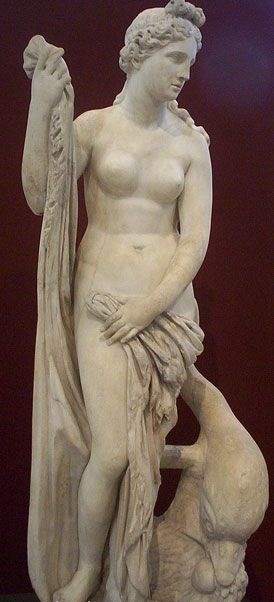
Культ в Аркадии
I. Мегалополь Столица Аркадии
Павсаний. Описание Эллады. Книга 8. 31. 5 — 6. (Источник: Павсаний. Описание Эллады /Пер. С. П. Кондратьева под ред. Е. Никитюк. Пред. Э. Фролова. СПб.: Алетейя, 1996) (греческое повествование о путешествии 2 в. н. э.):
«Внутри ограды святилища Великих богинь находится также храм Афродиты. Перед входом в него стоят древние ксоаны[4] (деревянные статуи) Геры, Аполлона и Муз; говорят, они перевезены сюда из Трапезунта. [6] Статуи же, находящиеся в храме, сделал Дамофонт: это вырезанный из дерева Гермес и ксоан Афродиты, только у нее руки, лицо и ступни ног сделаны из мрамора. Они совершенно правильно, как мне кажется, дали богине эпитет Маханитида (Изобретательница): <ведь> ради Афродиты и ее дел больше всего изобретено людьми всяких хитростей и придуманы хитрые обманные речи».
Павсаний. Описание Эллады. Книга 8. 32. 2. (Источник: Павсаний. Описание Эллады /Пер. С. П. Кондратьева под ред. Е. Никитюк. Пред. Э. Фролова. СПб.: Алетейя, 1996) (греческое повествование о путешествии 2 в. н. э.):
«Есть тут развалины и храма Афродиты; остался только пронаос и статуи числом три: одна из них носит название Афродиты Урании (Небесной), другая — Пандемос (Всенародной), а третьей не дано никакого названия»
II. Мелангея деревня в Аркадии
Павсаний. Описание Эллады. Книга 8. 6. 5. (Источник: Павсаний. Описание Эллады /Пер. С. П. Кондратьева под ред. Е. Никитюк. Пред. Э. Фролова. СПб.: Алетейя, 1996) (греческое повествование о путешествии 2 в. н. э.):
«Если идти дальше из Мелангей [В Аркадии], то на расстоянии от города приблизительно стадиев семи есть так называемый источник Мелиастов; эти Мелиасты совершают здесь свои оргии (торжественное богослужение) в честь Диониса, и около источника есть помещение, мегарон, <где эти оргии совершаются>, а равно и храм Афродиты Меланиды (Черной)»
Павсаний. Описание Эллады. Книга 8. 6. 5. (Источник: Павсаний. Описание Эллады /Пер. С. П. Кондратьева под ред. Е. Никитюк. Пред. Э. Фролова. СПб.: Алетейя, 1996) (греческое повествование о путешествии 2 в. н. э.):
«Если идти дальше из Мелангей, то на расстоянии от города приблизительно стадиев семи есть так называемый источник Мелиастов; эти Мелиасты совершают здесь свои оргии (торжественное богослужение) в честь Диониса, и около источника есть помещение, мегарон, <где эти оргии совершаются>, а равно и храм Афродиты Меланиды (Черной). Это наименование богиня получила не по чему иному, как только потому, что у людей совокупления происходят не так, как у животных, обычно днем, но по большей части ночью».
III. Мантинея город в Аркадии
Павсаний. Описание Эллады. Книга 8. 9. 6. (Источник: Павсаний. Описание Эллады /Пер. С. П. Кондратьева под ред. Е. Никитюк. Пред. Э. Фролова. СПб.: Алетейя, 1996) (греческое повествование о путешествии 2 в. н. э.):
«Позади театра есть развалины храма в честь Афродиты, носящей эпитет Симмахии (Союзницы), и ее статуя; имеющаяся на пьедестале надпись гласит, что воздвигла ее дочь Пасея Никиппа. Это святилище мантинейцы выстроили в память прежней своей совместной с римлянами морской победы при Актии».
IV. Анхизия гора в Аркадии
Павсаний. Описание Эллады. Книга 8. 12. 9. (Источник: Павсаний. Описание Эллады /Пер. С. П. Кондратьева под ред. Е. Никитюк. Пред. Э. Фролова. СПб.: Алетейя, 1996) (греческое повествование о путешествии 2 в. н. э.):
«У могилы Анхиза находятся развалины храма Афродиты, и у жителей Анхизии проходит граница между Мантинеей и Орхоменом».
V. Орхомен деревня в Аркадии
Павсаний. Описание Эллады. Книга 8. 13. 2. (Источник: Павсаний. Описание Эллады /Пер. С. П. Кондратьева под ред. Е. Никитюк. Пред. Э. Фролова. СПб.: Алетейя, 1996) (греческое повествование о путешествии 2 в. н. э.):
«Заслуживают осмотра здесь [Город Орхомен в Аркадии] источник, из которого жители получают воду, и храмы Посейдона и Афродиты; их статуи сделаны из мрамора».
VI. Псофид городв в Аркадии
Павсаний. Описание Эллады. Книга 8. 24. 6. (Источник: Павсаний. Описание Эллады /Пер. С. П. Кондратьева под ред. Е. Никитюк. Пред. Э. Фролова. СПб.: Алетейя, 1996) (греческое повествование о путешествии 2 в. н. э.):
«В городе Псофиде есть святилище Афродиты, именуемой Эрикиной, в мое время от него остались только развалины; говорят, что его построили сыновья Псофиды. Это предание вполне вероятное: есть и в Сицилии святилище <Афродиты> Эрикины в земле Эрикса, очень чтимое еще с самых древних времен и по своему богатству не уступающее храму в Пафосе».
VII. Тевфида деревня в Аркадии
Павсаний. Описание Эллады. Книга 8. 28. 6. (Источник: Павсаний. Описание Эллады /Пер. С. П. Кондратьева под ред. Е. Никитюк. Пред. Э. Фролова. СПб.: Алетейя, 1996) (греческое повествование о путешествии 2 в. н. э.):
«Кроме того, в Тевфиде есть еще храм Афродиты и Артемиды».
VIII. Акакесия деревня в Аркадии
Павсаний. Описание Эллады. Книга 8. 37. 12. (Источник: Павсаний. Описание Эллады /Пер. С. П. Кондратьева под ред. Е. Никитюк. Пред. Э. Фролова. СПб.: Алетейя, 1996) (греческое повествование о путешествии 2 в. н. э.):
«Есть тут и алтарь Ареса, есть и изображения Афродиты в храме — одно из белого мрамора, другое, более древнее из них, из дерева».
IX. Котил деревня в Аркадии
Павсаний. Описание Эллады. Книга 8. 41. 10. (Источник: Павсаний. Описание Эллады /Пер. С. П. Кондратьева под ред. Е. Никитюк. Пред. Э. Фролова. СПб.: Алетейя, 1996) (греческое повествование о путешествии 2 в. н. э.):
«Над храмом Аполлона Эпикурия есть местечко, носящее имя Котил, и в нем есть Афродита «в Котиле»: тут стоит ей храм, — но крыша на нем провалилась, — и стоит ее статуя».
X. Тегея город в Аркадии
Павсаний. Описание Эллады. Книга 8. 53. 7. (Источник: Павсаний. Описание Эллады /Пер. С. П. Кондратьева под ред. Е. Никитюк. Пред. Э. Фролова. СПб.: Алетейя, 1996) (греческое повествование о путешествии 2 в. н. э.):
«Есть в Тегее [Аркадия]… храм Афродиты, именуемой Пафосской. Этот храм был основан Лаодикой, которая, как я уже сказал раньше(2), была дочерью Агапенора, бывшего предводителем аркадян во время похода на Трою, и жила на Пафосе».
Павсаний. Описание Эллады. Книга 8. 48. 1. (Источник: Павсаний. Описание Эллады /Пер. С. П. Кондратьева под ред. Е. Никитюк. Пред. Э. Фролова. СПб.: Алетейя, 1996) (греческое повествование о путешествии 2 в. н. э.):
«На площади Тегеи, по форме очень похожей на кирпич, есть храм Афродиты, который так и называется «Храм Афродиты на кирпиче»; в нем есть мраморное изображение богини».
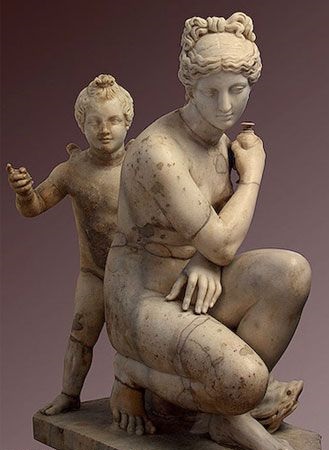
Культ в Беотии
I. Фивы столица Беотии
Павсаний. Описание Эллады. Книга 9. 16. 3. (Источник: Павсаний. Описание Эллады /Пер. С. П. Кондратьева под ред. Е. Никитюк. Пред. Э. Фролова. СПб.: Алетейя, 1996) (греческое повествование о путешествии 2 в. н. э.):
«В Фивах есть деревянные статуи Афродиты, столь древние, что, по их преданиям, они являются посвятительным даром Гармонии и что сделаны они из деревянных украшений, бывших на носу корабля Кадма. Этих Афродит называют — одну Уранией (Небесной), другую — Пандемос (Всенародной), а третью — Апострофией (Отвращающей). Эти названия дала Гармония. Название Урании дано богине в знак чистой любви, лишенной чувственной похоти, Пандемос — в знак общения между полами и, наконец, третье название Апострофии — с тем, чтобы она могла отвращать человеческий род от беззаконных страстей и безрассудных поступков. Знала Гармония, что много подобного совершено среди варваров, много другого решались уже совершать и у эллинов, о чем впоследствии было описано в стихах: так, например, о матери Адониса, о Федре, дочери Миноса, о фракийце Терее».
II. Танагра, деревня в Беотии
Павсаний. Описание Эллады. Книга 9. 2. 1. (Источник: Павсаний. Описание Эллады /Пер. С. П. Кондратьева под ред. Е. Никитюк. Пред. Э. Фролова. СПб.: Алетейя, 1996) (греческое повествование о путешествии 2 в. н. э.):
«В Танагре [Беотия], рядом с храмом Диониса, есть три храма: один Фемиды, другой Афродиты и третий храм Аполлона, а вместе с ним и Артемиды и Латоны [Лето]».
III. Феспия деревня в Беотии
Павсаний. Описание Эллады. Книга 9. 27. 5. (Источник: Павсаний. Описание Эллады /Пер. С. П. Кондратьева под ред. Е. Никитюк. Пред. Э. Фролова. СПб.: Алетейя, 1996) (греческое повествование о путешествии 2 в. н. э.):
«Тут есть и Афродита, произведение того же Праксителя, и изображение Фрины. Обе — и Фрина и богиня — изваяны из мрамора. В другом месте есть святилище Афродиты Меланиды (Черной), театр и площадь, заслуживающие осмотра».
Культ в Фокиде
I. Эантия деревня в Фокиде
Павсаний. Описание Эллады. Книга 10. 38. 9. (Источник: Павсаний. Описание Эллады /Пер. С. П. Кондратьева под ред. Е. Никитюк. Пред. Э. Фролова. СПб.: Алетейя, 1996) (греческое повествование о путешествии 2 в. н. э.):
«В Эантии есть святилище Афродиты»
Культ в Локрах Озольских
I. Навпакт столица Локра
Павсаний. Описание Эллады. Книга 10. 38. 1. (Источник: Павсаний. Описание Эллады /Пер. С. П. Кондратьева под ред. Е. Никитюк. Пред. Э. Фролова. СПб.: Алетейя, 1996) (греческое повествование о путешествии 2 в. н. э.):
«Афродите воздается поклонение в пещере. Молятся ей по разным причинам, но особенно к ней обращаются с молитвами вдовы, прося богиню о новом браке».
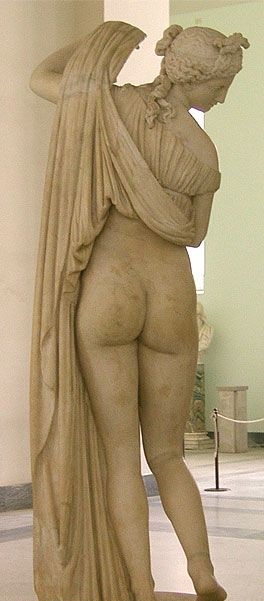
Культ в Фессалии
I. Метрополь столица Гестиеотиды в Фессалии
Страбон. География. Книга 9. 5. 17. (Источник: Страбон. География / Пер. Г. А. Стратановского. — М.: Наука, 1964. – С. 611-612) (греческий географ 1 в. до н. э. – 1 в. н. э.):
«Метрополь же раньше объединился из трех незначительных городков; впоследствии к нему присоединилось несколько других местечек, среди которых была и Ифома. C. 438Так, Каллимах в своих «Ямбах» говорит, что «из всех Афродит (ибо есть не одна богиня с таким именем) Афродита Кастниетида превосходит всех мудростью, так как только она одна принимает в жертву свиней». Конечно, он был весьма ученым человеком (больше всякого другого) и всю свою жизнь, как он сам говорил, желал посвятить подобным мифам. Однако позднейшие писатели доказали, что не только одна Афродита, но несколько приняли этот обряд; среди этих богинь была и Афродита Метропольская; один из городов, соединившихся в одно поселение с этим городом, передал Метрополю этот онфурийский обряд».
Культ в Делосе
I. Делос столица в Делоса
Павсаний. Описание Эллады. Книга 9. 40. 3. (Источник: Павсаний. Описание Эллады /Пер. С. П. Кондратьева под ред. Е. Никитюк. Пред. Э. Фролова. СПб.: Алетейя, 1996) (греческое повествование о путешествии 2 в. н. э.):
«У делосцев есть небольшой ксоан Афродиты, у которой правая рука попорчена от времени, внизу же вместо ног у нее четырехугольная колонна. [4] Думаю я, что эту статую Ариадна получила от Дедала, и когда она последовала за Тесеем, то она захватила из дому и это изображение. Делосцы говорят, что, лишившись Ариадны, Тесей посвятил этот ксоан богини Аполлону Делосскому для того, чтобы, привезя его домой, при виде его, невольно вспоминая об Ариадне, он не испытывал бы все новых страданий от этой любви».
Культ на острове Кос
I. Кос столица Кос
Страбон. География. Книга 14. 2. 19. (Источник: Страбон. География / Пер. Г. А. Стратановского. — М.: Наука, 1964. – С. 611-612) (греческий географ 1 в. до н. э. – 1 в. н. э.):
«Там же была и Афродита Анадиомена [Выходящая из моря], теперь принесенная в дар Божественному Цезарю в Риме, так как Август посвятил отцу изображение его родоначальницы [Афродиты]»
Культ во Фракии
I. Абидос город на Галлипольском полуострове
Мусей. Геро и Леандр. / Пер. М. Дриневич под ред. Μ. Е. Грабарь-Пассек (Источник: Памятники поздней античной поэзии и прозы. – М.: Наука, 1964. – С. 78):
«Часто она [Геро жрица Афродиты в Абидосе] и Эрота с Кипридой [Афродитой] небесной молила,
Жертвы неся им, недаром боясь огневого колчана»
Культ в Тевфрании (Малая Азия)
I. Возле Антандра в Тевфрании
Страбон. География. Книга 13. 1. 51. (Источник: Страбон. География / Пер. Г. А. Стратановского. — М.: Наука, 1964. – С. 611-612) (греческий географ 1 в. до н. э. – 1 в. н. э.):
«Гаргары же расположены на мысе, образующем так называемый собственно Адрамиттский залив… Адрамиттским заливом называют только часть его, заключенную между мысом, где расположены Гаргары, и мысом под названием Пирра, где находится святилище Афродиты. Ширина входа в залив от мыса до мыса составляет переезд в 120 стадий. — Внутри залива расположены Антандр с возвышающейся над ним горой под названием Александрия (где, как говорят, происходил суд Париса над богинями)»
Культ в Мисии (Малая Азия)
I. Апатур город в Мисии
Страбон. География. Книга 11. 2. 10. (Источник: Страбон. География / Пер. Г. А. Стратановского. — М.: Наука, 1964. – С. 611-612) (греческий географ 1 в. до н. э. – 1 в. н. э.):
«При въезде в Корокондамитиду находятся значительный город Фанагория, Кепы, Гермонасса и Апатур — святилище Афродиты. Фанагория и Кепы расположены на упомянутом острове при входе в озеро с левой стороны, а остальные города — за Гипанисом в Синдской области. В Синдской области есть место Горгипия — царская столица синдов, недалеко от моря, а также Аборака… Есть в Фанагории знаменитое святилище Афродиты Апатурос. Для объяснения первоначального значения эпитета богини приводят некий миф о том, как богиня, когда на нее здесь напали гиганты, позвала на помощь Геракла и спрятала его в какой-то пещере; затем, принимая гигантов поодиночке, она отдавала своих врагов Гераклу, чтобы коварно, обманом [По-гречески apatē] убить их».
Культ в Памфилии (Малая Азия)
I. Горы в Памфилии
Каллимах. Фрагмент эпиграммы (из греческих гимнов 3 в. до н. э. – 2 в. н. э.) (Источник: Каллимах. Перевод Блуменаю Л. Грабарь-Пассек М.Е. Голубец Ю. Свиясов Е.;Шульц Ю. Чистякова Н.Гаспаров М.Л. Иваница Г.) (греческий поэт 3 в. до н. э.):
«Так, Каллимах в своих «Ямбах» говорит, что «из всех Афродит (ибо есть не одна богиня с таким именем) Афродита Кастниетида превосходит всех мудростью, так как только она одна принимает в жертву свиней»
Культ в Карии (Малая Азия)
I. Книд город в Дорисе — Кария
Павсаний. Описание Эллады. Книга 1. 1. 3. (Источник: Павсаний. Описание Эллады /Пер. С. П. Кондратьева под ред. Е. Никитюк. Пред. Э. Фролова. СПб.: Алетейя, 1996) (греческое повествование о путешествии 2 в. н. э.):
«Книдяне больше всего почитают Афродиту и у них имеется ряд храмов богини. Из них самый древний — Афродиты Доритиды (Дающей плодородие), затем — Акреи (Владычицы горных вершин) и новейший, который все называют просто Книдией, а сами книдяне — Эвплоей (Доброй помощницей в плавании)».
Флавий Филострат. Жизнь Аполлония Тианского. Книга 6. 40. (Источник: Флавий Филострат. Жизнь Аполлония Тианского / Изд. подг. Е. Г. Рабинович; Отв. М. Л. Гаспаров. – М.: «Наука», 1985. – С. 186) (греческая биография 1-2 вв. н. э.):
«Некий человек решил, будто влюблен в изваяние нагой Афродиты, — такой кумир воздвигнут в Книде. Итак, этот влюбленный подносил истукану дары, твердя, что подарит еще больше, ибо намерен жениться. В иных обстоятельствах Аполлоний счел бы все это просто нелепостью, однако обитатели Книда не разделяли такого мнения, но, напротив, утверждали, что богиня воссияет ярче прежнего, ежели заведет себе любовника. Тогда Аполлоний решил изгнать из святилища подобные глупости и на вопрос горожан, намерен ли он исправить что-нибудь в порядке жертвоприношений и обетов, отвечал: «Я намерен вправить вам глаза, а что до храмовых обрядов, то пусть будут, как были!» Затем, призвав к себе развратного мечтателя, он спросил: «Почитаешь ли ты богов сущими?» Тот отвечал, что почитает-де их сущими и даже влюблен в богиню, супружества коей домогается, надеясь вскоре сыграть свадьбу. «Это стихотворцы заморочили тебе голову, — возразил Аполлоний, — сказками о всяких Пе-леях и Анхизах, женившихся на богинях! А вот я касательно всех этих любовных дел знаю одно: боги любятся с богами, люди с людьми, звери — со зверями, и так повсюду подобное влечется к подобному ради сходного с родителями и здорового потомства. У созданий несходных и разнопородных никакого супружества и никакой любви получиться не может — вспомни об Иксионе и перестань мечтать о чуждой возлюбленной! Иксион на картинках катится по небу на пыточном колесе, а тебе, ежели не уйдешь ты из храма, по всей земле будет погибель — и тогда уж не жалуйся, что боги осудили тебя несправедливо». Этой речью Аполлоний утихомирил безумие так называемого влюбленного, и тот покинул святилище, прежде принеся жертву, дабы простила его богиня».
Культ в Лидии (Малая Азия)
I. Сардис столица Лидии
Птолемей Хенн. Новая история для многознающих. (Источник: Латышев В. В. Известия древних писателей греческих и латинских о Скифии и Кавказе // Вестник древней истории. — 1947. — №№ 1—4; 1948. — №№ 1—4; 1949. — №№ 1—4. Переводчик: Мещанский Д.В.) (Греческий писатель. II века н. э.)
«Крез [Царь Лидии], как говорят, был зачат во время праздника Афродиты, когда лидийцы проводят шествие и украшают богиню своим богатством».
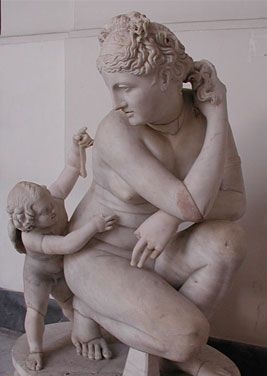
Культ на Кипре
Геродот. История. Книга 1. 199. (Источник: Геродот. История в девяти книгах. / Пер. и прим. Г. А. Стратановского. Статья В. Г. Боруховича. – Л.: Наука, 1972. – С. 195) (греческий историк 5 в. до н. э.):
«Самый же позорный обычай у вавилонян вот какой. Каждая вавилонянка однажды в жизни должна садиться в святилище Афродиты и отдаваться [за деньги] чужестранцу. Многие женщины, гордясь своим богатством, считают недостойным смешиваться с [толпой] остальных женщин. Они приезжают в закрытых повозках в сопровождении множества слуг и останавливаются около святилища. Большинство же женщин поступает вот как: в священном участке Афродиты сидит множество женщин с повязками из веревочных жгутов на голове. Одни из них приходят, другие уходят. Прямые проходы разделяют по всем направлениям толпу ожидающих женщин. По этим-то проходам ходят чужеземцы и выбирают себе женщин. Сидящая здесь женщина не может возвратиться домой, пока какой-нибудь чужестранец не бросит ей в подол деньги и не соединится с ней за пределами священного участка. Бросив женщине деньги, он должен только сказать: «Призываю тебя на служение богине Милитте!». Милиттой же ассирийцы называют Афродиту. Плата может быть сколь угодно малой. Отказываться брать деньги женщине не дозволено, так как деньги эти священные. Девушка должна идти без отказа за первым человеком, кто бросил ей деньги. После соития, исполнив священный долг богине, она уходит домой и затем уже ни за какие деньги не овладеешь ею вторично. Красавицы и статные девушки скоро уходят домой, а безобразным приходится долго ждать, пока они смогут выполнить обычай. И действительно, иные должны оставаться в святилище даже по три-четыре года [Обычай священной храмовой проституции описан у Геродота неправильно. Священной проституцией на службе богини Иштар занимались только девушки — жрицы богини Иштар (принадлежавшие, правда, к знатнейшим семьям Вавилона), а вовсе не все девушки-вавилонянки.]. Подобный этому обычай существует также в некоторых местах на Кипре».
Геродот. История. Книга 1. 105. (Источник: Геродот. История в девяти книгах. / Пер. и прим. Г. А. Стратановского. Статья В. Г. Боруховича. – Л.: Наука, 1972. – С. 195) (греческий историк 5 в. до н. э.):
«В городе Аскалон в Сирии… святилище Афродиты Урании [Это был знаменитый храм филистимлян, посвященный Астарте (Иштар).]. Как я узнал из расспросов, это святилище — самое древнее из всех храмов этой богини. Ведь святилище на Кипре основано выходцами оттуда, как утверждают сами киприоты, а храм в Кифере воздвигли финикияне, жители Сирии Палестинской».
Павсаний. Описание Эллады. Книга 1. 14. 6. (Источник: Павсаний. Описание Эллады /Пер. С. П. Кондратьева под ред. Е. Никитюк. Пред. Э. Фролова. СПб.: Алетейя, 1996) (греческое повествование о путешествии 2 в. н. э.):
«Поблизости стоит храм Афродиты Урании (Небесной). Первым народом, которому выпало на долю почитать Уранию, были ассирийцы, а после ассирийцев из жителей Кипра — пафийцы, а из финикийцев — жители Аскалона в Палестине».
Фестиваль Адония
Овидий. Метаморфозы. Книга 10. 724. (Источник: Публий Овидий Назон. Метаморфозы / Перевод с латинского С. В. Шервинского. – М.: Художественная литература, 1977) (римский эпос 1 в. до н. э. – 1 в. н. э.):
«[После смерти Адониса Афродита объявляет, что она установит праздник траура на Кипре:]
Слез, Адонис, моих; твоей повторенье кончины [Намек на празднества в честь Адониса]
Изобразит, что ни год, мой плач над тобой неутешный!»
[то есть во время празднования фестиваля Адония]
I. Пафос столица Кипра
Гомеровские гимны. IV. К Афродите. (Источник: Эллинские поэты VIII – III вв. до н. э. / Перевод В. В. Вересаева. – М.: Ладомир, 1999. – С. 149, 155) (греческий эпос 7-4 вв. до н. э.):
«Быстро примчавшись на Кипр, низошла она в храм свой душистый
В Пафосе: есть у нее там алтарь благовонный и роща»
Страбон. География. Книга 14. 6. 3. (Источник: Страбон. География / Пер. Г. А. Стратановского. — М.: Наука, 1964. – С. 611-612) (греческий географ 1 в. до н. э. – 1 в. н. э.):
«Палепаф [На кипре]; последний приблизительно в 10 стадиях над морем с корабельной стоянкой и древним святилищем Афродиты Пафии. Затем следуют мыс Зефирия с корабельной стоянкой и другая Арсиноя, также с корабельной стоянкой, со святилищем и священным участком. Неподалеку от моря находится Гиерокепида. Далее идет Пафос, основанный Агапенором, с гаванью и прекрасно построенными святилищами. Город находится на расстоянии 60 стадий пути по суше от Палепафа; на этой дороге мужчины и женщины из других городов ежегодно сходятся на торжественные процессии к Палепафу; некоторые считают от Пафоса до Александрии 3600 стадий. После Пафоса следует Акамант. После Акаманта на восток идет морской путь к городу Арсиное и к священному участку Зевса. Далее идет город Солы с гаванью, рекой и святилищем Афродиты и Исиды»
Павсаний. Описание Эллады. Книга 8. 5. 2. (Источник: Павсаний. Описание Эллады /Пер. С. П. Кондратьева под ред. Е. Никитюк. Пред. Э. Фролова. СПб.: Алетейя, 1996) (греческое повествование о путешествии 2 в. н. э.):
«Поднявшейся бурей Агапенор и корабли аркадян были занесены на Кипр; там Агапенор сделался строителем города Пафоса и воздвиг храм Афродиты в Палай Пафосе (в Старом Пафосе); до тех пор богиня принимала поклонение от жителей Кипра в местечке, называемом Голги».
Павсаний. Описание Эллады. Книга 8. 53. 7. (Источник: Павсаний. Описание Эллады /Пер. С. П. Кондратьева под ред. Е. Никитюк. Пред. Э. Фролова. СПб.: Алетейя, 1996) (греческое повествование о путешествии 2 в. н. э.):
«Есть в Тегее также храм Деметры и Коры, которых называют Карпофорами (Плодоносящими), а поблизости — храм Афродиты, именуемой Пафосской. Этот храм был основан Лаодикой, которая, как я уже сказал раньше, была дочерью Агапенора, бывшего предводителем аркадян во время похода на Трою, и жила на Пафосе».
Афиней. Пир мудрецов. Книга 3. 84c. (Источник: Афиней. Пир мудрецов. В пятнадцати книгах / Перевод с древнегреческого Н. Т. Голинкевича. – М.: Издательство «Наука», 2010. – С. 75):
«[Эриф Мелибея]
— А вот гранаты.
— Прелесть.
— Это дерево Посажено на Кипре Афродитою.
— О, чтимая Бербея!»
[Бербея была кипрским Была кипрским эпитетом Афродиты.]
Афиней. Пир мудрецов. Книга 3. 95f — 96a. (Источник: Афиней. Пир мудрецов. В пятнадцати книгах / Перевод с древнегреческого Н. Т. Голинкевича. – М.: Издательство «Наука», 2010. – С. 75):
«Антифан в «Коринфянке»:
— Как? Афродиту чтить свиной конечностью?
— Забыл, хозяин, что богиня Кипрская
Так любит всех свиней на этом острове,
Что и навозом у нее питаются
Не свиньи, а быки».[От том, что Афродите действительно приносится в жертву свинья, свидетельствует в «Исторических записках» Каллимах или Зенодот: «Аргосцы жертвуют Афродите свинью, и даже сам праздник называется Свиным (‛Υστήρια)».]
Овидий. Метаморфозы. Книга 10. 243. (Источник: Публий Овидий Назон. Метаморфозы / Перевод с латинского С. В. Шервинского. – М.: Художественная литература, 1977) (римский эпос 1 в. до н. э. – 1 в. н. э.):
«Праздник Венеры [Афродиты] настал, справляемый всюду на Кипре.
Возле святых алтарей с золотыми крутыми рогами
Падали туши телиц, в белоснежную за́кланных шею».
Овидий. Метаморфозы. Книга 10. 560. (Источник: Публий Овидий Назон. Метаморфозы / Перевод с латинского С. В. Шервинского. – М.: Художественная литература, 1977) (римский эпос 1 в. до н. э. – 1 в. н. э.):
«Поприще есть, — Тамазейским его называют туземцы, —
Кипрской земли наилучший кусок. Старинные люди
Мне посвятили его и решили, как дар благочестья,
К храму придать моему. Посреди его дерево блещет
Золотоглаво, горят шелестящие золотом ветви.
Яблока три золотых я с него сорвала и явилась,
Их же в руке принесла; не зрима никем, им одним лишь,
К юноше я подошла и что с ними делать внушила».
Апулей. Золотой осёл. Книга 11. 218. (Источник: Апулей. Золотой осёл / Перевод М. Кузьмина. – Л.: Academia, 1931. – C. 192) (роман 2 в. н. э. на латинском языке):
«[Афродита] вечным плодородием человеческий род умножая, ныне на Пафосе священном».
II. Аматунт город на Кипре
Павсаний. Описание Эллады. Книга 9. 41. 2. (Источник: Павсаний. Описание Эллады /Пер. С. П. Кондратьева под ред. Е. Никитюк. Пред. Э. Фролова. СПб.: Алетейя, 1996) (греческое повествование о путешествии 2 в. н. э.):
«Есть на Кипре город Аматунт, а в нем есть древний храм Адониса и Афродиты. Говорят, что в этом храме хранится ожерелье, некогда данное Гармонии; его называют ожерельем Эрифилы, так как она получила его в подарок, продав за него своего мужа. Дети Фегея посвятили его в Дельфы; каким образом оно попало в их руки, мною уже рассказано, когда я описывал историю Аркадии. Из Дельф его похитили фокейские тираны. Но мне лично кажется, что оно находится вовсе не в Аматунте, в храме Адониса. В Аматунте хранится ожерелье, состоящее из зеленых камней, оправленных в золото. А то ожерелье, которое было дано Эрифиле, по словам Гомера, было золотое».
III. Лапаф город на Кипре
Страбон. География. Книга 14. 6. 3. (Источник: Страбон. География / Пер. Г. А. Стратановского. — М.: Наука, 1964. – С. 611-612) (греческий географ 1 в. до н. э. – 1 в. н. э.):
«В этом промежутке находится город Лапаф… Далее идет Афродисий [Святилище Афродиты], где остров узок, так как переезд до Саламина равен 70 стадиям».
IV. Олимп гора на Кипре
Страбон. География. Книга 14. 6. 3. (Источник: Страбон. География / Пер. Г. А. Стратановского. — М.: Наука, 1964. – С. 611-612) (греческий географ 1 в. до н. э. – 1 в. н. э.):
«[Рядом с Карпасией на Кипре] Затем идут мыс и гора, вершина которой называется Олимпом. На ней находится храм Афродиты Акрейской, недоступный для женщин, которым запрещено даже смотреть на него».
V. Залив Педалий на Кипре
Страбон. География. Книга 14. 6. 3. (Источник: Страбон. География / Пер. Г. А. Стратановского. — М.: Наука, 1964. – С. 611-612) (греческий географ 1 в. до н. э. – 1 в. н. э.):
«Потом следуют город Арсиноя и гавань. Затем другая гавань — Левколла. Далее — мыс Педалий, над которым возвышается скалистый высокий трапециевидный холм, посвященный Афродите»
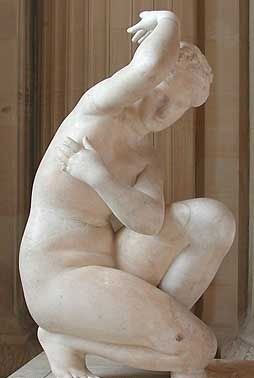
Культ в Египте
I. Зефирий мыс в Египте
Посидипп. 12. Храм Арсинои-Киприды (Переводчик: Блуменаю Л. Шульц Ю. Голубец Ю.) (Греческий поэт. 310 г. до н.э)
«[Эпиграмма, составленная Птолемеем II в честь основания святыни его жены Арсинои. Здание представляло собой часовню с изображением Арсинои, которой поклонялись здесь как Арсинои-Афродите: она стояла на мысе Зефирион, между Александрой и Канопусом.]
Я — на фаросской земле, у принильского устья Канопа,
Волны в изножье моем всюду кипят, волнорез
Тянется к краю ливийских песков, обильных стадами,
Тянется дамба моя вдоль к италийским ветрам.
Здесь меня воздвиг Калликрат, Арсинои-Киприды
Царственным именем храм он достославный назвал.
Но сюда, к Зефирите, чистые эллинов дщери,
Слух Афродиты склонить вы отправляйтесь скорей!
С ними мужи, бороздящие море! Наварх наш построил
Храм, защиту для всех ныне от всяческих бурь».
Псевдо-Гигин (общее имя для неизвестных античных авторов-мифографов 2 века н. э.) Астрономия. Книга 2. 24. ЛЕВ (Источник: Гигин. Астрономия / Перевод и комментарии А. И. Рубана. СПб., Изд-во «Алетейя», 1997):
«Математик Конон с Самоса и Каллимах называют Волосами Береники. Когда Птолемей вступил в брак со своей сестрой Береникой [около 243 г. до н.э.],, дочерью Птолемея и Арсинои, и спустя короткое время отправился на завоевание Азии, Береника дала обет, что она острижет свои волосы, если Птолемей вернется победителем. Она исполнила свое обещание и посвятила волосы в храм Венеры-Арсинои Зефиритидской, но на другой день они исчезли. Это привело царя в ярость, но математик Конон, как мы сказали выше, стремясь добиться царского расположения, объявил, что он разглядел волосы среди созвездий, и указал на семь звезд, не входивших ни в одно созвездие, которые, по его словам, и есть ее волосы».
II. Фарос остров в Египте
Геродот. История. Книга 2. 112. (Источник: Геродот. История в девяти книгах. / Пер. и прим. Г. А. Стратановского. Статья В. Г. Боруховича. – Л.: Наука, 1972. – С. 195) (греческий историк 5 в. до н. э.):
«Есть в этом священном участке Протея храм, называемый храмом «чужеземной Афродиты». Как я предполагаю, это — храм Елены, дочери Тиндарея. Во-первых, потому, что по сказанию, которое мне сообщили, Елена жила у Протея, а во-вторых, оттого, что этот храм называется храмом «чужеземной Афродиты». Ведь ни один другой храм в Египте не носит такого названия».
Культ в Ливии
I. Кирена город в Ливии
Геродот. История. Книга 2. 181. (Источник: Геродот. История в девяти книгах. / Пер. и прим. Г. А. Стратановского. Статья В. Г. Боруховича. – Л.: Наука, 1972. – С. 195) (греческий историк 5 в. до н. э.):
«Так вот, он [Амасис Египетский фараон C 5-года до н. Э.] взял себе в супруги девушку по имени Ладику, которая, как одни говорят, была дочерью Батта, по другим же, — Аркесилая или даже знатного гражданина Критобула. Однако, разделяя с супругой ложе, Амасис не мог сойтись с нею, хотя еще сходился с другими женщинами. И так как это повторялось не раз, то Амасис сказал Ладике: «Женщина! Ты меня совершенно околдовала! Ничто уже не спасет тебя от самой лютой казни, которую когда-либо испытала женщина!». Хотя Ладика отрицала свою вину, Амасис не сменил свой гнев на милость. Тогда Ладика принесла обет Афродите посвятить в Кирену статую богине, если Амасис сойдется с ней в эту ночь (ведь в этом одном было ее спасение). И действительно, после этого обета Амасис тотчас же сошелся с ней и с тех пор, всякий раз как приходил, имел сношение с ней, и потом очень полюбил ее. Ладика же исполнила свой обет богине. Она велела изваять статую и отослала ее в Кирену. Когда я был там, статуя была еще цела и стояла [в храме] за городом Киреной. Эту Ладику Камбис после завоевания Египта, узнав от нее самой, кто она, отослал в Кирену, не причинив обиды».
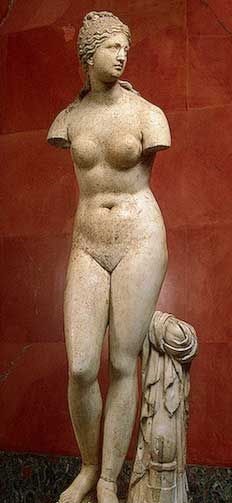
Культ в Сицилии
I. Эрикс город в Сицилии
Страбон. География. Книга 6. 2. 6. (Источник: Страбон. География / Пер. Г. А. Стратановского. — М.: Наука, 1964. – С. 611-612) (греческий географ 1 в. до н. э. – 1 в. н. э.):
«Населен также Эрикс — высокий холм с весьма чтимым святилищем Афродиты. В древние времена святилище было полно храмовых рабынь, которых посвящали по обету жители Сицилии и многие иностранцы. Теперь, однако, святилище, как и само поселение26, опустело и толпа храмовых служителей покинула его. В Риме есть храм — копия храма этой богини, святилище так называемой Венеры Эрикины перед Коллинскими воротами с замечательным храмом и портиком вокруг него… Сиракузы и Эрикс воздвигнуты на море как две твердыни»
Павсаний. Описание Эллады. 8. 24. 6. (Источник: Павсаний. Описание Эллады /Пер. С. П. Кондратьева под ред. Е. Никитюк. Пред. Э. Фролова. СПб.: Алетейя, 1996) (греческое повествование о путешествии 2 в. н. э.):
«В городе Псофиде есть святилище Афродиты, именуемой Эрикиной, в мое время от него остались только развалины; говорят, что его построили сыновья Псофиды. Это предание вполне вероятное: есть и в Сицилии святилище <Афродиты> Эрикины в земле Эрикса, очень чтимое еще с самых древних времен и по своему богатству не уступающее храму в Пафосе».
Клавдий Элиан. О мире животных. Книга 10. 50. / Переводчик: Агностик. (Источник: Симпосий, сайт об античной литературе, античной истории и людях античности — дата обращения 13 июля 2021):
«Слышал я, мол, в Эриксе, где конечно же знаменитый храм Афродиты (тамошних голубей и их особенности я упоминал ранее) имеет запасы золота, огромные запасы серебра, ожерелий и перстней большой цены; и что страх перед богиней обеспечивает им безопасность от грабителей и неприкосновенность; и что люди древних времён всегда почитали вышеупомянутую богиню и ее сокровища с благоговением и трепетом. Но я узнал, что Гамилькар карфагенянин ограбил сокровищницу, переплавил золото и серебро, а затем раздал позорные награды воинам. И за эти деяния он перенес самые болезненные и тяжкие муки и был казнен распятием, в то время как все его сообщники и соучастники в нечестивом святотатстве погибли насильственной и страшной смертью. И его родина, которая до это была столь процветающей, и которая славилась выше большинства стран, после того как священные предметы были доставлены, была порабощена. Но хотя эти впечатляющие факты не имеют отношения к нашей нынешней теме, но те, что уместны в этом обсуждении, сейчас будут предъявлены.
Каждый день в течение всего года народ Эрикса и чужестранцы приносят жертвы богине. И самый большой алтарь находится на открытом воздухе, и на нем предлагаются многие жертвы, и весь день и в ночи на нем горит огонь. Рассвет начинает очистку, и по–прежнему алтарь не показывает никаких следов угля, пепла, полусожженных чурок, но покрыт росой и свежей травой, которая вырастает за ночь. И священные жертвы из каждого стада приходят и встают перед алтарём по собственному желанию; это богиня в первую очередь приводит их, а во вторую, это возможность и желание платить со стороны жертвователя. В любом случае, если вы хотите принести в жертву овцу, и вдруг, о чудо! овца стоит у алтаря, и вы должны начать торжественное омовение. Но если вы человек состоятельный и хотите пожертвовать одну корову или даже больше чем одну, тогда ни пастух не обжулит вас, взимая слишком много, ни вы ни разочаруете его, ибо богиня видит, что купля–продажа справедлива, и если вы заплатили достаточно, то приобретете ее благосклонность. Если однако вы хотите купить по более низкой цене, чем должно, вы заплатите свои деньги зря — животное уйдет, и вы не сможете принести жертву.
Вот что касается особенностей животных Эрикса в дополнение к тем, о которых я упоминал ранее».
Клавдий Элиан. Пёстрые рассказы. Книга 1. 15. (Источник: Элиан. Пестрые рассказы. — М.-Л.: Издательство Академии наук СССР, 1963) (древнеримский писатель и философ 2-3 вв. н. э.):
«В сицилийском городе Эрике, где находится знаменитое святилище Афродиты, справляют праздник Анагогий в честь переселения богини из Сицилии в Ливию. Тогда голуби отсюда исчезают, точно они сопутствуют богине в ее странствии, а в остальное время, как известно, стаями кружатся над храмом Афродиты».
Культ венеры в Лации
I. Рим столица Империи
Страбон. География. Книга 6. 2. 6. (Источник: Страбон. География / Пер. Г. А. Стратановского. — М.: Наука, 1964. – С. 611-612) (греческий географ 1 в. до н. э. – 1 в. н. э.):
«В Риме есть храм — копия храма этой богини [Афродиты], святилище так называемой Венеры Эрикины перед Коллинскими воротами с замечательным храмом и портиком вокруг него»
Флавий Филострат, Жизнь Аполлония Тианского, Книга 7. 32. (Источник: Флавий Филострат. Жизнь Аполлония Тианского / Изд. Подг. Е. Г. Рабинович; Отв. М. Л. Гаспаров. – М.: «Наука», 1985. – С. 186) (греческая биография 1-2 вв. н. э.):
«Император [Домициан в Риме] был в масличном венке, ибо как раз перед тем приносил жертву Афине в Адонисовом дворе, а двор этот весь был уставлен цветочными горшками — такие цветы ассирияне растят у себя дома под крышей, готовя их к Адописовым игрищам [в честь Афродиты и Адониса]».
II. Ардея город в Риме в Лации
Страбон. География. Книга 5. 3. 5. (Источник: Страбон. География / Пер. Г. А. Стратановского. — М.: Наука, 1964. – С. 611-612) (греческий географ 1 в. до н. э. – 1 в. н. э.):
«Поблизости от Ардеи есть также храм Афродиты, где латины справляют всенародные праздники. Самниты разорили эту местность, и хотя сохранились только остатки городов, но и они стали знамениты пребыванием Энея и священными обрядами (по преданию) тех времен».
Культ в Галлии
Пиренеи горы в Галлии
Страбон. География. Книга 4. 1. 3. (Источник: Страбон. География / Пер. Г. А. Стратановского. — М.: Наука, 1964. – С. 611-612) (греческий географ 1 в. до н. э. – 1 в. н. э.):
«От этой реки морское побережье простирается до святилища Афродиты Пиренейской. Это святилище служит границей между этой провинцией — Нарбонитидой — и Иберийской страной».
[Вероятно, это культ местной богини, а не греческой Афродиты или римской Венеры.]
Страбон. География. Книга 4. 1. 6. (Источник: Страбон. География / Пер. Г. А. Стратановского. — М.: Наука, 1964. – С. 611-612) (греческий географ 1 в. до н. э. – 1 в. н. э.):
«Береговая линия начиная отсюда глубоко вдается в берег и образует до священного участка Афродиты (т. е. мыса Пиренеев)»
ИСТОЧНИКИ
Греческие
- Гомеровские гимны. / Перевод В. В. Вересаева. (Источник: Эллинские поэты VIII – III вв. до н. э. / Перевод В. В. Вересаева. – М.: Ладомир, 1999. – С. ???-???) (греческий эпос 8-7 вв. до н. э.):
- Геродот. История. (Источник: Геродот. История в девяти книгах. / Пер. и прим. Г. А. Стратановского. Статья В. Г. Боруховича. – Л.: Наука, 1972. – С. ???) (греческий историк 5 в. до н. э.):
- Каллимах. / Пер. О. Смыки. (Источник: Эллинские поэты VIII – III вв. до н. э. – М.: Ладомир, 1999. – С. ???-???) (греческий поэт 3 в. до н. э.):
- Страбон. География. (Источник: Страбон. География / Пер. Г. А. Стратановского. – М.: Наука, 1964. – С. ???-???) (греческий географ 1 в. до н. э. – 1 в. н. э.):
- Павсаний. Описание Эллады. (Источник: Павсаний. Описание Эллады /Пер. С. П. Кондратьева под ред. Е. Никитюк. Пред. Э. Фролова. СПб.: Алетейя, 1996) (греческое повествование о путешествии 2 в. н. э.):
- Клавдий Элиан. О мире животных. / Переводчик: Агностик. (Источник: Симпосий, сайт об античной литературе, античной истории и людях античности).
- Клавдий Элиан. Пёстрые рассказы. (Источник: Элиан. Пестрые рассказы. – М.-Л.: Издательство Академии наук СССР, 1963) (древнеримский писатель и философ 2-3 вв. н. э.):
- Афиней. Пир мудрецов. (Источник: Афиней. Пир мудрецов. В пятнадцати книгах / Перевод с древнегреческого Н. Т. Голинкевича. – М.: Издательство «Наука», 2004. – С. ???) (древнегреческий писатель 2-3 вв. н. э.):
- Флавий Филострат. Жизнь Аполлония Тианского. (Источник: Флавий Филострат. Жизнь Аполлония Тианского / Изд. подг. Е. Г. Рабинович; Отв. М. Л. Гаспаров. – М.: «Наука», 1985. – С. ???-???) (греческая биография 1-2 вв. н. э.):
- Птолемей Хенн (Гефестион). Новая история (в 7 книгах). V. (Перевод: Мещанский Д. В). (Источник: Латышев В. В. Известия древних писателей греческих и латинских о Скифии и Кавказе // Вестник древней истории. – 1947. – №№ 1-4; 1948. – №№ 1-4; 1949. – №№ 1-4) (греческий мифограф 1-2 вв. н. э.):
Римские
- Псевдо-Гигин (общее имя для неизвестных античных авторов-мифографов 2 века н. э.) Астрономия. (Источник: Гигин. Астрономия / Перевод и комментарии А. И. Рубана. – СПб.: Алетейя, 1997. – С. ???-???):
- Овидий. Метаморфозы. (Источник: Публий Овидий Назон. Метаморфозы / Перевод с латинского С. В. Шервинского. – М.: Художественная литература, 1977) (римский эпос 1 в. до н. э. – 1 в. н. э.):
- Цицерон. О природе богов. (Источник: Цицерон. Философские трактаты. / Пер. М. И. Рижского. Отв. ред., сост. и вступ. ст. Г. Г. Майорова. (Серия «Памятники философской мысли»). – М.: Наука, 1985. – 384 стр.) (римский ритор 1 в. до н. э.):
- Плиний Старший. Естественая история. / Перевод с латинского Б. А. Старостина. (Источник: Вопросы истории естествознания и техники. № 3. Москва, 2007. – С. 110-142) (римская энциклопедия 1 в. н. э.):
- Апулей. Золотой осёл. (Источник: Апулей. Золотой осёл / Перевод М. Кузьмина. – Л.: Academia, 1931. – C. ???-???) (роман 2 в. н. э. на латинском языке):
Список используемой литературы
Полная библиография переводов, цитируемых на этой странице.
Мифология Древней Греции позволяет нам погрузиться в уникальный, необыкновенный мир, где над событиями, людьми и даже чувствами властвовали всесильные боги Олимпа. Среди всех богинь особенно ярко выделяется Афродита, которой воспевали хвалу влюблённые.
Покровительница самого прекрасного и мучительного чувства, любви, она воплощала романтический образ в совершенном его воплощении. Древние греки слагали легенды о её рождении, помощи или гневе на людей. Сегодня этими преданиями мы зачитываемся не меньше, чем прошлые поколения. Какой же эллины видели свою прекрасную повелительницу – Афродиту?
Рождение Афродиты
Одно только имя Афродиты указывает на самую распространённую версию о её происхождении. В переводе с греческого “афрос” значит “пена”. Однако о рождении богини любви известно целых два варианта мифа.
В «Теогонии» говорится, что во время противостояния богов и титанов детородный орган оскоплённого Урана упал в море у острова Кифера. Взбив воду и превратив её в пену, он дал жизнь прекрасной Афродите.
Впрочем, более популярным стал миф о появлении Афродиты у берегов Кипра, из-за чего богиню называли Кипридой. Согласно ему, у берегов острова появилось скопление пены, из которой на поверхность всплыла прекрасная раковина. Раскрывшись, она подарила миру покровительницу любви.

Внешность и деятельность богини
Среди красавиц Олимпа Афродита выделялась особенным очарованием. Греки описывали её как прекрасную юную девушку с золотыми локонами, уложенными в подобие венка. Черты лица богини были нежными и мягкими.
Рядом с нею всегда были верные Оры и Хариты, что прислуживали богине, помогали ей облачаться в свои наряды. Когда она спускалась на землю, её встречали птицы и звери, собираясь у ног богини. Каждый шаг Афродиты дарил земле весну и радость, а вокруг неё распускались цветы.

© – G I I H – / giih.artstation.com
Греки считали Афродиту одной из самых могущественных обитательниц Олимпа. Не только люди, но и боги подчинялись её воле, ведь над силой любви никто не властен. Пожалуй, единственными богинями, кто мог противостоять власти Афины, были три покровительницы, отрицавшие всякие любовные отношения – Артемида, Афина и Гестия.
А вот боги-олимпийцы, напротив, мечтали о благосклонности прекрасной властительницы чувств. Несмотря на это, брак Афродиты был спланирован совсем не ею. По решению царицы богов, Геры, супругом красавицы стал хромой бог-кузнец Гефест.
Любовные похождения
Несмотря на многочисленные таланты, стать примерной женой Афродита не смогла. Любвеобильная богиня не пыталась противостоять соблазнам, тем более, на Олимпе у неё было множество поклонников. Поразительным и страстным стал союз Афродиты и Ареса, бога войны.
Такое противоречивое сочетание дало жизнь пяти юным богам. Среди детей Ареса и богини любви называют Фобоса и Деймоса (Страх и Ужас), а также ловкого Эроса. Последний стал постоянным помощником матери, умело пуская стрелы любви или ненависти в сердца людей.
Почитателем красоты Афродиты стал и хитрый Гермес, покровитель торговцев и ораторов. От него богиня родила сына Гермафродита, что имел как мужские, так и женские черты. Кроме олимпийцев, возлюбленными Афродиты становились и смертные мужчины, но сама богиня никогда не позволяла им распоряжаться своей судьбой.
В любви она не проявляла постоянства, была открыта новым отношениям и сама выбирала возлюбленного. На мой взгляд, именно такие качества с приходом христианства “превратили” некогда почитаемую покровительницу чувств в блудницу, поклонение которой осуждалось. Если в Древней Греции поведение Афродиты, описанное в мифах, было вполне обычным для богини, то в христианском мире противоречило многим принципам и моральным аспектам.

Гнев Афродиты
Афродита легко управляла судьбами и жизнями людей, нимф и богов. Одна из самых известных историй с её участием рассказывает нам о прекрасном юноше Нарциссе. Он был настолько красив, что считал, будто ни одна девушка не может быть достойной его.
Нарцисс отверг нимфу Эхо и прочих красавиц, без памяти влюбившихся в него. Это разгневало Афродиту, ведь его красота была даром богини. Кара её была поистине ужасной. Во время очередной прогулки по лесу Нарцисс решил попить воды из реки.
Склонившись, он увидел собственное отражение и потерял голову от любви к себе. Он не мог сделать и шагу прочь, чтобы не оставлять объект своей любви, что видел в отражении воды. Даже осознавая, что гибнет от голода и жажды, Нарцисс не мог отвести взгляда от своего облика на глади реки. Он умер, а вскоре на этом месте появился нежный и прекрасный цветок с тонким ароматом. Его люди назвали нарциссом.

Местонахождение: Галерея Уокера, Ливерпуль, Великобритания
Любовь богини
Однако Афродите пришлось и самой познать страдания любви. Однажды богиня влюбилась в красавца Адониса, что был прославленным охотником Греции. Нередко Адонис вместе со своей божественной возлюбленной выходил на охоту, но в один и дней решил не тревожить Афродиту.
В одиночку вступив в противостояние с диким вепрем, Адонис получил смертельную рану. Напрасно рвалась к любимому мужчине Афродита, раня свои руки зарослями кустарника – спасти Адониса она не могла.
В тех местах, где на белые цветы падала её кровь, начинали розоветь лепестки. Именно поэтому цветущий шиповник отличается такой нежной окраской. Воскресить возлюбленного Афродита не смогла, но, видя её страдания, Зевс вернул Адониса на землю – в облике весеннего цветка, символа влюблённых.

Местонахождение: Музей искусств, Иерусалим, Израиль
Афродита в Древней Греции была не просто одной из богинь Олимпа. Она воплощала силу и красоту любви, молодости, нежности. Неспроста люди считали её своей доброй покровительницей. Несмотря на суровый нрав Афродиты, она очень часто помогала влюблённым обрести счастье.
Битва за души людей, полем боя которой является сердце человека, идет до сих пор. День за днем туристические автобусы и арендованные авто приезжают к известным на весь мир камням в Petra Tou Romiou и в расположенную по соседству деревню Куклия (Kouklia).
Всего несколько километров разделяют легендарное место, куда Афродита согласно легенде причалила на половинке раковины, и центр древнего города Палеа-Пафос: миф и история волшебным образом соприкасаются. Здесь располагалось самое известное в средиземноморье капище, посвященное Афродите.
Рядом возвышается древний православный храм Панагии Католики, посвященный Божией Матери. Это и есть внешнее свидетельство противоборства добра и зла, света и тьмы, борьбы, которая невидимо касается сердца каждого туриста, ступающего на эту древнюю землю.
Petra Tou Romiou
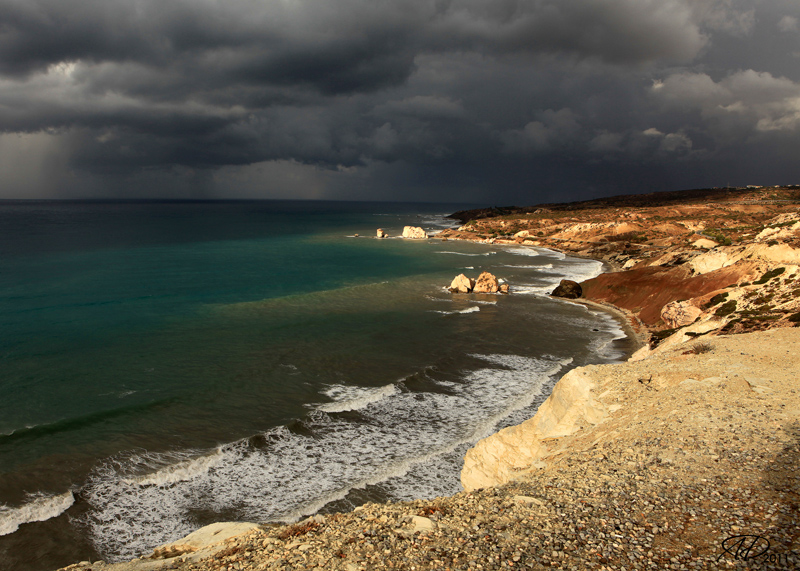 «Камень римлянина» — так переводится на русский греческое название. Одно из красивейших мест на земле (точка B на карте). Кисть великого художника тонкими мазками изображает волшебные рассветы, живописные закаты и три камня на фоне небесного цвета моря.
Согласно древней легенде, могучий воин-великан Дигенис Акрит, охраняя остров от вражеских набегов с моря, швырнул огромный камень и потопил корабль неприятеля. Каменная глыба так и осталась лежать у берега моря. Другая легенда утверждает, что именно здесь и ступила нога Афродиты — «пенорожденной» богини, с которой у многих связано столь много романтических ассоциаций. Однако романтика заканчивается, как только начинаешь читать древнегреческие мифы, повествующие историю рождения богини.
Здесь и злобные циклопы, заточенные отцом под землю, и мать, натравливающая сына против отца, сын, отсекающий отцу гениталии… Хватит?
Вместо любящего Бога Отца, ради людей благословившего Сына на лютую смерть на Кресте, люди выбирали жестоких богов, воевавших друг с другом, утопавших в интригах и грязных склоках.
В чем же причина? Коснемся этого позднее, а пока поднимемся чуть выше от морского берега — туда, где когда-то располагался древний город Палеа-Пафос, а сегодня находится деревня Куклия (точка С на карте).
Куклия (Kouklia)
В центре деревни, куда легко добраться по указателям, вход в музей под открытым небом. Цена билета — €3,40 (понедельник-воскресенье с 08:30 до 17:00).
В древности греки очень хорошо разбирались в искусстве и вообще ценили прекрасное. Место выбрано идеально: с ровной и плоской вершины холма открывается замечательный вид на море и окрестности. И сегодня это вид захватывает дух, его не портят ни современные виллы, ни огромные ветряки горной электростанции.
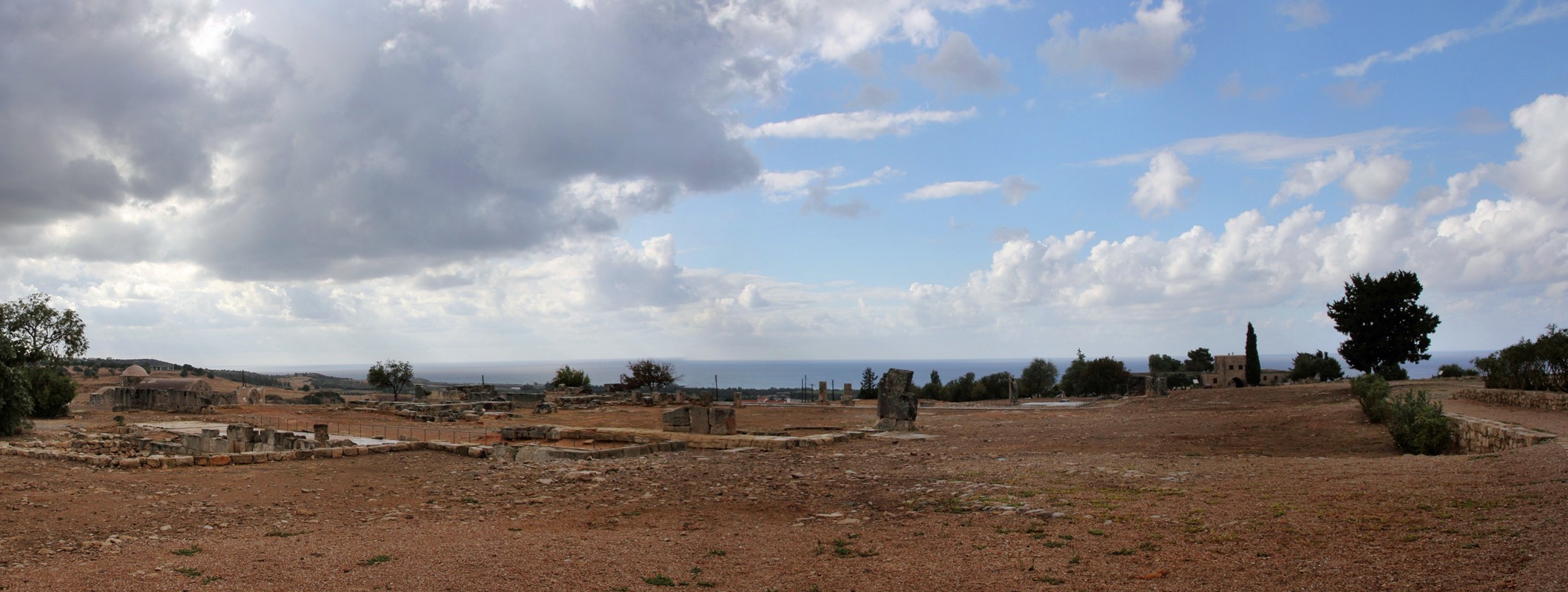
Центром древнего города было капище (храм) богини Афродиты. Капище представляло собой площадку, огороженную с четырех сторон высокой каменной стеной, сложенной из тесаного камня. Слева от центральной дорожки видны остатки грандиозного для той поры сооружения.
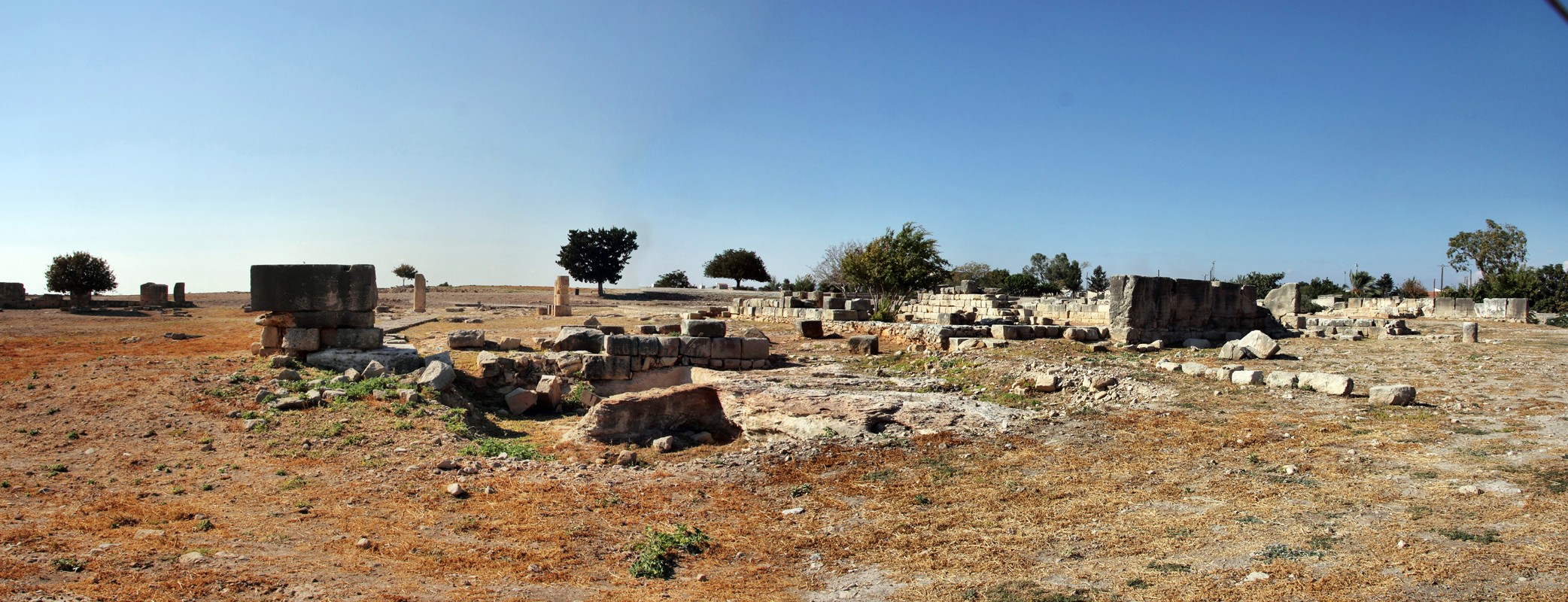
Первые упоминания о капище относятся к XII веку до РХ. Несколько всемирно известных мифов связано с этим местом.
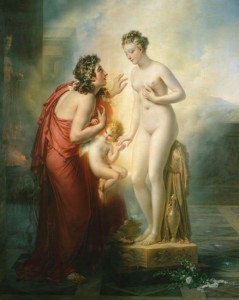 Несчастный Пигмалион, бывший кипрским правителем, безнадежно влюбился в Афродиту. Он сотворил статую, которую оживила богиня, тронутая чувством Пигмалиона. Так появилась на свет Галатея. У Пигмалиона и Галатеи родились две дочери — Пафо и Метарма. По некоторым источникам, они стали жрицами культа Афродиты. В честь Пафо Пигмалион назвал город, носящий это имя до сих пор.
С утверждением религиозного культа в Палеа-Пафосе появляется войско под предводительством Кинира – представителя одной из знатных сирийских династий. Кинир женится на Метарме – верховной жрице Афродиты, дочери Пигмалиона и, используя статус своей жены, становится правителем Палеа-Пафоса. Именно Кинир возводит храм Афродиты, став одновременно царем и верховным жрецом культа Афродиты. Палеа-Пафос же становится столицей Кипра и одним из религиозных центров всего Средиземноморья.
Справа от дорожки можно увидеть фундамент дома жреца, который относится к более позднему историческому периоду (I век).
Культ Афродиты
 Да, для Кинира культ Афродиты стал удобным средством концентрации власти в своих руках. Откуда же берут начало языческие культы? Что дает людям поклонение языческим божествам?
Если обратить внимание на самые известные объекты поклонения, то можно заметить интересную закономерность: все они имеют в основе определенные человеческие страсти.
Так, культы Диониса и Бахуса были неразрывно связаны с пьянством: человек вроде бы не упивался вином, но поклонялся Бахусу или восхвалял Диониса.
Культ Афродиты был связан с не менее популярной страстью не только нашего времени, и ритуальные совокупления в стенах капища были неотъемлемой частью культа. Хочу заметить, что христианская традиция, напротив, стремится сделать человека свободным, избавив от греха. Христианин призван трудиться над собой, избавляясь от страстей. Пост, молитва, покаяние – все направлено на исправление жизни. И здесь мы видим явное противопоставление двух религиозных традиций: христианства и языческих культов. Это не случайно, далее мы поговорим о причинах.
Символ божества для поклонения
Мы идем дальше – в сторону линии горизонта. Перед нами вход в средневековое поместье эпохи Лузиньянов. Это комплекс зданий с большим центральным двором.
Одним из основных предметов экспозиции, расположенной в замке, является «истукан» — серо-зеленый камень вулканического происхождения высотой 122 сантиметра. Это и была «Афродита» — символ божества, которому поклонялись люди.
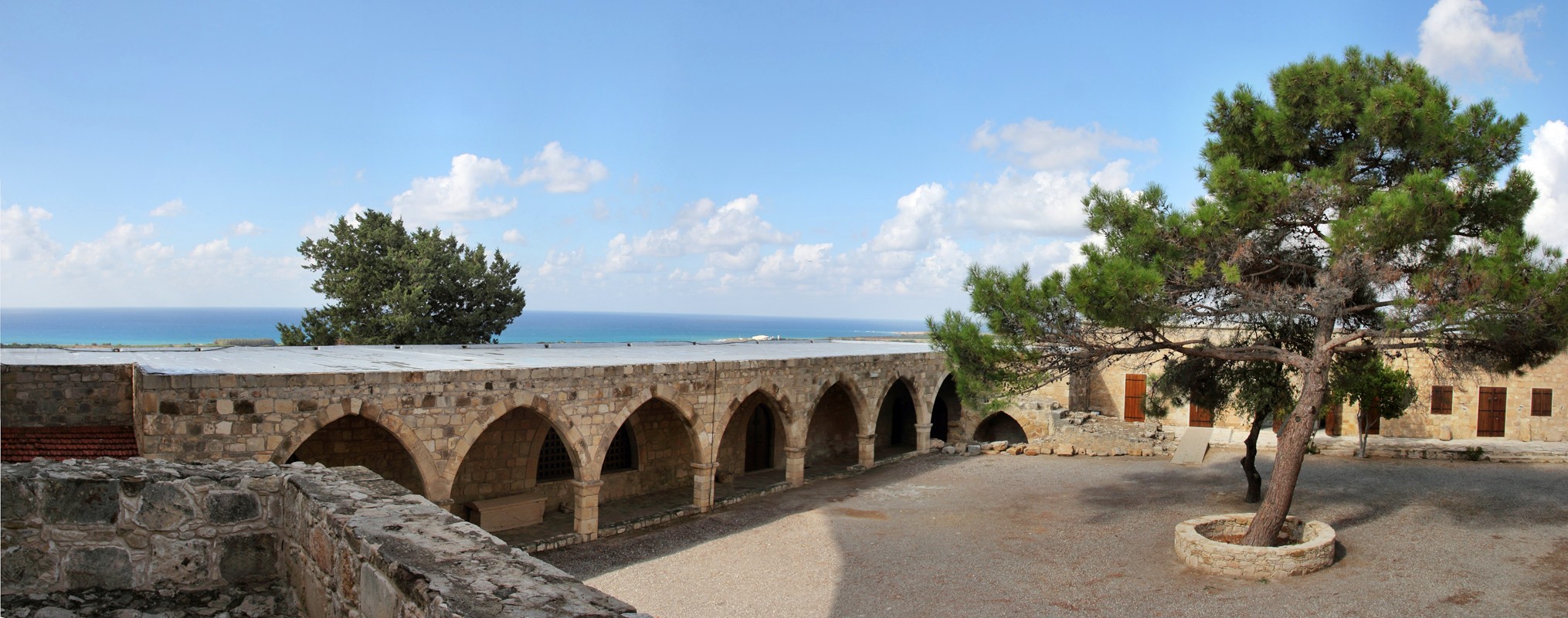
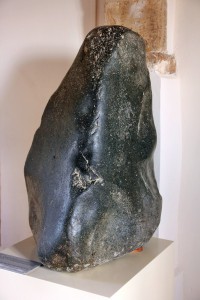 Стоя перед этим невзрачным предметом, невольно задумываешься над одним вопросом, только ли потакание своим страстям заставляло людей приносить дары «истукану»?
Афродита «любила» благовония, сладости, мед, фрукты и отвергала кровавые жертвоприношения. Однако их любили другие боги. Археологи тщательно исследовали раскопки в местах, где находились капища Ваала и Молоха. Страшным божествам, ради которых устраивались грязные оргии, приносили в жертву людей, включая собственных детей.
Об этом свидетельствуют останки детей с табличками, на которых родители писали прошения. Жизнь своего ребенка – такую страшную цену платили за что-то серьезное – богатство или положение в обществе, например.
И снова не удержусь от противопоставления язычества и христианства. Бог Отец ради людей принес в жертву Своего Сына. Языческие боги требуют от людей приношения в жертву собственных детей, спаивают, развращают, разрушают семьи.
Язычник или христианин?
 Стоя здесь, на чудесном холме, несложно проводить параллели между сегодняшним днем и событиями тысячелетней давности. Да, капище Афродиты разрушено: его не раз сотрясали мощные землетрясения, будто небеса уже не могли терпеть эту мерзость на земле, но люди восстанавливали «святыню» снова и снова, пока в IV веке император Феодосий Великий не запретил культ Афродиты.
Что, собственно, изменилось?
Язычество на первый взгляд очень толерантное, терпимое религиозное мировоззрение.
Язычник уважает всех существующих богов, и с радостью поклонится богам той страны или города, где окажется в гостях. Язычники понимают, что спокойная жизнь возможна, когда сумасбродные, мстительные боги благодушны, а значит их нельзя обижать. А раз так, то каждый гость, оказавшийся у язычника дома, должен поклониться его родным богам. За отказ нередко карали смертью. И эту смерть принимали христиане, не желавшие поклоняться никому, кроме истинного Бога.
Эта языческая «нетерпимая терпимость» в полной мере проявляется сегодня по отношению к различным общественным явлениям. Думаю, примеры приводить излишне. Турист, поклонившийся сначала православной святыне, а потом Афродите, ничем не отличается от язычника, жившего много веков назад. Да и жрицы Афродиты сегодня в изобилии доступны в определенных местах по всему миру.
Так что же получается, что согрешают все те, кто ездит в Petra Tou Romiou, или переступает порог музея в Палеопафосе? Конечно нет, это не так. Причина греха кроется в нашем сердце, в наших мыслях, желаниях и стремлениях.
В заключение
 Я люблю приезжать к «камням Афродиты» — это удивительно красивое место, и мы любим иногда прогуляться там с детьми. Но я никогда не связываю его посещение с возможностью получить «что-то». Кто-то хочет получить у Афродиты молодость и красоту. А откуда будут «дровишки»? Мы хотим чуда? Но чудеса совершаются в точке соприкосновения духовного и материального миров. Иными словами, чудеса творят нематериальные силы.
И в духовном мире, как и в нашем материальном, существуют добро и зло. Лучше написать так – Добро и зло.
Бог и Его помощники – ангелы на одном полюсе. Бывшие ангелы – творения Бога — диавол или сатана и бесы – на другом. Два полюса, два противоположных типа духовных сущностей являются основой двух противоположных религиозных культов – христианства и язычества.
И небольшая деревня Куклия наглядно демонстрирует их близость в нашей повседневной жизни: храм Панагии Католики и развалины древнего капища Афродиты до сих пор привлекают внимание людей, решающих, кому отдать свое сердце.

Поклонение Богине Любви, которая возникает из Хаоса и танцует на поверхности моря, существовало у многих народов: в Сирии и Палестине под именем Иштар, в Финикии – Астарта, в Элладе – Афродита. В этой статье я расскажу вам о традициях, обрядах и ритуалах, существовавших в древних храмах, посвященных прекрасной богине
Поскольку поклонение Афродите в те времена было широко распространено, в разных землях разными народами было построено огромное количество храмов Афродиты – священных мест, куда прихожане несли дары и молитвы, где совершались культовые ритуалы и сексуальные обряды. Это и храм в древнем городе Афродисия (у подножия гор Акдаг в Турции), знаменитый храм на Таманском полуострове (бывшая территоря Боспорского государства), храм Афродиты Урании на острове Кифера, храм Афродиты Астарты недалеко от Александрии в Египте, храм на Акрополе в Афинах… Те, кто читал роман Ефремова “Таис Афинская” наверное помнят, что куда бы ни прибыла Таис во время своих длительных путешествий, первым делом она отправлялась в храм Богини Любви. Это говорит о том, что святилища Афродиты в те времена были распространены на всём Средиземноморье. На Кипре самое известное святилище Афродиты находилось в древнем городе Пафос. Сегодня это поселение называется Куклия. Кстати, Ефремов и его упоминает в своём романе, описывая приезд Таис на Кипр.

Вход в святилища Афродиты обычно был обращен не к востоку, а в сторону города Пафос на Кипре, то есть в сторону месторождения Афродиты. План священных домов был примерно таков: дверь из красной меди — металла, посвященного богине — имела молоток в форме фаллоса, ударявшей о рельеф, изображавший пол женщины, а под этим было выгравировано имя куртизанки. По обе стороны двери открывались входы в две комнаты. Справа была “выставочная комната” — место, где разодетая куртизанка восседала на высокой кафедре в те часы, когда приходили мужчины. Комната слева была в распоряжении любовников, желавших провести ночь на открытом воздухе. По широкому коридору можно было пройти в вымощенный мрамором двор, в центре которого находился бассейн. В глубине двора возвышался алтарь из розового гранита.
В центре святилища Афродиты на Кипре возвышается каменный фаллос.
Храм традиционно был украшен эротическими изображениями людей, животных и мифических существ. Там встречались женщины-кентавры, отдающиеся жеребцам, козы с пристававшими к ним худощавыми сатирами, наяды, покрытые оленями, львицы, схваченные грифами. Все существа были объяты одной божественной страстью.
Женщины-прихожанки привозили из своих стран маленькую статуэтку богини и, поставив ее на алтарь, молились ей на своем языке, часто не понимая друг друга. Лахми, Ашлигорт, Венера, Иштар, Фрейя, Мелитта, Киприда — таковы были имена их божества. Некоторые из них обожали ее в символической форме: красный валун, конический камень, большая многоконечная раковина – все они символически изображали Богиню Любви. Но большинство ее изображений представляло собой грубую статуэтку на пьедестале из дерева — с худощавыми руками, с тяжелыми грудями, с торчащими бедрами, и указывающей рукой на свой живот. У ног этих статуэток женщины клали миртовую ветвь, алтарь покрывали лепестками роз и за каждое исполненное желание сжигали маленькое зернышко благовоний. Богиня была доверенной их печалей, свидетельницей их трудов, виновницей удовольствий. И когда женщина умирала, статуэтку клали в гроб, как хранительницу её могилы.
