
На чтение 5 мин Просмотров 6.5к. Опубликовано 17.09.2014 Обновлено 14.11.2019
Один из наиболее ярких праздников в календаре Индии — день рождения бога Ганеши. Ежегодно в его честь проходит красочный фестиваль, называемый Ганеша Чатуртхи, на котором жители Индии поклоняются божеству и молят его о благополучии.
День празднования меняется из года в год, так как это четвертый день прибывающей луны месяца Бхадра. По григорианскому календарю фестиваль проходит между 19 августа и 20 сентября.
В 2020 году фестиваль Ганеш Чатуртхи начнется 22 августа.
Содержание
- История появления Ганеши
- Почему Ганеша изображен с одним бивнем?
- Фестивали в честь Ганеши
- Крупное празднование в Махараштре
- Видео BBC с фестиваля
- Заключение
История появления Ганеши
 Сам Ганеша известен в Индии как бог мудрости, изобилия и благополучия. Он изображается в виде человека с головой слона, причем всего с одним бивнем. У каждой из этих «странностей» есть своя история.
Самая распространенная легенда о слоновьей голове связана с «родителями» Ганеши — Шивой и Парвати.
Ганеша не позволял отцу Шиве входить в покои Парвати, за что Шива разозлился и отрубил сыну голову. Парвати была в ярости от такого поступка, и Шиве пришлось пришить Ганеше голову первого встречного создания — слоненка. На этом легенда заканчивается, что значит, Парвати была довольна таким исходом.
Именно слоновий хобот стал символом благополучия у индусов, ведь по их мнению хоботом Ганеша избавляется от всех преград.
Почему Ганеша изображен с одним бивнем?
Согласно легенде, второй он использовал как оружие, сражаясь с великаном. Бивень превратил соперника в крысу, и, возможно, поэтому на некоторых изображениях Ганеша восседает именно на ней. Отметим, что, будучи сильным и могучим животным, слон остается травоядным: он не убивает ради еды, что еще раз свидетельствует о доброте бога Ганеши.
Неделей позже в штате Керала проходит фестиваль Онам, который длится аж целых 10 дней.
Еще есть праздник в честь сбора урожая, который называется Понгал. О нем читайте тут.

Фестивали в честь Ганеши
Как и многие индийские боги, Ганеша считается помощником своего народа. Еще бы, ведь своим хоботом он преодолевает препятствия! Для того, чтобы Ганеша был милосерден, раз в год проходит фестиваль в его честь — Ганеша Чатуртхи.
Обычно празднование длится десять дней, но семьи оставляют за собой право прославлять Ганешу более двух недель.
Фестиваль проходит в большинстве городов Индии. В день начала фестиваля люди собираются на самой крупной площади города, где уже приготовлены множество статуй Ганеши, размером с мизинец или выше человеческого роста.
Самой высокой статуей Ганеши можно по праву назвать фигуру в городе Гайдерабаде, ведь ее «рост» — целых 52 фута!

Вокруг таких скульптур на фестивале собираются священнослужители, молятся и поют песни. Цель такого ритуала — призвать жизнь в идола. Для тех, у кого получилось установить духовную связь с Ганешей, жизнь наладится, ведь в ней больше не будет преград.
Важным элементом на каждом фестивале Ганеши Чатуртхи является приношение даров. Обычно это фрукты, кокосы и молоко: Ганеша известен как сладкоежка. Дары оставляют под скульптурами Ганеши на ночь, дабы бог успел ими полакомиться.
Стоит сказать, что за десять дней празднования самим верующим нежелательно употреблять эти продукты, однако постом это назвать нельзя.

Крупное празднование в Махараштре
Особенно ярко и красочно проходит фестиваль Ганеши в штате Махараштра. В его столицу — город Мумбаи — за месяц до празднования съезжаются десятки тысяч паломников со всей страны.
Город встречает их радушно: для них организовано бесплатное питание и жилье, а также пункты первой помощи. Для гостей проходят бесплатные концерты, а если и платные, то все деньги уходят на благотворительность. Средства на подобные «излишества» собраны священнослужителями и верующими жителями.
Узнайте 10 малоизвестных фактов про Индию.
Дивали — пятидневный фестиваль огней, который никого не оставит равнодушным: https://indianochka.ru/kultura/holiday/divali.html

После окончания десяти дней яркого фестиваля в Махараштре все глиняные фигурки Ганеши опускают в реки и озера: помогают богу вернуться на небо.

Прихода Ганеши ждут в следующем году, заранее продумывая ход будущего фестиваля. Со дня окончания фестиваля начинается череда других религиозных индийских праздников, так что индусам не приходится скучать. Плюс, подготовка к ним превращается в сказку, ведь теперь на их пути нет никаких преград!
Стоит сказать, что праздник Ганеши проходит не только в Индии, но и во всех странах, где есть крупные индийские общины: США, Малазии, Сингапуре, Тайланде.
Видео BBC с фестиваля
Заключение
Фестиваль Ганеши Чатуртхи в Индии проходит раз в год, длится празднование десять дней. Ганеша — бог благополучия и мудрости — защищает народ и устраняет препятствия на их пути. Поклоняясь богу, индусы в течение всего фестиваля приносят ему фрукты, кокосы и сладости, молятся ему и поют специальные песни, чтобы «подружиться» с ним.
Праздник рождения бога Ганеши — первый в череде религиозных праздников Индии!
Праздник Ганеша-Чатуртхи отмечается во всех регионах Индии и является одним из самых важных торжеств. Это неудивительно, ведь Фестиваль Ганеши, как его называют, посвящён доброму и милостивому индуистскому богу-слону.
Индийцы верят, что в Ганеша-Чатуртхи можно попросить благополучия и успеха в делах, счастья и радости, а добродушный Ганеша обязательно исполнит пожелания, услышав молитвы. На Фестивале Ганеши, что длится более недели, существует множество самых разных ритуалов, которые важно соблюдать. Каковы история и традиции Ганеша-Чатуртхи?

История Ганеша-Чатуртхи
Ганеша–Чатуртхи – это празднование Дня рождения Ганеши. Приходится оно на месяц Бхадрапада, что попадает на конец августа-начало сентября. На мой взгляд, этот бог – самый любимый индийцами, ведь его доброта и мудрость не знают границ. В мифах
Ганеша грозен лишь с врагами, а к людям обычно благосклонен. Этот бог умеет устранять препятствия, помогает достичь заветной цели, исполняет мечту, наделяет человека верой и жизненной энергией.
Празднования в честь многих индуистских божеств зародились в далёкой древности, а потому нельзя сказать, когда впервые люди стали отмечать Ганеша-Чатуртхи. Известно, что масштабные празднования в честь бога мудрости и достатка проходили уже в 1630-1680 годы, в период правления Шиваджи. Тогда одним из главных центров почитания Ганеши был город Пуна.
Исследователи считают, что популярность Ганеши имела особые причины. Ещё в Средние века более почитаемым считался брат бога, Сканда, покровитель войн. Когда же жизнь стала спокойнее, а вооружённые конфликты как повсеместное явление исчезли, народу понадобилась поддержка миролюбивого бога Ганеши.
Легенды, связанные с праздником
Преданий, связанных с праздником, сохранилось немало. Народы Индии верят, что Ганеша стал спасителем людей от войска демонов, что хотели захватить мир. Когда Вселенная была окутана тьмой, прекрасной супруге Шивы, Парвати, было сообщено. что её новорожденный сын сумеет спасти людей и богов.
Когда на свет появился Ганеша, яркое сияние озарило темноту. На изображениях бога с головой слона часто отсутствует бивень – его Ганеше пришлось пожертвовать во время битвы с демоническими отрядами.
В дни Ганеша-Чатуртхи и сегодня индийцы соблюдают немало старинных ритуалов. Самый простой и обязательный – смотреть на луну. Согласно легенде, однажды лунный бог Чандра засмеялся, взглянув на Ганешу.
За это разгневанный бог проклял его, сказав, что люди отныне не увидят луны. Раскаявшись, Чандра принялся молить о прощении, и Ганеша смягчился. С тех пор часть лунного цикла луна исчезает или вовсе не видна, а во второй половине достигает полнолуния и роста.

Обряды в дни Фестиваля Ганеши
Ещё один обычай Ганеша-Чатуртхи – совершение пудж и подношений богу. В качестве даров выступают цветы, сладости, молоко. Специально к празднику выпекаются сладкие рисовые шарики, что являются излюбленным лакомством бога.
Что интересно, самим почитателям бога в дни Фестиваля Ганеши стоит воздержаться от употребления этих продуктов – все сладкие дары должны принадлежать божеству. Впрочем, постом это нельзя назвать. Зачитывая мантры, посвящённые Ганеше, индийцы вспоминают о его добрых делах, прославляют своего доброго покровителя.
Празднование Ганеша-Чатуртхи длится целых одиннадцать дней. В это время можно обращаться с просьбами к богу, главное – чтобы цель человека и его стремления были добрыми. В самом начале праздника индийцы отправляются к ближайшему водоёму, где опускают в воду статуэтки Ганеши.
Если пруда или реки поблизости нет, можно обойтись и искусственной тарой с водой. Важно, чтобы обряд совершался вдали от жилища. Согласно поверьям, такой ритуал прогоняет горести и тревоги. Погружение Ганеши в воду- это очищение и благословение.
В дни Ганеша-Чатуртхи можно начинать новые дела, строить планы на будущее. Как я уже отмечала, Ганеша помогает преодолеть препятствия. Не стоит забывать, что этот бог – покровитель мудрости, а потому людям любознательным наделённым живым умом он всегда помогает.
Ганеша-Чатуртхи в Мумбаи
Наиболее красочно празднование Ганеша-Чатуртхи проходит в штате Махараштра, в его столице Мумбаи. Туда уже за несколько дней до начала Фестиваля Ганеши приезжает множество туристов – как индийцев, так и представителей самых разных стран мира. Паломникам предоставляются бесплатное питание и жильё, а средства на это заблаговременно собираются служителями храмов Ганеши.
“Изюминкой” фестиваля являются необыкновенные скульптуры Ганеши. Нередко они напоминают огромные изваяния, которые расписывают, украшают, а в праздник провозят по городским улицам. Многие изваяния размещаются под Деревом Бодхи, мифическим растением, что имеет реальный аналог.
Оно способно излечить от самых разных болезней, что связано с могуществом милостивого бога. В одном только Мумбаи в дни праздника Ганеша-Чатуртхи появляется более 10 000 статуй Ганеши, что устанавливаю в разных местах (и это не считая храмов).

Ганеша-Чатуртхи – это яркий фестиваль, наполненный традиционными индийскими танцами и песнями, исполнением гимнов в честь бога, разыгрыванием театрализованных сценок из жизни Ганеши. Это время позволяет поверить в чудо, обрести надежду и уверенность в своих силах. Ведь неспроста люди искренне верят, что Ганеша всегда исполняет заветные желания.
Фестиваль Ганеша Чатуртхи празднует День Рождения Господа Ганеши. По индуистскому календарю он отмечается на четвёртый день Светлой половины Бхадрапада. По Григорианскому календарю эта дата обычно приходится на период с 19 августа по 20 сентября (2019 год — 2 сентября). Люди покупают божества Господа Ганеши, помещают их в свои дома и поклоняются им в течение одного-десяти дней. Прочитав статью, вы узнаете об истории фестиваля Ганеша Чатуртхи, а также как он проводится в современной Индии.

1. История праздника Ганеша Чатуртхи
Не известно, когда Ганеша Чатуртхи был впервые отпразднован. Однако история знает фестиваль, отмечаемый в Пуне как публичное событие во время правления Шиваджи, основателя империи Маратхи в 1630-80 годах. С 1749 по 1818 год Пешвы поощряли празднование в Пуне.
С падением Пешваса фестиваль Ганеша Чатуртхи потерял свою государственную поддержку и стал частным семейным праздником до его возобновления Локманьей Тилак. В 1893 году выдающийся деятель национально-освободительного движения в Индии Локманья Тилак превратил семейный праздник в большое общественное мероприятие.
Избранник народа Тилак популяризировал Ганеша Чатуртхи как крупный фестиваль, чтобы преодолеть разрыв между различными кастами и вызвать патриотическое рвение среди людей против британского правления. В настоящее время Ганеша Чатуртхи является государственным праздником в Андхра-Прадеш, Гоа, Гуджарат, Махараштра, Орисса, Пудучерри и Тамилнад.

2. Когда отмечается Ганеша Чатуртхи в Индии?
Ганеша Чатуртхи, также известный как «Винаяк Чатуртхи» или «Винаяка Чавити» — это день, когда все индусы празднуют день рождения одного из самых популярных божеств, Господа Ганеши. Праздник отмечается в индуистском календарном месяце Бхадрапада, начиная с Шукла Чатуртхи (четвёртый день прибывающей Луны). По Григорианскому календарю он может выпасть на одну из дат в период с 19 августа по 20 сентября. В 2019 году фестиваль будет продолжаться со 2 по 12 сентября.

3. Кто такой Бог Ганеша согласно индуизма?
Бог Ганеша изображается с головой слона на человеческом теле, и в индуистской традиции он является сыном Господа Шивы и богини Парвати. Ганеша также может быть известен под именами Ганапати, Экаданта, Винаяка, Пиллайяр и Херамба.
Ганеша является одним из самых популярных божеств для поклонения. Его благословения часто просят на религиозных церемониях. Это связано с тем, что он является тем, кто может устранить все препятствия на пути к успеху, особенно когда люди начинают новый бизнес или предприятие. Ганеша известен как даритель удачи и тот, кто может помочь избежать стихийных бедствий. Ганеша также является богом-покровителем путешествий.

4. Как празднуется Ганеша Чатуртхи в современной Индии?
Ганеша Чатуртхи может праздноваться в домах, где поют гимны, и делают подношения божеству. Сладости являются общим предложением, так как индуистская легенда гласит, что Ганеша любил их.
В некоторых частях Индии, таких как Андхра-Прадеш и Махараштра, фестиваль отмечается в течение десяти дней и является очень публичным событием. Подготовка начинается за два-три месяца до фестиваля. Скульптуры Ганеши подготавливаются в большом количестве квалифицированными мастерами. Они, как правило, делаются из глины или металла во всех размерах. Их красиво расписывают и украшают.

В день фестиваля глиняные идолы (скульптуры) Ганеши размещаются в домах или на открытом воздухе в украшенных палатках, называемых Мандапами или Пандалами в зависимости от местности. Пандалы украшаются огнями, цветочными гирляндами и т. д. Это делается для того, чтобы люди могли посмотреть и отдать дань уважения Богу Ганеше.
Многие из скульптур Ганеши размещаются под деревьями Бодхи. Дерево Бодхи почитается как «великий лекарь» и используется для лечения до 50 различных заболеваний. Эти целебные аспекты дерева делают его популярным местом для поклонения.
Как только статуя Господа Ганеша будет установлена, проводится церемония, в ходе которой жрец вызывает «жизнь в статуе». Этот ритуал называется Пранапратишхта Пуджа, во время которой читается ряд мантр. После этого проводится специальная церемония поклонения. Богу Ганеше делаются подношения в виде сладостей, цветов, риса, кокосового ореха и монет.

Господу Ганеше поклоняются в течение десяти дней, а на одиннадцатый день статую везут в процессии по улицам в сопровождении фанфар, пения и танцев. Местные общины соревнуются друг с другом, чтобы показать самую впечатляющую статую Ганеши.
В конце концов она погружается в море или реку. Этот ритуал символизирует следующее. Господь Ганеша совершает путешествие к своей обители, беря с собой проблемы своих преданных почитателей.

В Мумбаи одно из лучших мест проведения фестиваля, посвящённого Господу Ганеше, находится в возвышающемся храме Сиддхивинаяк. Он расположен в Центральном районе Южного Мумбаи — Прабхадеви.
Неисчислимое количество индусов посещают храм, чтобы присоединиться к молитвам и выразить свое почтение Богу во время фестиваля. Кроме того, около 10 000 статуй Господа Ганеши выставляются в различных местах по всему городу. Шествие и погружение статуй проходит в последний день.

5. Культурные мероприятия во время Ганеша Чатуртхи в Индии
Фестиваль Ганеша Чатуртхи также отмечается различными культурными мероприятиями, такими как классическая музыка, танцевальные и театральные представления, народные танцы, поэтические декламации, кинофестивали… Это могут быть также и общественными мероприятиями, включающие бесплатные медицинские лагеря, благотворительность для бедных и т. д.

Таким образом в Индии отмечается праздник Ганеша Чатуртхи! Индусы верят, что поклонение Богу с головой слона принесёт им удачу в жизни! Вы можете прочитать также об индуистском празднике Шарад Наваратри, перейдя по ссылке ниже:
Читать статью: «Индуистский праздник Шарад Наваратри в Индии»
Читайте также:
Праздники и фестивали Индии
Праздники и фестивали разных стран мира
Навруз в разных странах мира
Популярные фестивали мира
Уважаемые читатели! Пишите комментарии! Читайте статьи на сайте «Мир праздников»!

Фестиваль Ганеши или Ганеша-чатуртхи — красочный праздник, который ежегодно проходит в разных штатах Индии в августе—сентябре. В эти дни в города приезжают паломники, почитающие бога Ганешу, а также туристы, желающие познакомиться с индийской культурой и принять участие в торжественных 10-дневных мероприятиях.
Ганеша — божество индуистского культа, изображается как существо с человеческим телом, 4-мя руками и головой слона. Индусы верят, что он приносит удачу и достаток, отгоняя неприятности своим хоботом. Также Ганеша почитается как бог мудрости.

Где и когда проходит Фестиваль Ганеши
Праздничные мероприятия проходят по всей Индии, в некоторых штатах Ганеша-чатуртхи считается государственным праздником. Наиболее массовые и яркие торжества проходят в Мумбае (бывш. Бомбей).
В 2023 году Фестиваль Ганеши в Мумбае проходит с 31 августа по 9 сентября.
Дата начала Фестиваля Ганеши рассчитывается по индуистскому календарю и приходится на шестой месяц Бхадрапада (23 августа — 22 сентября). В Бхадрападе выделяют светлую и темную половины. Праздновать Ганеша-чатуртхи начинают в светлой половине месяца.

Церемонии и развлекательные мероприятия
В дни почитания Ганеши каждый житель, поклоняющийся этому божеству, должен приобрести его статую и провести ряд обязательных церемоний, поэтому подготовка к фестивалю начинается за несколько месяцев. Мастерские начинают массовый выпуск керамических скульптур и статуй бога-слона. Они называются Ганеша-мурти и бывают всевозможных размеров и расцветок — встречаются как совсем маленькие изваяния не более 2 сантиметров, так и гигантские, достигающие 20 метров в высоту.

Статуи Ганеши в торговой лавке на Ганеша-чатуртхи, © VedSutra
В преддверии фестиваля ярмарки Мумбая заполняются этими изделиями, небольшие статуэтки местные покупают для дома, а огромные Ганеша-мурти предназначены для установки в общественных местах — в мандапах, на площадях, в религиозных общинах. Крупные организации заказывают мурти за счет пожертвований. Перед установкой идола помещение тщательно чистят и моют, затем комнату и саму скульптуру украшают цветами, яркими лентами и тканями, в домах для Ганеши отводится самое лучшее место.
В первый день Фестиваля Ганеши священники читают молитвы у скульптур, верующие считают, что посредством такого ритуала в статуи входит дух божества. После этого можно просить у Ганеши благословения. В течение следующих дней индусы приносят к мурти дары — чаще всего это различные сладости, цветы, фрукты, пряности, благовония. На городских площадях устраиваются танцевальные и музыкальные выступления, проходят массовые шествия с цветными идолами, жители и гости Мумбая украшают себя цветами, красят кожу яркими красками холи, молятся, поют мантры и гимны.

Часть индусов в эти дни придерживается ряда правил. Верующим рекомендуется соблюдать не строгий пост, посвятить время изучению жизни Ганеши, молитвам и не смотреть на Луну — по преданию бог-слон ее не любил, а потому это приносит несчастья.
Наиболее массовые события происходят на 11-ые сутки Фестиваля Ганеши. В этот день все паломники выходят на демонстрацию, улицы перекрываются и верующие на руках несут тысячи мурти. Особенно впечатляет передвижение гигантских статуй. Красочная процессия с танцами и песнями не спеша продвигается к побережью, где состоится важный ритуал Висарджан — погружение Ганеши в воду.
Интересно, что эта часть праздника вызывает ряд проблем. Кроме блокирования движения в Мумбае, остро встает вопрос о загрязнении окружающей среды. Исторически мурти для фестиваля делали из разлагаемых материалов — глины, натуральных красителей, грязи. Размокая, они не причиняли вреда флоре и фауне водоемов. Однако, в последние годы появилась практика делать фигурки из гипса и покрывать их красками — такие изделия оказались очень токсичными и сегодня находятся под запретом. Чтобы соблюсти ритуал некоторые жители погружают идола в бочку с водой у себя дома, а после разложения выливают в саду.

Основные площадки Фестиваля Ганеши
Фестиваль Ганеши в Мумбае — это событие, где стоит побывать, чтобы познакомиться с древней и загадочной культурой Индии. Туристические операторы даже организуют специальные туры на Ганеша-чатуртхи с посещением главных площадок и участием в народном шествии.
Увидеть самые большие изваяния бога Ганеши можно в 5-ти храмах Мумбая (первые три находятся в центре города):
- Lalbaugcha Raja Ganapati и Mumbaicha Raja открыты круглосуточно, но приготовьтесь отстоять длинную очередь, прежде чем подойдете к мурти, так как это самые посещаемые среди паломников храмы.
- Guru Ganesh Seva Mandal. В дни фестиваля в этом храме проходят концерты живой музыки и социальные мероприятия. Здесь установлена глиняная скульптура Ганеши, украшенная несколькими килограммами золотых украшений.
- Khetwadi Cha Ganraj (Южный Мумбай). Лучше приходить днем, вечером наблюдается большой приток верующих.
- Andheri Cha Raja (Западный Мумбай). Идол в этом храме меньше по размеру, чем в других, но славится исполнением желаний.
Именно от этих религиозных сооружений начинается праздничная процессия в последний день Фестиваля Ганеши. Погружения обычно проходят на пляжах Чаупатти, Джуху, Версова и на озере Повай.

Как добраться
Передвигаться по Мумбаю удобно на общественном транспорте и на такси. Аренда машины или байка довольно популярная услуга, однако движение в городе очень хаотичное — лучше довериться местным водителям.
Если вы планируете посетить религиозные общины с Ганеша-мурти, то до них можно добраться следующим образом:
До храмов Lalbaugcha Raja Ganapati и Mumbaicha Raja довезут автобусы № 1, 5, 6LTD, 7LTD, 8LTD, 9, 11LTD, 15, 19LTD, 21LTD, 22LTD, 25LTD, 30LTD, 43, 51, 52, 61, 66, 66LTD, 67, 69, 119, 134, 506LTD, 526LTD, а также туристические RedBus. Выходите на остановке «Sant Jagnade Chowk», от нее нужно пройти около 500 метров.
До Guru Ganesh Seva Mandal ходят автобусы № 8LTD, 16LTD, 19LTD, 20LTD, 21LTD, 27, 85, 92LTD, 103, 103AC, 105AC, 119, 121, 121AC (ост. «Highway Apartment»). На рейсах № 102, 104, 105, 135 получится доехать до Khetwadi Cha Ganraj (ост. «Play House»), а до Andheri Cha Raja — на маршрутах № 254, 268AS (ост. «Azad Nagar»).
Общественный транспорт Мумбая: автобусы RedBus, городской портал
Такси в Мумбае лучше заказывать через мобильные сервисы Uber или Ola Cabs, так вы сразу узнаете стоимость поездки и номер машины.
Фестиваль Ганеши в Мумбае: видео
Куда сходить и что посмотреть в Мумбаи
А также
Полезные ссылки:
✔️ Кэшбэк 4% при бронировании на Ostrovok.ru. Более 3000 отзывов.
✔️ Кэшбэк 2% при бронировании ЖД-Билетов на Яндекс.Путешествия.
✔️ Кэшбэк 4% при бронировании квартир, отелей на Tvil.ru.
✔️ Кэшбэк 4% при бронировании Авто на Localrent. Автомобили от локальных прокатных контор на популярных курорта: Турция, Крым, Сочи, Грузия, ОАЭ, Армения и многие другие. Принимают карты МИР.
✔️ Русские гиды и экскурсии по всему миру. Трансферы, услуги фотографов и многое другое.
✔️ Дешевые авиабилеты? Конечно Aviasales.
Дата события уникальна для каждого года. В 2023 году эта дата — 20 августа
День рождения Бога мудрости и изобилия Ганеша Чатуртхи (Ganesh Chaturthi / Vinayaka Chaturthi) с туловищем человека и головой слона — устранителя препятствий, сына Шивы и его супруги Парвати — отмечается в месяце Бхадра (август—сентябрь).
Ганеш является одним из самых почитаемых богов индуистского пантеона. Любые начинания сопровождаются молитвой Ганешу: «Ом Ганешая намах».
Праздник Ганеша Чатурти символизирует собой хорошее предзнаменование.
В этот день совершают поклонение Ганешу, приносят ему фрукты, молоко, цветы и сладости, перед изображением Бога разбивают кокосовые орехи.
В некоторых районах страны (например, в Махараштре, Тамилнаду) к этому дню из сырой глины создают новые изображения Ганеша. После молитв, подношений и краткой церемонии прощания старые изображения погружают в воду рек, озер и других водоемов.
Рождение Ганеша Чатуртхи отмечается по всей стране. Особенно пышно и радостно он празднуется в штате Махараштра. Праздник также символизирует наступление череды праздников, посвященных другим индуистским божествам.
Слоноголовий индийский Бог Ганеш, также известный под именами Винаяка, Ганапати, Пиллаяр, Вигнешвара, широко почитается во всех уголках Индии. Он известен как самый любимый бог каждого жителя этой страны. Его почитают как шактисты и шиваиты, так и вишнуиты. Согласно устоявшейся индуистской традиции, перед любым богослужением в первую очередь почитается именно мудрый Ганапати. Это правило соблюдают и в мирской жизни. Какое бы начинание не планировал правоверный индиец, он всегда начнет его с молитвы Ганеше. Считается, что Ганапати помогает устранять все препятствия, возникающие на пути к той или иной цели. Неудивительно, что праздник в честь Ганапати — один из самых ярких и продолжительных ежегодных фестивалей, отмечаемых в Индии.
Ганеша Чатуртхи, также известный как Винаяка Чавитхи, Ганеш Фестивал, Ганешотсав, почитается индийцами как момент появления Бога на Земле после схождения с горы Кайлаш вместе с его матерью Парвати. Празднования в честь Ганеши длятся целых 10 дней. Кульминацией фестиваля становится торжественное погружение фигуры слоноголового божества в водоем, реку, море.
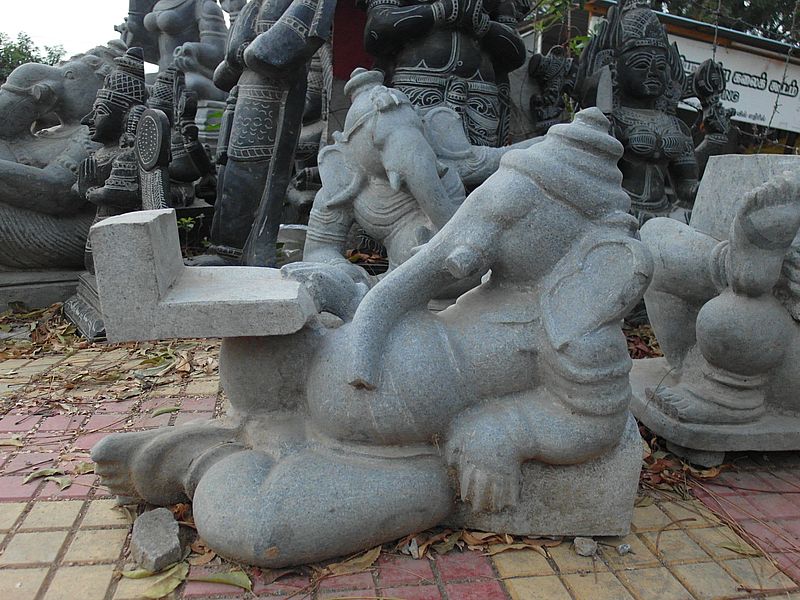
Как выглядит Бог Ганеш?
Мужская фигура, увенчанная головой слона с одним бивнем (другой сломан), имеющая от 2 до 32 рук и отличающаяся выразительным круглым животиком – это каноническое изображение сына Шивы и Парвати. Легенда о рождении Ганапати гласит, что изначально его звали Винаяка и он был создан чудесным образом из пота Богини-Матери. Парвати создала себе стража, чтобы иметь возможность иногда уединятся. Но когда ее муж – Господь Шива – не смог пройти в пещеру к любимой, так как его остановил неизвестный юноша, Бог-разрушитель наказал строптивого стража и лишил его головы. Это событие символизирует усмирение человеческого эга ради служения высшему. Парвати была безутешна, узнав о гибели своего сына и даже пригрозила разрушить Вселенную, если Ганапати не продолжит жить. И тогда ее муж – великий Махадев – совершил чудо, приставив к телу сына Парвати голову небесного слона Айраваты. Так гордец Винаяка превратился в мудреца Ганапати.
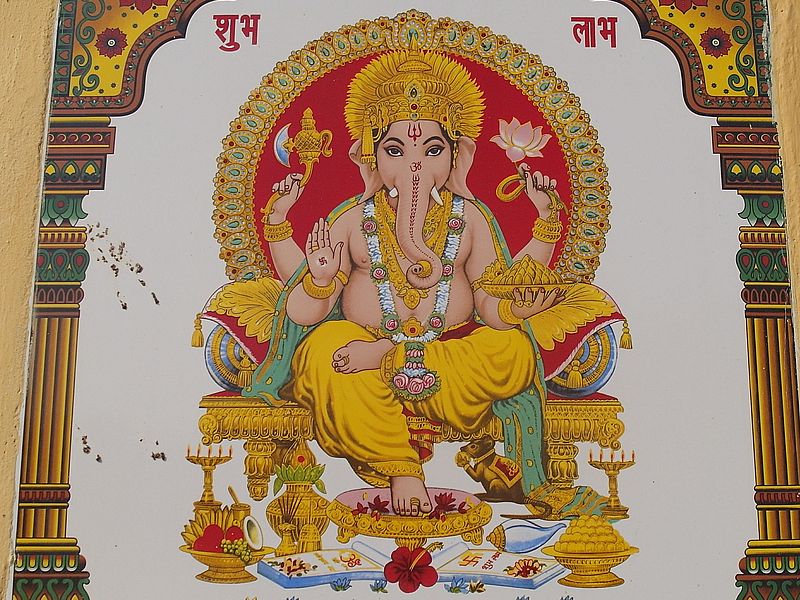
Ганеш изображается многоруким и держит различные символы-атрибуты: цветок лотоса как знак просветления, топор как символ отсечения привязанностей к материальным объектам, аркан в качестве отсылки к способности усмирять свое эго, модак или ладду как символ способности к концентрации. Пальцы одной из рук могут быть сложены в абхайя-мудру (защитный знак). Рядом с Ганапати, а чаще всего – под ним или у его ног – можно увидеть крысу или мышь. Она считается ваханой – ездовым животным, на котором передвигается Бог-Слон. Выбор именно грызуна на эту роль не случаен. Мышь или крыса олицетворяет чувства и эгоистичные желания, которые с легкостью преодолевает Ганапати.
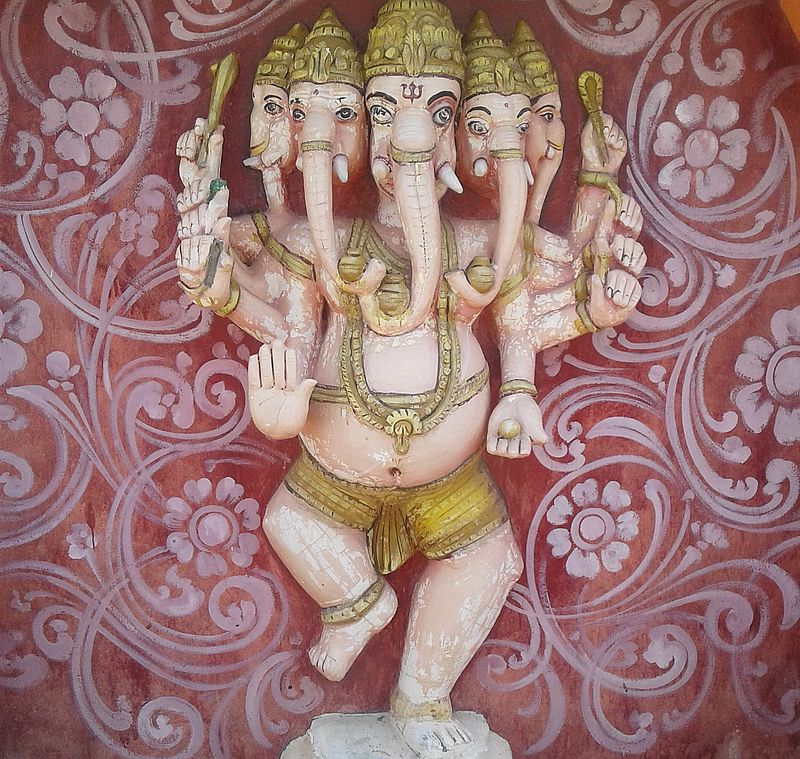
Как в Индии отмечают рождение Ганеши
Ганешу обожают в Индии все: не только индуисты, но и христиане, буддисты, джайны, мусульмане. К этому празднику все вокруг украшается, люди надевают красивые праздничные одежды, готовят сладости. Жители Юга Индии более склонны с размахом отмечать День рождения сына Шивы и Парвати, чем северяне. Ganesh Gaturthi празднуют в Карнатаке, Гуджарате, Керале, Мадхья-Прадеше, Одише, Чхаттисгархе, Андхра-Прадеше, Телангане, Западной Бенгалии и на Гоа. Жители Тамил-Наду отмечают праздник в семейном кругу. Но больше всего превозносят мудрого Ганапати обитатели Махараштры. Нигде праздник Винаяки не отмечается так ярко и красочно, как в ее столице — Мумбаи. Толпы людей устремляются к храмам слоноголового бога в период фестиваля, чтобы выказать ему свою любовь. Еще больше мумбайцев делают домашние пуджи, своими руками делают сладкие ладду, модаки и кхир для сладкоежки Ганеши. Наконец, тысячи паломников выходят на улицы в последний день фестиваля, чтобы доставить статуи Ганеша к морю для погружения. Примерно 150 тысяч статуй Ганапати каждый год погружают в воду в одном только Бомбее! Шикарные торжества в честь Винаяки характерны для многих городов Махараштры. Любят Ганешу не только в Мумбаи, но и в Пуне, Нашике, Джалгаоне, Ратнагири, Нагпуре, а также в городах с 8 священными храмами Аштавинаяка Ятры.
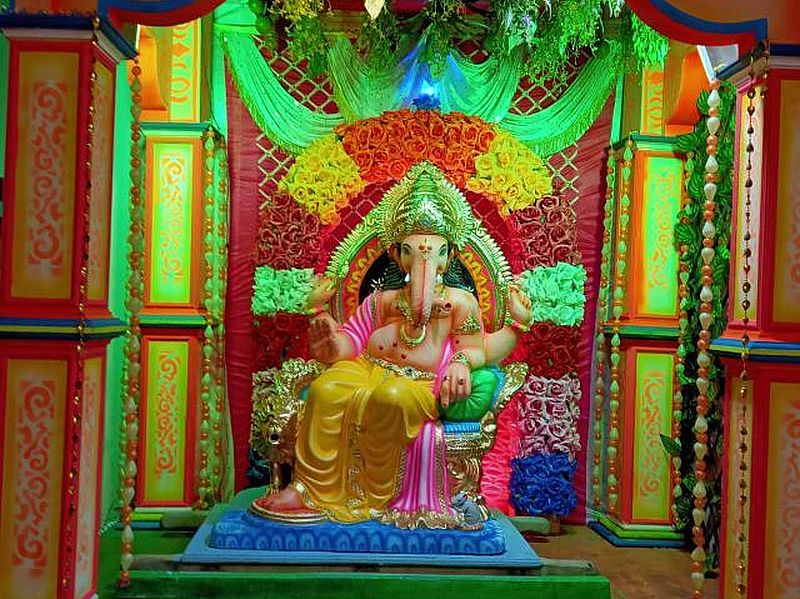
В дни фестиваля Ганеши его преданные посещают храмы или приглашают пандитов, браминов к себе домой для проведения служб. Пуджа Ганеше предполагает в обязательном порядке смиренное предложение Богу молока, различных сладостей (особенно – его любимых модаков и ладду), кокосов и фруктов, цветов, благовоний. Подношения можно предлагать как в храме, так и в любых других условиях: на домашнем алтаре или соорудив импровизированное мурти на любой плоскости.
Дары можно предлагать любому изображению Ганеши: картине с его ликом, большой статуэтке Ганеши или маленькой фигурке с изображением слоноголовьего бога. Наряду с пуджей может проводиться церемония аарти и огненная ягья.

Чтобы Бог, разрушающий препятствия, проявил благосклонность к своим преданным, в этот день поются бхаджаны в его честь, читаются мантры Ганеши для привлечения денег, успеха, любви, удачи, благополучия, а также устранения препятствий на пути к цели.
Фестиваль Ганеши принято отмечать 10 дней. К концу празднований верующие собираются на берегах водоемов и окунают в реки и озера статуэтки, предложенные ранее Божеству. Фигурки бога с головой слона массово опускают в воду и оставляют на дне, глина растворяется и становится частью речного/озерного/морского ландшафта. Этот ритуал символизирует собой колесо перерождений – сансару. В начале фестиваля Бог появляется на земле, его превозносят и почитают 10 дней, а затем он вновь уходит, возвращаясь в природу.
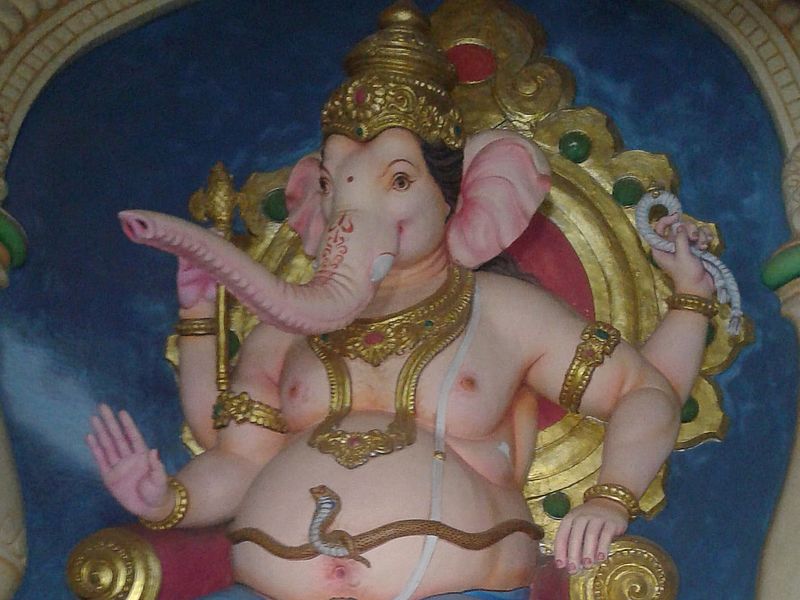
Когда отмечается Ганеша Чатуртхи?
День рождения Ганапати вычисляется ежегодно по лунному календарю и отмечается в 4-й день растущей луны месяца Бхадрапада (август-сентябрь по нашему календарю). Дата каждый год меняется:
- праздник Ганеши в 2020 году приходится на 22 августа;
- в 2021 году Ganesh Chaturthi будет отмечаться 10 сентября;
- в 2022 году празднования начнутся 31-го августа;
- в 2023 году чествовать Ганеша в Индии будут 19 сентября.
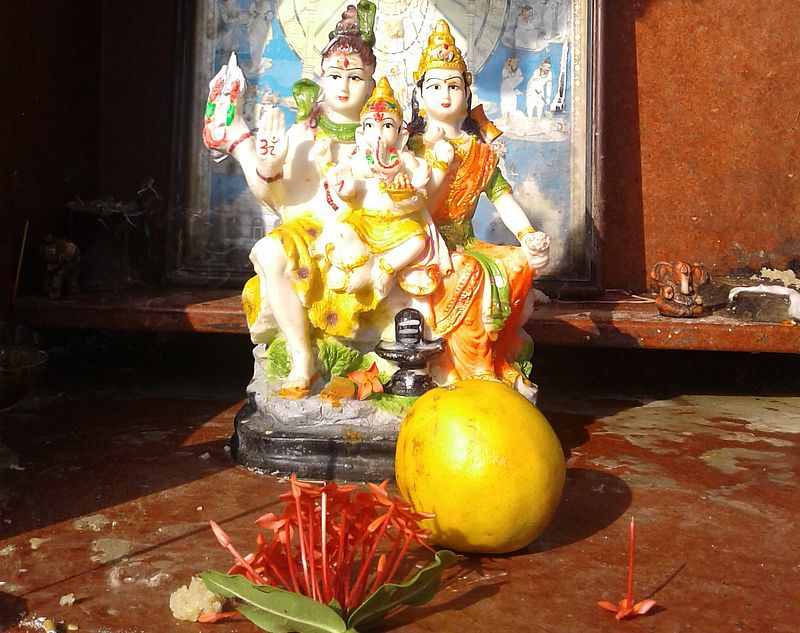
Для установления последнего дня празднований добавляйте к этим датам еще 10 дней.
На чтение 4 мин Просмотров 1.2к. Опубликовано 22.08.2022
Ганеш Чатуртхи или Винаяка Чатуртхи — это десятидневный фестиваль, посвященный индуистскому богу разума Ганеше. Этот день обычно приходится на август или сентябрь по григорианскому календарю и отмечается молитвами, публичной и частной демонстрацией идолов Ганеши, пением ведических гимнов и постом. В последний день фестиваля идола Ганеши несут в публичной процессии и опускают в ближайший водоем. Когда глина растворяется, считается, что Ганеша возвращается к Шиве. Ганеш Чатурти отмечается в Индии, а также в странах индуистской диаспоры, таких как Непал. Ганеша-Чатуртхи — дата праздника, как отмечают Ганеша-Чатуртхи, узнайте в следующей статье на kakogo-chisla.ru.
Содержание
- Какого числа Ганеша-Чатуртхи
- Ганеш Чатуртхи: история праздника
- Как отмечают Ганеша-Чатуртхи
- Интересные факты Ганеша-Чатуртхи
- Почему важен Ганеша-Чатуртхи
Какого числа Ганеша-Чатуртхи
Какого числа Ганеш Чатуртхи? Узнайте, на какой день выпадает Ганеш Чатуртхи в 2022, 2023, 2024, 2025 и 2026 годах.
| Год | Дата | День |
|---|---|---|
| 2021 | десятое сентября | Пятница |
| 2022 | 31 августа | Среда |
| 2023 | 18 сентября | Понедельник |
| 2024 | 7 сентября | Суббота |
| 2025 | 26 августа | Вторник |
Ганеш Чатуртхи: история праздника
Рождение Господа Ганеши имеет две истории происхождения. Во-первых, он родился, когда богиня Парвати принимала омовение. Ганеша — в то время еще ребенок — Шива попросил его охранять дверь, пока его напарница Парвати заканчивала свое омовение. Когда позже Шива вернулся, Ганеша отказал ему в доступе к его дому, что разозлило Шиву и заставило его отрубить Ганеше голову.

Огорченная и убитая горем этим инцидентом, Парвати потребовала, чтобы Ганеше нашли новую голову. Все, что удалось найти, так это голову слона, которую затем поместили на тело Ганеши. Вторая версия менее популярна и говорит нам, что Ганеша был сознательным творением Шивы и Парвати по приказу высших небесных существ. Целью Ганеши было преградить путь демоническим сущностям.
Широко распространено мнение, что Ганеш Чатуртхи впервые отмечался, когда династии Сатавахана, Раштракута и Чалукья правили между 271 г. до н.э. и 1190 г. н.э.
Как отмечают Ганеша-Чатуртхи
- Украсьте свой дом
К прибытию лорда Ганеши вы хотите, чтобы в вашем доме была положительная энергия, чтобы максимизировать его благословения. Тщательно очистите свой дом, украсьте его и создайте ауру хорошей энергии.
- Получите идола Ганеши
Приобретите идола Ганеши и поставьте его у себя дома до начала празднеств. Этим идолам поклоняются, а затем их погружают в воду.
- Молитесь Ганеше
Ищите удовольствия Господа Ганеши в праздничные дни, поклоняйтесь ему с великой преданностью и устраивайте молебны у себя дома.
Интересные факты Ганеша-Чатуртхи
- Первое празднование Ганеша Чатуртхи
Первое зарегистрированное празднование фестиваля относится к эпохе Чатрапати Шиваджи Махараджа.
- Фестиваль не только в Индии
Лорду Ганеше поклоняются в Китае, Камбодже, Таиланде, Непале и Китае.
- Лорд Ганеша изображен на валюте
Лорд Ганеша напечатан на банкноте Индонезии в 20 000 рупий.
- Изображение Китая отличается
В Китае почитается божество Канги Тен, представляющее собой фигуру с двумя слоновьими головами.
- Избегайте смотреть на луну
Считается несчастливым увидеть луну во время праздника Ганеша Чатуртхи.

Советуем почитать: День Республики Индия
Почему важен Ганеша-Чатуртхи
- Важный религиозный праздник
Ганеш Чатурти чествует индуистского бога Ганеша, приветствуя его прибытие и устраивая грандиозные празднования в течение 10 дней.
- Фестиваль заряжает позитивом
Ганеш Чатуртхи — это поиск благословений от Господа Ганеши, инвентаризация всего хорошего и плохого в нашем образе жизни и создание баланса на следующий год. Это событие знаменует собой новые начинания, поэтому мы стремимся к изобилию в богатстве, здоровье и процветании, вселяя в нас надежду и позитивный настрой.
- Дарить радость международным сообществам
Ганеш Чатурти отмечается в индуистских общинах по всему миру. Во время этого фестиваля среди индусов возникает чувство единства, которые чувствуют себя ближе к своему дому и стране, практикуя веру и участвуя в грандиозных празднествах.
Ганеша-Чатуртхи — повод отметить этот замечательный день!
Post Views: 445
| Ganesh Chaturthi | |
|---|---|

Lalbaugcha Raja, Mumbai |
|
| Official name | Chatur/Vinayaka Chaturthi/Vinayaka Chavithi |
| Also called | Chavithi, Chouthi, Ganeshotsav |
| Observed by | Hindus |
| Type | Religious |
| Celebrations | Chanting of Vedic hymns and Hindu texts, prayers, last day: processions, idol immersion |
| Begins | māsa (amānta) / māsa (purnimānta), pakṣa, tithi |
| Ends | 11 days after the start |
| Date | Bhadra Shukla Chaturthi |
| 2022 date | 31 August[1] |
| 2023 date | 19 September[2] |
| Frequency | Annual |
|
Hindu festival dates The Hindu calendar is lunisolar but most festival dates are specified using the lunar portion of the calendar. A lunar day is uniquely identified by three calendar elements: māsa (lunar month), pakṣa (lunar fortnight) and tithi (lunar day). Furthermore, when specifying the masa, one of two traditions are applicable, viz. amānta / pūrṇimānta. Iff a festival falls in the waning phase of the moon, these two traditions identify the same lunar day as falling in two different (but successive) masa. A lunar year is shorter than a solar year by about eleven days. As a result, most Hindu festivals occur on different days in successive years on the Gregorian calendar. |
|
Ganesh Chaturthi (ISO: Gaṇeśa Caturthī), also known as Vinayak Chaturthi (Vināyaka Caturthī), or Ganeshotsav (Gaṇeśōtsava) is a Hindu festival commemorating the birth of the Hindu god Ganesha.[3] The festival is marked with the installation of Ganesha’s clay idols privately in homes and publicly on elaborate pandals (temporary stages). Observances include chanting of Vedic hymns and Hindu texts, such as prayers and vrata (fasting).[3] Offerings and prasada from the daily prayers, that are distributed from the pandal to the community, include sweets such as modaka as it is believed to be a favourite of Ganesha.[4][5] The festival ends on the tenth day after start, when the idol is carried in a public procession with music and group chanting, then immersed in a nearby body of water such as a river or sea, called visarjan on the day of Anant Chaturdashi. In Mumbai alone, around 150,000 statues are immersed annually.[6] Thereafter the clay idol dissolves and Ganesha is believed to return to his celestial abode.[3][7]
The festival celebrates Ganesha as the God of New Beginnings and the Remover of Obstacles as well as the god of wisdom and intelligence[8][9] and is observed throughout India, especially in the states such as Tamil Nadu, Maharashtra, Karnataka, Kerala, Andhra Pradesh and Goa.[3][10] Ganesh Chaturthi is also observed in Nepal and by the Hindu diaspora elsewhere such as in Australia, New Zealand, Canada, Singapore, Malaysia, Trinidad and Tobago, Guyana, Suriname, other parts of the Caribbean, Fiji, Mauritius, South Africa,[11] the United States, and Europe. In the Gregorian calendar, Ganesh Chaturthi falls between 22 August and 20 September every year.[7][12][13]
Although it was unknown when or where Ganesh Chaturthi was first observed, the public celebration was initiated by Bal Gangadhar Tilak in Pune in the year 1893. At public venues, along with the reading of texts and group feasting, athletic and martial arts competitions are also held.[14]
History[edit]
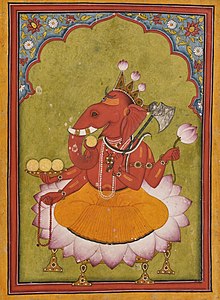
Ganesha, Basohli miniature, circa 1730.
Ganesha[edit]
Though not alluding to the classical form of Ganapati, the earliest mention of Ganapati is found in the Rigveda. It appears twice in the Rigveda, once in shloka 2.23.1, as well as in shloka 10.112.9.[15][16][17] Both of these shlokas imply a role of Ganapati as «the seer among the seers, abounding beyond measure in food presiding among the elders and being the lord of an invocation», while the shloka in mandala 10 states that without Ganapati «nothing nearby or afar is performed without you», according to Michael.[15][18] However, it is uncertain that the Vedic term Ganapati which literally means «guardian of the multitudes», referred specifically to later era Ganesh, nor do the Vedic texts mention Ganesh Chaturthi.[19] appears in post-Vedic texts such as the Grhya Sutras and thereafter ancient Sanskrit texts such as the Vajasaneyi Samhita, the Yajnavalkya Smriti and the Mahabharata mention Ganapati as Ganesvaras and Vinayak. Ganesh appears in the medieval Puranas in the form of «god of success, obstacle remover». The Skanda Purana, Narada Purana and the Brahma Vaivarta Purana, in particular, profusely praise him. [20] Beyond textual interpretations, archaeological and epigraphical evidence suggest Ganesha had become popular, was revered before the 8th century CE and numerous images of him are traceable to the 7th century or earlier.
For example, carvings at Hindu, Buddhist, and Jain temples such as at the Ellora Caves, dated between the 5th and 8th-century show Ganesha reverentially seated with major Hindu goddess (Shakti).[21]
Festival[edit]

Although it is unknown when (or how) Ganesh Chaturthi was first observed,[22] the festival has been publicly celebrated in Pune since the era of King Shivaji (1630–1680, founder of the Maratha Empire).[22] The Peshwa in the 18th century were devotees of Ganesha and started as a public Ganesh festival in their capital city of Pune during the month of Bhadrapad.[23] After the start of the British Raj, the Ganesh festival lost state patronage and became a private family celebration in Maharashtra until its revival by Indian freedom fighter and social reformer Lokmanya Tilak.[22][24] Indian freedom fighter Lokmanya Tilak,[25] championed it as a means to circumvent the colonial British government ban on Hindu gatherings through its anti-public assembly legislation in 1892.[26][27][28]
I followed with the greatest curiosity crowds who carried in procession an infinite number of idols of the God Ganesh. Each little quarter of the town, each family with its adherents, each little street corner I may almost say, organizes a procession of its own, and the poorest may be seen carrying on a simple plank their little idol or of paper mâché… A crowd, more or less numerous, accompanies the idol, clapping hands and raises cries of joy, while a little orchestra generally precedes the idol.
– Angelo de Gubernatis, Bombay Gazette (1886)[29][30]
According to others such as Kaur, the festival became a public event later, in 1892 when Bhausaheb Laxman Javale (also known as Bhau Rangari), installed the first sarvajanik (public) Ganesha idol in Pune.[31] In 1893, the Indian freedom fighter Lokmanya Tilak praised the celebration of Sarvajanik Ganesh Utsav in his newspaper, Kesari, and dedicated his efforts to launch the annual domestic festival into a large, well-organised public event.[32] Tilak recognised Ganesh’s appeal as «the god for everybody»,[33] and according to Robert Brown, he chose Ganesha as the god that bridged «the gap between Brahmins and non-Brahmins», thereby building a grassroots unity across them to oppose British colonial rule.[34]
Other scholars state that the British Empire, after 1870 out of fear of seditious assemblies, had passed a series of ordinances that banned public assembly for social and political purposes of more than 20 people in British India, but exempted religious assembly for Friday mosque prayers under pressure from the Indian Muslim community. Tilak believed that this effectively blocked the public assembly of Hindus whose religion did not mandate daily prayers or weekly gatherings, and he leveraged this religious exemption to make Ganesh Chaturthi to circumvent the British colonial law on large public assembly.[25][26][28] He was the first to install large public images of Ganesha in pavilions in Bombay Presidency, and other celebratory events at the festival.[35]
God Ganesh: political obstacle remover
Why shouldn’t we convert the large religious festivals
into mass political rallies?
—Lokmanya Tilak, Kesari, 8 September 1896[36]
[note 1]
According to Richard Cashman, Tilak recruited and passionately committed himself to god Ganesha after the 1893 Hindu-Muslim communal violence in Bombay and the Deccan riots, when he felt that the British India government under Lord Harris had repeatedly taken sides and not treated Hindus fairly because Hindus were not well organised.[41] In Tilak’s estimate, Ganesha worship and processions were already popular in rural and urban Hindu populations, across social castes and classes in Baroda, Gwalior, Pune and most of the Maratha region in the 18th century.[42] In 1893, Tilak helped expand Ganesh Chaturthi festival into a mass community event and a hidden means for political activism, intellectual discourse, poetry recitals, plays, concerts, and folk dances.[43]
In Goa, Ganesh Chaturthi predates the Kadamba era. The Goa Inquisition had banned Hindu festivals, and Hindus who did not convert to Christianity were severely restricted. However, Hindu Goans continued to practice their religion despite the restrictions. Many families worship Ganesha in the form of patri (leaves used for worshiping Ganesha or other gods), a picture is drawn on paper or small silver idols. In some households Ganesha idols are hidden, a feature unique to Ganesh Chaturthi in Goa due to a ban on clay Ganesha idols and festivals by the Jesuits as part of the Inquisition.[44]
Celebration in India[edit]

Artist preparing Ganesh’s image for the festival in Margao, Goa
In India, Ganesh Chaturthi is primarily celebrated at home and in public by local community groups in the central and western states of Maharashtra, Madhya Pradesh, Gujarat, Rajasthan and Goa and the southern states of Karnataka, Andhra Pradesh, Telangana, Tamil Nadu and eastern states of West Bengal and Odisha and in North eastern states of Assam.
On the same day, Chaurchan festival is celebrated in Mithila region of Bihar which is related to Ganesha and the moon-god Chandra.[45][46]
The date for the festival is usually decided by the presence of Chaturthi Thithi. The festival is held during «Bhadrapada Madyahanaa Purvabaddha». If the Chaturthi Thiti begins at night on the previous day and gets over by morning on next day, then the next day is observed as Vinayaka Chaturthi.
In the consecration ceremony, a priest performs a Prana Pratishtha to invite Ganesh like a guest. This is followed by the 16-step Shodashopachara ritual,[47] (Sanskrit: Shodash, 16; Upachara, process) during which coconut, jaggery, modaks, durva grass and red hibiscus (Jaswand) flowers[48] are offered to the idol. Depending on the region and time zone, the ceremony commences with hymns from the Rigveda, the Ganapati Atharvashirsa, the Upanishads and the Ganesh stotra (prayer) from the Narada Purana are chanted. In Maharashtra as well as Goa, Aartis are performed with friends and family, typically in the morning and evening.
In preparation for the festival, artisans create clay models of Ganesha for sale. The images (murtis) range in size from 20 mm (3⁄4 in) for homes to over 20 m (70 ft) for large community celebrations.[49]
On the last day of the festival, the tradition of Ganesh visarjan or nimajjanam (lit. «immersion») takes places, when the Ganesha images are immersed in a river, sea or water body. On the last day, the devotees come out in processions carrying the idols of Ganesha, culminating in immersion. It is believed that the god who comes to the earthly realm on Ganesh Chaturthi, returns to his celestial abode after immersion. The celebration of Ganesh Chaturthi also denotes the significance of the cycle of birth, life and death. It is believed that when the idol of the Ganesha is taken out for immersion, it also takes away with it the various obstacles of the house and these obstacles are destroyed along with the immersion. Every year, people wait with great anticipation to celebrate the festival of Ganesh Chaturthi.[50]
Domestic celebration[edit]
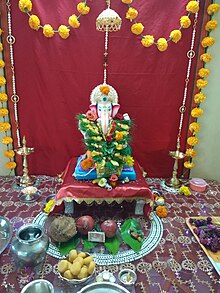
A domestic celebration of Ganesh during Ganesh Chaturthi in a Maharashtrian home
In Maharashtra, Ganesh Chaturthi is known as Ganeshotsav. Families install small clay statues for worship during the festival.[51] At home, the festival preparation includes purchases such as puja items or accessories a few days in advance and booking the Ganesh murti as early as a month beforehand (from local artisans). The murti is brought home either a day before or on the day of the Ganesh Chaturthi itself. Families decorate a small, clean portion of the house with flowers and other colourful items before installing the idol. When the Murti is installed, it and its shrine are decorated with flowers and other materials. On the day of the festival, The ceremonial installation of the clay murti (idol) is done along with chants of holy mantras and pooja including bhajans during a certain auspicious period of the day. The Murti is worshipped in the morning and evening with offerings of flowers, durva (strands of young grass), karanji and modaks (jaggery and coconut flakes wrapped in rice flour dumplings).[4][52][53] The worship ends with the singing of an aarti in honour of Ganesh, other Gods and Saints.
In Maharashtra the Marathi aarti «Sukhakarta Dukhaharta», composed by the 17th-century saint, Samarth Ramdas is sung.[54]
Family traditions differ about when to end the celebration. Domestic celebrations end after 1+1⁄2, 3, 5, 7 or 11 days. At that time the Murti is ceremoniously brought to a body of water (such as a lake, river or the sea) for immersion. In Maharashtra, Ganeshotsav also incorporates other festivals, namely Hartalika and the Gauri festival, the former is observed with a fast by women on the day before Ganesh Chaturthi whilst the latter by the installation of statues of Gauris.[55] In some communities such as the Chitpavan, and the CKP, pebbles collected from river bank are installed as representations of Gauri.[56]
In Goa, Ganesh Chaturthi is known as Chavath in Konkani and Parab or Parva («auspicious celebration»);[57] it begins on the third day of the lunar month of Bhadrapada. On this day Parvati and Shiva are worshipped by women, who fast.[58] Instruments such as ghumots, Crash cymbals (ताळ(taal) in Konkani) and pakhavaj (an Indian barrel-shaped, two-headed drum) are played during the rituals.[59] The harvest festival, Navyachi Pancham, is celebrated the next day; freshly harvested paddy is brought home from the fields (or temples) and a puja is conducted. Communities who ordinarily eat seafood refrain from doing so during the festival.[58]
In Karnataka the Gowri festival precedes Ganesh Chaturthi, and people across the state wish each other well. In Andhra Pradesh, Ganesh Murtis of clay (Matti Vinayakudu) and turmeric (Siddhi Vinayakudu) are usually worshipped at home with plaster of Paris Murti’s.[citation needed]
Public celebration[edit]

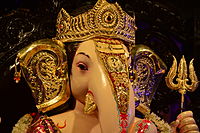
Public celebrations of the festival are popular, and are organised by local youth groups, neighbourhood associations or groups of tradespeople. Funds for the public festival are collected from members of the association arranging the celebration, local residents and businesses.[60] The Ganesh idols and accompanying statues are installed in temporary shelters, known as mandaps or pandals. Public preparations begin months in advance. The making of the Murti in Maharashtra usually begins with «Padya pooja» or worshipping the feet of Ganesh. The Murti’s are brought to «pandals» on the day or a day before the festival begins. The pandals have elaborate decoration and lighting.[61]
The festival features cultural activities such as singing, theatre and orchestral performances and community activities such as free medical checkups, blood-donation sites and donations to the poor. Ganesh Chaturthi, in addition to its religious aspects, is an important economic activity in Mumbai, Surat, Pune, Hyderabad, Bangalore, Chennai and Kurnool. Many artists, industries, and businesses earn a significant amount of their living from the festival, which is a stage for budding artists. Members of other religions also participate in the celebration.[62][63][64]
In Tamil Nadu, the festival, also known as Vinayaka Chaturthi or Pillayar Chaturthi, falls on the fourth day after the new moon in the month of Āvaṇi in the Tamil calendar. The idols are usually made of clay or papier-mâché,[65] since Plaster of Paris idols have been banned by the state government,[66][67] but violations of this rule are often reported.[68] Idols are also made of coconuts and other organic products. They are worshipped for several days in pandals, and immersed in the Bay of Bengal the following Sunday. In Kerala the festival is also known as Lamboodhara Piranalu, which falls in the month of Chingam.[69] In Thiruvananthapuram a procession marches from the Pazhavangadi Ganapathi Temple to Shankumugham Beach, with tall statues of Ganesha made from organic items and milk immersed in the sea.[70]
At prominent temples[edit]
At Varasidhi Vinayaka Swamy Temple in Kanipakam, Andhra Pradesh, annual brahmotsavams will be celebrated for 21 days starting from Vinayaka Chavithi day. The processional deity of Vinayaka (Ganesh) will be taken in a procession on different vahanams on these days amidst large number of pilgrims across the country.[71]
Celebration outside India[edit]

In Pakistan, Ganesh Chaturthi celebrations are conducted by the Shri Maharashtra Panchayat, an organisation for Maharashtrians in Karachi.[72]
Ganesh Chaturthi is celebrated in the UK by the British Hindu population living there. The Hindu Culture and Heritage Society, a Southall-based organisation, celebrated Ganesh Chaturthi for the first time in London in 2005 at the Vishwa Hindu Temple; and the idol was immersed in the River Thames at Putney Pier[citation needed]. Another celebration, organised by a Gujarati group, has been celebrated in Southend-on-Sea, and attracted an estimated 18,000 devotees.[73] Annual celebrations are also held on the River Mersey in Liverpool.[74][75]
The Philadelphia Ganesh Festival is one of the most popular celebrations of Ganesh Chaturthi in North America,[76] and it is also celebrated in Canada (particularly in the Toronto area), Mauritius, Malaysia and Singapore. The Mauritius festival dates back to 1896,[77] and the Mauritian government has made it a public holiday.[78] In Malaysia and Singapore, the festival is more commonly known as Vinayagar Chaturthi because of the large Tamil-speaking Hindu minority.[79]
In Ghana, ethnic African Hindus celebrate Ganesh Chaturti.[80]
Foods[edit]

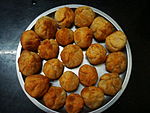
Modaka are sweet dumplings, the traditional offerings and prasada in Ganesh Chaturthi. Left: steamed with fillings, Right: Fried
The primary sweet dish during the festival is Modak (modak in Marathi and Konkani, modakam or kudumu in Telugu, modaka or kadubu in Kannada, kozhakatta or modakkam in Malayalam and kozhukattai or modagam in Tamil). A modak is a dumpling made from rice or wheat flour, stuffed with grated coconut, [jaggery], dried fruits and other condiments and steamed or fried. Another popular sweet dish is the karanji (karjikai in Kannada), similar to modak in composition and taste but in a semicircular shape. This sweet meal is called Nevri in Goa and is synonymous with Ganesh festival amongst the Goans and the Konkani diaspora.[81]
In Andhra Pradesh and Telangana modak, laddu, vundrallu (steamed, coarsely ground rice-flour balls), panakam (a jaggery-, black pepper- and cardamom-flavoured drink), vadapappu (soaked moong lentils) and chalividi (a cooked rice flour and jaggery mixture) are offered to Ganesh. These offerings are known as naivedya, and a plate of modak traditionally holds 21 pieces of the sweet. In Goa, modak and a Goan version of idli (sanna) is popular.[82]
Panchakajjaya is an offering made to Lord Ganesh during this festival in parts of Karnataka. It is a mixture of desiccated coconut, roasted Bengal gram powder, sugar, ghee, and sesame. Different versions of panchakajjaya are made. Roasted Bengal gram, green gram, roasted chana dal (putani) or aval can be used.[83]
Environmental impact[edit]
The Madras High Court ruled in 2004 that immersion of Ganesh idols is unlawful because it incorporates chemicals that pollute the sea water.[84] In Goa the sale of plaster-of-Paris Ganesha idols has been banned by the state government and celebrants are encouraged to buy traditional, artisan-made clay idols.[85] Recent initiatives to produce traditional clay Ganesh idols in Hyderabad have been sponsored by the Andhra Pradesh Pollution Control Board.[86][87] Environmental concern is also making people in Gujarat to opt for Ganesh Idols made with a mixture of cow dung and clay. These are marketed as «Vedic Ganesh idols» by the organization making them.[88]
Due to environmental concerns, a number of families now avoid bodies of water and let the clay statue disintegrate in a barrel of water at home. After a few days, the clay is spread in the garden. In some cities a public, eco-friendly process is used for the immersion.[89]
Gallery[edit]
Cultural depictions of Ganesh Chaturthi
-

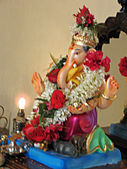
A Ganesh idol in a home during the festival
-

-

-


See also[edit]
- Cultural depictions of elephants
- 1994 plague in India
Notes[edit]
- ^ The transformation of Ganesh Chaturthi into a major annual religious and politically significant procession event started in 1894. According to Aslam Syed, the Ganesh statue immersion ritual in the western states of India may have grown because the annual gathering and procession by Shia Muslims on Muharram was allowed by the colonial British government in the 19th and early 20th century, and after the ritual mourning of the death of the 7th century Imam, they would immerse Tazia (Taboots) into river or ocean.[37] The Hindus expanded their own Ganesh processions by walking through the streets, joyfully dancing and reciting their scriptural verses and ended their procession with a ceremonial immersion of Ganesh. The colonial British government attempted to introduce procession licence, to Muslims only, which Hindu leaders presented as evidence of discriminatory oppression by the Muslims and the British. The Hindu leaders such as Tilak defied any attempts to selectively stop the Hindu congregational gathering and processions associated with Ganesh Chaturthi.[37][38] The right to organise processions and immersion rituals of Tazia by Muslims, and Ganesh by Hindus, have remained a religious and equal rights issue ever since, particularly when the religious calendars overlap.[39][40]
References[edit]
- ^ «National Portal of India». www.india.gov.in. Retrieved 28 April 2022.
- ^ «Calendar| National Portal of India». www.india.gov.in. Retrieved 29 August 2022.
- ^ a b c d Ganesh Chaturthi: Hindu Festival, Encyclopædia Britannica (2014)
- ^ a b Darra Goldstein (2015). The Oxford Companion to Sugar and Sweets. Oxford University Press. pp. 82, 254, 458. ISBN 978-0-19-931361-7.
- ^ K. T. Achaya (2001). A Historical Dictionary of Indian Food. Oxford University Press. pp. 68–69, 132. ISBN 978-0-19-565868-2.
- ^ «Ganesh Chaturthi 2019 in India – Dates & Map». rove.me.
- ^ a b Patrick Taylor; Frederick I. Case (2013). The Encyclopedia of Caribbean Religions. University of Illinois Press. p. 332. ISBN 978-0-252-09433-0.
- ^ Heras 1972, p. 58.
- ^ Getty 1936, p. 5.
- ^ Lawrence A. Babb (1975). The Divine Hierarchy: Popular Hinduism in Central India. Columbia University Press. pp. 62–63. ISBN 978-0-231-08387-4.
- ^ Ramesh Dutt Ramdoyal (1990). Festivals of Mauritius. Editions de l’Océan Indien. pp. 21–22.
- ^ «Festivals, Cultural Events and Public Holidays in Mauritius». Mauritius Tourism Authority. Archived from the original on 20 January 2012. Retrieved 28 January 2012.
- ^ «Ganesh Chaturthi – CONCURSO FOTOGRÁFICO: MIGRACIONES INTERNACIONALES Y FRONTERAS». investigacion.cchs.csic.es.
- ^ Royina Grewal (2009). The Book of Ganesha. Penguin Books. pp. 143–146. ISBN 978-0-14-306760-3.
- ^ a b Michael 1983, pp. 99–102.
- ^ Rigveda Mandala 2, shloka 2.23.1, Wikisource, Quote: गणानां त्वा गणपतिं हवामहे कविं कवीनामुपमश्रवस्तमम् । ज्येष्ठराजं ब्रह्मणां ब्रह्मणस्पत आ नः शृण्वन्नूतिभिः सीद सादनम् ॥१॥; For translation, see Grimes (1995), pp. 17–19
- ^ Sanskrit Original: नि षु सीद गणपते गणेषु त्वामाहुर्विप्रतमं कवीनाम् । नgdऋते त्वत्क्रियते किं चनारे महामर्कं मघवञ्चित्रमर्च ॥९॥ – Rigveda 10.112.9; Wikisource
- ^ Alain Daniélou (1954), The meaning of Ganapati, The Adyar library bulletin X V III. Madras: The Sanvi!! Adyar Library, pp. 110–11
- ^ Grimes 1995, pp. 17–19, 201.
- ^ Michael 1983, pp. 107–09.
- ^ Michael 1983, pp. 109–10.
- ^ a b c Kapoor, Subodh (2002). The Indian Encyclopaedia. Cosmo Publications. p. 2514. ISBN 978-81-7755-257-7.
- ^ The Experience of Hinduism: Essays on Religion in Maharashtra; Edited By Eleanor Zelliot, Maxine Berntsen, pp. 76–94 («The Ganesh Festival in Maharashtra: Some Observations» by Paul B. Courtright); 1988; SUNY Press; ISBN 088706664X
- ^ Barnouw, Victor. “The Changing Character of a Hindu Festival.” American Anthropologist 56, no. 1 (1954): 74–86. http://www.jstor.org/stable/664633.
- ^ a b Paul B. Courtright (1985). Ganesa. Oxford University Press. pp. 230–37. ISBN 978-0-19-503572-8.
- ^ a b Trimbak Vishnu Parvate (1958). Bal Gangadhar Tilak: A Narrative and Interpretative Review of His Life, Career and Contemporary Events. Navajivan. pp. 96–102.
- ^ Sohoni, Ashutosh (2011). «Ganesh Temple at Tasgaon: Apotheosis of Maratha Temple Architecture». South Asian Studies. Informa UK Limited. 27 (1): 51–73. doi:10.1080/02666030.2011.556011. S2CID 154444431.
- ^ a b Christian Roy (2005). Traditional Festivals: A Multicultural Encyclopedia. ABC-CLIO. pp. 178–80. ISBN 978-1-57607-089-5.
- ^ Richard I. Cashman (1975). The Myth of the Lokamanya Tilak and Mass Politics in Maharashtra. University of California Press. p. 76. ISBN 978-0-520-02407-6.
- ^ Robin Jeffrey (1990). India: rebellion to republic, selected writings 1857–1990. Stirling. pp. 40–41. ISBN 978-8120711075.
- ^ Kaur, R. (2003). Performative politics and the cultures of Hinduism: Public uses of religion in western India. Anthem Press, pp. 38–48.
- ^ Metcalf, Thomas R.; Metcalf, Barbara Daly (26 November 2001). A Concise History of India. ISBN 0-521-63027-4., Metcalf and Metcalf, p. 150.
- ^ Momin, A.R., The Legacy of G. S. Ghurye: A Centennial Festschrift, p. 95.
- ^ Brown, Robert L. (1991). Ganesh: Studies of an Asian God. Albany: State University of New York. p. 9. ISBN 0-7914-0657-1.
- ^ For Tilak as the first to use large public images in maṇḍapas (pavilions or tents) see: Thapan, p. 225.Thapan, Anita Raina (1997). Understanding Gaņapati: Insights into the Dynamics of a Cult. New Delhi: Manohar Publishers. ISBN 81-7304-195-4.
- ^ Richard I. Cashman (1975). The Myth of the Lokamanya Tilak and Mass Politics in Maharashtra. University of California Press. p. 75 with footnote 1. ISBN 978-0-520-02407-6.
- ^ a b Aslam Syed (2014). David Jones; Michele Marion (eds.). The Dynamics of Cultural Counterpoint in Asian Studies. SUNY Press. pp. 97–98. ISBN 978-1-4384-5191-6.
- ^ Shabnum Tejani (2008). Indian Secularism: A Social and Intellectual History, 1890–1950. Indiana University Press. pp. 58–61. ISBN 978-0-253-22044-8.
- ^ HC’s 2-hour immersion breather for home Pujas The Times of India (7 October 2016).
- ^ Peter van der Veer (2015). Handbook of Religion and the Asian City: Aspiration and Urbanization in the Twenty-First Century. University of California Press. pp. 95–100. ISBN 978-0-520-96108-1.
- ^ Richard I. Cashman (1975). The Myth of the Lokamanya Tilak and Mass Politics in Maharashtra. University of California Press. pp. 70–73. ISBN 978-0-520-02407-6.
- ^ Richard I. Cashman (1975). The Myth of the Lokamanya Tilak and Mass Politics in Maharashtra. University of California Press. pp. 75–77. ISBN 978-0-520-02407-6.
- ^ Cashman, Richard I. (1975). The Myth of the Lokamanya Tilak and Mass Politics in Maharashtra. Berkeley and Los Angeles, California: University of California Press. pp. 75–91. ISBN 0-520-02407-9.
- ^ «Of fervour & Traditions». The Times of India. TOI. Retrieved 23 August 2014.
- ^ «चौरचन के दिन की जाती है श्रापित चंद्र की पूजा, जानिये महत्त्व, कथा और शुभ मुहूर्त | Jansatta». www.jansatta.com (in Hindi). Retrieved 28 August 2022.
- ^ Rajesh (10 September 2021). «Chaurchan Festival 2021 : बिहार में गणेश चतुर्थी को मनाई जाती चौरचन पूजा, जानिए क्या है चंद्र दोष». Live Cities. Retrieved 28 August 2022.
- ^ «Rituals Explained». thehindutemple.org. Retrieved 21 September 2015.
- ^ Kolte, R.R., Kulkarni, R.S., Shinde, P.V., Padvekar, H.K., Magadum, V.G. and Apate, S.A., Studies on the ethnomedicinal plants used on the occasion of festivals with special reference to Ratnagiri district from Maharashtra state [1].
- ^ «Andhra laddu-maker eyes to break own Guinness Record with 8000 kg laddu». Daily News and Analysis India. Daily News and Analysis India. 16 September 2015. Retrieved 25 September 2015.
… ready for delivery tomorrow to an 80-feet tall Ganesh Murti put up by Visakha Integrated Social Welfare Association supported by NRIs at the Gajuwaka area in Visakhapatnam.
- ^ Sahu, Manish (21 August 2020). «What is the story behind the tradition of Ganesh visarjan?». Times of India.
- ^ «Essential Guide to the Ganesh Festival in India». TripSavvy.
- ^ «What is the significance of ‘durva’ in Ganesh Poojan ?». sanatan.org/. 9 September 2000. Retrieved 3 January 2015.
- ^ Sharma, Usha (2008). Festivals In Indian Society (2 Vols. Set). New Delhi: Mittal publications. p. 144. ISBN 978-81-8324-113-7.
- ^ Shanbag, Arun (2007). Prarthana: A Book of Hindu Psalms. Arlington, MA: Arun Shanbag. p. 163. ISBN 978-0-9790081-0-8.
- ^ Pattanaik, Devdutt (2011). 99 thoughts on Ganesh : [stories, symbols and rituals of India’s beloved elephant-headed deity]. Mumbai: Jaico Pub House. p. 61. ISBN 978-81-8495-152-3. Retrieved 29 August 2016.
- ^ Bari, Prachi (2017). «Traditions from all over Maharashtra merge to welcome Gauri in Pune». Hindustan Times. No. 30 August 2017. HT Media Limited. Retrieved 28 August 2019.
- ^ Goa, Daman and Diu (India). Directorate of Archives, Archaeology, and Museum. Purabhilekh-puratatva: Journal of the Directorate of Archives, Archaeology and Museum, Volume 2. Panaji-Goa: The Directorate, 1984. p. 94.
{{cite book}}: CS1 maint: multiple names: authors list (link) - ^ a b «Ganesh Chaturhi or Chovoth». goatourism.gov.in. Government of Goa. Retrieved 23 August 2014.
- ^ Singbal, Anwesha. «Bringing the local beat back». thegoan.net/. The Goan. Archived from the original on 26 August 2014. Retrieved 23 August 2014.
- ^ Courtright, P.B. (1988). «The Ganesh Festival in Maharashtra: Some Observations». The Experience of Hinduism: Essays on Religion in Maharashtra, 84–86.
- ^ «Ganesh Chaturthi 2020: Puja Vidhi, Shubh Muhurat, Fasting, Vrat Katha and Ganpati Visarjan information – Times of India». The Times of India. Retrieved 22 August 2020.
- ^ «Kolhapur Muslims mark Ganesh festival with Hindu brothers in mosque». Oneindia. 18 September 2010. Retrieved 9 September 2015.
- ^ «Tv9 Gujarat – Hindu-Muslim celebrates Ganesh Chaturthi together, Ahmedabad». TV9 (Gujarati).
- ^ «Hindu, Muslim families celebrate Ganesh Puja». India Today. Headlines Today. 24 August 2009. Retrieved 9 September 2015.
- ^ «Idol makers in Madurai take to eco-friendly Ganeshas». The Times of India. Retrieved 11 September 2018.
- ^ «Govt order on rules for Ganesh Chathurthi not violative of rights, says Madras HC». The News Minute. 6 September 2018. Retrieved 11 September 2018.
- ^ Special Correspondent (24 August 2017). «Plaster of Paris Ganesha idols banned». The Hindu. ISSN 0971-751X. Retrieved 11 September 2018.
- ^ «Raid against idols made of plaster of paris». The Times of India. Retrieved 11 September 2018.
- ^ «Ganesh Chaturthi Pooja Rituals». ganeshchaturthigifts.com.
- ^ «OM GAM: GANAPATHAYE NAMAH». Ganeshotsavam.org. Archived from the original on 25 September 2015. Retrieved 17 September 2015.
- ^ «All set for Kanipakam temple fest». The Hans India. 4 September 2016. Retrieved 7 September 2018.
- ^ Sutar, Kamlesh Damodar (13 September 2016). «Karachi celebrates Ganeshotsav with much zest and zeal». India Today. Retrieved 18 December 2019.
- ^ «Thousands turn out for Hindu Festival at Shoebury East Beach». Southend Standard. 1 September 2009. Retrieved 25 September 2015.
It is thought as many as 18,000 people attended from across Essex, Kent, Middlesex, London, the Midlands and even India.
Alternate Link - ^ «River marks religious ceremony». bbc.co.uk. BBC News. 14 September 2008.
- ^ «Liverpool Echo: Latest Liverpool and Merseyside news, sports and what’s on». liverpoolecho.
- ^ Kalyana Ramanathan; Indira Kannan (11 September 2010). «Non-resident gods». Business Standard. Retrieved 14 October 2015.
- ^ «Mauritius takes the day off for Ganesh Chaturthi». aglobalworld.com. Retrieved 29 May 2017.
- ^ Eisenlohr, Patrick (2006). Little India: Diaspora, Time, and Ethnolinguistic Belonging in Hindu Mauritius. University of California Press. p. 153. ISBN 9780520248793. Retrieved 14 October 2015.
- ^ «Hindus celebrate Vinayagar Chathurthi». The Malaysian Times. 9 September 2013. Retrieved 14 October 2015.
- ^ «अफ्रीका के घाना में हर साल विराजते हैं गणपति, 50 साल से धूमधाम से होता है ‘बप्पा का स्वागत’«. Zee News (in Hindi). 11 September 2019. Retrieved 4 April 2020.
- ^ «Ganesh Chaturthi festival fervour grips Goa». The Indian Express. PTI. 29 August 2014. Retrieved 27 November 2015.
- ^ Gazetteer of the Union Territory Goa, Daman and Diu: district gazetteer, Volume 1. Goa, Daman and Diu (India). Gazetteer Dept. 1979. p. 258.
- ^ Ferro-Luzzi, G.E., 1977. «The logic of South Indian food offerings». Anthropos, (H. 3./4), pp. 529–56.
- ^ «Ganesha immersions ruled unlawful». bbc.co.uk. BBC News – South Asia. 8 September 2004.
- ^ Special Correspondent (29 August 2013). «Goa bans plaster of Paris Ganesh idols». The Hindu.
- ^ «The Environmentally Friendly Ganesh». chakranews.com. 21 October 2011.
- ^ «Ganesha immersion: temple’s awareness campaign finds many takers». The Hindu. 11 August 2006. Archived from the original on 13 August 2006.
- ^ Sahu, Manish (21 August 2020). «Ganesh Chaturthi 2020: Artists make eco-friendly cow dung ‘Vedic’ Ganpati idols in Gujarat». hindustantimes.
- ^ Zha, Bagish K. (20 September 2013). «Eco-friendly ‘Ganesh Visarjan’ save water and soil from getting polluted in Indore». The Times of India. Retrieved 12 February 2014.
Bibliography[edit]
- Grimes, John A. (1995), Ganapati: Song of the Self, SUNY Series in Religious Studies, Albany: State University of New York Press, ISBN 0-7914-2440-5
- Michael, S. M. (1983). «The Origin of the Ganapati Cult» (PDF). Asian Folklore Studies. 42 (1): 91–116. doi:10.2307/1178368. JSTOR 1178368. Alternate Link
External links[edit]
 Media related to Ganesh Chaturthi at Wikimedia Commons
 Media related to Ganesh Chaturthi at Wikimedia Commons
| Ganesh Chaturthi | |
|---|---|
|
Lalbaugcha Raja, Mumbai |
|
| Official name | Chatur/Vinayaka Chaturthi/Vinayaka Chavithi |
| Also called | Chavithi, Chouthi, Ganeshotsav |
| Observed by | Hindus |
| Type | Religious |
| Celebrations | Chanting of Vedic hymns and Hindu texts, prayers, last day: processions, idol immersion |
| Begins | māsa (amānta) / māsa (purnimānta), pakṣa, tithi |
| Ends | 11 days after the start |
| Date | Bhadra Shukla Chaturthi |
| 2022 date | 31 August[1] |
| 2023 date | 19 September[2] |
| Frequency | Annual |
|
Hindu festival dates The Hindu calendar is lunisolar but most festival dates are specified using the lunar portion of the calendar. A lunar day is uniquely identified by three calendar elements: māsa (lunar month), pakṣa (lunar fortnight) and tithi (lunar day). Furthermore, when specifying the masa, one of two traditions are applicable, viz. amānta / pūrṇimānta. Iff a festival falls in the waning phase of the moon, these two traditions identify the same lunar day as falling in two different (but successive) masa. A lunar year is shorter than a solar year by about eleven days. As a result, most Hindu festivals occur on different days in successive years on the Gregorian calendar. |
|
Ganesh Chaturthi (ISO: Gaṇeśa Caturthī), also known as Vinayak Chaturthi (Vināyaka Caturthī), or Ganeshotsav (Gaṇeśōtsava) is a Hindu festival commemorating the birth of the Hindu god Ganesha.[3] The festival is marked with the installation of Ganesha’s clay idols privately in homes and publicly on elaborate pandals (temporary stages). Observances include chanting of Vedic hymns and Hindu texts, such as prayers and vrata (fasting).[3] Offerings and prasada from the daily prayers, that are distributed from the pandal to the community, include sweets such as modaka as it is believed to be a favourite of Ganesha.[4][5] The festival ends on the tenth day after start, when the idol is carried in a public procession with music and group chanting, then immersed in a nearby body of water such as a river or sea, called visarjan on the day of Anant Chaturdashi. In Mumbai alone, around 150,000 statues are immersed annually.[6] Thereafter the clay idol dissolves and Ganesha is believed to return to his celestial abode.[3][7]
The festival celebrates Ganesha as the God of New Beginnings and the Remover of Obstacles as well as the god of wisdom and intelligence[8][9] and is observed throughout India, especially in the states such as Tamil Nadu, Maharashtra, Karnataka, Kerala, Andhra Pradesh and Goa.[3][10] Ganesh Chaturthi is also observed in Nepal and by the Hindu diaspora elsewhere such as in Australia, New Zealand, Canada, Singapore, Malaysia, Trinidad and Tobago, Guyana, Suriname, other parts of the Caribbean, Fiji, Mauritius, South Africa,[11] the United States, and Europe. In the Gregorian calendar, Ganesh Chaturthi falls between 22 August and 20 September every year.[7][12][13]
Although it was unknown when or where Ganesh Chaturthi was first observed, the public celebration was initiated by Bal Gangadhar Tilak in Pune in the year 1893. At public venues, along with the reading of texts and group feasting, athletic and martial arts competitions are also held.[14]
History[edit]
Ganesha, Basohli miniature, circa 1730.
Ganesha[edit]
Though not alluding to the classical form of Ganapati, the earliest mention of Ganapati is found in the Rigveda. It appears twice in the Rigveda, once in shloka 2.23.1, as well as in shloka 10.112.9.[15][16][17] Both of these shlokas imply a role of Ganapati as «the seer among the seers, abounding beyond measure in food presiding among the elders and being the lord of an invocation», while the shloka in mandala 10 states that without Ganapati «nothing nearby or afar is performed without you», according to Michael.[15][18] However, it is uncertain that the Vedic term Ganapati which literally means «guardian of the multitudes», referred specifically to later era Ganesh, nor do the Vedic texts mention Ganesh Chaturthi.[19] appears in post-Vedic texts such as the Grhya Sutras and thereafter ancient Sanskrit texts such as the Vajasaneyi Samhita, the Yajnavalkya Smriti and the Mahabharata mention Ganapati as Ganesvaras and Vinayak. Ganesh appears in the medieval Puranas in the form of «god of success, obstacle remover». The Skanda Purana, Narada Purana and the Brahma Vaivarta Purana, in particular, profusely praise him. [20] Beyond textual interpretations, archaeological and epigraphical evidence suggest Ganesha had become popular, was revered before the 8th century CE and numerous images of him are traceable to the 7th century or earlier.
For example, carvings at Hindu, Buddhist, and Jain temples such as at the Ellora Caves, dated between the 5th and 8th-century show Ganesha reverentially seated with major Hindu goddess (Shakti).[21]
Festival[edit]
Although it is unknown when (or how) Ganesh Chaturthi was first observed,[22] the festival has been publicly celebrated in Pune since the era of King Shivaji (1630–1680, founder of the Maratha Empire).[22] The Peshwa in the 18th century were devotees of Ganesha and started as a public Ganesh festival in their capital city of Pune during the month of Bhadrapad.[23] After the start of the British Raj, the Ganesh festival lost state patronage and became a private family celebration in Maharashtra until its revival by Indian freedom fighter and social reformer Lokmanya Tilak.[22][24] Indian freedom fighter Lokmanya Tilak,[25] championed it as a means to circumvent the colonial British government ban on Hindu gatherings through its anti-public assembly legislation in 1892.[26][27][28]
I followed with the greatest curiosity crowds who carried in procession an infinite number of idols of the God Ganesh. Each little quarter of the town, each family with its adherents, each little street corner I may almost say, organizes a procession of its own, and the poorest may be seen carrying on a simple plank their little idol or of paper mâché… A crowd, more or less numerous, accompanies the idol, clapping hands and raises cries of joy, while a little orchestra generally precedes the idol.
– Angelo de Gubernatis, Bombay Gazette (1886)[29][30]
According to others such as Kaur, the festival became a public event later, in 1892 when Bhausaheb Laxman Javale (also known as Bhau Rangari), installed the first sarvajanik (public) Ganesha idol in Pune.[31] In 1893, the Indian freedom fighter Lokmanya Tilak praised the celebration of Sarvajanik Ganesh Utsav in his newspaper, Kesari, and dedicated his efforts to launch the annual domestic festival into a large, well-organised public event.[32] Tilak recognised Ganesh’s appeal as «the god for everybody»,[33] and according to Robert Brown, he chose Ganesha as the god that bridged «the gap between Brahmins and non-Brahmins», thereby building a grassroots unity across them to oppose British colonial rule.[34]
Other scholars state that the British Empire, after 1870 out of fear of seditious assemblies, had passed a series of ordinances that banned public assembly for social and political purposes of more than 20 people in British India, but exempted religious assembly for Friday mosque prayers under pressure from the Indian Muslim community. Tilak believed that this effectively blocked the public assembly of Hindus whose religion did not mandate daily prayers or weekly gatherings, and he leveraged this religious exemption to make Ganesh Chaturthi to circumvent the British colonial law on large public assembly.[25][26][28] He was the first to install large public images of Ganesha in pavilions in Bombay Presidency, and other celebratory events at the festival.[35]
God Ganesh: political obstacle remover
Why shouldn’t we convert the large religious festivals
into mass political rallies?
—Lokmanya Tilak, Kesari, 8 September 1896[36]
[note 1]
According to Richard Cashman, Tilak recruited and passionately committed himself to god Ganesha after the 1893 Hindu-Muslim communal violence in Bombay and the Deccan riots, when he felt that the British India government under Lord Harris had repeatedly taken sides and not treated Hindus fairly because Hindus were not well organised.[41] In Tilak’s estimate, Ganesha worship and processions were already popular in rural and urban Hindu populations, across social castes and classes in Baroda, Gwalior, Pune and most of the Maratha region in the 18th century.[42] In 1893, Tilak helped expand Ganesh Chaturthi festival into a mass community event and a hidden means for political activism, intellectual discourse, poetry recitals, plays, concerts, and folk dances.[43]
In Goa, Ganesh Chaturthi predates the Kadamba era. The Goa Inquisition had banned Hindu festivals, and Hindus who did not convert to Christianity were severely restricted. However, Hindu Goans continued to practice their religion despite the restrictions. Many families worship Ganesha in the form of patri (leaves used for worshiping Ganesha or other gods), a picture is drawn on paper or small silver idols. In some households Ganesha idols are hidden, a feature unique to Ganesh Chaturthi in Goa due to a ban on clay Ganesha idols and festivals by the Jesuits as part of the Inquisition.[44]
Celebration in India[edit]
Artist preparing Ganesh’s image for the festival in Margao, Goa
In India, Ganesh Chaturthi is primarily celebrated at home and in public by local community groups in the central and western states of Maharashtra, Madhya Pradesh, Gujarat, Rajasthan and Goa and the southern states of Karnataka, Andhra Pradesh, Telangana, Tamil Nadu and eastern states of West Bengal and Odisha and in North eastern states of Assam.
On the same day, Chaurchan festival is celebrated in Mithila region of Bihar which is related to Ganesha and the moon-god Chandra.[45][46]
The date for the festival is usually decided by the presence of Chaturthi Thithi. The festival is held during «Bhadrapada Madyahanaa Purvabaddha». If the Chaturthi Thiti begins at night on the previous day and gets over by morning on next day, then the next day is observed as Vinayaka Chaturthi.
In the consecration ceremony, a priest performs a Prana Pratishtha to invite Ganesh like a guest. This is followed by the 16-step Shodashopachara ritual,[47] (Sanskrit: Shodash, 16; Upachara, process) during which coconut, jaggery, modaks, durva grass and red hibiscus (Jaswand) flowers[48] are offered to the idol. Depending on the region and time zone, the ceremony commences with hymns from the Rigveda, the Ganapati Atharvashirsa, the Upanishads and the Ganesh stotra (prayer) from the Narada Purana are chanted. In Maharashtra as well as Goa, Aartis are performed with friends and family, typically in the morning and evening.
In preparation for the festival, artisans create clay models of Ganesha for sale. The images (murtis) range in size from 20 mm (3⁄4 in) for homes to over 20 m (70 ft) for large community celebrations.[49]
On the last day of the festival, the tradition of Ganesh visarjan or nimajjanam (lit. «immersion») takes places, when the Ganesha images are immersed in a river, sea or water body. On the last day, the devotees come out in processions carrying the idols of Ganesha, culminating in immersion. It is believed that the god who comes to the earthly realm on Ganesh Chaturthi, returns to his celestial abode after immersion. The celebration of Ganesh Chaturthi also denotes the significance of the cycle of birth, life and death. It is believed that when the idol of the Ganesha is taken out for immersion, it also takes away with it the various obstacles of the house and these obstacles are destroyed along with the immersion. Every year, people wait with great anticipation to celebrate the festival of Ganesh Chaturthi.[50]
Domestic celebration[edit]
A domestic celebration of Ganesh during Ganesh Chaturthi in a Maharashtrian home
In Maharashtra, Ganesh Chaturthi is known as Ganeshotsav. Families install small clay statues for worship during the festival.[51] At home, the festival preparation includes purchases such as puja items or accessories a few days in advance and booking the Ganesh murti as early as a month beforehand (from local artisans). The murti is brought home either a day before or on the day of the Ganesh Chaturthi itself. Families decorate a small, clean portion of the house with flowers and other colourful items before installing the idol. When the Murti is installed, it and its shrine are decorated with flowers and other materials. On the day of the festival, The ceremonial installation of the clay murti (idol) is done along with chants of holy mantras and pooja including bhajans during a certain auspicious period of the day. The Murti is worshipped in the morning and evening with offerings of flowers, durva (strands of young grass), karanji and modaks (jaggery and coconut flakes wrapped in rice flour dumplings).[4][52][53] The worship ends with the singing of an aarti in honour of Ganesh, other Gods and Saints.
In Maharashtra the Marathi aarti «Sukhakarta Dukhaharta», composed by the 17th-century saint, Samarth Ramdas is sung.[54]
Family traditions differ about when to end the celebration. Domestic celebrations end after 1+1⁄2, 3, 5, 7 or 11 days. At that time the Murti is ceremoniously brought to a body of water (such as a lake, river or the sea) for immersion. In Maharashtra, Ganeshotsav also incorporates other festivals, namely Hartalika and the Gauri festival, the former is observed with a fast by women on the day before Ganesh Chaturthi whilst the latter by the installation of statues of Gauris.[55] In some communities such as the Chitpavan, and the CKP, pebbles collected from river bank are installed as representations of Gauri.[56]
In Goa, Ganesh Chaturthi is known as Chavath in Konkani and Parab or Parva («auspicious celebration»);[57] it begins on the third day of the lunar month of Bhadrapada. On this day Parvati and Shiva are worshipped by women, who fast.[58] Instruments such as ghumots, Crash cymbals (ताळ(taal) in Konkani) and pakhavaj (an Indian barrel-shaped, two-headed drum) are played during the rituals.[59] The harvest festival, Navyachi Pancham, is celebrated the next day; freshly harvested paddy is brought home from the fields (or temples) and a puja is conducted. Communities who ordinarily eat seafood refrain from doing so during the festival.[58]
In Karnataka the Gowri festival precedes Ganesh Chaturthi, and people across the state wish each other well. In Andhra Pradesh, Ganesh Murtis of clay (Matti Vinayakudu) and turmeric (Siddhi Vinayakudu) are usually worshipped at home with plaster of Paris Murti’s.[citation needed]
Public celebration[edit]
Public celebrations of the festival are popular, and are organised by local youth groups, neighbourhood associations or groups of tradespeople. Funds for the public festival are collected from members of the association arranging the celebration, local residents and businesses.[60] The Ganesh idols and accompanying statues are installed in temporary shelters, known as mandaps or pandals. Public preparations begin months in advance. The making of the Murti in Maharashtra usually begins with «Padya pooja» or worshipping the feet of Ganesh. The Murti’s are brought to «pandals» on the day or a day before the festival begins. The pandals have elaborate decoration and lighting.[61]
The festival features cultural activities such as singing, theatre and orchestral performances and community activities such as free medical checkups, blood-donation sites and donations to the poor. Ganesh Chaturthi, in addition to its religious aspects, is an important economic activity in Mumbai, Surat, Pune, Hyderabad, Bangalore, Chennai and Kurnool. Many artists, industries, and businesses earn a significant amount of their living from the festival, which is a stage for budding artists. Members of other religions also participate in the celebration.[62][63][64]
In Tamil Nadu, the festival, also known as Vinayaka Chaturthi or Pillayar Chaturthi, falls on the fourth day after the new moon in the month of Āvaṇi in the Tamil calendar. The idols are usually made of clay or papier-mâché,[65] since Plaster of Paris idols have been banned by the state government,[66][67] but violations of this rule are often reported.[68] Idols are also made of coconuts and other organic products. They are worshipped for several days in pandals, and immersed in the Bay of Bengal the following Sunday. In Kerala the festival is also known as Lamboodhara Piranalu, which falls in the month of Chingam.[69] In Thiruvananthapuram a procession marches from the Pazhavangadi Ganapathi Temple to Shankumugham Beach, with tall statues of Ganesha made from organic items and milk immersed in the sea.[70]
At prominent temples[edit]
At Varasidhi Vinayaka Swamy Temple in Kanipakam, Andhra Pradesh, annual brahmotsavams will be celebrated for 21 days starting from Vinayaka Chavithi day. The processional deity of Vinayaka (Ganesh) will be taken in a procession on different vahanams on these days amidst large number of pilgrims across the country.[71]
Celebration outside India[edit]
In Pakistan, Ganesh Chaturthi celebrations are conducted by the Shri Maharashtra Panchayat, an organisation for Maharashtrians in Karachi.[72]
Ganesh Chaturthi is celebrated in the UK by the British Hindu population living there. The Hindu Culture and Heritage Society, a Southall-based organisation, celebrated Ganesh Chaturthi for the first time in London in 2005 at the Vishwa Hindu Temple; and the idol was immersed in the River Thames at Putney Pier[citation needed]. Another celebration, organised by a Gujarati group, has been celebrated in Southend-on-Sea, and attracted an estimated 18,000 devotees.[73] Annual celebrations are also held on the River Mersey in Liverpool.[74][75]
The Philadelphia Ganesh Festival is one of the most popular celebrations of Ganesh Chaturthi in North America,[76] and it is also celebrated in Canada (particularly in the Toronto area), Mauritius, Malaysia and Singapore. The Mauritius festival dates back to 1896,[77] and the Mauritian government has made it a public holiday.[78] In Malaysia and Singapore, the festival is more commonly known as Vinayagar Chaturthi because of the large Tamil-speaking Hindu minority.[79]
In Ghana, ethnic African Hindus celebrate Ganesh Chaturti.[80]
Foods[edit]
Modaka are sweet dumplings, the traditional offerings and prasada in Ganesh Chaturthi. Left: steamed with fillings, Right: Fried
The primary sweet dish during the festival is Modak (modak in Marathi and Konkani, modakam or kudumu in Telugu, modaka or kadubu in Kannada, kozhakatta or modakkam in Malayalam and kozhukattai or modagam in Tamil). A modak is a dumpling made from rice or wheat flour, stuffed with grated coconut, [jaggery], dried fruits and other condiments and steamed or fried. Another popular sweet dish is the karanji (karjikai in Kannada), similar to modak in composition and taste but in a semicircular shape. This sweet meal is called Nevri in Goa and is synonymous with Ganesh festival amongst the Goans and the Konkani diaspora.[81]
In Andhra Pradesh and Telangana modak, laddu, vundrallu (steamed, coarsely ground rice-flour balls), panakam (a jaggery-, black pepper- and cardamom-flavoured drink), vadapappu (soaked moong lentils) and chalividi (a cooked rice flour and jaggery mixture) are offered to Ganesh. These offerings are known as naivedya, and a plate of modak traditionally holds 21 pieces of the sweet. In Goa, modak and a Goan version of idli (sanna) is popular.[82]
Panchakajjaya is an offering made to Lord Ganesh during this festival in parts of Karnataka. It is a mixture of desiccated coconut, roasted Bengal gram powder, sugar, ghee, and sesame. Different versions of panchakajjaya are made. Roasted Bengal gram, green gram, roasted chana dal (putani) or aval can be used.[83]
Environmental impact[edit]
The Madras High Court ruled in 2004 that immersion of Ganesh idols is unlawful because it incorporates chemicals that pollute the sea water.[84] In Goa the sale of plaster-of-Paris Ganesha idols has been banned by the state government and celebrants are encouraged to buy traditional, artisan-made clay idols.[85] Recent initiatives to produce traditional clay Ganesh idols in Hyderabad have been sponsored by the Andhra Pradesh Pollution Control Board.[86][87] Environmental concern is also making people in Gujarat to opt for Ganesh Idols made with a mixture of cow dung and clay. These are marketed as «Vedic Ganesh idols» by the organization making them.[88]
Due to environmental concerns, a number of families now avoid bodies of water and let the clay statue disintegrate in a barrel of water at home. After a few days, the clay is spread in the garden. In some cities a public, eco-friendly process is used for the immersion.[89]
Gallery[edit]
Cultural depictions of Ganesh Chaturthi
-
A Ganesh idol in a home during the festival
-
-
-
See also[edit]
- Cultural depictions of elephants
- 1994 plague in India
Notes[edit]
- ^ The transformation of Ganesh Chaturthi into a major annual religious and politically significant procession event started in 1894. According to Aslam Syed, the Ganesh statue immersion ritual in the western states of India may have grown because the annual gathering and procession by Shia Muslims on Muharram was allowed by the colonial British government in the 19th and early 20th century, and after the ritual mourning of the death of the 7th century Imam, they would immerse Tazia (Taboots) into river or ocean.[37] The Hindus expanded their own Ganesh processions by walking through the streets, joyfully dancing and reciting their scriptural verses and ended their procession with a ceremonial immersion of Ganesh. The colonial British government attempted to introduce procession licence, to Muslims only, which Hindu leaders presented as evidence of discriminatory oppression by the Muslims and the British. The Hindu leaders such as Tilak defied any attempts to selectively stop the Hindu congregational gathering and processions associated with Ganesh Chaturthi.[37][38] The right to organise processions and immersion rituals of Tazia by Muslims, and Ganesh by Hindus, have remained a religious and equal rights issue ever since, particularly when the religious calendars overlap.[39][40]
References[edit]
- ^ «National Portal of India». www.india.gov.in. Retrieved 28 April 2022.
- ^ «Calendar| National Portal of India». www.india.gov.in. Retrieved 29 August 2022.
- ^ a b c d Ganesh Chaturthi: Hindu Festival, Encyclopædia Britannica (2014)
- ^ a b Darra Goldstein (2015). The Oxford Companion to Sugar and Sweets. Oxford University Press. pp. 82, 254, 458. ISBN 978-0-19-931361-7.
- ^ K. T. Achaya (2001). A Historical Dictionary of Indian Food. Oxford University Press. pp. 68–69, 132. ISBN 978-0-19-565868-2.
- ^ «Ganesh Chaturthi 2019 in India – Dates & Map». rove.me.
- ^ a b Patrick Taylor; Frederick I. Case (2013). The Encyclopedia of Caribbean Religions. University of Illinois Press. p. 332. ISBN 978-0-252-09433-0.
- ^ Heras 1972, p. 58.
- ^ Getty 1936, p. 5.
- ^ Lawrence A. Babb (1975). The Divine Hierarchy: Popular Hinduism in Central India. Columbia University Press. pp. 62–63. ISBN 978-0-231-08387-4.
- ^ Ramesh Dutt Ramdoyal (1990). Festivals of Mauritius. Editions de l’Océan Indien. pp. 21–22.
- ^ «Festivals, Cultural Events and Public Holidays in Mauritius». Mauritius Tourism Authority. Archived from the original on 20 January 2012. Retrieved 28 January 2012.
- ^ «Ganesh Chaturthi – CONCURSO FOTOGRÁFICO: MIGRACIONES INTERNACIONALES Y FRONTERAS». investigacion.cchs.csic.es.
- ^ Royina Grewal (2009). The Book of Ganesha. Penguin Books. pp. 143–146. ISBN 978-0-14-306760-3.
- ^ a b Michael 1983, pp. 99–102.
- ^ Rigveda Mandala 2, shloka 2.23.1, Wikisource, Quote: गणानां त्वा गणपतिं हवामहे कविं कवीनामुपमश्रवस्तमम् । ज्येष्ठराजं ब्रह्मणां ब्रह्मणस्पत आ नः शृण्वन्नूतिभिः सीद सादनम् ॥१॥; For translation, see Grimes (1995), pp. 17–19
- ^ Sanskrit Original: नि षु सीद गणपते गणेषु त्वामाहुर्विप्रतमं कवीनाम् । नgdऋते त्वत्क्रियते किं चनारे महामर्कं मघवञ्चित्रमर्च ॥९॥ – Rigveda 10.112.9; Wikisource
- ^ Alain Daniélou (1954), The meaning of Ganapati, The Adyar library bulletin X V III. Madras: The Sanvi!! Adyar Library, pp. 110–11
- ^ Grimes 1995, pp. 17–19, 201.
- ^ Michael 1983, pp. 107–09.
- ^ Michael 1983, pp. 109–10.
- ^ a b c Kapoor, Subodh (2002). The Indian Encyclopaedia. Cosmo Publications. p. 2514. ISBN 978-81-7755-257-7.
- ^ The Experience of Hinduism: Essays on Religion in Maharashtra; Edited By Eleanor Zelliot, Maxine Berntsen, pp. 76–94 («The Ganesh Festival in Maharashtra: Some Observations» by Paul B. Courtright); 1988; SUNY Press; ISBN 088706664X
- ^ Barnouw, Victor. “The Changing Character of a Hindu Festival.” American Anthropologist 56, no. 1 (1954): 74–86. http://www.jstor.org/stable/664633.
- ^ a b Paul B. Courtright (1985). Ganesa. Oxford University Press. pp. 230–37. ISBN 978-0-19-503572-8.
- ^ a b Trimbak Vishnu Parvate (1958). Bal Gangadhar Tilak: A Narrative and Interpretative Review of His Life, Career and Contemporary Events. Navajivan. pp. 96–102.
- ^ Sohoni, Ashutosh (2011). «Ganesh Temple at Tasgaon: Apotheosis of Maratha Temple Architecture». South Asian Studies. Informa UK Limited. 27 (1): 51–73. doi:10.1080/02666030.2011.556011. S2CID 154444431.
- ^ a b Christian Roy (2005). Traditional Festivals: A Multicultural Encyclopedia. ABC-CLIO. pp. 178–80. ISBN 978-1-57607-089-5.
- ^ Richard I. Cashman (1975). The Myth of the Lokamanya Tilak and Mass Politics in Maharashtra. University of California Press. p. 76. ISBN 978-0-520-02407-6.
- ^ Robin Jeffrey (1990). India: rebellion to republic, selected writings 1857–1990. Stirling. pp. 40–41. ISBN 978-8120711075.
- ^ Kaur, R. (2003). Performative politics and the cultures of Hinduism: Public uses of religion in western India. Anthem Press, pp. 38–48.
- ^ Metcalf, Thomas R.; Metcalf, Barbara Daly (26 November 2001). A Concise History of India. ISBN 0-521-63027-4., Metcalf and Metcalf, p. 150.
- ^ Momin, A.R., The Legacy of G. S. Ghurye: A Centennial Festschrift, p. 95.
- ^ Brown, Robert L. (1991). Ganesh: Studies of an Asian God. Albany: State University of New York. p. 9. ISBN 0-7914-0657-1.
- ^ For Tilak as the first to use large public images in maṇḍapas (pavilions or tents) see: Thapan, p. 225.Thapan, Anita Raina (1997). Understanding Gaņapati: Insights into the Dynamics of a Cult. New Delhi: Manohar Publishers. ISBN 81-7304-195-4.
- ^ Richard I. Cashman (1975). The Myth of the Lokamanya Tilak and Mass Politics in Maharashtra. University of California Press. p. 75 with footnote 1. ISBN 978-0-520-02407-6.
- ^ a b Aslam Syed (2014). David Jones; Michele Marion (eds.). The Dynamics of Cultural Counterpoint in Asian Studies. SUNY Press. pp. 97–98. ISBN 978-1-4384-5191-6.
- ^ Shabnum Tejani (2008). Indian Secularism: A Social and Intellectual History, 1890–1950. Indiana University Press. pp. 58–61. ISBN 978-0-253-22044-8.
- ^ HC’s 2-hour immersion breather for home Pujas The Times of India (7 October 2016).
- ^ Peter van der Veer (2015). Handbook of Religion and the Asian City: Aspiration and Urbanization in the Twenty-First Century. University of California Press. pp. 95–100. ISBN 978-0-520-96108-1.
- ^ Richard I. Cashman (1975). The Myth of the Lokamanya Tilak and Mass Politics in Maharashtra. University of California Press. pp. 70–73. ISBN 978-0-520-02407-6.
- ^ Richard I. Cashman (1975). The Myth of the Lokamanya Tilak and Mass Politics in Maharashtra. University of California Press. pp. 75–77. ISBN 978-0-520-02407-6.
- ^ Cashman, Richard I. (1975). The Myth of the Lokamanya Tilak and Mass Politics in Maharashtra. Berkeley and Los Angeles, California: University of California Press. pp. 75–91. ISBN 0-520-02407-9.
- ^ «Of fervour & Traditions». The Times of India. TOI. Retrieved 23 August 2014.
- ^ «चौरचन के दिन की जाती है श्रापित चंद्र की पूजा, जानिये महत्त्व, कथा और शुभ मुहूर्त | Jansatta». www.jansatta.com (in Hindi). Retrieved 28 August 2022.
- ^ Rajesh (10 September 2021). «Chaurchan Festival 2021 : बिहार में गणेश चतुर्थी को मनाई जाती चौरचन पूजा, जानिए क्या है चंद्र दोष». Live Cities. Retrieved 28 August 2022.
- ^ «Rituals Explained». thehindutemple.org. Retrieved 21 September 2015.
- ^ Kolte, R.R., Kulkarni, R.S., Shinde, P.V., Padvekar, H.K., Magadum, V.G. and Apate, S.A., Studies on the ethnomedicinal plants used on the occasion of festivals with special reference to Ratnagiri district from Maharashtra state [1].
- ^ «Andhra laddu-maker eyes to break own Guinness Record with 8000 kg laddu». Daily News and Analysis India. Daily News and Analysis India. 16 September 2015. Retrieved 25 September 2015.
… ready for delivery tomorrow to an 80-feet tall Ganesh Murti put up by Visakha Integrated Social Welfare Association supported by NRIs at the Gajuwaka area in Visakhapatnam.
- ^ Sahu, Manish (21 August 2020). «What is the story behind the tradition of Ganesh visarjan?». Times of India.
- ^ «Essential Guide to the Ganesh Festival in India». TripSavvy.
- ^ «What is the significance of ‘durva’ in Ganesh Poojan ?». sanatan.org/. 9 September 2000. Retrieved 3 January 2015.
- ^ Sharma, Usha (2008). Festivals In Indian Society (2 Vols. Set). New Delhi: Mittal publications. p. 144. ISBN 978-81-8324-113-7.
- ^ Shanbag, Arun (2007). Prarthana: A Book of Hindu Psalms. Arlington, MA: Arun Shanbag. p. 163. ISBN 978-0-9790081-0-8.
- ^ Pattanaik, Devdutt (2011). 99 thoughts on Ganesh : [stories, symbols and rituals of India’s beloved elephant-headed deity]. Mumbai: Jaico Pub House. p. 61. ISBN 978-81-8495-152-3. Retrieved 29 August 2016.
- ^ Bari, Prachi (2017). «Traditions from all over Maharashtra merge to welcome Gauri in Pune». Hindustan Times. No. 30 August 2017. HT Media Limited. Retrieved 28 August 2019.
- ^ Goa, Daman and Diu (India). Directorate of Archives, Archaeology, and Museum. Purabhilekh-puratatva: Journal of the Directorate of Archives, Archaeology and Museum, Volume 2. Panaji-Goa: The Directorate, 1984. p. 94.
{{cite book}}: CS1 maint: multiple names: authors list (link) - ^ a b «Ganesh Chaturhi or Chovoth». goatourism.gov.in. Government of Goa. Retrieved 23 August 2014.
- ^ Singbal, Anwesha. «Bringing the local beat back». thegoan.net/. The Goan. Archived from the original on 26 August 2014. Retrieved 23 August 2014.
- ^ Courtright, P.B. (1988). «The Ganesh Festival in Maharashtra: Some Observations». The Experience of Hinduism: Essays on Religion in Maharashtra, 84–86.
- ^ «Ganesh Chaturthi 2020: Puja Vidhi, Shubh Muhurat, Fasting, Vrat Katha and Ganpati Visarjan information – Times of India». The Times of India. Retrieved 22 August 2020.
- ^ «Kolhapur Muslims mark Ganesh festival with Hindu brothers in mosque». Oneindia. 18 September 2010. Retrieved 9 September 2015.
- ^ «Tv9 Gujarat – Hindu-Muslim celebrates Ganesh Chaturthi together, Ahmedabad». TV9 (Gujarati).
- ^ «Hindu, Muslim families celebrate Ganesh Puja». India Today. Headlines Today. 24 August 2009. Retrieved 9 September 2015.
- ^ «Idol makers in Madurai take to eco-friendly Ganeshas». The Times of India. Retrieved 11 September 2018.
- ^ «Govt order on rules for Ganesh Chathurthi not violative of rights, says Madras HC». The News Minute. 6 September 2018. Retrieved 11 September 2018.
- ^ Special Correspondent (24 August 2017). «Plaster of Paris Ganesha idols banned». The Hindu. ISSN 0971-751X. Retrieved 11 September 2018.
- ^ «Raid against idols made of plaster of paris». The Times of India. Retrieved 11 September 2018.
- ^ «Ganesh Chaturthi Pooja Rituals». ganeshchaturthigifts.com.
- ^ «OM GAM: GANAPATHAYE NAMAH». Ganeshotsavam.org. Archived from the original on 25 September 2015. Retrieved 17 September 2015.
- ^ «All set for Kanipakam temple fest». The Hans India. 4 September 2016. Retrieved 7 September 2018.
- ^ Sutar, Kamlesh Damodar (13 September 2016). «Karachi celebrates Ganeshotsav with much zest and zeal». India Today. Retrieved 18 December 2019.
- ^ «Thousands turn out for Hindu Festival at Shoebury East Beach». Southend Standard. 1 September 2009. Retrieved 25 September 2015.
It is thought as many as 18,000 people attended from across Essex, Kent, Middlesex, London, the Midlands and even India.
Alternate Link - ^ «River marks religious ceremony». bbc.co.uk. BBC News. 14 September 2008.
- ^ «Liverpool Echo: Latest Liverpool and Merseyside news, sports and what’s on». liverpoolecho.
- ^ Kalyana Ramanathan; Indira Kannan (11 September 2010). «Non-resident gods». Business Standard. Retrieved 14 October 2015.
- ^ «Mauritius takes the day off for Ganesh Chaturthi». aglobalworld.com. Retrieved 29 May 2017.
- ^ Eisenlohr, Patrick (2006). Little India: Diaspora, Time, and Ethnolinguistic Belonging in Hindu Mauritius. University of California Press. p. 153. ISBN 9780520248793. Retrieved 14 October 2015.
- ^ «Hindus celebrate Vinayagar Chathurthi». The Malaysian Times. 9 September 2013. Retrieved 14 October 2015.
- ^ «अफ्रीका के घाना में हर साल विराजते हैं गणपति, 50 साल से धूमधाम से होता है ‘बप्पा का स्वागत’«. Zee News (in Hindi). 11 September 2019. Retrieved 4 April 2020.
- ^ «Ganesh Chaturthi festival fervour grips Goa». The Indian Express. PTI. 29 August 2014. Retrieved 27 November 2015.
- ^ Gazetteer of the Union Territory Goa, Daman and Diu: district gazetteer, Volume 1. Goa, Daman and Diu (India). Gazetteer Dept. 1979. p. 258.
- ^ Ferro-Luzzi, G.E., 1977. «The logic of South Indian food offerings». Anthropos, (H. 3./4), pp. 529–56.
- ^ «Ganesha immersions ruled unlawful». bbc.co.uk. BBC News – South Asia. 8 September 2004.
- ^ Special Correspondent (29 August 2013). «Goa bans plaster of Paris Ganesh idols». The Hindu.
- ^ «The Environmentally Friendly Ganesh». chakranews.com. 21 October 2011.
- ^ «Ganesha immersion: temple’s awareness campaign finds many takers». The Hindu. 11 August 2006. Archived from the original on 13 August 2006.
- ^ Sahu, Manish (21 August 2020). «Ganesh Chaturthi 2020: Artists make eco-friendly cow dung ‘Vedic’ Ganpati idols in Gujarat». hindustantimes.
- ^ Zha, Bagish K. (20 September 2013). «Eco-friendly ‘Ganesh Visarjan’ save water and soil from getting polluted in Indore». The Times of India. Retrieved 12 February 2014.
Bibliography[edit]
- Grimes, John A. (1995), Ganapati: Song of the Self, SUNY Series in Religious Studies, Albany: State University of New York Press, ISBN 0-7914-2440-5
- Michael, S. M. (1983). «The Origin of the Ganapati Cult» (PDF). Asian Folklore Studies. 42 (1): 91–116. doi:10.2307/1178368. JSTOR 1178368. Alternate Link
External links[edit]
- Media related to Ganesh Chaturthi at Wikimedia Commons