
- Home
- Kazakhstan
- Holidays
- 2023
- 2024
Public Holidays in Kazakhstan in 2023
| Date | Holiday |
|---|---|
| January 1-2, Sun-Mon | New Year |
| January 7, Sat | Orthodox Christmas |
| March 8, Wed | International Women’s Day |
| March 21-23, Tue-Thu | Nauryz |
| May 1, Mon | Unity Day |
| May 7, Sun | Defender of the Fatherland Day |
| Date | Holiday |
|---|---|
| May 9, Tue | Victory Day |
| June 28, Wed | Eid al-Adha |
| July 6, Thu | Capital City Day |
| August 30, Wed | Constitution Day |
| October 25, Wed | Republic Day of Kazakhstan |
| December 16-17, Sat-Sun | Independence Day |
| Date | Holiday |
|---|---|
| January 1-2, Sun-Mon | New Year |
| January 7, Sat | Orthodox Christmas |
| March 8, Wed | International Women’s Day |
| March 21-23, Tue-Thu | Nauryz |
| May 1, Mon | Unity Day |
| May 7, Sun | Defender of the Fatherland Day |
| May 9, Tue | Victory Day |
| June 28, Wed | Eid al-Adha |
| July 6, Thu | Capital City Day |
| August 30, Wed | Constitution Day |
| October 25, Wed | Republic Day of Kazakhstan |
| December 16-17, Sat-Sun | Independence Day |
Public Holidays in Kazakhstan in 2024
| Date | Holiday |
|---|---|
| January 1-2, Mon-Tue | New Year |
| January 7, Sun | Orthodox Christmas |
| March 8, Fri | International Women’s Day |
| March 21-23, Thu-Sat | Nauryz |
| May 1, Wed | Unity Day |
| May 7, Tue | Defender of the Fatherland Day |
| Date | Holiday |
|---|---|
| May 9, Thu | Victory Day |
| July 6, Sat | Capital City Day |
| Date changes annually | Eid al-Adha |
| August 30, Fri | Constitution Day |
| October 25, Wed | Republic Day of Kazakhstan |
| December 16-17, Mon-Tue | Independence Day |
| Date | Holiday |
|---|---|
| January 1-2, Mon-Tue | New Year |
| January 7, Sun | Orthodox Christmas |
| March 8, Fri | International Women’s Day |
| March 21-23, Thu-Sat | Nauryz |
| May 1, Wed | Unity Day |
| May 7, Tue | Defender of the Fatherland Day |
| May 9, Thu | Victory Day |
| July 6, Sat | Capital City Day |
| Date changes annually | Eid al-Adha |
| August 30, Fri | Constitution Day |
| October 25, Wed | Republic Day of Kazakhstan |
| December 16-17, Mon-Tue | Independence Day |
Kazakhstan, the ninth largest country in the world, embraces many nationalities who have contributed to the evolution of the nation’s public holidays. Below we have listed the major Kazakhstan holidays, each of which is likely to invoke in visitors the tourism slogan of Kazakhstan — “Very Nice!”
January 1-2, New Year
Kazakhstan began celebrating the New Year in accordance with European traditions while under Russian rule in the mid-19th century, and today it is one of the country’s most beloved holidays.
In Kazakhstan, the heroes of New Year are Ayaz Ata (Santa Claus) and his granddaughter Qar Qiz (Snow Girl). Together they deliver bags of gifts and plenty of cheer to homes and schoolrooms across the country. Long after children grow into adults, the magic created for them by parents and relatives over the New Year remains etched in their minds as they recreate a festive atmosphere for the next generation.
At midnight on December 31st, people welcome the New Year with exuberant words of congratulations accompanied by ample fireworks, heartfelt toasts and mouthwatering feasts shared with family and friends. Although traditionally a family holiday, some residents of Kazakhstan’s larger cities now prefer to spend New Year’s Eve at special events held in many restaurants and bars. Read more…
January 7, Orthodox Christmas
Along with the entire Orthodox Christian world, Orthodox residents of Kazakhstan celebrate Christmas on January 7th. Church bells chime and festive liturgies are recited in Orthodox churches across the country. The main service is held in Assumption Cathedral in capital city Astana, the largest Orthodox church in Central Asia which can accommodate up to four thousand persons. After the service, it is customary for believers to visit relatives and friends, congratulating each other with gifts, sweets and special Christmas presents for children.
In 2005, Orthodox Christmas was declared an official holiday in Kazakhstan, and today the holiday is observed by many people in the country regardless of their religion or ethnicity.
March 8, International Women’s Day
International Women’s Day, now celebrated in many countries throughout the world, has long been counted among the major national holidays in Kazakhstan. Its history dates back to 1908 when more than fifteen thousand women gathered in the streets of New York to fight for their equality and demand shorter working hours, better paying conditions and the dismissal of child labor. Two years later, at an international conference in Copenhagen, Clara Zetkin established an international day on which women could unite to draw attention to their plight through rallies, processions and demonstrations.
In Kazakhstan, March 8 became a non-working holiday in 1966. On the eve of the holiday, the head of state honours mothers with multiple children and other successful women with state awards. Men give flowers and gifts to the women in their lives in a show of respect and admiration, and events which celebrate women and their unique role in society are held at schools, businesses and public venues. Read more…
March 21-23, Nauryz
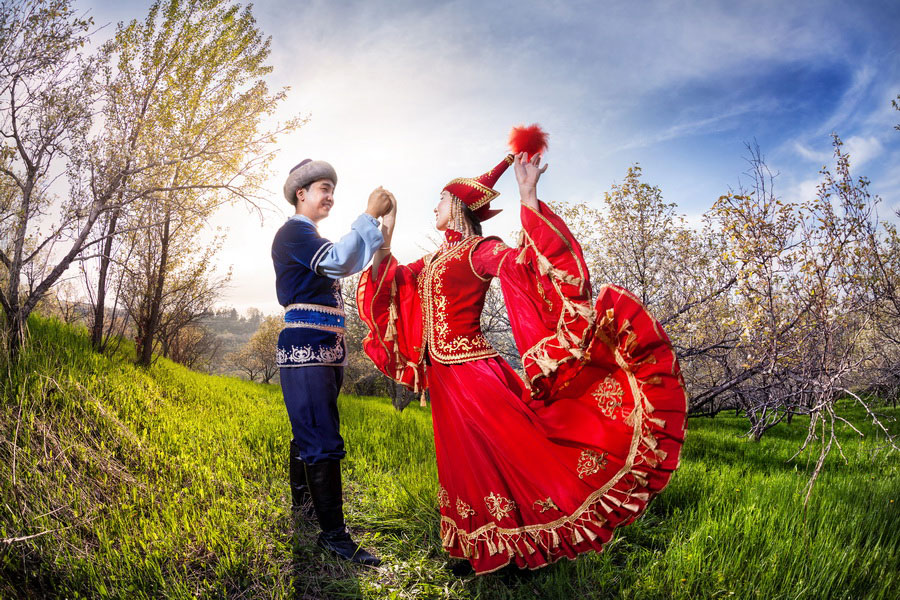
Nauryz (Navruz), the holiday of the spring equinox, is observed in Kazakhstan and many other eastern nations as a symbol of spring, new beginnings, prosperity and unity.
The history of the holiday has its roots in the pagan rituals of the pre-Islamic period. In former times, Nauryz was called the «Great Day of the Ulus (Nation)» and it was believed that the more elaborate the celebration, the more prosperous the coming year would be.
Nauryz remains one of the most important national holidays of Kazakhstan, where Kazakhs celebrate in their own unique way as they seek to preserve as many traditions passed down from their ancestors as possible. It is believed that on the eve of the holiday all debts should be paid, quarreling should cease and the whole house be put in order.
Each family prepares a special feast, or dastarkhan. The main dish is navruz-kozhe, a rich soup traditionally made from 7 ingredients — milk, meat, butter, millet, rice, raisins and corn. Although the precise ingredients may vary (one can add cottage cheese instead of rice, for example), the number of ingredients used in the dish must always be 7, the number of luck and prosperity considered essential for the Navruz celebration. In ancient times navruz-kozhe was poured into seven bowls to feed 7 persons. It was important to invite 7 guests to your home on this day and for each person to visit 7 houses in turn.
Today Nauryz reflects the implementation of centuries-old folk traditions with modern culture. People celebrate with concerts and theatrical performances, a variety of tasty national dishes, traditional sports and games and lively intellectual battles of the akyns, or Kazakh folk poets. Read more…
May 1, Unity Day
Kazakhstan People’s Unity Day was established in 1996, replacing the International Day of Workers that was celebrated during the Soviet era. Representatives of more than 150 nationalities have lived in Kazakhstan for many centuries, and on this day the people of Kazakhstan celebrate “Unity in Diversity”, one of the main principles espoused in the country. Various concerts, festivals and sports competitions are held in every city across the nation. Museums, theaters and libraries offer performances and exhibitions, demonstrating the equal respect shown toward each ethnic group in the country. Read more…
May 7, Defender of the Fatherland Day
On May 7, 1992, a decree was signed to create the National Armed Forces of the Republic of Kazakhstan, and in 2012 the day was declared a national holiday. On this day, the people of Kazakhstan pay tribute to their veterans, who are presented with awards and honorary military titles by the authorities. Open-air concerts are typically held at city squares, along with military parades and demonstrations of elaborate military exercises.
May 9, Victory Day
The Allied defeat of Nazi Germany is celebrated in Kazakhstan on May 9 in touching displays of respect and honor toward those who lost their lives in World War II. More than a million soldiers from Kazakhstan fought in the ranks of the Soviet army during the war, with more than a hundred thousand Kazakhstanis awarded for their courage and heroic acts.
Massive celebrations are organized in the country on this day, including military parades and the Immortal Regiment March comprised of a grand procession of the war heroes’ grateful descendants. «Garlands of Glory» are placed at the graves of the deceased and at the monument of Otan Korkaushylar (Defenders of the Fatherland) in capital city Astana. Festive concerts and gatherings are organized for the war veterans in a show of gratitude for their deeds. Read more…
July 6, Capital City Day
The city of Almaty served as the first capital of Kazakhstan until July 6, 1994, when it was moved for strategic purposes to the central city of Akmola. In 1998, its name was changed to Astana, and in 2019 the city was renamed Nur-Sultan, in honor of the first president of Kazakhstan, Nursultan Nazarbayev, whose birthday is also July 6. On September 17, 2022, President Tokayev signed a decree renaming the capital city back to Astana. The decree entered into force from the day of its publication.
Capital City Day is celebrated on a grand scale, particularly in Astana itself, where fireworks, concerts, theatrical performances, children’s events and city exhibitions may be enjoyed by residents and visitors. Read more…
Date varies, Eid al-Adha
Eid al-Adha is the culmination of Hajj, the annual Islamic pilgrimage to Mecca, and is celebrated on the 10th day of the 12th month of the Islamic lunar calendar. One of the most important significant religious holidays in Kazakhstan, it celebrates the joy of life and wellbeing while encouraging everyone to reach out to their neighbors. A key element of the holiday is the sacrifice of a cow, ram or camel, whose meat is then distributed to those in need. Charitable funds for the poor are likewise organized in the mosques.
In Kazakhstan, Eid al-Adha traditionally begins with the morning prayer, known as ait-namaz. During the day, people visit friends and family members, exchange gifts and treats and participate in celebrations and charity events. Festivals are held throughout the country which unite not only Muslims but local people of other faiths.
August 30, Constitution Day
Constitution Day in Kazakhstan recognizes the basic principles of the state, which were approved at a national referendum on August 30, 1995. According to the first article of the Constitution, Kazakhstan asserts itself as a democratic, secular and legal state whose highest values are the life and basic human rights of the individual.
The capital offers residents and guests an array of festive programs. Kazakh and foreign pop star concerts are held in open-air and enclosed venues. At a sports festival held on the city square, everyone can take part in tug-of-war, streetball, mini-football, the ancient nomadic game of asyk atu and other competitions. In city parks, entertainment programs for children are organized, and in the evening colorful fireworks illuminate the city. Read more…
October 25, Republic Day
Republic Day was included in the list of public holidays in 2001, but in 2009 it was removed from the calendar of official dates.
Speaking at the first meeting of the National Kurultai, President of Kazakhstan Kassym-Zhomart Tokayev proposed to restore the Republic Day as a national holiday.
Republic Day is celebrated on October 25. Concerts, scientific conferences, creative contests, sports competitions, patriotic, volunteer and charity events are held in honor of the Republic Day in the regions of Kazakhstan.
December 16-17, Independence Day
On December 16, 1991, a new era began in the history of Kazakhstan when the country declared its independence from the Soviet Union. Kazakhstanis celebrate this holiday, counted among the most important public holidays in Kazakhstan, with gusto. On the eve of the holiday, distinguished cultural and political figures are awarded with honors. Top state officials participate in concerts and festivals held throughout the republic, with the holiday ending in a huge display of fireworks.
New Year People meet the New Year at midnight on 31st of December with a feast, surrounded by friends and family.
Orthodox Christmas During the Christmas celebration the bells are ringing in the churches, believers congratulate each other with gifts and sweets.
International Women’s Day International Women’s Day is celebrated in Kazakhstan, like many other countries, on March 8.
Nauryz Nauryz in Kazakhstan symbolizes fertility, friendship and love.
Day of Unity People’s Unity Day is a holiday of unity of all peoples who live in the territory of Kazakhstan.
Defender of the Fatherland On this day, Kazakhstanis pay tribute to the defenders of their homeland.
Victory Day People of Kazakhstan pay a great attention to this holiday since this date symbolizes the protection of the Motherland and people from enemies.
Capital Day On 18 July 2008 Kazakhstan announced the 6th of July as a national holiday of Capital City Day.
Eid al-Adha Eid al-Adha holiday is the culmination of Hajj (an annual Islamic pilgrimage to Mecca), celebrated on the 10th day of the 12th month of the Islamic lunar calendar.
Constitution Day Constitution Day of the Republic of Kazakhstan is one of the official holidays celebrated in Kazakhstan on 30 August.
Republic Day Republic Day is celebrated on October 25. Concerts, scientific conferences, creative contests, sports competitions, patriotic, volunteer and charity events are held in honor of the Republic Day in the regions of Kazakhstan.
Independence Day On December 16, 1991, a new era began in the history of Kazakhstan. The country declared its independence from the former Soviet Union.
Published: 16 june 2014
 The first holiday in Kazakhstan is the Nowruz holiday or Spring Holiday, which originates from pre-Islamic history of the Kazakhs. This day the main holiday property is specially prepared dish nauryz-koje, which includes such ingredients as meat, wheat, rice, barley, Siberian millet and kurt. People visit their relatives and friends, sing songs, as well as wish the New Year to be prosperous.
Raz-ayt Holiday is celebrated the first and second day of the month in honor of the end of fasting month of Ramadan. According to the canons of «Koran», every Moslem must fast during the month every year. During the day it is not allowed to eat, drink and take pleasure. But after sunset and before sunrise it is allowed to eat and drink. All daytime must be devoted to working, praying and reading Koran. The holiday is celebrated in honor of the end of Ramadan month. The main rite of this holiday is a special common prayer, after which is followed meal and giving charity to poor people. This day is also organized various entertainment activities.
The most important Muslim holiday is Kurban-ait or «Feast of Sacrifice», which is usually celebrated for three or four days. There is a legend, once one of the ancestors of the peoples of northern Arabia Ibrahim saw Allah in his dream, who told him to bring to sacrifice his son Ishmael. When he was ready to kill the boy, Allah was sure in his devotion and told him to bring him a lamb. So, this day every faithful Muslim sacrifices a sheep or lamb. Meat is used for family holiday meal, the rest is given to the poor people. This day also all people congratulate each other, the Kazakhs who live in the village, arrange traditional competition kokpar.
This is a list of public holidays in Kazakhstan:[1][2]
Public holidays[edit]
| Date | English name | Local name/s | Notes |
|---|---|---|---|
| 1–2 January | New Year’s Day | Жаңа жыл (Jańa jyl) Новый Год (Novyy God) |
|
| 7 January | Eastern Orthodox Christmas | Рождество Христово (Rojdestvo hrıstovo / Rozhdestvo Khristovo) |
An official holiday since 2007 |
| 8 March | International Women’s Day | Халықаралық әйелдер күні (Xalyqaralyq áıelder kúni) Международный женский день (Mezhdunarodnyy zhenskiy den’) |
|
| 21–23 March | Nauryz Meyramy | Наурыз мейрамы (Naýryz meıramy) | Originally the Persian New Year, is traditionally a springtime holiday marking the beginning of a new year. |
| 1 May | Kazakhstan People’s Unity Day | Қазақстан халқының бірлігі мерекесі (Qazaqstan xalqynyń birligi merekesi) | |
| 7 May | Defender of the Fatherland Day | Отан Қорғаушы күні (Otan Qorǵaýshy kuni) День Защитника Отечества (Den’ Zashchitnika Otechestva) |
An official holiday since 2013 |
| 9 May | Great Patriotic War Against Fascism Victory Day | Жеңіс күні (Jeńis kúni) День Победы (Den’ Pobedy) |
A holiday in the former Soviet Union carried over
to present-day Kazakhstan and other former republics (Except Baltic countries) |
| 6 July | Capital City Day | Астана күні (Astana kúni) День столицы (Den’ stolitsy) |
Birthday of the first President of Kazakhstan |
| 30 August | Constitution Day | Қазақстан Республикасының Конституциясы күні (Qazaqstan Respýblıkasynyń Konstıtýcıyasy kúni) День Конституции Республики Казахстан (Den’ Konstitutsii Respubliki Kazakhstan) |
|
| Last day of Hajj | Qurban Ayta | Құрбан айт (Qúrban aıt) Курбан айт (Kurban ayt) |
An official holiday since 2007 |
| 25 October | Republic Day | Республика күні (Respublika kúni) День Республики (Den’ Respubliki) |
An official holiday since 2022 |
| 16 December | Independence Day | Тәуелсіздік күні (Táýelsizdik kúni) День независимости (Den’ nezavisimosti) |
Independence from the Soviet Union |
a Eid al-Adha, the Islamic «Feast of the Sacrifice».
Other holidays[edit]
- National Guard Day — January 10
- Day of the State Security Service of Kazakhstan — April 21[3]
- Police Day — June 23
- Border Guards Day — August 18
- Day of Remembrance of the Victims of Political Repressions — October 30
References[edit]
- ^ Kazakhstan Public Holidays Archived 9 February 2016 at the Wayback Machine. Worldtravelguide.net. Retrieved 14 January 2013.
- ^ «Electronic government of the Republic of Kazakhstan». Egov.kz. Archived from the original on 16 October 2015. Retrieved 31 May 2013.
- ^ День Службы государственной охраны Республики Казахстан
Public holidays in Asia |
|
|---|---|
| Sovereign states |
|
| States with limited recognition |
|
| Dependencies and other territories |
|
|
 Category
 Asia portal
Public holidays in Europe |
|
|---|---|
| Sovereign states |
|
| States with limited recognition |
|
| Dependencies and other entities |
|
| Other entities |
|
 |
This Kazakhstan-related article is a stub. You can help Wikipedia by expanding it. |
- v
- t
- e
 |
This holiday-related article is a stub. You can help Wikipedia by expanding it. |
- v
- t
- e
Топик British Holidays
There are a number of holidays, which are celebrated in Great Britain every year.
One of them is, of course, the New Year’s Day on the first of January. It is not so popular in England as in our country, but it is rather popular in Scotland. On that day people usually visit their friends and there is a lot of dancing and eating. In Scotland people bring a piece of coal for good luck in the New Year.
The next holiday of the year is St. Valentine’s Day. It is on the 14th of February. People buy or make Valentine cards and send them to the people they love.
In March there is Mother’s Day. All the children and adults, come to their mothers on that day to express their love and gratitude.
In April there is Easter. At Easter children eat chocolate Easter eggs. Sometimes parents hide them in the house or in the garden and children have to look for them.
In June there is Father’s Day. On Father’s Day children give or send their fathers and grandfathers cards and presents.
On the 31st of October there is a Halloween. They say ghosts and witches come out on Halloween. People make lanterns out of pumpkins. Some people have Halloween parties and dress as witches and ghosts.
The 25th of December is Christmas Day. It is one of the people’s favourite holidays. People put Christmas trees in their houses and decorate them. There are beautiful Christmas decorations in the streets. On Christmas Eve everybody puts the presents under the Christmas tree. People say that at night Father Christmas puts presents into the stockings which children usually hang above their beds. The traditional Christmas meal is roasted turkey and Christmas pudding.
Nauryz Meiramy — the holiday of spring renewal in Kazakhstan. It arose among the peoples of the East long before the adoption of Islam, therefore, devoid of religious rituals and orientation. According to the eastern calendar, Nauryz — the beginning of the new year, coincides with the day of the vernal equinox.
For the Kazakhs, this holiday is a symbol of spring renewal, the triumph of love, fertility and friendship. In the old days before the arrival of Nauryz, people brought their houses and household in order, in honor of the holiday planted trees and flowers. It was believed that if Nauryz enters a clean house to a good owner, then illness, failure, and adversity bypass it.
«Nauryz» means «the birth of spring». This is the most important and ancient festival of eastern nations. In fact, this is the New Year according to the ancient eastern calendar. He has another name, Ulys Kuna (“The First Day of the New Year”) or Ulystyna Uly Kuna (“The Great Day of the People”). It is believed that a generous celebration of the Nauryz holiday will bring abundance and success for the whole year to the house. These beliefs explain the abundance of holiday rituals and customs.
With the arrival of the holiday, Kazakhs dress in festive clothes, go to visit each other and exchange congratulations and wishes of well-being in the coming year.
Celebrations are accompanied by widespread fun, games, horse racing and other amusements. The main ritual dish of this holiday is Nauryz-koje, which should consist of 7 ingredients, symbolizing the 7 elements of life: water, meat, salt, fat, flour, cereals (rice, corn or wheat) and milk. These ingredients symbolize joy, luck, wisdom, health, well-being, speed, growth, and divine protection.
When Kazakhs celebrate Nauryz, the presence of the number “7” is obligatory — it encompasses 7 days of the week — temporary units of the infinity of the universe: opposite the aksakal (white-bearded, old man) 7 bowls of Nauryz should be put. Everyone should visit 7 houses and invite 7 guests.
“Koktem Tudy” (“With the birth of spring”) — so the Kazakhs congratulate each other on the streets, in parks, squares and stadiums on the holiday of Nauryz. Thousands of people are watching the sharp competitions of the word akyns, for competitions in national sports — kazahsha kures, toguz kumalak, horse racing (Kyz-Kuu and baiga). A variety of performances and theatrical performances representing national traditions and rituals attract people and teach them to respect their culture and native land, to strive to preserve peace and understanding between the various nationalities of Kazakhstan.
Later in the evening, aytis begins — a verbal contest of akyns accompanied by dombra. Men and women, old and young, can participate in it. Aytys continues until dawn. The winner is the one who best praised Good!
In the midst of the holiday, young people gather at the swing — altybakan. All sing songs, dance, have fun and play national games.
In Kazakhstan, Nauryz was not celebrated nationally from 1926 to 1988. Since 2001, Nauryz has been declared a public holiday, and since 2009, the holiday has been celebrated for 3 days in a row, starting on March 21. These three days in Kazakhstan are declared non-working.
Download
Essay,
Pages 3 (541 words)
Save to my list
Remove from my list
The aim of my article is to introduce foreign tourists with our national holidays. That is why, I decided to present May events, which will happen in the nearest future. At the beginning of May we are going to celebrate the 1st of May. This day is included two festive occasions. The first is Day of Solidarity of workers. This event is also celebrated more than in 142 countries around the World. And the second occasion is the Day of Unity of people.
Don’t use plagiarized sources. Get your custom essay on
“ Holidays in Kazakhstan ”
Get custom paper
NEW! smart matching with writer
Usually people gather in public places and organize the concert with traditional songs, dances and you have the chance to taste national dishes of all ethnic groups living in Kazakhstan. At night above city’s sky you can behold hundreds lanterns. People set on fire, make a wish and let them fly. It is a beautiful end of event.
Victory Day takes place on the 9th of May. It is a legendary day, when all generations wait for this date to congratulate people, who gave us the Peace in 1945.
Unfotubately, Veterans of war we can count on fingers of one hand. We show our respect and gratitude to these people for our saved lives. All day street festivals are held all around the city. In the end of this occasion people come to the main square, where is given a wonderful salute at 10 p.m. On the 25th of May it became a tradition to open all fountains in the city. Students after their solemnity at school come in places with fountain.
Singing songs, dancing, telling poems we can observe there. So, this is the list of holidays that we will celebrate in the near future. Dear foreigner, join to us in our street festivals!
Education in Kazakhstan
1.Before going to school, children attend kindergartens until they are six or seven. 2.Compulsory education begins in our country at the age of seven, when children go to primary school. 3.The secondary stage begins from the 5th form when children start studying a lot of new subjects, such as Literature, History, Natural Sci¬ences and others. 4.Examinations are taken at the end of the 9-th and the 11-th forms. 5.Some children may leave school after the 9-th form and continue their education at vocational or technical schools or colleges. 6.Besides secondary schools there are other types of schools in Ka¬zakhstan.
There are specialized secondary schools with intensive study of a certain subject, for example Foreign Languages, Literature, Physics and others. 7.There are also specialized art, music, ballet and sport schools for gifted children and special schools for handicapped children. 8.Secondary education in our country is free of charge. Among secondary schools there are gymnasiums, colleges and lyceums most of them are private. 9.There are institutes, schools of higher education, universities and academies among higher educational institutions.
10.In 1992 Kazakhstan system of higher education adopted the western model – a 4 years course of studies with getting the Bachelor degree after graduation and a 2 years course of study with getting the Master’s degree after graduation. 11.In order to enter a higher educational institution young people have to take an entrance examination. Only those who successfully pass entrance testing are admitted free of charge. In other cases education is given on the commercial basis.