
Из этой статьи вы узнаете:
-
Праздники Колеса Года
-
Праздник Имболк — день начала весны
-
Праздник Остара — день весеннего равноденствия
-
Праздник Лита — день летнего солнцестояния
-
Лугнасад — праздник урожая и осени
-
Мабон — день осеннего равноденствия
-
Самайн — праздник кельтского нового года
-
Йоль — день зимнего солнцестояния
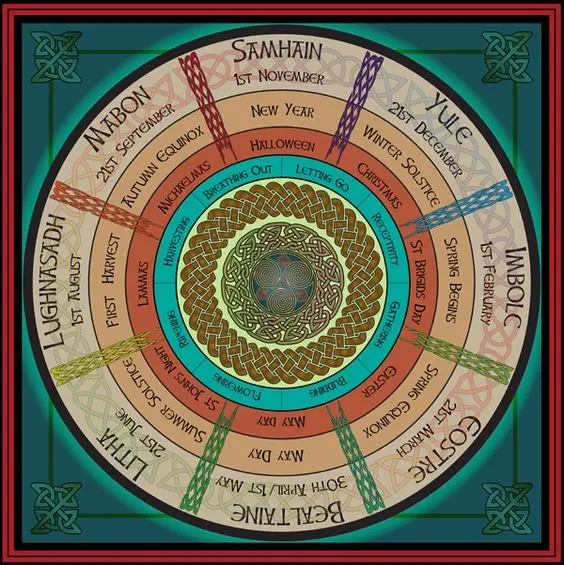
Колесо Года — это магический календарь современного язычества. Он отражает смену сезонов, а собственно праздники Колеса Года являются важными точками переходов, днями особого напряжения энергий.
Издавна мудрые люди обращали внимание на связь времен года и человеческой жизни. Таким образом, сложились традиции отмечания праздников Колеса Года — точек перехода из сезона в сезон. В основе современного магического календаря, который можно назвать универсальным по той причине, что именно он более всего распространен и применяется колдунами, ведьмами и язычниками на всех континентах, лежат кельтские праздники Колеса Года. Всего их восемь. Четыре связаны с астрономическими событиями — это равноденствия и солнцестояния, остальные четыре являются Праздниками Огня (Костров).
Колесо года у Викки также включает в себя Лунные эсбаты — полнолуния, но мы в этой статье остановимся именно на «общепринятом» колдовском календаре, поскольку он связан с движением звезд и планет, с длиной дня и ночи.
Ниже вы найдете информацию про Колесо Года, о ритуалах и традициях, о том, как отмечаются праздники годового цикла у современных язычников.
Праздники Колеса Года
Имболк (Imbolc) — 1-2 февраля
Остара (Ostara) — весеннее равноденствие, 21-22 марта
Белтайн (Bealtaine) — ночь с 30 апреля на 1 мая
Лита (Litha) — летнее солнцестояние, 21-22 июня
Ламмас/Лугнасад (Lughnasadh) — 1-2 августа
Мабон (Mabon) — осеннее равноденствие, 21-22 сентября
Самайн (Samhain) — ночь с 31 октября на 1 ноября
Йоль (Yule) — зимнее солнцестояние, 21-22 декабря
Праздник Имболк — день начала весны
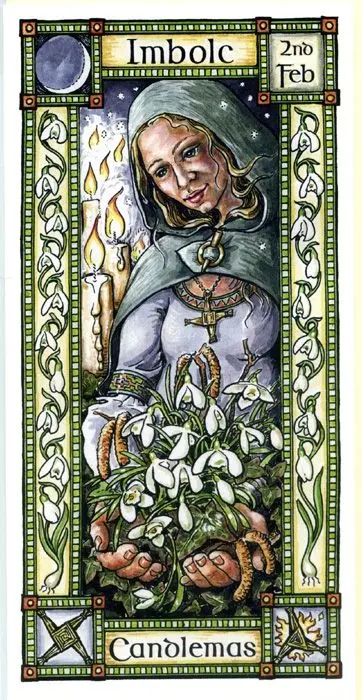
1-2 февраля. Несмотря на то, что Имболк приходится на начало февраля, «волчьего месяца», именно он является праздником порога, перехода от Темного Времени года к новому времени пробуждения природы от зимнего сна. Традиция Викки говорит, что богиня оправилась от родов и кормит грудью маленького бога — и само название праздника, Imbolc, восходит, очевидно, к староирландскому mblek («молоко»). У славян соответствующий праздник назывался Громницы, т.к. в некоторых регионах в феврале уже случались грозы. В последнюю субботу перед Громницей хозяева отливали особую свечу, «громничку», зажигали ее в праздник и после, в грозы, чтобы защитить дом и хозяйство от ударов молний.
Имболк — время очищения. В прежние времена на Имболк вычищали дом и все хозяйственные помещения, мылись сами и окатывали водой скот, чистили домашний очаг и двор. В этот день все было посвящено богине Бригитте, покровительнице дома и семьи, ремесел, домашних животных и всего, что дает человеку силы и средства для жизни.
Цвета Имболка: белый, кремовый, красный, желтый, розовый.
Ритуалы на Имболк: очищение дома, благословение новых инструментов, в том числе колдовских, сотворение талисманов.
ВСЁ ДЛЯ ИМБОЛКА
Праздник Остара — день весеннего равноденствия
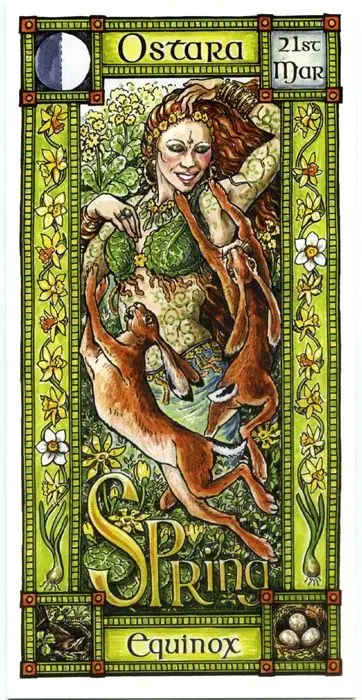
21-22 марта. Остара отмечается уже как праздник весны, вступившей в свои права. Это день середины весны, момент равновесия — день равен по длительности ночи, и после Остары день будет удлиняться. Название «Остара» связывают с именем европейской языческой богини рассвета и плодородия Эостры. Судя по всему, европейское название христианской Пасха, Easter, также происходит от ее имени.
День весеннего равноденствия и традиции его празднования плотно связаны с весной, с пробуждением земли от зимнего сна, с «отворением земли» и началом сельскохозяйственных работ. Интересно, что животным Остары является заяц, и поныне это животное является одним из символов Пасхи.
Цвета Остары: белый, красный, зеленый.
Ритуалы на Остару: призывание удачи, ритуалы на привлечение денег.
АТРИБУТЫ ОСТАРЫ
Белтейн — праздник начала лета
С 30 апреля на 1 мая.Бельтейн — это праздник начала лета. История его происхождения теряется во мгле времен, но известно, что в древности он становился началом пастбищного сезона, лето полностью вступает в свои права, и Темная половина года наконец заканчивается. Виккане в это время славят Зеленого человека, бога леса — полную сил ипостась бога, оставившего странствия и присоединяющегося к богине. Это волшебное время, когда граница между мирами тонка и зыбка.
Если позволяет погода, праздновать Бельтайн лучше всего в лесу — в царстве Бога.
Основные символы Бельтайна — костер и майский шест.
Цвета Бельтайна: зеленый, красный, золотой, белый.
Ритуалы на Бельтайн: привлечение любви, все ритуалы плодородия, сексуальная магия.
ТОВАРЫ ДЛЯ БЕЛТАЙНА
Эксперты магазина «Ведьмино Счастье» рекомендуют:
Праздник Лита — день летнего солнцестояния
21-22 июня. Лита — праздник солнечный и теплый. Кельтское колесо года определяло Литу, как день середины лета. В том или ином виде, летнее солнцестояние нашло отражение в культурах всех народов, населяющих землю. Шаманы и колдуны всех народностей осознавали важность этого дня.
В викканской традиции Лита — день бракосочетания бога и богини. Также, как и на Бельтейн, зажигаются костры, и в целом огню, как проявлению солярной энергии, придается большое значение.
Цвета Литы: зеленый, оранжевый, красный, золотой, голубой, белый, желтый.
Ритуалы на Литу: магическое очищение, ритуалы любовной магии, исцеление, денежная магия.
ВСЁ ДЛЯ ВСТРЕЧИ ЛИТЫ
Лугнасад — праздник урожая и осени
1-2 августа. Лугнасад, или Ламмас — первый праздник урожая, время начала его сбора. Колесо времен года кельтов определяло этот день, как момент конца лета и начало осени. Название «Лугнасад» берет начало у имени бога Луга, покровителя земледелия и ремесел, прекрасный бог творцов всех мастей — от поэта до кузнеца.
Это время радостных пиршеств, время благодарности земле за ее дары. В этот день хорошо печь хлеб и делать расклады на остаток года. Вместе с тем, это и поминальный праздник — то, что нужно, люди берут от земли, остальное же возвращается в ее чрево.
Цвета Лугнасада: все оттенки осени — оранжевый, рыжий, золотой, красный, коричневый, темно-зеленый, темно-синий.
Ритуалы на Лугнасад: создание и посвящение колдовских инструментов, очищение и избавление от отжившего.
МАГИЯ ЛАММАСА
Мабон — день осеннего равноденствия
21-22 сентября. В середине осени, ровно через полгода после Остары, отмечается Мабон. Это момент, когда день равен ночи, точка равновесия. Уже на следующий день светлое время суток станет короче, и мир сделает шаг навстречу Темному Времени. Природа готовится к зиме, и люди вместе с ней. Богиня нисходит в Нижний Мир, и бог остается бродить по земле в одиночестве, чтобы присоединиться в богине, когда наступит Самайн.
Мабон также является праздником второго урожая, подведения итогов, пожинания плодов прошедших дней.
Цвета Мабона: цвета поздней осени — темно-красный, золотой, коричневый, оранжевый, голубой и синий, темно-зеленый.
Ритуалы на Мабон: ритуалы поминовения, освобождения от изжившего и вредного, подведение итогов, формирование желаний и планов на будущее.
ГОТОВИМСЯ К МАБОНУ
Самайн — праздник кельтского нового года
С 31 октября на 1 ноября. Самайн — один из самых главных праздников Колеса Года, и, пожалуй, самый знаменитый. Он известен людям всего мира, как Хеллоуин, и многие ведьмы с радостью отмечают его, не забывая и об истинно колдовской стороне этого праздника. У кельтов он знаменовал окончание сбора урожая и окончание сельскохозяйственных работ.
Самайн тесно связан с почитанием умерших предков и темой угасания, смерти. Дни Самайна еще называют Временем Безвременья. Именно в эти дни граница между мирами истончается максимально, и духи приходят в мир живых.
Цвета Самайна: красный, рыжий, коричневыый, черный, оранжевый, темно-красный и все оттенки пламени.
Ритуалы на Самайн: магия очищения, защита, избавления от негатива, гадание.
ВСТЕЧАЕМ САМАЙН
Эксперты магазина «Ведьмино Счастье» рекомендуют:
Йоль — день зимнего солнцестояния
21-22 декабря. Самая длинная ночь в году. В это время Солнце астрономически наиболее удалено от зенита. Несмотря на то, что это самая длинная и темная ночь, праздник этот радостный и полный надежд. После Йоля день начинает прибавляться, становиться длинней, темнота отступает, чтобы дать дорогу свету. Богиня дает жизнь богу и новому времени.
Этот праздник хорошо отмечать в кругу семьи, при свете свечей или камина, с любимыми людьми.
Цвета Йоля: красный, золотой и зеленый.
Ритуалы на Йоль: привлечение успеха и удачи, благополучия, семейного счастья.
ПОДАРКИ К ЙОЛЮ

The Wheel of the Year is an annual cycle of seasonal festivals, observed by many modern pagans, consisting of the year’s chief solar events (solstices and equinoxes) and the midpoints between them. While names for each festival vary among diverse pagan traditions, syncretic treatments often refer to the four solar events as «quarter days», with the four midpoint events as «cross-quarter days».[1] Differing sects of modern paganism also vary regarding the precise timing of each celebration, based on distinctions such as lunar phase and geographic hemisphere.
Observing the cycle of the seasons has been important to many people, both ancient and modern. Contemporary Pagan festivals that rely on the Wheel are based to varying degrees on folk traditions, regardless of actual historical pagan practices.[2] Among Wiccans, each festival is also referred to as a sabbat (), based on Gerald Gardner’s view that the term was passed down from the Middle Ages, when the terminology for Jewish Shabbat was commingled with that of other heretical celebrations.[3] Contemporary conceptions of the Wheel of the Year calendar were largely influenced by mid-20th century British paganism.
Origins[edit]

Historical and archaeological evidence suggests ancient pagan and polytheist peoples varied in their cultural observations; Anglo-Saxons celebrated the solstices and equinoxes, while Celts celebrated the seasonal divisions with various fire festivals.[4] In the tenth century Cormac Mac Cárthaigh wrote about «four great fires…lighted up on the four great festivals of the Druids…in February, May, August, and November.»[5]
The contemporary Neopagan festival cycle, prior to being known as the Wheel of the Year, was influenced by works such as The Golden Bough by James George Frazer (1890) and The Witch-Cult in Western Europe (1921) by Margaret Murray. Frazer claimed that Beltane (the beginning of summer) and Samhain (the beginning of winter) were the most important of the four Gaelic festivals mentioned by Cormac. Murray used records from early modern witch trials, as well as the folklore surrounding European witchcraft, in an attempt to identify the festivals celebrated by a supposedly widespread underground pagan religion that had survived into the early modern period. Murray reports a 1661 trial record from Forfar, Scotland, where the accused witch (Issobell Smyth) is connected with meetings held «every quarter at Candlemas, Rud−day, Lammas, and Hallomas.»[6] In The White Goddess (1948) Robert Graves claimed that, despite Christianization, the importance of agricultural and social cycles had preserved the «continuity of the ancient British festal system» consisting of eight holidays: «English social life was based on agriculture, grazing, and hunting» implicit in «the popular celebration of the festivals now known as Candlemas, Lady Day, May Day, Midsummer Day, Lammas, Michaelmas, All-Hallowe’en, and Christmas; it was also secretly preserved as religious doctrine in the covens of the anti-Christian witch-cult.»[7]

The Witches’ Cottage, where the Bricket Wood coven celebrated their sabbats (2006).
By the late 1950s the Bricket Wood coven led by Gerald Gardner and the Order of Bards, Ovates and Druids led by Ross Nichols had both adopted eight-fold ritual calendars, in order to hold more frequent celebrations. Popular legend holds that Gardner and Nichols developed the calendar during a naturist retreat, where Gardner advocated for celebrating the solstices and equinoxes while Nichols preferred celebrating the four Celtic fire festivals; ultimately they combined the two approaches into a single festival cycle. Though this coordination eventually had the benefit of more closely aligning celebrations between the two early Neopagan groups,[8] Gardner’s first published writings omit any mention of the solstices and equinoxes, focusing exclusively on the fire festivals. Gardner initially referred to these as «May eve, August eve, November eve (Hallowe’en), and February eve.» Gardner further identified these modern witch festivals with the Gaelic fire festivals Beltene, Lugnasadh, Samhuin, and Brigid (Imbolc).[3] By the mid-1960s, the phrase Wheel of the Year had been coined to describe the yearly cycle of witches’ holidays.[9]
Aidan Kelly gave names to the summer solstice (Litha) and equinox holidays (Ostara and Mabon) of Wicca in 1974, which were subsequently promulgated by Timothy Zell through his Green Egg magazine.[10] Popularization of these names happened gradually; in her 1978 book Witchcraft For Tomorrow influential Wiccan author Doreen Valiente did not use Kelly’s holiday names, instead simply identifying the solstices and equinoxes («Lesser Sabbats») by their seasons.[11] Valiente identified the four «Greater Sabbats», or fire festivals, by the names Candlemas, May Eve, Lammas, and Hallowe’en, though she also identified their Irish counterparts as Imbolc, Beltane, Lughnassadh, and Samhain.[12]
Due to early Wicca’s influence on modern paganism and the syncretic adoption of Anglo-Saxon and Celtic motifs, the most commonly used English festival names for the Wheel of the Year tend to be the Celtic ones introduced by Gardner and the mostly Germanic-derived names introduced by Kelly, even when the celebrations are not based on those cultures. The American Ásatrú movement has adopted, over time, a calendar in which the Heathen major holidays figure alongside many Days of Remembrance which celebrate heroes of the Edda and the Sagas, figures of Germanic history, and the Viking Leif Ericson, who explored and settled Vinland (North America). These festivals are not, however, as evenly distributed throughout the year as in Wicca and other Heathen denominations.
Festivals[edit]

The eight-armed sun cross is often used to represent the Neopagan Wheel of the Year.
In many traditions of modern pagan cosmology, all things are considered to be cyclical, with time as a perpetual cycle of growth and retreat tied to the Sun’s annual death and rebirth. This cycle is also viewed as a micro- and macrocosm of other life cycles in an immeasurable series of cycles composing the Universe. The days that fall on the landmarks of the yearly cycle traditionally mark the beginnings and middles of the four seasons. They are regarded with significance and host to major communal festivals. These eight festivals are the most common times for community celebrations.[2][13][14]
While the «major» festivals are usually the quarter and cross-quarter days, other festivals are also celebrated throughout the year, especially among the non-Wiccan traditions such as those of polytheistic reconstructionism and other ethnic traditions.
In Wiccan and Wicca-influenced traditions, the festivals, being tied to solar movements, have generally been steeped in solar mythology and symbolism, centered on the life cycles of the sun. Similarly, the Wiccan esbats are traditionally tied to the lunar cycles. Together, they represent the most common celebrations in Wiccan-influenced forms of Neopaganism, especially in contemporary Witchcraft groups.[13][14]
Winter Solstice (Yule)[edit]
Midwinter, known commonly as Yule or within modern Druid traditions as Alban Arthan,[15] has been recognised as a significant turning point in the yearly cycle since the late Stone Age. The ancient megalithic sites of Newgrange and Stonehenge, carefully aligned with the solstice sunrise and sunset, exemplify this.[16] The reversal of the Sun’s ebbing presence in the sky symbolizes the rebirth of the solar god and presages the return of fertile seasons. From Germanic to Roman tradition, this is the most important time of celebration.[17][18]
Practices vary, but sacrifice offerings, feasting, and gift giving are common elements of Midwinter festivities. Bringing sprigs and wreaths of evergreenery (such as holly, ivy, mistletoe, yew, and pine) into the home and tree decorating are also common during this time.[17][19][20]
In Roman traditions additional festivities take place during the six days leading up to Midwinter.[18]
Imbolc (Candlemas)[edit]
The cross-quarter day following Midwinter falls on the first of February and traditionally marks the first stirrings of spring. It aligns with the contemporary observance of Groundhog Day. It is time for purification and spring cleaning in anticipation of the year’s new life. In Rome, it was historically a shepherd’s holiday,[21] while the Celts associated it with the onset of ewes’ lactation, prior to birthing the spring lambs.[22][23]
For Celtic pagans, the festival is dedicated to the goddess Brigid, daughter of The Dagda and one of the Tuatha Dé Danann.[23]
Among Reclaiming tradition Witches, this is the traditional time for pledges and rededications for the coming year[24] and for initiation among Dianic Wiccans.[25]
Spring Equinox (Ostara)[edit]
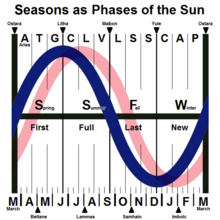
The annual cycle of insolation for the northern hemisphere (Sun energy, shown in blue) with key points for seasons (middle), quarter days (top) and cross-quarter days (bottom) along with months (lower) and Zodiac houses (upper). The cycle of temperature (shown in pink) is delayed by seasonal lag.
Derived from a reconstruction produced by linguist Jacob Grimm of an Old High German form of the Old English goddess name Ēostre, Ostara marks the vernal equinox in some modern Pagan traditions.
Known as Alban Eilir to modern Druid traditions, this holiday is the second of three spring celebrations (the midpoint between Imbolc and Beltane), during which light and darkness are again in balance, with light on the rise. It is a time of new beginnings and of life emerging further from the grips of winter.[26]
Beltane (May Eve)[edit]
Traditionally the first day of summer in Ireland, in Rome the earliest celebrations appeared in pre-Christian times with the festival of Flora, the Roman goddess of flowers, and the Walpurgisnacht celebrations of the Germanic countries.[27]
Since the Christianisation of Europe, a more secular version of the festival has continued in Europe and America, commonly referred to as May Day. In this form, it is well known for maypole dancing and the crowning of the Queen of the May.
Celebrated by many pagan traditions, among modern Druids this festival recognizes the power of life in its fullness, the greening of the world, youthfulness and flourishing.[28]
Summer Solstice (Litha)[edit]
Midsummer is one of the four solar holidays and is considered the turning point at which summer reaches its height and the sun shines longest. Among the Wiccan sabbats, Midsummer is preceded by Beltane, and followed by Lammas or Lughnasadh.
Some Wiccan traditions call the festival Litha, a name occurring in Bede’s The Reckoning of Time (De Temporum Ratione, eighth century), which preserves a list of the (then-obsolete) Anglo-Saxon names for the twelve months. Ærra Liða (first or preceding Liða) roughly corresponds to June in the Gregorian calendar, and Æfterra Liða (following Liða) to July. Bede writes that «Litha means gentle or navigable, because in both these months the calm breezes are gentle and they were wont to sail upon the smooth sea».[29]
Modern Druids celebrate this festival as Alban Hefin. The sun in its greatest strength is greeted and celebrated on this holiday. While it is the time of greatest strength of the solar current, it also marks a turning point, for the sun also begins its time of decline as the wheel of the year turns. Arguably the most important festival of the Druid traditions, due to the great focus on the sun and its light as a symbol of divine inspiration. Druid groups frequently celebrate this event at Stonehenge.[30]
Lughnasadh (Lammas)[edit]
Lammas or Lughnasadh () is the first of the three Wiccan harvest festivals, the other two being the autumnal equinox (or Mabon) and Samhain. Wiccans mark the holiday by baking a figure of the god in bread and eating it, to symbolise the sanctity and importance of the harvest. Celebrations vary, as not all Pagans are Wiccans. The Irish name Lughnasadh[4][31] is used in some traditions to designate this holiday. Wiccan celebrations of this holiday are neither generally based on Celtic culture nor centered on the Celtic deity Lugh. This name seems to have been a late adoption among Wiccans. In early versions of Wiccan literature the festival is referred to as August Eve.[32]
The name Lammas (contraction of loaf mass) implies it is an agrarian-based festival and feast of thanksgiving for grain and bread, which symbolises the first fruits of the harvest. Christian festivals may incorporate elements from the Pagan Ritual.[31][33]
Autumn Equinox (Mabon)[edit]
The holiday of the autumnal equinox, Harvest Home, Mabon, the Feast of the Ingathering, Meán Fómhair, An Clabhsúr, or Alban Elfed (in Neo-Druid traditions), is a modern Pagan ritual of thanksgiving for the fruits of the earth and a recognition of the need to share them to secure the blessings of the Goddess and the Gods during the coming winter months. The name Mabon was coined by Aidan Kelly around 1970 as a reference to Mabon ap Modron, a character from Welsh mythology.[34] Among the sabbats, it is the second of the three Pagan harvest festivals, preceded by Lammas / Lughnasadh and followed by Samhain.
Samhain[edit]
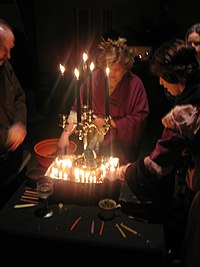
Neopagans honoring the dead as part of a Samhain ritual
Samhain () is one of the four Greater Sabbats among Wiccans. Samhain is typically considered as a time to celebrate the lives of those who have passed on, and it often involves paying respect to ancestors, family members, elders of the faith, friends, pets, and other loved ones who have died. Aligned with the contemporary observance of Halloween and Day of the Dead, in some traditions the spirits of the departed are invited to attend the festivities. It is seen as a festival of darkness, which is balanced at the opposite point of the Wheel by the festival of Beltane, which is celebrated as a festival of light and fertility.[35]
Many Neopagans believe that the veil between this world and the afterlife is at its thinnest point of the year at Samhain, making it easier to communicate with those who have departed.[14]
Some authorities claim the Christian festival of All Hallows Day (All Saints Day) and the preceding evening are appropriations of Samhain by early Christian missionaries to the British Isles.[36][37]
Minor festivals[edit]
In addition to the eight major holidays common to most modern pagans, there are a number of minor holidays during the year to commemorate various events.
Germanic[edit]
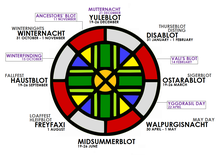
Holidays of the Ásatrú Alliance[38]
- black: main names
- gray: alternative names
- purple: minor common holidays
Some of the holidays listed in the “Runic Era Calendar” of the Ásatrú Alliance:
- Vali’s Blot (14 February)
- Celebration dedicated to the god Váli and to love[38]
- Feast of the Einherjar (11 November)
- Celebration to honor kin who died in battle[38]
- Ancestors’ Blot (11 November)
- Celebration of one’s own ancestry or the common ancestors of a Germanic ethnicity[39]
- Yggdrasil Day (22 April)
- Celebration of the world tree Yggdrasil, of the reality world it represents, of trees and nature[38]
- Winterfinding (mid-October)
- Celebration which marks the beginning of winter, held on a date between Haustblot and Winternights[38][40]
- Summerfinding (mid-April)
- Celebration which marks the beginning of summer, held on a date between Ostara and Walpurgis Night[38][40]
Practice[edit]
Celebration commonly takes place outdoors in the form of a communal gathering.
Dates of celebration[edit]
The precise dates on which festivals are celebrated are often flexible. Dates may be on the days of the quarter and cross-quarter days proper, the nearest full moon, the nearest new moon, or the nearest weekend for secular convenience. The festivals were originally celebrated by peoples in the middle latitudes of the Northern Hemisphere. Consequently, the traditional times for seasonal celebrations do not agree with the seasons in the Southern Hemisphere or near the equator. Pagans in the Southern Hemisphere often advance these dates by six months to coincide with their own seasons.[14][41][42][43]
Offerings[edit]
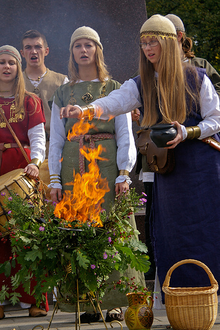
Offerings of food, drink, various objects, etc. have been central in ritual propitiation and veneration for millennia. Modern pagan practice strongly avoids sacrificing animals in favour of grains, herbs, milk, wines, incense, baked goods, minerals, etc. The exception being with ritual feasts including meat, where the inedible parts of the animal are often burned as offerings while the community eats the rest.[44][45]
Sacrifices are typically offered to gods and ancestors by burning them. Burying and leaving offerings in the open are also common in certain circumstances. The purpose of offering is to benefit the venerated, show gratitude, and give something back, strengthening the bonds between humans and divine and between members of a community.[44][46][47]
Narratives[edit]
Celtic[edit]
It is a misconception in some quarters of the Neopagan community, influenced by the writings of Robert Graves,[48] that historical Celts had an overarching narrative for the entire cycle of the year. While the various Celtic calendars include some cyclical patterns, and a belief in the balance of light and dark, these beliefs vary between the different Celtic cultures. Modern preservationists and revivalists usually observe the four ‘fire festivals’ of the Gaelic Calendar, and some also observe local festivals that are held on dates of significance in the different Celtic nations.[49][50]
Slavic[edit]

Kołomir – the Slavic example of Wheel of the Year indicating seasons of the year. Four-point and eight-point swastika-shaped wheels were more common.
Slavic mythology tells of a persisting conflict involving Perun, god of thunder and lightning, and Veles, the black god and horned god of the underworld. Enmity between the two is initiated by Veles’ annual ascent up the world tree in the form of a huge serpent and his ultimate theft of Perun’s divine cattle from the heavenly domain. Perun retaliates to this challenge of the divine order by pursuing Veles, attacking with his lightning bolts from the sky. Veles taunts Perun and flees, transforming himself into various animals and hiding behind trees, houses, even people. (Lightning bolts striking down trees or homes were explained as results of this.) In the end Perun overcomes and defeats Veles, returning him to his place in the realm of the dead. Thus the order of the world is maintained.[51][52][53]
The idea that storms and thunder are actually divine battle is pivotal to the changing of the seasons. Dry periods are identified as chaotic results of Veles’ thievery. This duality and conflict represents an opposition of the natural principles of earth, water, substance, and chaos (Veles) and of heaven, fire, spirit, order (Perun), not a clash of good and evil. The cosmic battle between the two also echoes the ancient Indo-European narrative of a fight between the sky-borne storm god and chthonic dragon.
On the great night (New Year), two children of Perun are born, Jarilo, god of fertility and vegetation and son of the Moon, and Morana, goddess of nature and death and daughter of the Sun. On the same night, the infant Jarilo is snatched and taken to the underworld, where Veles raises him as his own. At the time of the spring equinox, Jarilo returns across the sea from the world of the dead, bringing with him fertility and spring from the evergreen underworld into the realm of the living. He meets his sister Morana and courts her. With the beginning of summer, the two are married bringing fertility and abundance to Earth, ensuring a bountiful harvest. The union of Perun’s kin and Veles’ stepson brings peace between two great gods, staving off storms which could damage the harvest. After the harvest, however, Jarilo is unfaithful to his wife and she vengefully slays him, returning him to the underworld and renewing enmity between Perun and Veles. Without her husband, god of fertility and vegetation, Morana – and all of nature with her – withers and freezes in the ensuing winter. She grows into the old and dangerous goddess of darkness and frost, eventually dying by the year’s end only to be reborn again with her brother in the new year.[51][52]
Wicca and Druidry[edit]
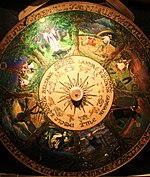
In Wicca, the narrative of the Wheel of the Year traditionally centers on the sacred marriage of the God and the Goddess and the god/goddess duality. In this cycle, the God is perpetually born from the Goddess at Yule, grows in power at the vernal equinox (as does the Goddess, now in her maiden aspect), courts and impregnates the Goddess at Beltane, reaches his peak at the summer solstice, wanes in power at Lammas, passes into the underworld at Samhain (taking with him the fertility of the Goddess/Earth, who is now in her crone aspect) until he is once again born from Her mother/crone aspect at Yule. The Goddess, in turn, ages and rejuvenates endlessly with the seasons, being courted by and giving birth to the Horned God.[14][54][55]
Many Wiccan, Neo-Druid, and eclectic Neopagans incorporate a narrative of the Holly King and Oak King as rulers of the waning year and the waxing year respectively. These two figures battle endlessly with the turning of the seasons. At the summer solstice, the Holly King defeats the Oak King and commences his reign.[56]: 94 After the Autumn equinox the Oak King slowly begins to regain his power as the sun begins to wane. Come the winter solstice the Oak King in turn vanquishes the Holly King.[56]: 137 After the spring equinox the sun begins to wax again and the Holly King slowly regains his strength until he once again defeats the Oak King at the summer solstice. The two are ultimately seen as essential parts of a whole, light and dark aspects of the male God, and would not exist without each other.[14][57][58][59]
The Holly King is often portrayed as a woodsy figure, similar to the modern Santa Claus, dressed in red with sprigs of holly in his hair and the Oak King as a fertility god.[60][61]
See also[edit]
- Ember days, quarterly periods (usually three days) of prayer and fasting in the liturgical calendar of Western Christian churches.
- List of neo-pagan festivals and events
- Medicine wheel, metaphor for a variety of Native American spiritual concepts
- Solar terms, year’s divisions in China and East Asia
Calendars[edit]
- Celtic calendar
- Gaelic calendar
- Welsh seasonal festivals
- Germanic calendar
- Runic calendar
- Hellenic calendars
- Attic calendar
- Macedonian calendar
- Roman calendar
- Roman festivals
References[edit]
- ^ Williams, Liz (29 July 2013). «Paganism, part 3: the Wheel of the Year». The Guardian. Retrieved 23 October 2021.
- ^ a b Harvey, Graham (1994). «The Roots of Pagan Ecology». Journal of Contemporary Religion. 9 (3): 38–41. doi:10.1080/13537909408580720.
- ^ a b Gardner, Gerald (1954). Witchcraft Today. p. 147.
- ^ a b Hutton, Ronald (8 December 1993), The Pagan Religions of the Ancient British Isles, Oxford, Blackwell, pp. 337–341, ISBN 0-631-18946-7
- ^ Murray, Margaret. 1931. The God of the Witches.
- ^ Kinloch, George Ritchie. Reliquiae Antiquae Scoticae. Edinburgh, 1848.
- ^ Robert Graves, The White Goddess, New York: Creative Age Press, 1948. Published in London by Faber & Faber.
- ^ Lamond, Frederic (2004), Fifty Years of Wicca, Sutton Mallet, England: Green Magic, pp. 16–17, ISBN 0-9547230-1-5
- ^ Glass, Justine (1965). Witchcraft, the Sixth Sense—and Us. London: Neville Spearman. p. 98.
- ^ Kelly, Aidan. About Naming Ostara, Litha, and Mabon. Including Paganism. Patheos. Accessed 8 May 2019.
- ^ Beckett, John. Enough With the Mabon Hate! Under the Ancient Oaks. Patheos. 11 Sep 2018.
- ^ Valiente, Doreen. 1978. Witchcraft For Tomorrow. London: Robert Hale Limited.
- ^ a b Zell-Ravenheart, Oberon; Zell-Ravenheart, Morning Glory (2006). «Book III: Wheel of the Year». In Kirsten Dalley and Artemisia (ed.). Creating Circles & Ceremonies: Rituals for All Seasons And Reasons. Book-Mart Press. p. 192. ISBN 1-56414-864-5.
- ^ a b c d e f Drury, Nevill (2009). «The Modern Magical Revival: Esbats and Sabbats». In Pizza, Murphy; Lewis, James R (eds.). Handbook of Contemporary Paganism. Leiden, Netherlands: Brill Publishers. pp. 63–67. ISBN 9789004163737.
- ^ «Winter Solstice — Alban Arthan». Order of Bards, Ovates and Druids. 10 January 2012. Retrieved 20 February 2019.
- ^ Johnson, Anthony (2008). Solving Stonehenge: The New Key to an Ancient Enigma. Thames & Hudson. pp. 252–253. ISBN 978-0-500-05155-9.
- ^ a b Zell-Ravenheart, Oberon; Zell-Ravenheart, Morning Glory (2006). «7. Yule (Winter Solstice)». Creating Circles & Ceremonies: Rituals for All Seasons And Reasons. Career Press. pp. 250–252. ISBN 1-56414-864-5.
- ^ a b Gagarin, Michael (2010). «S». The Oxford Encyclopedia of Ancient Greece and Rome: Volume 1. Oxford University Press. p. 231. ISBN 978-0-19517-072-6.
- ^ Selbie, John A. (1914). «Gifts (Greek and Roman)». In Hastings, James (ed.). Encyclopædia of Religion and Ethics, Volume 6. New York; Edinburgh: Charles Scribner’s Sons; T. & T. Clark. p. 212.
- ^ Harvey, Graham (2000). «1: Celebrating the Seasons». Contemporary Paganism: Listening People, Speaking Earth. NYU Press. pp. 6–8. ISBN 0-8147-3549-5.
- ^ Plutarch. Life of Caesar. Parallel Lives. Vol. Alexander and Caesar.
- ^ Chadwick, Nora K.; Cunliffe, Barry (1970). The Celts. Harmondsworth: Penguin. p. 181. ISBN 0-14-021211-6.
- ^ a b Rabinovitch, Shelley T.; Lewis, James R. (2004). The Encyclopedia of Modern Witchcraft and Neo-Paganism. Citadel Press. pp. 232–233. ISBN 0-8065-2407-3.
- ^ Starhawk (1979). The Spiral Dance: A Rebirth of the Ancient Religion of the Great Goddess (1989 revised ed.). New York, New York: Harper and Row. pp. 7–186, 246. ISBN 0-06-250814-8.
- ^ Budapest, Zsuzsanna E. (1980). The Holy Book of Women’s Mysteries. ISBN 0-914728-67-9.
- ^ «Deeper into Alban Eilir». Order of Bards, Ovates and Druids. 18 January 2012. Retrieved 20 February 2019.
- ^ Zell-Ravenheart, Oberon; Zell-Ravenheart, Morning Glory (2006). «Book III: Wheel of the Year». In Kirsten Dalley and Artemisia (ed.). Creating Circles & Ceremonies: Rituals for All Seasons And Reasons. Book-Mart Press. pp. 203–206. ISBN 1-56414-864-5.
- ^ «Deeper Into Beltane». Order of Bards, Ovates and Druids. 18 January 2012. Retrieved 20 February 2019.
- ^ Beda, Venerabilis (1999). Bede, the reckoning of time. Liverpool: Liverpool University Press. p. 54. ISBN 9781846312663.
- ^ «Deeper into Alban Hefin». Order of Bards, Ovates and Druids. 18 January 2012. Retrieved 20 February 2019.
- ^ a b Starhawk (1979, 1989) The Spiral Dance: A Rebirth of the Ancient Religion of the Great Goddess. New York, Harper and Row ISBN 0-06-250814-8 pp.191-2 (revised edition)
- ^ «Gardnerian Book of Shadows: The Sabbat Rituals: August Eve». www.sacred-texts.com. Retrieved 20 September 2017.
- ^ «Lammas (n.)». etymonline.com. Retrieved 25 November 2012.
- ^ Zell-Ravenheart, Oberon Zell-Ravenheart & Morning Glory (2006). Creating circles & ceremonies : rituals for all seasons & reasons. Franklin Lakes, NJ: New Page Books. p. 227. ISBN 1564148645.
- ^ Starhawk (1979, 1989) The Spiral Dance: A Rebirth of the Ancient Religion of the Great Goddess. New York, Harper and Row ISBN 0-06-250814-8 pp.193-6 (revised edition)
- ^ Smith, Bonnie G. (2004). Women’s History in Global Perspective. University of Illinois Press. p. 66. ISBN 978-0-252-02931-8. Retrieved 14 December 2015.
The pre-Christian observance obviously influenced the Christian celebration of All Hallows’ Eve, just as the Taoist festival affected the newer Buddhist Ullambana festival. Although the Christian version of All Saints’ and All Souls’ Days came to emphasize prayers for the dead, visits to graves, and the role of the living assuring the safe passage to heaven of their departed loved ones, older notions never disappeared.
- ^ Roberts, Brian K. (1987). The Making of the English Village: A Study in Historical Geography. Longman Scientific & Technical. ISBN 978-0-582-30143-6. Retrieved 14 December 2015.
Time out of time’, when the barriers between this world and the next were down, the dead returned from the grave, and gods and strangers from the underworld walked abroad was a twice- yearly reality, on dates Christianised as All Hallows’ Eve and All Hallows’ Day.
- ^ a b c d e f «Runic Era Calender». asatru.org. Retrieved 24 November 2012.
- ^ Arith Härger (November 2012). «Ancestors Blot 11th of November». whispersofyggdrasil.blogspot.com. Retrieved 24 November 2012.
- ^ a b William (Bil) R Linzie (July 2003). «Germanic Spirituality» (PDF). p. 27.
- ^ Hume, Lynne (1997). Witchcraft and Paganism in Australia. Melbourne: Melbourne University Press. ISBN 9780522847826.
- ^ Vos, Donna (2002). Dancing Under an African Moon: Paganism and Wicca in South Africa. Cape Town: Zebra Press. pp. 79–86. ISBN 9781868726530.
- ^ Bodsworth, Roxanne T (2003). Sunwyse: Celebrating the Sacred Wheel of the Year in Australia. Victoria, Australia: Hihorse Publishing. ISBN 9780909223038.
- ^ a b Thomas, Kirk. «The Nature of Sacrifice». Cosmology. Ár nDraíocht Féin: A Druid Fellowship. Retrieved 8 November 2012.
- ^ Bradbury, Scott (1995). «Julian’s Pagan Revival and the Decline of Blood Sacrifice». Phoenix. 49 (4 (Winter)): 331–356. doi:10.2307/1088885. JSTOR 1088885.
- ^ Krasskova, Galina; Wodening, Swain (forward) (2005). Exploring the northern tradition: A guide to the gods, lore, rites, and celebrations from the Norse, German, and Anglo-Saxon traditions. Franklin Lakes, NJ: New Page Books. ISBN 9781435658943.
- ^ Meuli 1946
- ^ Hutton, Ronald (1993). The Pagan Religions of the Ancient British Isles: Their Nature and Legacy. Oxford: Blackwell publishing. p. 145. ISBN 0-631-18946-7.
- ^ Bonewits, Isaac (2006). Bonewits’s Essential Guide to Druidism. New York, New York: Kensington Publishing Group. pp. 179, 183–4, 128–140. ISBN 0-8065-2710-2.
- ^ McColman, Carl (2003). Complete Idiot’s Guide to Celtic Wisdom. Alpha Press. pp. 12, 51. ISBN 0-02-864417-4.
- ^ a b Leeming, David (2005). «A-Z Entries». The Oxford Companion to World Mythology. New York, New York: Oxford University Press. p. 360. ISBN 0-19-515669-2.
- ^ a b Hlobil, Karel (2009). «Chapter Eleven:Slavic Mythology». Before You. Insomniac Press. ISBN 978-1-92-658247-4.
- ^ Lyle, Emily (2008). «Time and the Indo-European Gods in the Slavic Context» (PDF). Studia Mythologica Slavica. 11: 115–126. doi:10.3986/sms.v11i0.1691.
- ^ Vivianne Crowley (1989). Wicca: The Old Religion in the New Age. London: Aquarian Press. pp. 162–200. ISBN 9780850307375.
- ^ Starhawk (1999). The Spiral Dance: A Rebirth of the Ancient Religion of the Great Goddess: 20th Anniversary Edition. San Francisco: HarperOne. pp. 197–213. ISBN 9780062516329.
- ^ a b Farrar, Janet & Stewart Farrar; with line illustrations by Stewart; Farrar, photographs by Ian David & Stewart (1984). A witches bible. New York: Magickal Childe. ISBN 093970806X.
- ^ Farrar, Janet and Stewart (1988). Eight Sabbats for Witches, revised edition. Phoenix Publishing. ISBN 0-919345-26-3.
- ^ Joanne Pearson (2002). A Popular Dictionary of Paganism. London: Taylor & Francis Ltd. p. 80. ISBN 9780700715916.
- ^ Carl McColman (2002). The Complete Idiot’s Guide to Paganism. Indianapolis, IN: Alpha. p. 121. ISBN 9780028642666.
- ^ Raven Grimassi (2000). Encyclopedia of Wicca & Witchcraft. St Paul, Minnesota: Llewellyn Worldwide. p. 219. ISBN 9781567182576.
- ^ Wigington, Patti. «The Legend of the Holly King and the Oak King». paganwiccan.about.com. Retrieved 25 October 2012.
External links[edit]
- Astronomical cusps and pagan holidays
- Celebrating the Seasons at Circle Sanctuary
- Sun Moon calendar
- Festival Calendar for the Indo-Europeans
- Atheopagan Sabbaths
The Wheel of the Year is an annual cycle of seasonal festivals, observed by many modern pagans, consisting of the year’s chief solar events (solstices and equinoxes) and the midpoints between them. While names for each festival vary among diverse pagan traditions, syncretic treatments often refer to the four solar events as «quarter days», with the four midpoint events as «cross-quarter days».[1] Differing sects of modern paganism also vary regarding the precise timing of each celebration, based on distinctions such as lunar phase and geographic hemisphere.
Observing the cycle of the seasons has been important to many people, both ancient and modern. Contemporary Pagan festivals that rely on the Wheel are based to varying degrees on folk traditions, regardless of actual historical pagan practices.[2] Among Wiccans, each festival is also referred to as a sabbat (), based on Gerald Gardner’s view that the term was passed down from the Middle Ages, when the terminology for Jewish Shabbat was commingled with that of other heretical celebrations.[3] Contemporary conceptions of the Wheel of the Year calendar were largely influenced by mid-20th century British paganism.
Origins[edit]
Historical and archaeological evidence suggests ancient pagan and polytheist peoples varied in their cultural observations; Anglo-Saxons celebrated the solstices and equinoxes, while Celts celebrated the seasonal divisions with various fire festivals.[4] In the tenth century Cormac Mac Cárthaigh wrote about «four great fires…lighted up on the four great festivals of the Druids…in February, May, August, and November.»[5]
The contemporary Neopagan festival cycle, prior to being known as the Wheel of the Year, was influenced by works such as The Golden Bough by James George Frazer (1890) and The Witch-Cult in Western Europe (1921) by Margaret Murray. Frazer claimed that Beltane (the beginning of summer) and Samhain (the beginning of winter) were the most important of the four Gaelic festivals mentioned by Cormac. Murray used records from early modern witch trials, as well as the folklore surrounding European witchcraft, in an attempt to identify the festivals celebrated by a supposedly widespread underground pagan religion that had survived into the early modern period. Murray reports a 1661 trial record from Forfar, Scotland, where the accused witch (Issobell Smyth) is connected with meetings held «every quarter at Candlemas, Rud−day, Lammas, and Hallomas.»[6] In The White Goddess (1948) Robert Graves claimed that, despite Christianization, the importance of agricultural and social cycles had preserved the «continuity of the ancient British festal system» consisting of eight holidays: «English social life was based on agriculture, grazing, and hunting» implicit in «the popular celebration of the festivals now known as Candlemas, Lady Day, May Day, Midsummer Day, Lammas, Michaelmas, All-Hallowe’en, and Christmas; it was also secretly preserved as religious doctrine in the covens of the anti-Christian witch-cult.»[7]
The Witches’ Cottage, where the Bricket Wood coven celebrated their sabbats (2006).
By the late 1950s the Bricket Wood coven led by Gerald Gardner and the Order of Bards, Ovates and Druids led by Ross Nichols had both adopted eight-fold ritual calendars, in order to hold more frequent celebrations. Popular legend holds that Gardner and Nichols developed the calendar during a naturist retreat, where Gardner advocated for celebrating the solstices and equinoxes while Nichols preferred celebrating the four Celtic fire festivals; ultimately they combined the two approaches into a single festival cycle. Though this coordination eventually had the benefit of more closely aligning celebrations between the two early Neopagan groups,[8] Gardner’s first published writings omit any mention of the solstices and equinoxes, focusing exclusively on the fire festivals. Gardner initially referred to these as «May eve, August eve, November eve (Hallowe’en), and February eve.» Gardner further identified these modern witch festivals with the Gaelic fire festivals Beltene, Lugnasadh, Samhuin, and Brigid (Imbolc).[3] By the mid-1960s, the phrase Wheel of the Year had been coined to describe the yearly cycle of witches’ holidays.[9]
Aidan Kelly gave names to the summer solstice (Litha) and equinox holidays (Ostara and Mabon) of Wicca in 1974, which were subsequently promulgated by Timothy Zell through his Green Egg magazine.[10] Popularization of these names happened gradually; in her 1978 book Witchcraft For Tomorrow influential Wiccan author Doreen Valiente did not use Kelly’s holiday names, instead simply identifying the solstices and equinoxes («Lesser Sabbats») by their seasons.[11] Valiente identified the four «Greater Sabbats», or fire festivals, by the names Candlemas, May Eve, Lammas, and Hallowe’en, though she also identified their Irish counterparts as Imbolc, Beltane, Lughnassadh, and Samhain.[12]
Due to early Wicca’s influence on modern paganism and the syncretic adoption of Anglo-Saxon and Celtic motifs, the most commonly used English festival names for the Wheel of the Year tend to be the Celtic ones introduced by Gardner and the mostly Germanic-derived names introduced by Kelly, even when the celebrations are not based on those cultures. The American Ásatrú movement has adopted, over time, a calendar in which the Heathen major holidays figure alongside many Days of Remembrance which celebrate heroes of the Edda and the Sagas, figures of Germanic history, and the Viking Leif Ericson, who explored and settled Vinland (North America). These festivals are not, however, as evenly distributed throughout the year as in Wicca and other Heathen denominations.
Festivals[edit]
The eight-armed sun cross is often used to represent the Neopagan Wheel of the Year.
In many traditions of modern pagan cosmology, all things are considered to be cyclical, with time as a perpetual cycle of growth and retreat tied to the Sun’s annual death and rebirth. This cycle is also viewed as a micro- and macrocosm of other life cycles in an immeasurable series of cycles composing the Universe. The days that fall on the landmarks of the yearly cycle traditionally mark the beginnings and middles of the four seasons. They are regarded with significance and host to major communal festivals. These eight festivals are the most common times for community celebrations.[2][13][14]
While the «major» festivals are usually the quarter and cross-quarter days, other festivals are also celebrated throughout the year, especially among the non-Wiccan traditions such as those of polytheistic reconstructionism and other ethnic traditions.
In Wiccan and Wicca-influenced traditions, the festivals, being tied to solar movements, have generally been steeped in solar mythology and symbolism, centered on the life cycles of the sun. Similarly, the Wiccan esbats are traditionally tied to the lunar cycles. Together, they represent the most common celebrations in Wiccan-influenced forms of Neopaganism, especially in contemporary Witchcraft groups.[13][14]
Winter Solstice (Yule)[edit]
Midwinter, known commonly as Yule or within modern Druid traditions as Alban Arthan,[15] has been recognised as a significant turning point in the yearly cycle since the late Stone Age. The ancient megalithic sites of Newgrange and Stonehenge, carefully aligned with the solstice sunrise and sunset, exemplify this.[16] The reversal of the Sun’s ebbing presence in the sky symbolizes the rebirth of the solar god and presages the return of fertile seasons. From Germanic to Roman tradition, this is the most important time of celebration.[17][18]
Practices vary, but sacrifice offerings, feasting, and gift giving are common elements of Midwinter festivities. Bringing sprigs and wreaths of evergreenery (such as holly, ivy, mistletoe, yew, and pine) into the home and tree decorating are also common during this time.[17][19][20]
In Roman traditions additional festivities take place during the six days leading up to Midwinter.[18]
Imbolc (Candlemas)[edit]
The cross-quarter day following Midwinter falls on the first of February and traditionally marks the first stirrings of spring. It aligns with the contemporary observance of Groundhog Day. It is time for purification and spring cleaning in anticipation of the year’s new life. In Rome, it was historically a shepherd’s holiday,[21] while the Celts associated it with the onset of ewes’ lactation, prior to birthing the spring lambs.[22][23]
For Celtic pagans, the festival is dedicated to the goddess Brigid, daughter of The Dagda and one of the Tuatha Dé Danann.[23]
Among Reclaiming tradition Witches, this is the traditional time for pledges and rededications for the coming year[24] and for initiation among Dianic Wiccans.[25]
Spring Equinox (Ostara)[edit]
The annual cycle of insolation for the northern hemisphere (Sun energy, shown in blue) with key points for seasons (middle), quarter days (top) and cross-quarter days (bottom) along with months (lower) and Zodiac houses (upper). The cycle of temperature (shown in pink) is delayed by seasonal lag.
Derived from a reconstruction produced by linguist Jacob Grimm of an Old High German form of the Old English goddess name Ēostre, Ostara marks the vernal equinox in some modern Pagan traditions.
Known as Alban Eilir to modern Druid traditions, this holiday is the second of three spring celebrations (the midpoint between Imbolc and Beltane), during which light and darkness are again in balance, with light on the rise. It is a time of new beginnings and of life emerging further from the grips of winter.[26]
Beltane (May Eve)[edit]
Traditionally the first day of summer in Ireland, in Rome the earliest celebrations appeared in pre-Christian times with the festival of Flora, the Roman goddess of flowers, and the Walpurgisnacht celebrations of the Germanic countries.[27]
Since the Christianisation of Europe, a more secular version of the festival has continued in Europe and America, commonly referred to as May Day. In this form, it is well known for maypole dancing and the crowning of the Queen of the May.
Celebrated by many pagan traditions, among modern Druids this festival recognizes the power of life in its fullness, the greening of the world, youthfulness and flourishing.[28]
Summer Solstice (Litha)[edit]
Midsummer is one of the four solar holidays and is considered the turning point at which summer reaches its height and the sun shines longest. Among the Wiccan sabbats, Midsummer is preceded by Beltane, and followed by Lammas or Lughnasadh.
Some Wiccan traditions call the festival Litha, a name occurring in Bede’s The Reckoning of Time (De Temporum Ratione, eighth century), which preserves a list of the (then-obsolete) Anglo-Saxon names for the twelve months. Ærra Liða (first or preceding Liða) roughly corresponds to June in the Gregorian calendar, and Æfterra Liða (following Liða) to July. Bede writes that «Litha means gentle or navigable, because in both these months the calm breezes are gentle and they were wont to sail upon the smooth sea».[29]
Modern Druids celebrate this festival as Alban Hefin. The sun in its greatest strength is greeted and celebrated on this holiday. While it is the time of greatest strength of the solar current, it also marks a turning point, for the sun also begins its time of decline as the wheel of the year turns. Arguably the most important festival of the Druid traditions, due to the great focus on the sun and its light as a symbol of divine inspiration. Druid groups frequently celebrate this event at Stonehenge.[30]
Lughnasadh (Lammas)[edit]
Lammas or Lughnasadh () is the first of the three Wiccan harvest festivals, the other two being the autumnal equinox (or Mabon) and Samhain. Wiccans mark the holiday by baking a figure of the god in bread and eating it, to symbolise the sanctity and importance of the harvest. Celebrations vary, as not all Pagans are Wiccans. The Irish name Lughnasadh[4][31] is used in some traditions to designate this holiday. Wiccan celebrations of this holiday are neither generally based on Celtic culture nor centered on the Celtic deity Lugh. This name seems to have been a late adoption among Wiccans. In early versions of Wiccan literature the festival is referred to as August Eve.[32]
The name Lammas (contraction of loaf mass) implies it is an agrarian-based festival and feast of thanksgiving for grain and bread, which symbolises the first fruits of the harvest. Christian festivals may incorporate elements from the Pagan Ritual.[31][33]
Autumn Equinox (Mabon)[edit]
The holiday of the autumnal equinox, Harvest Home, Mabon, the Feast of the Ingathering, Meán Fómhair, An Clabhsúr, or Alban Elfed (in Neo-Druid traditions), is a modern Pagan ritual of thanksgiving for the fruits of the earth and a recognition of the need to share them to secure the blessings of the Goddess and the Gods during the coming winter months. The name Mabon was coined by Aidan Kelly around 1970 as a reference to Mabon ap Modron, a character from Welsh mythology.[34] Among the sabbats, it is the second of the three Pagan harvest festivals, preceded by Lammas / Lughnasadh and followed by Samhain.
Samhain[edit]
Neopagans honoring the dead as part of a Samhain ritual
Samhain () is one of the four Greater Sabbats among Wiccans. Samhain is typically considered as a time to celebrate the lives of those who have passed on, and it often involves paying respect to ancestors, family members, elders of the faith, friends, pets, and other loved ones who have died. Aligned with the contemporary observance of Halloween and Day of the Dead, in some traditions the spirits of the departed are invited to attend the festivities. It is seen as a festival of darkness, which is balanced at the opposite point of the Wheel by the festival of Beltane, which is celebrated as a festival of light and fertility.[35]
Many Neopagans believe that the veil between this world and the afterlife is at its thinnest point of the year at Samhain, making it easier to communicate with those who have departed.[14]
Some authorities claim the Christian festival of All Hallows Day (All Saints Day) and the preceding evening are appropriations of Samhain by early Christian missionaries to the British Isles.[36][37]
Minor festivals[edit]
In addition to the eight major holidays common to most modern pagans, there are a number of minor holidays during the year to commemorate various events.
Germanic[edit]
Holidays of the Ásatrú Alliance[38]
- black: main names
- gray: alternative names
- purple: minor common holidays
Some of the holidays listed in the “Runic Era Calendar” of the Ásatrú Alliance:
- Vali’s Blot (14 February)
- Celebration dedicated to the god Váli and to love[38]
- Feast of the Einherjar (11 November)
- Celebration to honor kin who died in battle[38]
- Ancestors’ Blot (11 November)
- Celebration of one’s own ancestry or the common ancestors of a Germanic ethnicity[39]
- Yggdrasil Day (22 April)
- Celebration of the world tree Yggdrasil, of the reality world it represents, of trees and nature[38]
- Winterfinding (mid-October)
- Celebration which marks the beginning of winter, held on a date between Haustblot and Winternights[38][40]
- Summerfinding (mid-April)
- Celebration which marks the beginning of summer, held on a date between Ostara and Walpurgis Night[38][40]
Practice[edit]
Celebration commonly takes place outdoors in the form of a communal gathering.
Dates of celebration[edit]
The precise dates on which festivals are celebrated are often flexible. Dates may be on the days of the quarter and cross-quarter days proper, the nearest full moon, the nearest new moon, or the nearest weekend for secular convenience. The festivals were originally celebrated by peoples in the middle latitudes of the Northern Hemisphere. Consequently, the traditional times for seasonal celebrations do not agree with the seasons in the Southern Hemisphere or near the equator. Pagans in the Southern Hemisphere often advance these dates by six months to coincide with their own seasons.[14][41][42][43]
Offerings[edit]
Offerings of food, drink, various objects, etc. have been central in ritual propitiation and veneration for millennia. Modern pagan practice strongly avoids sacrificing animals in favour of grains, herbs, milk, wines, incense, baked goods, minerals, etc. The exception being with ritual feasts including meat, where the inedible parts of the animal are often burned as offerings while the community eats the rest.[44][45]
Sacrifices are typically offered to gods and ancestors by burning them. Burying and leaving offerings in the open are also common in certain circumstances. The purpose of offering is to benefit the venerated, show gratitude, and give something back, strengthening the bonds between humans and divine and between members of a community.[44][46][47]
Narratives[edit]
Celtic[edit]
It is a misconception in some quarters of the Neopagan community, influenced by the writings of Robert Graves,[48] that historical Celts had an overarching narrative for the entire cycle of the year. While the various Celtic calendars include some cyclical patterns, and a belief in the balance of light and dark, these beliefs vary between the different Celtic cultures. Modern preservationists and revivalists usually observe the four ‘fire festivals’ of the Gaelic Calendar, and some also observe local festivals that are held on dates of significance in the different Celtic nations.[49][50]
Slavic[edit]
Kołomir – the Slavic example of Wheel of the Year indicating seasons of the year. Four-point and eight-point swastika-shaped wheels were more common.
Slavic mythology tells of a persisting conflict involving Perun, god of thunder and lightning, and Veles, the black god and horned god of the underworld. Enmity between the two is initiated by Veles’ annual ascent up the world tree in the form of a huge serpent and his ultimate theft of Perun’s divine cattle from the heavenly domain. Perun retaliates to this challenge of the divine order by pursuing Veles, attacking with his lightning bolts from the sky. Veles taunts Perun and flees, transforming himself into various animals and hiding behind trees, houses, even people. (Lightning bolts striking down trees or homes were explained as results of this.) In the end Perun overcomes and defeats Veles, returning him to his place in the realm of the dead. Thus the order of the world is maintained.[51][52][53]
The idea that storms and thunder are actually divine battle is pivotal to the changing of the seasons. Dry periods are identified as chaotic results of Veles’ thievery. This duality and conflict represents an opposition of the natural principles of earth, water, substance, and chaos (Veles) and of heaven, fire, spirit, order (Perun), not a clash of good and evil. The cosmic battle between the two also echoes the ancient Indo-European narrative of a fight between the sky-borne storm god and chthonic dragon.
On the great night (New Year), two children of Perun are born, Jarilo, god of fertility and vegetation and son of the Moon, and Morana, goddess of nature and death and daughter of the Sun. On the same night, the infant Jarilo is snatched and taken to the underworld, where Veles raises him as his own. At the time of the spring equinox, Jarilo returns across the sea from the world of the dead, bringing with him fertility and spring from the evergreen underworld into the realm of the living. He meets his sister Morana and courts her. With the beginning of summer, the two are married bringing fertility and abundance to Earth, ensuring a bountiful harvest. The union of Perun’s kin and Veles’ stepson brings peace between two great gods, staving off storms which could damage the harvest. After the harvest, however, Jarilo is unfaithful to his wife and she vengefully slays him, returning him to the underworld and renewing enmity between Perun and Veles. Without her husband, god of fertility and vegetation, Morana – and all of nature with her – withers and freezes in the ensuing winter. She grows into the old and dangerous goddess of darkness and frost, eventually dying by the year’s end only to be reborn again with her brother in the new year.[51][52]
Wicca and Druidry[edit]
In Wicca, the narrative of the Wheel of the Year traditionally centers on the sacred marriage of the God and the Goddess and the god/goddess duality. In this cycle, the God is perpetually born from the Goddess at Yule, grows in power at the vernal equinox (as does the Goddess, now in her maiden aspect), courts and impregnates the Goddess at Beltane, reaches his peak at the summer solstice, wanes in power at Lammas, passes into the underworld at Samhain (taking with him the fertility of the Goddess/Earth, who is now in her crone aspect) until he is once again born from Her mother/crone aspect at Yule. The Goddess, in turn, ages and rejuvenates endlessly with the seasons, being courted by and giving birth to the Horned God.[14][54][55]
Many Wiccan, Neo-Druid, and eclectic Neopagans incorporate a narrative of the Holly King and Oak King as rulers of the waning year and the waxing year respectively. These two figures battle endlessly with the turning of the seasons. At the summer solstice, the Holly King defeats the Oak King and commences his reign.[56]: 94 After the Autumn equinox the Oak King slowly begins to regain his power as the sun begins to wane. Come the winter solstice the Oak King in turn vanquishes the Holly King.[56]: 137 After the spring equinox the sun begins to wax again and the Holly King slowly regains his strength until he once again defeats the Oak King at the summer solstice. The two are ultimately seen as essential parts of a whole, light and dark aspects of the male God, and would not exist without each other.[14][57][58][59]
The Holly King is often portrayed as a woodsy figure, similar to the modern Santa Claus, dressed in red with sprigs of holly in his hair and the Oak King as a fertility god.[60][61]
See also[edit]
- Ember days, quarterly periods (usually three days) of prayer and fasting in the liturgical calendar of Western Christian churches.
- List of neo-pagan festivals and events
- Medicine wheel, metaphor for a variety of Native American spiritual concepts
- Solar terms, year’s divisions in China and East Asia
Calendars[edit]
- Celtic calendar
- Gaelic calendar
- Welsh seasonal festivals
- Germanic calendar
- Runic calendar
- Hellenic calendars
- Attic calendar
- Macedonian calendar
- Roman calendar
- Roman festivals
References[edit]
- ^ Williams, Liz (29 July 2013). «Paganism, part 3: the Wheel of the Year». The Guardian. Retrieved 23 October 2021.
- ^ a b Harvey, Graham (1994). «The Roots of Pagan Ecology». Journal of Contemporary Religion. 9 (3): 38–41. doi:10.1080/13537909408580720.
- ^ a b Gardner, Gerald (1954). Witchcraft Today. p. 147.
- ^ a b Hutton, Ronald (8 December 1993), The Pagan Religions of the Ancient British Isles, Oxford, Blackwell, pp. 337–341, ISBN 0-631-18946-7
- ^ Murray, Margaret. 1931. The God of the Witches.
- ^ Kinloch, George Ritchie. Reliquiae Antiquae Scoticae. Edinburgh, 1848.
- ^ Robert Graves, The White Goddess, New York: Creative Age Press, 1948. Published in London by Faber & Faber.
- ^ Lamond, Frederic (2004), Fifty Years of Wicca, Sutton Mallet, England: Green Magic, pp. 16–17, ISBN 0-9547230-1-5
- ^ Glass, Justine (1965). Witchcraft, the Sixth Sense—and Us. London: Neville Spearman. p. 98.
- ^ Kelly, Aidan. About Naming Ostara, Litha, and Mabon. Including Paganism. Patheos. Accessed 8 May 2019.
- ^ Beckett, John. Enough With the Mabon Hate! Under the Ancient Oaks. Patheos. 11 Sep 2018.
- ^ Valiente, Doreen. 1978. Witchcraft For Tomorrow. London: Robert Hale Limited.
- ^ a b Zell-Ravenheart, Oberon; Zell-Ravenheart, Morning Glory (2006). «Book III: Wheel of the Year». In Kirsten Dalley and Artemisia (ed.). Creating Circles & Ceremonies: Rituals for All Seasons And Reasons. Book-Mart Press. p. 192. ISBN 1-56414-864-5.
- ^ a b c d e f Drury, Nevill (2009). «The Modern Magical Revival: Esbats and Sabbats». In Pizza, Murphy; Lewis, James R (eds.). Handbook of Contemporary Paganism. Leiden, Netherlands: Brill Publishers. pp. 63–67. ISBN 9789004163737.
- ^ «Winter Solstice — Alban Arthan». Order of Bards, Ovates and Druids. 10 January 2012. Retrieved 20 February 2019.
- ^ Johnson, Anthony (2008). Solving Stonehenge: The New Key to an Ancient Enigma. Thames & Hudson. pp. 252–253. ISBN 978-0-500-05155-9.
- ^ a b Zell-Ravenheart, Oberon; Zell-Ravenheart, Morning Glory (2006). «7. Yule (Winter Solstice)». Creating Circles & Ceremonies: Rituals for All Seasons And Reasons. Career Press. pp. 250–252. ISBN 1-56414-864-5.
- ^ a b Gagarin, Michael (2010). «S». The Oxford Encyclopedia of Ancient Greece and Rome: Volume 1. Oxford University Press. p. 231. ISBN 978-0-19517-072-6.
- ^ Selbie, John A. (1914). «Gifts (Greek and Roman)». In Hastings, James (ed.). Encyclopædia of Religion and Ethics, Volume 6. New York; Edinburgh: Charles Scribner’s Sons; T. & T. Clark. p. 212.
- ^ Harvey, Graham (2000). «1: Celebrating the Seasons». Contemporary Paganism: Listening People, Speaking Earth. NYU Press. pp. 6–8. ISBN 0-8147-3549-5.
- ^ Plutarch. Life of Caesar. Parallel Lives. Vol. Alexander and Caesar.
- ^ Chadwick, Nora K.; Cunliffe, Barry (1970). The Celts. Harmondsworth: Penguin. p. 181. ISBN 0-14-021211-6.
- ^ a b Rabinovitch, Shelley T.; Lewis, James R. (2004). The Encyclopedia of Modern Witchcraft and Neo-Paganism. Citadel Press. pp. 232–233. ISBN 0-8065-2407-3.
- ^ Starhawk (1979). The Spiral Dance: A Rebirth of the Ancient Religion of the Great Goddess (1989 revised ed.). New York, New York: Harper and Row. pp. 7–186, 246. ISBN 0-06-250814-8.
- ^ Budapest, Zsuzsanna E. (1980). The Holy Book of Women’s Mysteries. ISBN 0-914728-67-9.
- ^ «Deeper into Alban Eilir». Order of Bards, Ovates and Druids. 18 January 2012. Retrieved 20 February 2019.
- ^ Zell-Ravenheart, Oberon; Zell-Ravenheart, Morning Glory (2006). «Book III: Wheel of the Year». In Kirsten Dalley and Artemisia (ed.). Creating Circles & Ceremonies: Rituals for All Seasons And Reasons. Book-Mart Press. pp. 203–206. ISBN 1-56414-864-5.
- ^ «Deeper Into Beltane». Order of Bards, Ovates and Druids. 18 January 2012. Retrieved 20 February 2019.
- ^ Beda, Venerabilis (1999). Bede, the reckoning of time. Liverpool: Liverpool University Press. p. 54. ISBN 9781846312663.
- ^ «Deeper into Alban Hefin». Order of Bards, Ovates and Druids. 18 January 2012. Retrieved 20 February 2019.
- ^ a b Starhawk (1979, 1989) The Spiral Dance: A Rebirth of the Ancient Religion of the Great Goddess. New York, Harper and Row ISBN 0-06-250814-8 pp.191-2 (revised edition)
- ^ «Gardnerian Book of Shadows: The Sabbat Rituals: August Eve». www.sacred-texts.com. Retrieved 20 September 2017.
- ^ «Lammas (n.)». etymonline.com. Retrieved 25 November 2012.
- ^ Zell-Ravenheart, Oberon Zell-Ravenheart & Morning Glory (2006). Creating circles & ceremonies : rituals for all seasons & reasons. Franklin Lakes, NJ: New Page Books. p. 227. ISBN 1564148645.
- ^ Starhawk (1979, 1989) The Spiral Dance: A Rebirth of the Ancient Religion of the Great Goddess. New York, Harper and Row ISBN 0-06-250814-8 pp.193-6 (revised edition)
- ^ Smith, Bonnie G. (2004). Women’s History in Global Perspective. University of Illinois Press. p. 66. ISBN 978-0-252-02931-8. Retrieved 14 December 2015.
The pre-Christian observance obviously influenced the Christian celebration of All Hallows’ Eve, just as the Taoist festival affected the newer Buddhist Ullambana festival. Although the Christian version of All Saints’ and All Souls’ Days came to emphasize prayers for the dead, visits to graves, and the role of the living assuring the safe passage to heaven of their departed loved ones, older notions never disappeared.
- ^ Roberts, Brian K. (1987). The Making of the English Village: A Study in Historical Geography. Longman Scientific & Technical. ISBN 978-0-582-30143-6. Retrieved 14 December 2015.
Time out of time’, when the barriers between this world and the next were down, the dead returned from the grave, and gods and strangers from the underworld walked abroad was a twice- yearly reality, on dates Christianised as All Hallows’ Eve and All Hallows’ Day.
- ^ a b c d e f «Runic Era Calender». asatru.org. Retrieved 24 November 2012.
- ^ Arith Härger (November 2012). «Ancestors Blot 11th of November». whispersofyggdrasil.blogspot.com. Retrieved 24 November 2012.
- ^ a b William (Bil) R Linzie (July 2003). «Germanic Spirituality» (PDF). p. 27.
- ^ Hume, Lynne (1997). Witchcraft and Paganism in Australia. Melbourne: Melbourne University Press. ISBN 9780522847826.
- ^ Vos, Donna (2002). Dancing Under an African Moon: Paganism and Wicca in South Africa. Cape Town: Zebra Press. pp. 79–86. ISBN 9781868726530.
- ^ Bodsworth, Roxanne T (2003). Sunwyse: Celebrating the Sacred Wheel of the Year in Australia. Victoria, Australia: Hihorse Publishing. ISBN 9780909223038.
- ^ a b Thomas, Kirk. «The Nature of Sacrifice». Cosmology. Ár nDraíocht Féin: A Druid Fellowship. Retrieved 8 November 2012.
- ^ Bradbury, Scott (1995). «Julian’s Pagan Revival and the Decline of Blood Sacrifice». Phoenix. 49 (4 (Winter)): 331–356. doi:10.2307/1088885. JSTOR 1088885.
- ^ Krasskova, Galina; Wodening, Swain (forward) (2005). Exploring the northern tradition: A guide to the gods, lore, rites, and celebrations from the Norse, German, and Anglo-Saxon traditions. Franklin Lakes, NJ: New Page Books. ISBN 9781435658943.
- ^ Meuli 1946
- ^ Hutton, Ronald (1993). The Pagan Religions of the Ancient British Isles: Their Nature and Legacy. Oxford: Blackwell publishing. p. 145. ISBN 0-631-18946-7.
- ^ Bonewits, Isaac (2006). Bonewits’s Essential Guide to Druidism. New York, New York: Kensington Publishing Group. pp. 179, 183–4, 128–140. ISBN 0-8065-2710-2.
- ^ McColman, Carl (2003). Complete Idiot’s Guide to Celtic Wisdom. Alpha Press. pp. 12, 51. ISBN 0-02-864417-4.
- ^ a b Leeming, David (2005). «A-Z Entries». The Oxford Companion to World Mythology. New York, New York: Oxford University Press. p. 360. ISBN 0-19-515669-2.
- ^ a b Hlobil, Karel (2009). «Chapter Eleven:Slavic Mythology». Before You. Insomniac Press. ISBN 978-1-92-658247-4.
- ^ Lyle, Emily (2008). «Time and the Indo-European Gods in the Slavic Context» (PDF). Studia Mythologica Slavica. 11: 115–126. doi:10.3986/sms.v11i0.1691.
- ^ Vivianne Crowley (1989). Wicca: The Old Religion in the New Age. London: Aquarian Press. pp. 162–200. ISBN 9780850307375.
- ^ Starhawk (1999). The Spiral Dance: A Rebirth of the Ancient Religion of the Great Goddess: 20th Anniversary Edition. San Francisco: HarperOne. pp. 197–213. ISBN 9780062516329.
- ^ a b Farrar, Janet & Stewart Farrar; with line illustrations by Stewart; Farrar, photographs by Ian David & Stewart (1984). A witches bible. New York: Magickal Childe. ISBN 093970806X.
- ^ Farrar, Janet and Stewart (1988). Eight Sabbats for Witches, revised edition. Phoenix Publishing. ISBN 0-919345-26-3.
- ^ Joanne Pearson (2002). A Popular Dictionary of Paganism. London: Taylor & Francis Ltd. p. 80. ISBN 9780700715916.
- ^ Carl McColman (2002). The Complete Idiot’s Guide to Paganism. Indianapolis, IN: Alpha. p. 121. ISBN 9780028642666.
- ^ Raven Grimassi (2000). Encyclopedia of Wicca & Witchcraft. St Paul, Minnesota: Llewellyn Worldwide. p. 219. ISBN 9781567182576.
- ^ Wigington, Patti. «The Legend of the Holly King and the Oak King». paganwiccan.about.com. Retrieved 25 October 2012.
External links[edit]
- Astronomical cusps and pagan holidays
- Celebrating the Seasons at Circle Sanctuary
- Sun Moon calendar
- Festival Calendar for the Indo-Europeans
- Atheopagan Sabbaths

Язычество — это Поэзия…
Здравствуйте, друзья!
Вы, конечно, слышали про места силы. А про дни силы? Почему я все это собрала почти в одно предложение, и причем тут Колесо года? Да и кто такие, в конце концов, последователи викки?
Ну, с последними просто. Викка — это неоязыческая религия запада, основанная на почитании природы. Считается, что возникла она в начале 20-го века, но своими корнями уходит далеко вглубь веков. Одной из особенностей викки является празднование восьми праздников Колеса года. На Википедии есть большая статья о ней, можете там подробнее почитать.
А я не стану углубляться в эту религию, меня интересует исключительно языческое Колесо года. Дело в том, что я все чаще и чаще к нему возвращаюсь: у меня было уже две статьи, про два праздника Колеса Года. Скоро февраль, запланирована третья статья. Так вышло случайно, но раз уж я иду по порядку, от одного праздника к другому, то стоит все-таки рассказать о том, что их объединяет.
Что такое Колесо года?
А объединяет их кельтское Колесо года. Но что это?
Люди древности представляли цикличность природы, смену погодных сезонов, как этапы жизни человека: рождение, взросление, старение, смерть, перерождение. Не только кельты, славяне тоже. Языческое Колесо года — это, своего рода, визуализация цикличности природы, где праздниками отмечены точки перехода из сезона в сезон.
В викканской традиции Колесо года — это цикл колдовских праздников.
Состоит оно из восьми праздников: четырех больших (большие огненные шабаши или Великие саббаты) и четырех малых. Четыре праздника завязаны на четырех значимых для язычников астрономических явлениях — равноденствиях (весеннем и осеннем) и солнцестояниях (зимним и летним).
Все восемь праздников очень и очень древние, они дошли до наших дней, естественно, не полностью, не в истинном виде. Что-то потерялось в веках, что-то изменилось.
И если вы думаете, что только современные язычники и эзотерики их отмечают, то глубоко заблуждаетесь. Часть из кельтских праздников, которые входят в Колесо года, со временем были заменены на христианские или светские. Например, всем известный Хеллоуин.
Был канун праздника Юлтайд, и хотя теперь его называют Рождеством, все в глубине души знают, что он старше Вифлеема и Вавилона, старше Мемфиса и вообще человечества…
Праздники Колеса года
У наших предков славян было свое Годовое колесо, оно называлось Коло Сварога, суть та же, но разница есть. О славянских праздниках, мы поговорим в другой статье, а сегодня на повестке дня кельты.
У древних кельтов, не было привычных нам времен года: они делили год на четыре части, которые соответствовали какому-то времени года. Специальных названий тоже не было, кельтские «времена года» назывались по праздникам Годового колеса.
Кельтские праздники
-
Йоль (Yule) — зимнее солнцестояние, 21-22 декабря
-
Имболк (Imbolc) — 1-2 февраля
-
Остара (Ostara) — весеннее равноденствие, 21-22 марта
-
Белтайн (Bealtaine) — ночь с 30 апреля на 1 мая
-
Лита (Litha) — летнее солнцестояние, 21-22 июня
-
Ламмас/Лугнасад (Lughnasadh) — 1-2 августа
-
Мабон (Mabon) — осеннее равноденствие, 21-22 сентября
-
Самайн (Samhain) — ночь с 31 октября на 1 ноября
Из этих восьми, было четыре главных праздника: Имболк, Белтайн, Лугнасад, Самайн. И хотя, у этих праздников была привязка к определенным датам, дни их торжества все же больше ориентировались на какие-либо природные события. Так, Белтайн праздновали, когда отцветал боярышник. Это еще раз показывает нам сильную связь человека и природы.
Начало праздника всегда выпадало на вечер. Ночь для кельтов была, скажем так, важнее дня. То есть, отчет нового дня вели не с утра, как сейчас делаем мы, а с вечера.
Йоль (Yule). В дни этого праздника все приветствовали Новое солнце, которое восстало из мрака. Большая статья об этом празднике находится тут: Языческий праздник Йоль — ритуалы и история: как отмечали праздник зимнего солнцестояния северные народы.
Имболк (Imbolc) — Возвращение Света. Это, по сути, конец зимы. Традиционно в этот праздники проводили ритуалы, направленные на благополучие. Статья о празднике: Имболк (Imbolc) — праздник Огней и факелов: как праздновать Имболк.
Остара (Ostara). День весеннего равноденствия — день истинного начала весны. Про Остару есть отдельная статья: Древний праздник Остара — гимн свободе и жизни: весеннее равноденствие у кельтов.
Белтайн (Bealtaine). День, когда приоткрывались двери другого мира. Белтайн — середина между весенним равноденствием и летним солнцестоянием, знаменовал собой — приход лета. В этот день люди просили богов продлить хорошую погоду, чтобы бы было больше урожая. Статья по теме: Белтайн — кельтский праздник: волшебное время начала лета.
Лита (Litha). Летнее солнцестояние — момент, когда мир знатонится зрелым, наполняется энергией и силой. Главное межвременье для друидов.Точка отсчета, с которой Солнце начинает свое движение к «смерти». Статья: Языческий праздник Лита — точка, в которой свершается все!
Лугнасад (Lughnasadh). Праздник в честь кельтского бога Луга — покровителя земледелия и ремесел. Лугнасад всегда сопровождался песнями, плясками и различными игрищами.
Мабон (Mabon). Осеннее равноденствие — время подводить итоги. Также время для сбора последних урожаев.
Самайн (Samhain). Праздник тесно связан с темой смерти и почитания предков. Означал окончательное завершение сельскохозяйственных работ. Статья на сайте: Хэллоуин (Halloween) канун Дня Всех Святых история и некоторые факты. Древний кельтский праздник Самайн
Какой праздник заканчивал год? Тут несколько вариантов:
- Например, у северных народов, год заканчивался Йолем.
- А в викканской традиции — Самайном.
Зачем отмечают праздники Колеса года?
Да, все верно. Праздники Колеса года отмечают и в наши дни. А зачем? Ладно люди прошлого, тогда важно было знать, когда начинать те или иные сельскохозяйственные работы, сейчас же мы меньше обращаем на это внимания. Раньше наша связь с природой была сильнее, сейчас все не так. Тогда зачем эти праздники?
Ну, кто-то продолжает чтить связь с природой и в 21-ом веке. Но чаще всего, Дни силы (а именно таковыми считались и продолжают считаться праздники Колеса года) отмечают люди, занимающиеся магическими практиками.
-
Для того, чтобы набраться энергии;
-
Увеличить свои силы;
-
Поставить новые цели;
-
И так далее.
Для многих из нас, кельтские праздники не несут какого-то тайного сакрального смысла, а просто вызывают интерес (и то, далеко не у всех).
На этом, я закончу небольшую заметку. Однако, она будет пополняться ссылками на статьи, в которых традиции и история каждого праздника раскрывается более подробно.
Цикл стихов
Но прежде, чем совсем уйду, я хочу познакомить вас с циклом стихов Екатерины Смирновой «Колесо года». Лично я их отметила, может и вам будет интересно.


Вот теперь точно все. Всего вам доброго, друзья!
8 дней силы в году
Что такое колесо года
В чём смысл праздников колеса года?
Моё знакомство с праздниками колеса года произошло в 2013 году, с тех пор жизнь преобразилась кардинально и 8 солнечных праздников вошли в мою жизнь, как естественный ход событий.
С каждым годом раскрывается всё больше понимания о ключевых точках колеса, открываются новые уровни глубины древнего знания. Самое главное — это научиться чувствовать энергию периода и направлять её на реализацию необходимого.
В этой статье я собрала вводную информацию про колесо года, чтобы вам было проще понять смысл мистерии годового коловращения. Информация будет постепенно пополняться, на эту тему можно говорить бесконечно.
Чтобы быть в курсе всех обновлений подписывайтесь на мой
Telegram канал
.
Подскаст: Что такое колесо года?
Знакомство с праздниками Колеса года
Колесо года — это природный солнечный календарь, он отражает смену сезонов, а праздники колеса года являются важными точками переходов, днями силы.
На протяжении тысячелетий дни солнцестояний и равноденствий имели огромное значение для всех народов. Человек жил в гармонии с природными циклами и организовывал свою жизнь в соответствии с ними.
Это особые даты в году, они определяют начало астрономических времён года. Дни Равноденствий и Солнцестояний отмечали во всех уголках мира, не зависимо от культурной и религиозной принадлежности.
Современный календарь, как мы его знаем, появился не так давно. На Руси в 1700 году — Юлианский календарь, а в 1918 — Григорианский календарь, тот по которому мы живём сейчас.Новый календарь потерял связь с важными природными периодами, не смотря на то, что в его основе лежит годовой путь Солнца.

До этого времени тысячелетиями наши предки жили в соответствии с астрономическими солнечными циклами, уделяя особенное внимание важным точкам в году. Память об этом сильна в ДНК человека.
Если взглянуть на наследие древних цивилизаций, хотя бы в архитектуре, то можно лишь восхититься этому масштабу. Современники до сих пор не могут разгадать секреты строительства древних сооружений. Это один из показателей того, что люди древности, живущие в согласии с природными циклами, отличались разумом и обладали колоссальными знаниями.
А что станет с современным человеком, если он начнёт отмечать дни Равноденствий и Солнцестояний? Думаю, что он станет более масштабной личностью, будет становиться более мудрым и осознанным с каждым поворотом колеса года…
Следуя за Солнцем в его годовом вращении, я создаю путеводную нить для тех, кто ищет подсказки среди информационного шума. И возможно именно для тебя, мой друг, откликнется то, о чём будут мои рассказы…
Колесо года или коловрат:
древний сакральный образ
«Катится солнечное колесо по небесному пути, и вехами встают великие даты. Выкатывается оно на небосклон в день весеннего равноденствия, на летнее солнцестояние входит в зенит, на осеннее равноденствие начинает клониться к закату – пока не скроется в подземном мире в час зимнего солнцестояния.»

Коловрат – это сакральный образ солнца, проекция Вселенной. Олицетворяет цикличность мироздания – смену времени года, завершение ночи и наступление дня. «Коло» означает «круг», а «врат» подразумевает повторяемое движение – вращение.
Солярные – солнечные символы занимают одно из центральных мест в культурах древних народов по всему миру.
Цикличность отражается в годовом движении Солнца по небу. За год Солнце проходит через 12 созвездий видимых с Земли. В астрономии и астрологии этот путь Солнца называется эклиптикой.
Каждый год Солнце возвращается к исходной точке, в которой происходит его символическая «смерть», не для того, чтобы всё вернулось «на круги своя», — а чтобы переродиться и начать новый этап эволюции.
В этом и состоит суть годовой мистерии и великого превращения.
Среди современных исторических теорий есть одна очень интересная, соотносимая с древним миропониманием. Это теория бифуркации.
Бифуркация времени-пространства в научной фантастике — разделение времени на несколько потоков, в каждом из которых происходят свои события. В параллельном времени-пространстве у героев бывают разные жизни.
Точка бифуркации — смена установившегося режима работы системы. Термин из неравновесной термодинамики и синергетики.
Теория говорит о том, что кардинально изменить ход событий можно отнюдь не в любую минуту, а только на определенных отрезках жизни, в так называемых точках бифуркации.
Представьте дорогу. По обочинам высятся горы или лежат пропасти, или трасса идет по берегу бурной реки, а с другой стороны к ней вплотную подступает тайга. Даже если вам очень надо, вы не сможете никуда свернуть, пока не доберетесь до перекрестка. Не желаете сворачивать – дело ваше. Минуйте любые перекрестки и жмите на газ. Хотите изменить маршрут – не упустите шанс свернуть. Вот эти перекрестки и есть точки бифуркации, точки выбора пути.
Такими точками и являются в годовом движении Солнца дни равноденствий и солнцестояний. Это – перекрестки, шанс изменить ход судьбы, подняться на новый уровень.
Когда отмечают праздники колеса года?

Традиционно дни равноденствий и солнцестояний (Йоль, Остара, Лита, Мабон) плавающие, а промежуточные праздники (Имболк, Белтайн, Ламмас, Самайн) фиксированные. С точки зрения астрологии более точными и сакральными являются плавающие даты всех восьми праздников.
Астрологическая дата является более точной и сакральной, нежели фиксированная, т.к. праздники колеса года отражают движение Солнца по небу и его вхождение в определённые градусы знаков зодиака. К тому же сотни и тысячи лет назад даты отличались от современных.

Олеся Велесова
Астрописхолог

Обычно период праздников колеса года длится неделю (3 дня до праздника, день праздника, 3 дня после), только в Йоль период длится две недели (13 волшебных ночей).
Что отражают праздники
колеса года?
Изначально праздники колеса года символизируют смену сезонов (дни равноденствия и солнцестояний и их пик (4 промежуточных праздника).
- Зимнее Солнцестояние (Йоль) наступила зима. Имболк — пик зимы.
- Весеннее равноденствие (Остара) наступает весна. Белтайн — пик весны.
- Летнее солнцестояние (Лита) наступает лето. Ламмас — пик лета.
- Осеннее равноденствие (Мабон) наступает осень. Самайн — пик осени.
Наблюдая за погодой мы придём к такому же заключению, февраль — это самый холодный зимний месяц, весной пока что даже не пахнет. После Имболка и до Весеннего равноденствия природа будет постепенно переходить к весне. С приходом Остары наступает Весна, мы ощущаем её как переходный период, ещё не совсем весна, снег лежит, на улице холодно, но уже точно не зима. Пик весны наступает на Белтайн, с 30 апреля на 1 мая и так дале…
Сезоны, как мы их знаем сейчас из современного социального календаря смещены и не отражают в полной мере истинного положения вещей.
Так как природа это Макрокосм, а человек Микрокосм, то смена сезонов года находит отражение в наших психических процесах.

Tobias Schutz «Гармония макрокосма с микрокосмом» (1654 г.)
Годовой цикл, как процесс развития человека
В современном мире праздники колеса года в первую очередь стоит рассматривать, как процессы происходящие в нашей психике и жизни.
Выполняя рекомендованные практики в ключевые периоды года мы синхронизируемся с природным циклом, переводим бессознательное в осознанное, за счёт чего происходит стремительное развитие личности.
4 сезона года — 4 этапа жизни человека
Годовой цикл сезонов, четырёх времён года — одна из наиболее базовых и понятных метафор процесса развития. Само по себе число 4 — квадрат, несёт в себе устойчивость, завершенность, каждая его грань соответствует определенной фазе развития или времени года.

Зима — это конец и начало одновременно.Заканчивается один год, происходит переход в новый годовой цикл, наступает новый этап эволюции человека.
Зима — период подведения итогов, осмысления, обдумывания успехов или неудач прошедшего года. Зимой мы закладываем цели на новый годовой цикл, над реализацией которых будет происходить работа следующие месяцы года. Зимой человек накапливает силу потенциала, которая проявится весной.
Зима время отдыха, засыпания природы, покоя, земля укутывается холодным белым снегом, храня воспоминания о былой щедрости природы. Зима заставляет погрузиться внутрь, соки уходят к корням, и там в глубине растут силы для будущего возрождения. Для человека это время не только физического отдыха, но и более глубокой внутренней работы.
Весна — это время смены энергий.
Мы переходим из внутренних процессов во внешнюю деятельность
ради реализации запланированного в Зимнее Солнцестояние (Йоль). Наступает светлая половина года — идеальное время для действий в явном мире ради достижения желаемого.
Природа пробуждается от зимнего сна, потенциальная сила, которая копилась всю зиму проявляется в мир, начинается динамическое движение вперёд, зарождаются новые процессы.
Лето период максимального расцвета, созревания, полдень года. Солнце находится в своей максимальной силе, в экзальтации. Летом человек пользуется дарами природы максимально, она кормит и согревает его. Лето — это время активности, усиленных действий ради достижения поставленных целей на год.
Осень — это время смены энергийМы переходим из активной внешней деятельности во внутренние процессы, всё глубже погружаемся в свой внутренний мир. Наступает тёмная половина год — это самый подходящий период для знакомства со своей тенью работы с подсознанием и разбора внутренних завалов.
Осень период сбора урожая, результатов своего труда за прошедший годовой период. Осенью мы получаем результаты тех процессов, которые запланировали зимой и над которыми работали прошедшие месяца.
Природа постепенно увядает, человек утрачивает щедрость Матери-Природы, которая холила и лелеяла его. Блекнут яркие краски. И человек оказывается лицом к лицу с необходимостью пройти через испытание своих сил, встать на собственные ноги и выжить.
8 ключевых точек в годовом цикле Солнца
Если вы ещё только начинаете знакомство с праздниками колеса года рекомендую посмотреть мой краткий обзор 8-ми годовых праздников:
Каждый сезон года ставит перед человеком разные задачи, в каждый период он проходит через различные испытания. Издревле человек готовился к следующему сезону, выполняя определенные ритуалы. Задачей ритуалов была психологическая и частично физическая подготовка к сезонным изменениям, внутренняя настройка людей на готовность к изменению внешних условий и к решению будущих задач.
В современном мире место ритуалов могут заменять психологические практики. В первую очередь через свою психическую реальность мы прострачиваем свой годовой путь и закладываем желаемые перемены в своей жизни.
Следуя праздникам колеса года мы сонастраиваемся с природными циклами, в результате чего получаем дополнительное ускорение в развитии сознания.
Продолжение следует…

Колесо года для современных язычников — это календарь празднования естественных дат, связанных с максимальными энергетическими потоками. В этой статье мы опишем полный список всех астрономических праздников, проводимых ритуалов, обрядов и традиций Колеса года.
Содержание
- Что такое Колесо года?
- Праздники языческого календаря Колесо года
- Имболк – время очищения и благословения
- Остара – время пробуждения
- Белтейн – время любви
- Лита – время семейных уз
- Лугнасад – время урожая
- Мабон – время второго урожая
- Самайн – время угасания
- Йоль – время изобилия
- Почему следует отмечать праздники Колеса года?
Что такое Колесо года?
Колесо года – это языческий годовой календарь, отражающий смену естественных сезонов и включающий в себя соответствующие этой смене праздники, которые являются точками максимальной концентрации магических энергий.

Еще с давних времён люди вели наблюдение за естественной сменой времен года и их связью с укладом человеческой жизни. Праздники устраивались именно в точках особого энергетического накала, во время перехода одного сезона в другой.
Сегодня Колесо года – это универсальный и применимый календарь, основанный на кельтских праздниках и верованиях. Он активно используется ведьмами, колдунами и поклонниками язычества. Однако, в некоторых случаях может быть полезен и для обычных людей.
Колесо года состоит из 8 праздников. Четыре из них связаны с астрономическими событиями вроде солнцестояния или равноденствия. Вторая половина является праздниками Огня, или, как они еще называются, праздниками Костров.
Ниже мы поговорим об этих праздниках и традициях, с ними связанных.
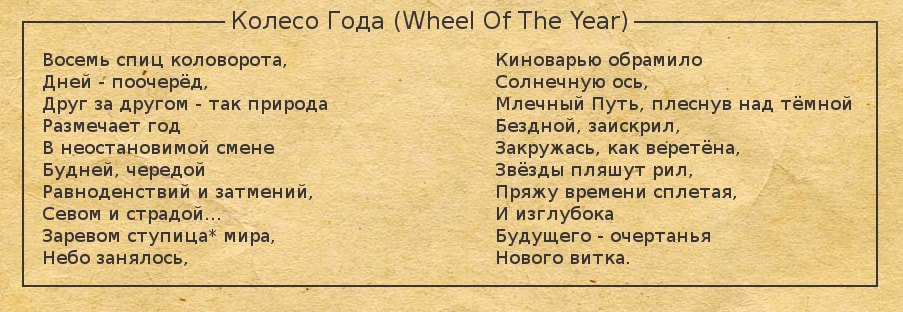
Праздники языческого календаря Колесо года
Первые четыре праздника, что связаны с естественными астрономическими событиями, имеют следующие названия:
- Йоль, или зимнее солнцестояние, происходящее 21–22 декабря. В это время светило переходит из Стрельца в Козерога, а осень переходит в зиму;
- Остара, или весеннее равноденствие, происходящее 20–21 марта. Период, когда светило покидает Рыбы и входит в Овна, а зима сменяется весной;
- Лита, или летнее солнцестояние, происходящее 20–21 июня. Светило покидает Близнецов и направляется в знак Рака, а весна оборачивается летом;
- Мабон, или осенние равноденствие, происходящее 22–23 сентября. Время, когда светило покидает знак Девы и входит в Весы, знаменуя конец лета, сменяющегося осенью.
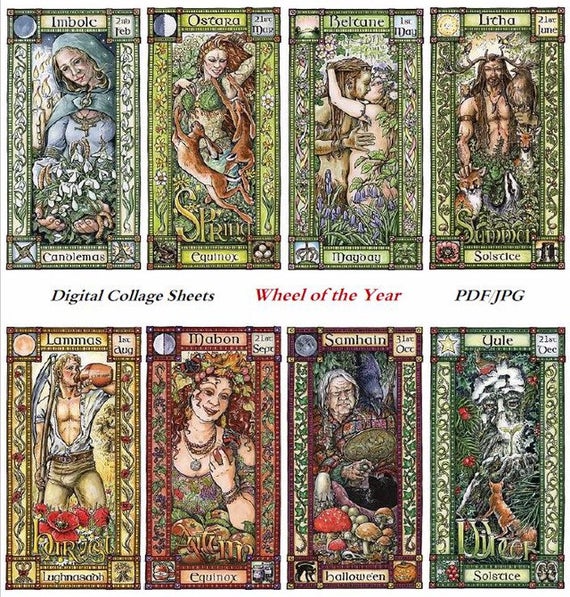
Помимо этого, есть еще 4 праздника огня (празднуемые в середине каждого вышеперечисленного сезона), к которым относятся:
- Имболк, или середина зимы, а именно 2 февраля, солнце в Водолее;
- Бельтайн, или середина весны, а именно 1 мая, солнце в Тельце;
- Лугнасад, или середина лета, а именно 1 августа, солнце во Льве;
- Самайн, или середина осени, а именно 1 ноября, солнце в Скорпионе.
Имболк – время очищения и благословения
Празднуемый 1–2 февраля, Имболк является праздником очищения и всеобщего благословения, знаменуя переход от Темного и закостенелого времени года к Светлому, животворящему. Согласно традиции Викки, в этот момент Богиня уже успела оправиться от родов маленького бога и кормит его грудью. Даже само слово «Imbolc» в переводе со староирландского языка означает «молоко».

У славян также был похожий праздник, который носил название Громницы. Наши предки отливали восковую свечу, которую зажигали на подоконнике, чтобы уберечь жилище от ударов молнии.
Имболк – праздник очищения. Традиционно в этот день осуществляли омовения скотины и мылись сами. Было принято убираться в своем жилище, выносить золу из домашнего очага и мести двор. Нужно было обязательно отдавать благодарность своему ремеслу, инструментам производства, домашним животным и прочим вещам.
Цвета праздника: кремовый, розовый, желтый, красный и белый.
Обряды и ритуалы: В этот праздник обычно проводят ритуалы благословления новых дел, начинаний, инструментов и приобретений. Он также подходит для творения и освящения талисманов и инструментов для колдовства и магии.
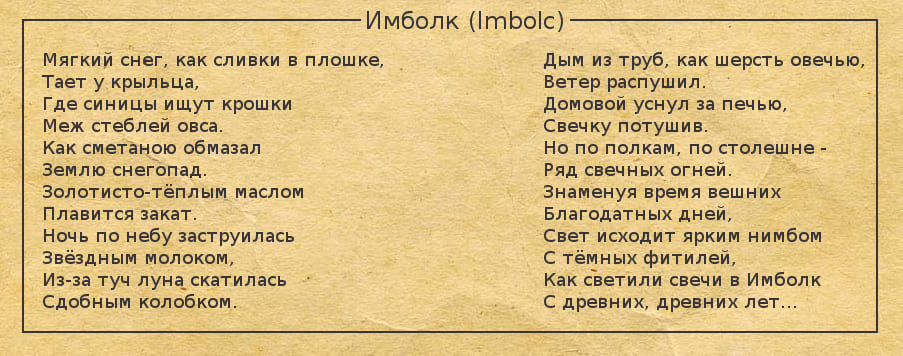
Остара – время пробуждения
Остара празднуется 21–22 марта и знаменует начало весны. У многих среднеазиатских и тюркских народов в это время проходит празднование Нового года.

У казахов он называется Наурыз , а у узбеков — Навруз. День и ночь равны по времени, наступает весеннее равноденствие, природа пробуждается и начинает новый цикл.
Само название праздника обычно приписывают на счет древней европейской Богини плодородия Эостры, символом которой является рассвет. Ей поклонялись еще во времена язычества. Европейское название праздника пасхи «Easter» также дань уважения ей.
Остара – это праздник пробуждения природы и всеобщего начала работ на природе. Следует отдавать благодарность земле и плодородию, рождению и рассвету.
Цвета праздника: зеленый, красный и белый.
Обряды и ритуалы: В этот праздник принято проводить ритуалы на удачу и привлечение денег.
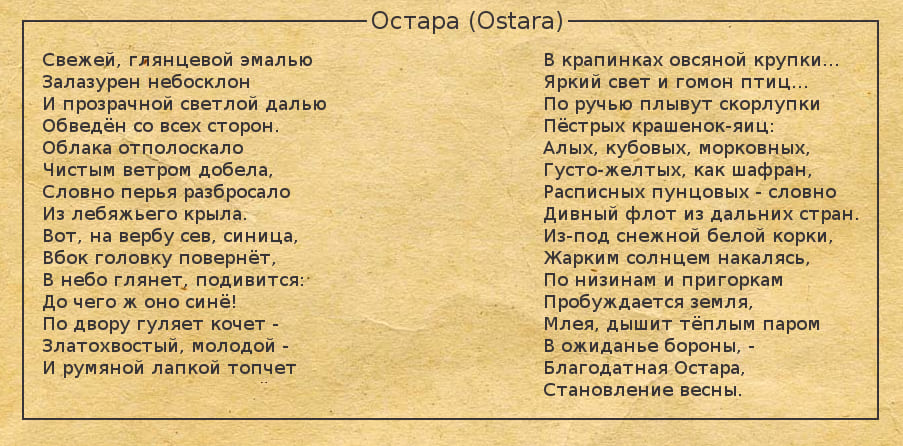
Белтейн – время любви
Празднуемый в ночь с 30 апреля на 1 мая праздник Белтейн – это время любви и естественного начала лета. История данного праздника теряется в древности, и никто из современников точно не знает, какому народу мы обязаны этой датой.

Тем не менее, Белтейн часто ассоциируется с началом пастбищного сезона. Темное время подходит к концу, уступая лавры правления Светлому.
Богиня Виккане в это время отдает свое прославление богу леса – Зеленому человеку, который ответственен за рост растений и силу земли. Согласно легендам, этот бог является странником. Он только во время празднования Белтейна селится в лесах присоединившись к своей напарнице Викки.
Лучше всего праздновать это событие на лоне природы или в лесу. Непременный атрибут — костер, который наряду с майским шестом является одним из символов праздника.
Цвета праздника: зеленый, золотой, красный и белый.
Обряды и ритуалы: Проводятся ритуалы по повышению сексуальной энергетики, обряды на привлечение любви и возрождение страсти.
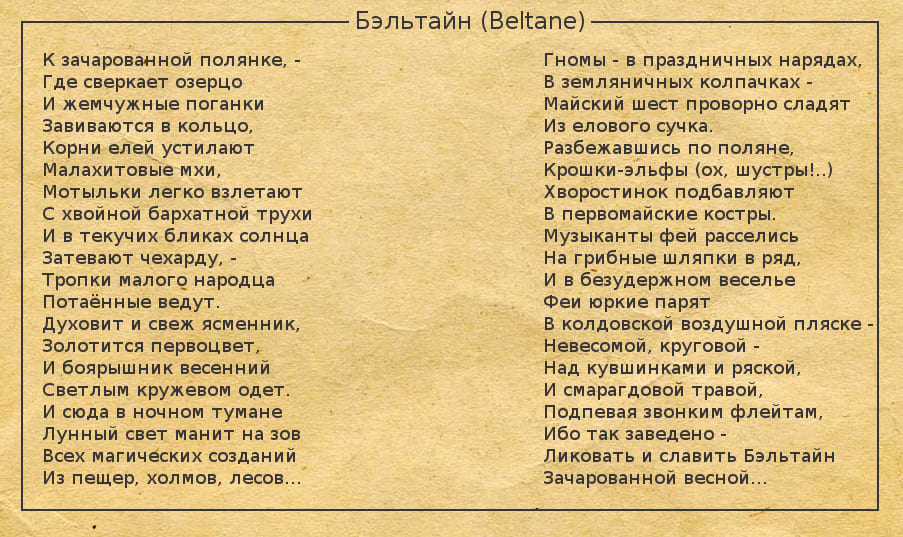
Лита – время семейных уз
Лита празднуется аккурат в середине лета 21–22 июня, которое было определено Кельтским колесом с большой точностью. День летнего солнцестояния был отражен во многих древних культурах, которые считали данную дату священной, особенной и уникальной.

Особое значение ей придавали колдуны, ведьмы и шаманы, считающие летнее солнцестояние одним из важных событий для проведения ритуалов.
По Викканской традиции, Лита – день бракосочетания бога и богини. Символом праздника служит огонь и все что с ним связанно. Праздновали Литу разведением большого числа костров, дым от которых порой застилал все небо.
В современности праздник проводится в семейном кругу. Благодарность следует отдавать членам своей семьи и крепкому дружному родственному обществу.
Цвета праздника: оранжевый, золотой, голубой, желтый и белый.
Обряды и ритуалы: Празднуется с ритуалами, направленными на укрепление любви и верности, магическое очищение от негативного воздействия и исцеление членов семьи.
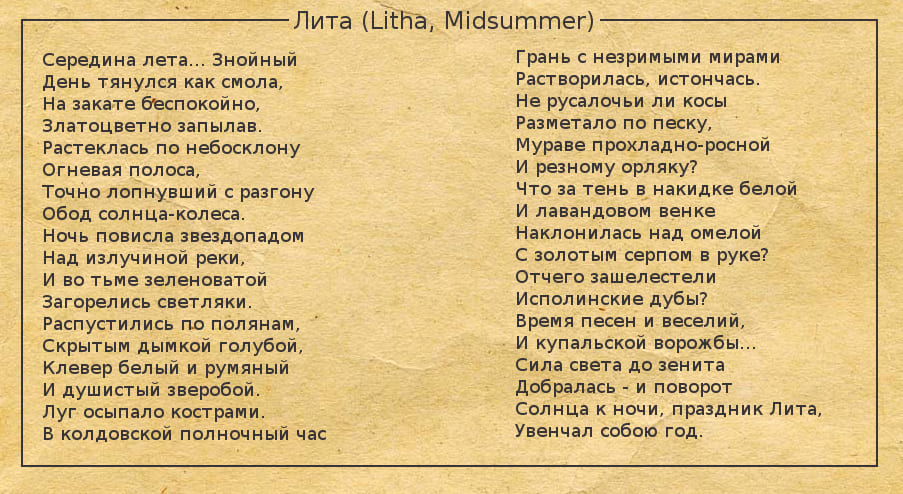
Лугнасад – время урожая
Празднуемый 1–2 августа Лугнасад – это время начала сбора первого урожая. Важность этой даты трудно переоценить, ведь для большинства древних народов собирать плоды своего труда было настоящим событием.

По некоторым данным, название праздника пришло от бога всех ремесленников и земледельцев – Луга.
В этот день принято печь домашний хлеб и благодарить землю за урожай. Делать расклады запасов на предстоящую зиму и пировать, радуясь получаемому благополучию от матери Земли.
В то же время Лугнасад является праздником поминания. Его символом считается жатва, которая забирает все необходимое, отправляя излишнее обратно в чрево земли.
Цвета праздника: оранжевый, золотой, рыжий, багряный, красный и прочие осенние цвета.
Обряды и ритуалы: ритуалы на избавление от грузов.

Мабон – время второго урожая
21–22 сентября празднуется Мабон, очередной праздник, посвященный второму урожаю и окончанию жатвы. Дата также знаменует приход Темного времени, в то время как Светлое начинает постепенно отходить, начиная с точки осеннего равноденствия. Вся природа в ожидании зимы и начинает медленно к ней готовиться.

Согласно легендам, богиня Викки в этот праздник прощается с надземным миром и погружается в подземелье. Она оставляет своего супруга бога бродить по поверхности земли в удручающем одиночестве.
Это еще один поминальный праздник, празднуемый с большим размахом, пышными застольями и обильным поеданием даров природы. Благодарить следует землю за богатый урожай и трудолюбивых близких, отличившихся в своем ремесле.
Цвета праздника: золотой, коричневый, синий, темно-зеленый и голубой.
Обряды и ритуалы: Данный праздник также является поминальным, но отличается ритуалами, связанными с надеждами на будущее. Помимо избавления от изжившего, проводятся обряды на удачу и благословление.
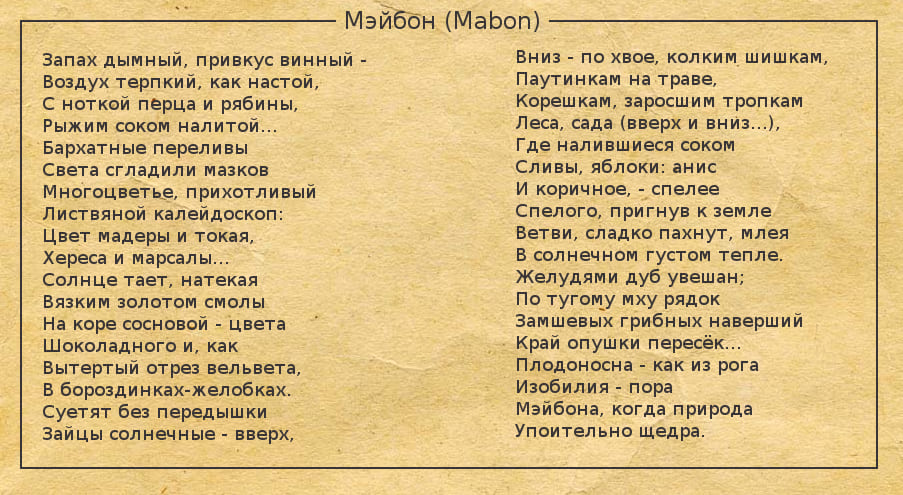
Самайн – время угасания
Самайн, празднуемый в ночь с 31 октября на 1 ноября, – это праздник, тесно связанный с памятью об усопших и смерти. Это самый значимый праздник из календаря Колесо года. Он известен на западе как Хэллоуин, или время всей нечисти.

Самайн также ждут и ценят колдуны, ведьмы, шаманы и прочие маги, чтобы совершить свои ритуалы и подпитаться сильной Темной энергией, исходящей из самой земли.
У кельтов же данный праздник означал окончательный сбор урожая и завершение всех полевых работ. Они праздновали его с большим размахом и пиршествовали всю ночь напролет.
Для людей, связанных с магией, Самайн является временем духов. Считается, что в данное время границы между миром живых и мертвых становятся максимально тонкими и проницаемыми.
Цвета праздника: рыжий, коричневый, красный, оранжевый и черный.
Обряды и ритуалы: В данное время проводятся ритуалы по избавлению от порчи, негатива и прочих неприятностей, а также гадание.

Йоль – время изобилия
Самая длинная и темная ночь в году 21–22 декабря, также известная как праздник Йоль.

В это время солнце находится в своем зените, но уже в ближайшее время дни пойдут на прибыль и цикл начнет повторяться. Наверное, поэтому Йоль имел такое сакральное значение и был праздником, исполненным надежд и загаданных желаний.
Согласно легенде, богиня дарует жизнь новому богу, и все повторяется снова. Отмечается праздник в кругу семьи при свечах. Его символами считаются вечнозеленая ель, дарящая надежду на весну и лето, а также горячий теплый очаг.
Цвета праздника: золотой, красный и зеленый.
Обряды и ритуалы: Проводятся ритуалы на привлечение удачи, благословлению планов на очередной астрономический цикл.

Почему следует отмечать праздники Колеса года?
Древние люди, ведущие оседлый и сельскохозяйственный образ жизни, видели в праздновании вышеперечисленных дат практический смысл. Они подчиняли свой быт четко определенным сезонам со своими заботами и надеждами. Но зачем нам, жителям 21 века, продолжать эти, казалось бы, давно изжившие себя традиции?
На это есть несколько причин. Во-первых, это почтительное отношение к естественным природным циклам и датам. Их празднование может само по себе наполнять вас положительной энергией. А во-вторых, праздники Колеса считаются идеальными для:
- собственного набора внутренних сил из максимальных энергетических потоков;
- увеличения и выравнивания своих циклических ритмов;
- проведения ритуалов и традиционных деяний, усиливающихся в эти даты;
- магической практики и колдовских обрядов для увлекающихся магией.
Конечно, не все верят в сакральный смысл праздников Колеса года. Многие даже и не знают, что современные религиозные праздники приходятся как раз на эти сильные энергетические даты. Верить во все это или нет – личное дело каждого. Однако, чтобы набраться сил, положительной энергии и начать новый жизненный этап, их вполне можно взять на заметку.
Последний месяц зимы начинается с кельтского праздника, которое означает долгожданное возрождение природы и отступление зимних холодов. Отметить Имболк может каждый, придерживаясь древних традиций.
1 февраля — особенный день, названный кельтами Имболк. Праздничный день символизирует победу весны над зимой, и эксперты сайта dailyhoro.ru рекомендуют провести знаменательное событие по всем традициям. Соблюдение заветов поможет каждому освободиться от негатива и привлечь в жизнь процветание.
Имболк — светлый праздник Колеса Года, отметить который важно в кругу семьи. В прежние времена зажигали яркие костры, а в современном мире можно обойтись красивыми интерьерными свечами. Огонь, символ очищения, помогает избавиться от негатива и предать забвению все то, что мешает счастью и развитию. Над пламенем свечи можно сжечь список, который составляют заранее, чтобы начать новый этап жизни и попрощаться с тем, что гнетет.
1 февраля принято убираться в домах, чтобы встретить весну, освободить помещения от накопившегося хлама, а также убрать грязь — символ бедности и болезней. Принято на Имболк мыть двери и окна, чтобы впустить благополучие, а использованную воду выливать подальше от дома.
Важной традицией праздника остаются медитации, направленные на очищение и освобождение. Духовные практики помогают сосредоточиться, открыть чакры и найти свое истинное предназначение.
Еще одна традиция — приготовление лакомств, которые подносят богине Бриггите, отвечающей за плодородие. Для нее выпекают булочки, варят кашу и ставят свежее молоко. Поклониться ей может каждый, и богиня обязательно поможет.
В день праздника принято проводить очищающие ритуалы, а также оставлять в прошлом ссоры и обиды. Эксперты рекомендуют провести это время с семьей, попросить друг у друга прощения и вместе начать новый этап жизни, наполненный счастьем и благополучием.

Сретение Господне: молитвы на счастье и удачу
Сретение Господне — важный христианский праздник. Именно в этот день верующие люди читают молитвы, чтобы …

Трифон-мышегон 14 февраля: заговоры от мышей, клопов и тараканов
Народные праздники — кладезь мудрых советов, которые и по сей день помогают справляться с невзгодами, …

Народный праздник Никиты-пожарника 13 февраля: традиции и обряды
Существует огромное множество народных праздников, так или иначе связанных с поверьями и приметами. 13 февраля …

Церковный календарь постов на 2023 год
Каждый год всех православных христиан ожидают одни и те же посты — однодневные и многодневные. …
Содержание:
Славяне и древние европейцы — откуда катится Колесо года?
Кельтские праздники Колеса года: мы помогаем миру — мир помогает нам
Коловорот у славян и Северные Традиции: обряды и приметы
Запускаем аттракцион «Коловорот» и отмечаем праздники Колеса года в надежде, что в 2021 году не придется в нем крутиться, как белкам, или вставлять в него палки. Колесо года у славян также, как и Колесо года по Северным традициям, состоит из множества аутентичных обрядов, ритуалов, практик на особые праздники. Все о них знают последователи викки неоязыческой религии Запада, основанной на почитании природы.

Ежегодно мы проживаем большой Цикл, в котором сконцентрированы Порядки и Законы жизни

Магическое колесо состоит из 8 праздников, связанных с солнечным календарем
Славяне и древние европейцы — откуда катится Колесо года?
Колесо года по Северной традиции или Коловорот — мистическая цепочка праздников, которая знаменует смену сезонов, указывает на энергетически мощные точки календаря. В Колесе года кроется секрет реализации амбициозных планов всех, кто с головой погряз в индустриальной эпохе, напичканной информацией, нано-технологиями и вечной нехваткой времени. Для викки в европейской Северной традиции существует 8 праздников Колеса года, представляющие природную цикличность, смену погоды и сезонов. Традиции северных народов (кельтов) представляют Колесо года в виде этапов человеческой жизни:
- юности
- становления
- старости
- смерти
- реинкарнации.

Смена времен года во все времена влияла на уклад жизни, даже современный

В особые дни люди очищаются и накапливают энергию, проводя конкретные обряды
Славяне также визуализируют Колесо года или Коловорот, как цикличность природы. В особые дни Колеса года происходит колдовство, призываются духи предков, богов. Каждый праздник Колеса года соответствует астрономическим явлениям: равноденствию, солнцестоянию. В Северной традиции праздники Коловорота сопровождают ритуальные шабаши, огненные саббаты, необычные обряды и практики.

Веселые шабаши — мистическая и отличительная черта праздников Колеса года
У славян Колесо года (Коловорот) насчитывает более 50 праздников: Громница, Зимний Троян, Масленица, Ладодение, пробуждение Домового, Родоница. Также у славян в Коловороте известны праздники Лельник или Красная Горка, день Трибогов, Ивана Купалы, Спожники, Покров, Корочун и другие. Коло Сварога (Коловорот) кроет в себе особый смысл, заключающийся в вечном перерождении и обновлении всего живого. Впрочем, как и в Северной Традиции.

В особые дни — особые ритуалы, традиции и своя магия!
Кельтские праздники Колеса года: мы помогаем миру — мир помогает нам
Сегодня среди нас язычников не так уж и много, однако отмечают праздники Колеса года (Коловорот) многие. Они хотят в эти дни набраться энергии, увеличить свои силы, ресурсы, поставить новые цели. «Колесо года» или Коловорот у славян отражает магический временной цикл: как и человек природа рождается, взрослеет, расцветает по весне, формирует и проходит становление летом, пожинает плоды с осени и умирает (перерождается) зимой. Праздники Коловорота — это отличный способ постигнуть взаимосвязь с окружающим миром.

Йога, медитация, чтение книг или гадания — выбирай, что ближе тебе!
Праздник Йоль — солнцестояние у славян и кельтов
В ночь на 21 декабря случилось зимнее солнцестояние, а еще соединение планет Юпитера и Сатурна. Этот толчок передвинул человечество в новую эпоху, эпоху интеллекта и информации. По легендам Северной традиции Великая мать рождает бога Солнца, а мы отмечаем праздник возвращения света в мир. Важные символы Йоль — йольское дерево, венки и полено, которое украшалось и сжигалось.

Йольский Кот поджидает тебя в самую длинную ночь в году и самый короткий день
Имболк в Северной традиции — праздник огней и факелов
Этот праздник Колеса года посвящен богу Солнца, отмечается 1 февраля, когда язычники просят у богини вернуть из иного мира своего сына, осветить всех своим присутствием. В ночь Имболка зажигаются свечи, а дом освещается водой, очищается. У славян Коловорот, у кельтов Колесо года в феврале — это праздник молока молодой овцы. Он посвящен домашнему уюту, свету.

Имболк отмечает молодость Бога, зажигает белые свечи или большие ритуальные костры
Остара — весеннее равноденствие Колеса года
21 марта в Колесе года по Северным традициям европейцы и славяне празднуют возвращение Великой матери, наполняющей любовью весь мир. В день силы хорошо накапливать энергию земли, заниматься йогой, медитацией и просто очищаться. В этот праздник принято прыгать через костры, спускать с холмов огненное колесо.

Приветствуйте время начинаний, действий, стройте планы, сажайте семена…
Белтайн или прибывающая сила Колеса года
В ночь с 30 апреля на 1 мая славяне и европейцы, придерживающиеся Северной традиции, отмечают праздник Костров — Белтейн. Бог Солнца вырастает и обретает свою силу, приносит процветание, изобилие в каждый дом. В день буйства природы, зелени хорошо проводить время с семьей, а места силы искать в полях, лугах, на лесных опушках. Символами праздника считаются зелень, цветы, ленты, зеленая одежда.

«Матушка-природа — самое важное на Земле», — напоминает еще раз праздник Белтайн
Лита — праздник летнего солнцестояния у славян и кельтов
Ночь на 22 июня — самая длинная в году, когда Бог чествует свой новый статус Господина. В праздник Коловорота молодежь придумывает веселые игры, а сам день наполнен беззаботностью и легкостью. По северным традициям Коловорота (Колеса года) кельты и славяне проводят состязания, ярмарки, заряжаясь энергией Солнца. С этим днем связаны обряды, направленные на урожай, счастье, здоровье, магическое знание.

В этот день взывают к богу Грома, проводят звездную медитацию, веселятся
Ламмас/Лугнасад — «Коловорот» труда и страсти
А 1 августа язычники и славяне отмечают сразу три урожайные фестиваля, восхваляя Бога Падуба, кормящего всю землю. Теперь Бог становится отцом, кормильцем и защитником всего живого. В праздник Ламмас выпекают первый в сезоне хлеб, продолжаются продовольственные ярмарки с богатыми сырными, медовыми прилавками, рассыпанным зерном.

Поймать удачу поможет выпекание каравая в форме солнца из зерна
Мабон — праздник идеального равновесия Колеса года
В ночь на 22 сентября по Северной традиции в дорогу собирают бога Солнца и богиню Мать. Славяне не унывают и продолжают праздновать урожайный год. По обрядам Северных традиций Коловорота принято в Мабон собирать в лесу листья, грибы, семена растений, украшать жилища цветами, ягодами.

За праздничным ужином поблагодарите еще раз богов за урожай
Самайн или Хэллоуин в Колесе года северных традиций
В ночь с 31 октября на 1 ноября на Самайн Богиня мать превращается в старую клячу, а Великий Бог приходит в образе Смерти. Они еще раз напоминают язычникам чтить своих предков и готовят к суровой зиме. Если сегодня молодежь веселится под масками зомби, вампиров и ведьмочек, то по северным традициям кельтов в этот день проводились широкие трапезы с сытной едой.

Все мы отмечаем этот удивительный мистический праздник, не так ли?

Ритуалы на Самайн — это время жертвоприношений
Религии в эпоху дохристианства отличались гармоничностью, ведь тогда уважали природу, трепетнее относились к ее явлениям, растениям и животным. Закон Коловорота у славян или Колеса Года гласит, что все в мире бесконечно вращается, движется, следует череде смертей и рождений, будто сансара.

Только от человека зависит в какую сторону раскрутится Колесо. Уважайте природу!
Коловорот у славян и Северные Традиции: обряды и приметы
В Йоль рекомендуется надевать украшения в форме солнца, звезды, змеи, а в Самайн можно погадать на суженого-ряженого, сжечь воспоминания прошлого в огне забвения или нового очага, помянуть усопшего «трапезой молчания». Обряды и практики праздников Колеса Года (Коловорота) у славян и кельтов уходят корнями в Северные традиции. Мы отмечаем Пасху, а древние кельтские народы издавна разукрашивали яйца в праздник Остара, в честь будущего плодородия. Именно в Бельтайн женщины, мечтающие о детях, могли увести возлюбленных в поле на всю ночь. Также в праздник свадьбы Богов украшали лентами длинные шесты.

Отмечать праздники Бельтейн, Лугнасад, Мабон и другие намного веселее в компании!

А как ярко выглядят фестивали Самайна…

Каждый раз на Остару все загорается, горит, дышит и живет…
Коловорот у славян в летние и зимние праздники — это нечто магическое, сакральное. Например, в праздник Лита девушки превращаются в соблазнительных русалок, пускают венки и горящие свечи по воде, а зимой поют гимны и колядки, восхваляя богов. Каждый сезон в Коловороте приносит свои уроки и задачи, призывы и испытания.

От кельтских народов мы унаследовали и сохранили традиции уважения природы и богов